
Mentawai Surili, Presbytis potenziani
MENTAWAI SURILI
Presbytis potenziani
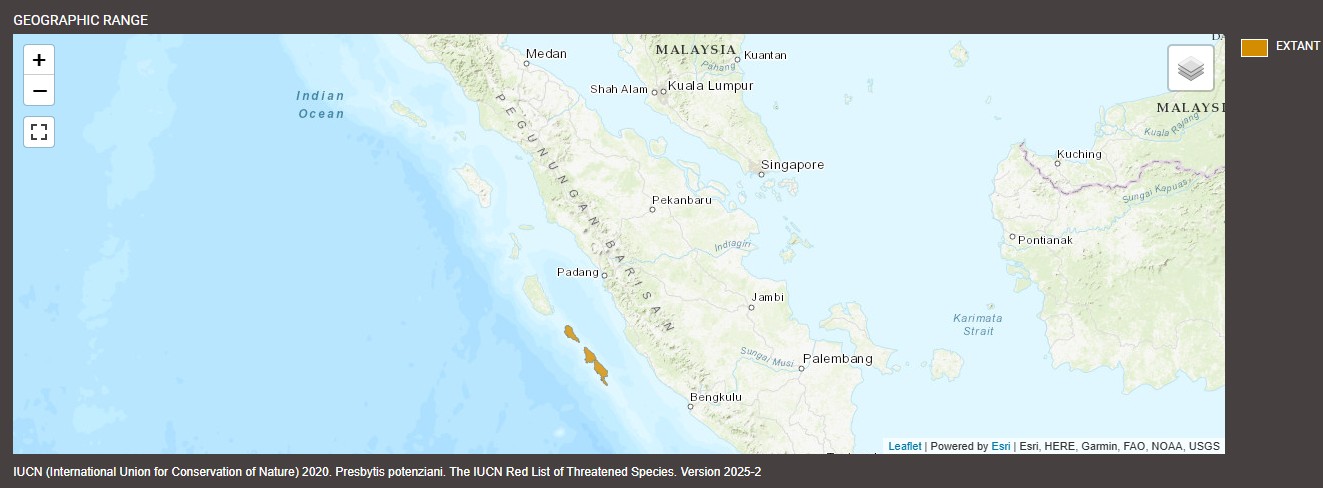
Geographic Distribution and Habitat
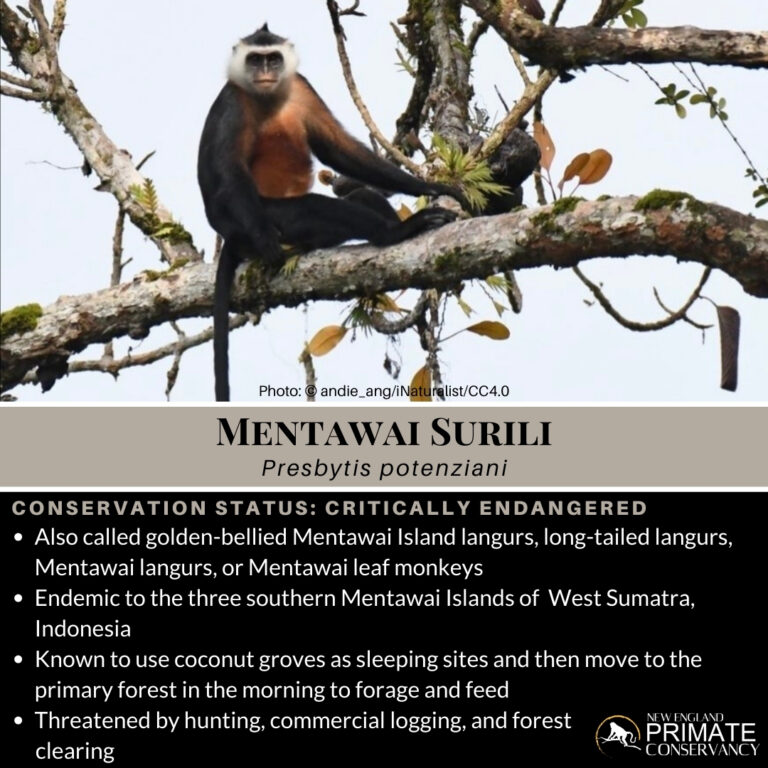
The Mentawai surili, also known as the golden-bellied Mentawai Island langur, long-tailed langur, Mentawai langur, or Mentawai leaf monkey, is native to the three southern Mentawai islands off the western coast of Sumatra, Indonesia: Sipora, North Pagai, and South Pagai. On these islands, they prefer to inhabit wet evergreen rainforests and lowland primary forests—primarily undisturbed by humans. They have also been found in swamps, mangroves, cultivated habitats known as “forest gardens”, and secondary forests—those that have naturally regrown after a period of human-caused disturbance. These habitats are close to sea level, with surilis found up to 0.19 miles (313 m) above sea level. Surilis sleep in the mid-upper levels of “sleeping trees” above 66 feet (20 m), where the canopy density is thickest.
The Mentawai Islands experience a tropical rainforest climate, with distinct wet (November to February) and dry (March to October) seasons. Hot and humid throughout the year, the region’s humidity ranges from 77% to 88%, with temperatures ranging between 75ºF-88ºF (24ºC-31ºC). Average annual rainfall amounts to approximately 1,468 feet (450 m). The Mentawai surili’s diet consists of leaves, fruit, flowers, and seeds.
Thanks to this wet, tropical climate, leaves are available year-round, while fruit availability fluctuates with rainfall and plant cycles. In primary forests, their diet consists mainly of leaves, which are a stable resource. In secondary forests, their diet is more variable, with fruit and seeds also available. Rainfall affects the movement patterns of the Mentawai surili, with heavy rainfall reducing movement, while moderate to light rain has little effect.
The Siberut langur (P. siberu) was formerly considered to be a subspecies of Mentawai surili, but was reclassified as a separate species after genetic studies found them to be sufficiently distinct in 2011.
Size, Weight, and Lifespan
The Mentawai surili has a head-body length ranging from 18.5 to 21.0 inches (470-530 mm) for males, and 18.1-20.4 inches (460-520 mm) for females. Tail length ranges between 23.0-23.4 inches (585-595 mm) for males, and 23.6-23.8 inches (600-605 mm) for females. Males weigh an average of 14.3 pounds (6.5 kg), while females weigh an average of 14.1 pounds (6.4 kg). Except for a few characteristics which will be mentioned in the Appearance section, Mentawai surilis display little to moderate sexual dimorphism, or noticeable physical differences between sexes. Males are typically a bit larger and heavier than females, and they exhibit different fur colors.
Information on the lifespan of the Mentawai surili is limited due to their elusive nature in the wild, but they are estimated to live around 20 years, similar to that of other members of their genus.
Appearance
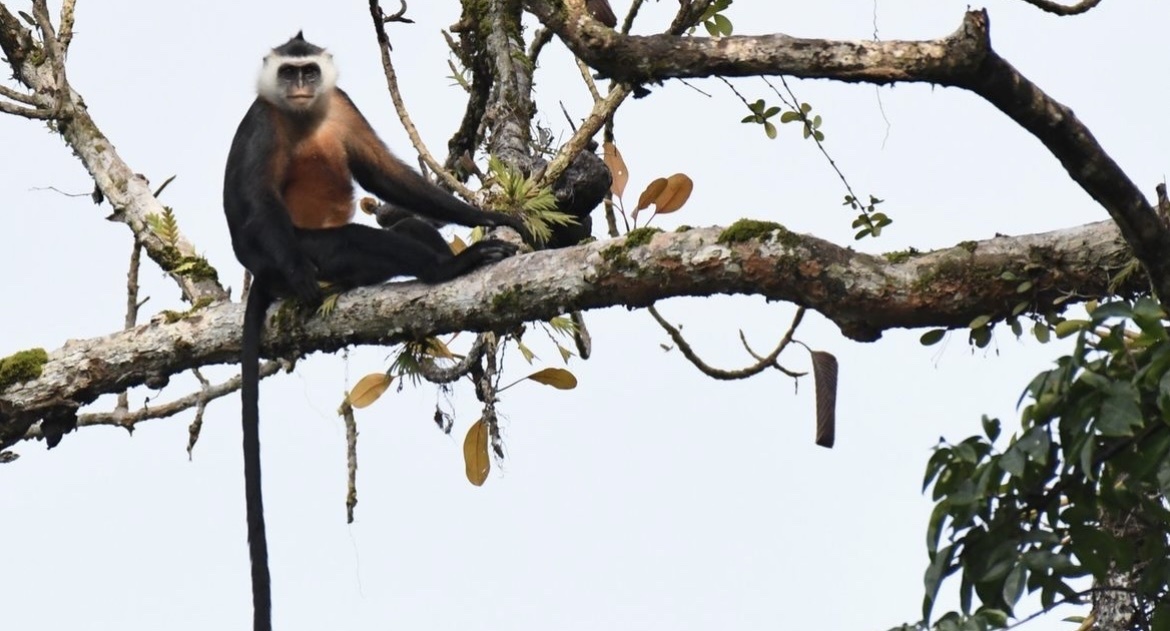
Adult Mentawai langurs have a striking appearance. Dark and rich reddish-brown fur covers the chest, belly, and upper arms, contrasting with white fur on the forehead, cheeks, and throat. The crown of their heads, which also has a small crest, is black, as is the rest of their bodies.
Their long, slender tails are used for balance and agility when moving through forested habitats, rather than for grasping objects. Their bodies are slender, with hind limbs longer than the forelimbs, additional adaptations to their tree-based lifestyle. Although there are low levels of sexual dimorphism, or differences between the sexes, males are larger, heavier, and have slightly differently colored fur.
Males have a white patch of fur surrounding their genitals and connected to the ischial callosities on their rear end. Ischial callosities are sitting pads, which provide comfort and stability when sitting on branches. Females, on the other hand, have separated callosities and dark genitalia. Like other members of their genus, infants are born with white fur and a pale face, which darkens after two to three weeks.
The Mentawai surili is a colobine monkey, a member of a group of primates with specialized adaptations for digesting leaves and other fibrous plant material. As colobines, they have a highly modified digestive system that helps them extract nutrients from tough, leafy foods. This includes a large, multi-chambered stomach filled with microbes that ferment leaves and break down cellulose before the food reaches the intestines—somewhat similar to how cows digest plants. The microbial fermentation process produces short-chain fatty acids, which the monkeys can absorb as energy. This helps them survive on leaves, seeds, and other relatively low-energy foods. Although colobines mainly ferment food in the stomach, research on colobine monkeys shows that their colons can also aid in breaking down remaining fiber. Some colobines even have enlarged colons that provide extra fermentation space and help process large amounts of fibrous food. Since Mentawai surilis eat many leaves and fibrous plant parts, these digestive adaptations allow them to gain nutrients from foods that many primates can’t efficiently digest.
Diet
According to one resource, two-thirds of the Mentawai surili’s diet consists of fruit, 22% leaves, 7% flowers, 4% seeds, and 1% bark, sap, or fungi.
As their diet consists of highly fibrous leaves, seeds, and unripe fruit, the Mentawai surili possesses a specialized, multi-chambered stomach designed for properly digesting these foods. This complex, ruminant-like system, reminiscent of that of cows, allows them to break down cellulose and neutralize harmful plant toxins. Additionally, they can consume unripe fruit and tough leafy resources that other animals cannot, and extract every available nutrient. Due to this specialized digestion, Mentawai surilis spend over 80% of their time resting and foraging, as breaking down fibrous food is a slow and energy-intensive process.
Direct studies of the Mentawai surili are relatively limited. However, by comparing the foraging strategies of other Mentawai Island primates and other members of their genus, Mentawai surilis most likely move deliberately through the forest canopy, traveling along established routes slowly and quietly to visit and revisit, as needed, trees full of the leaves and fruit they crave. Their flexible bodies allow them to exploit food resources that less agile animals might not be able to reach, and they likely use their grasping hands and feet to balance on thin branches, making mealtime an acrobatic affair.
Behavior and Lifestyle
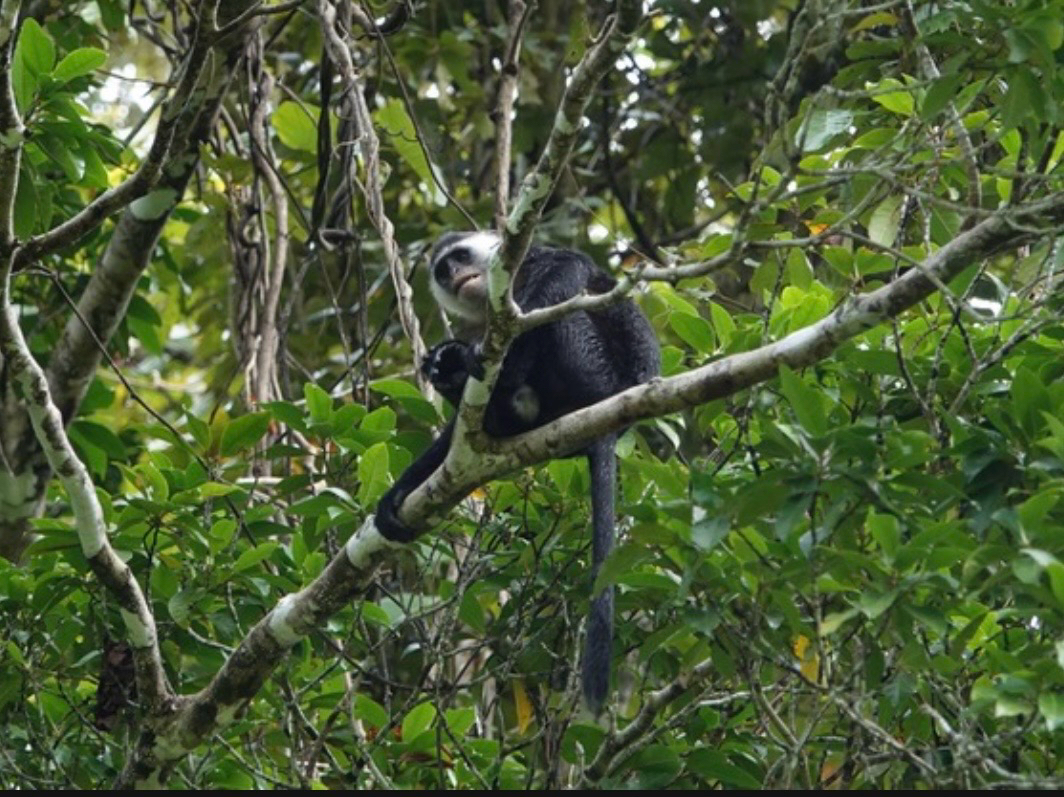
The Mentawai surili is diurnal or active during the day, and primarily arboreal, or tree-dwelling. They spend most of their time in the mid and upper forest canopy, and they rarely descend to the ground.
According to one resource, they spent 45% of their time resting, 25% foraging, 24% travelling, and 2% to social activity. Many resources cite that over 80% of their activity budget is dedicated to resting and foraging, as their diet requires a lot of time and energy to digest. Clearly, more research is needed to clear up this lack of agreement.
Their primary mode of locomotion is arboreal quadrupedalism, or running and walking on all fours along the branches, combined with frequent leaping in the upper canopy. They also climb up and down trees vertically as they move about their forested habitat. Surili’s bodies are built for an agile life in the trees: their hindlimbs are longer than their forelimbs, which provides the power for leaping across large gaps in the canopy, and the slender body and tail provide balance and agility.
As one of the larger animals in their habitat, they have few natural predators. Besides persistent human hunters, threats include large reptiles or raptors, like reticulated pythons or crested serpent eagles. Once again, direct studies of the Mentawai surili are relatively limited. However, if we look at the predator avoidance strategies of other Mentawai Island primates and other members of their genus, predator avoidance strategies likely include staying in the upper canopy to avoid ground-based threats, frequently pausing to scan their surroundings to avoid detection, using alarm calls when a potential predator is detected, fleeing quickly through the canopy using those amazing leaping powers, and exhibiting shy, elusive behaviors, especially to avoid humans.
After foraging, Mentawai surilis retreat at night and sleep as a group in the mid-upper levels of designated “sleeping trees” above 66 feet (20 m), where the canopy density is thickest, with the most common sites being in coconut groves. Like other langurs, they may sleep in a hunched position. Sleeping as a group in canopy-dense trees also allows them to avoid potential predation. Upon waking in the morning, Mentawai surilis move from their coconut grove sleeping trees to the primary forest to begin foraging.
Hair Today, Hat Forever: Surilis are called “Mützenlanguren” (“capped langurs”) in German, referring to the hair on their heads, which forms a tuft.
The home range of a Mentawai surili group is 42-99 acres (17-40 ha). During their daily foraging sessions, they travel 0.34-0.50 miles (540-800 m) per day.
Their social organization is variable, and may consist of unimale-unifemale pairings, unimale-multifemale groups, and multimale-multifemale groups. Typically, they live in groups of two to six individuals, consisting of a breeding pair and their offspring. Like other members of their genus, male Mentawai surilis typically leave their natal group at or near sexual maturity to form their own family groups. At the same time, females are more likely to remain in or near their natal group. Before establishing new family groups or taking over a new group by replacing a resident male, young males may spend time as solitary individuals or in loose bachelor associations. Females form the stable core of a group, but in some cases, especially in disturbed habitats, they may disperse. All in all, this dynamic system of male turnover and female stability minimizes the risk of inbreeding, increases genetic mixing between groups, maintains stable female-based groups, and allows males to maximize their reproductive success through group takeovers.
Mentawai surilis sometimes spend time with pig-tailed langurs (Simias concolor), Pagai Island macaques (Macaca pagensis), and Kloss’s gibbons (Hylobates klossii). They have overlapping home ranges but limited direct interactions in the forests of the Mentawai Islands. Pig-tailed langurs and Pagai Island macaques have differences in diet and canopy usage, so they rarely interact with Mentawai surilis.
Surilis produce loud calls and duets for long-distance communications, which may provide useful information to other species, although this has not been directly tested or observed.
Communication specifically among Mentawai surilis has not been extensively documented. Luckily, fieldwork coupled with comparative research provides some information.
The most distinctive feature of Mentawai surili communication is the use of loud, far-carrying calls, typically produced by adult males. These low-frequency, penetrating calls travel through the dense forest and are often emitted in series between 3 and 5 AM. These long-distance calls serve to advertise territorial boundaries, to keep the group together when individuals are spread out, and possibly to signal the attention of potential mates. Some studies also suggest Mentawai surilis may engage in coordinated vocalizations, or duet-like calling between adult males and females. These duets may help reinforce pair or group bonds and could once again be used to define a group’s territory. This behavior is less elaborate than that of gibbons, for example, but it is still important for social signaling.
Although not extensively described, Mentawai surilis almost certainly use alarm calls, as seen in all closely related colobine monkeys (subfamily Colobinae). These calls are typically shorter and more abrupt than long-distance calls, and different threats may produce different responses. These calls warn group members of danger, such as predators, and can trigger behaviors associated with vigilance, freezing, or hastily retreating. Solo calls have also been documented among females and are high-pitched, shrill meows.
Due to limited visibility in the dense rainforest canopy, visual signals are used at short ranges and are secondary to vocalizations. These include relaxed vs. alert body posturing, subtle facial expressions, and movement cues, such as indicating danger with sudden stillness or fleeing.
All primates benefit from grooming one another, not only to rid themselves of parasites, but also to strengthen social bonds. Though never directly observed, mutual grooming probably occurs in Mentawai surili family groups.
Once again, extensive research on the communication repertoire of the Mentawai surili is lacking and requires further exploration.
Mentawai surilis are notable as one of the few monkeys found in the Eastern Hemisphere who are thought to form monogamous male-female pairings, though social systems appear variable and additional research is needed.
Mentawai surilis are notable as one of the few monogamous, one-male-one-female pairings of monkeys found in the Eastern Hemisphere, though social systems are variable and more research is needed. In one study, mating was initiated by the female two-thirds of the time and included multiple mounts by the male before ejaculation. Like other members of their genus, gestation, or pregnancy, likely lasts five to six months before the female gives birth to a single offspring, usually around July or August. Females likely give birth every other year.
Infants are born with pale skin and white fur, which darkens after two to three weeks, with full adult coloration achieved by around three to four months of age. Social interactions within the family group are infrequent, with Mom providing most of the care. While some references suggest the father’s direct interaction might be limited compared to that of other species, the monogamous nature of Mentawai surilis suggests the male is always present and involved in protection and territorial defense, which is crucial for the infant’s survival.
Infants typically cling to their mother’s belly or chest fur while she travels around. Weaning from Mom’s milk occurs at one year of age, and sexual maturity is reached at approximately four to five years of age. Upon reaching this milestone, males leave their group to form one of their own, while females, for the most part, remain in or near their natal or birth group. If the family lives in a disturbed habitat, females may be more likely to leave their natal groups
As fruit-eaters, Mentawai surilis aid in the regeneration of their forest habitats by dispersing seeds through their feces as they move around the habitat. As leaf-eaters, they regulate plant populations and help balance the amount of sunlight reaching the forest floor. As prey, they also maintain populations of local predators like pythons and eagles.


The International Union for Conservation of Nature lists the Mentawai surili as Critically Endangered (IUCN, 2020), appearing on the IUCN Red List of Threatened Species.
Mentawai surilis are threatened mainly by local hunters, commercial logging, forest conversion to oil palm plantations, forest clearing, and local extraction of forest products. Hunting pressure has increased in recent years as a result of improved access to remote areas due to increases in logging roads and tracks, as well as the replacement of bows and arrows with air rifles. Furthermore, local rituals and taboos that formerly regulated hunting have been progressively eroded by missionary and state influences. In a horribly cruel practice to increase their yield, hunters will climb the Mentawai surilis’ sleeping trees at night and shoot them.
As of 2006, their total population was estimated between 200 and 800 individuals.
The Mentawai surili is listed in Appendix I of the Convention on International Trade in Endangered Species (CITES), an international agreement between governments whose goal is to ensure that international trade in specimens of wild animals and plants does not threaten their survival.
Mentawai surilis are not found in any protected areas, nor are they found in captivity.
Being listed in Appendix I of CITES means that the Mentawai surili is threatened with extinction and receives the highest level of international protection. Commercial trade of the Mentawai surili is generally prohibited, with strict permitting required for rare exceptions.
Several proposed actions to save the primates of the Mentawai Island primates from extinction include: areas of North and South Pagai Islands recieving formal protection through cooperation with a logging corporation that has a record of practicing sustainable logging in the area since 1971, local conservation education, especially regarding hunting, and the development of alternative economic models for the residents to reduce the likelihood of their selling off land to logging companies.
Additional monitoring of the Mentawai surili populations, along with more research on their population size, distribution, and trends are critical to informing conservation action plans. Local livelihoods, threats, and potential conservation actions are needed should this elusive monkey be able to bounce back from the ongoing critical extinction threat.
- https://3d.si.edu/object/3d/presbytis-potenziani-potenziani-cranium%3A883b2d6d-8e0f-42e3-861c-ad4848b93061
- https://animalia.bio/mentawai-langur
- https://www.alltheworldsprimates.org/Members/Home/MasterPrimate.aspx?tid=1324
- https://www.cell.com/the-innovation/pdfExtended/S2666-6758(22)00003-0
- https://collections.nmnh.si.edu/search/mammals/?ark=ark:/65665/3214a0a03645247a39841f693e846bcd1
- https://d1wqtxts1xzle7.cloudfront.net/50555279/bf0238260620161126-5961-r16rux-libre.pdf?1480165544=&response-content-disposition=inline%3B+filename%3DVariations_in_group_composition_and_popu.pdf&Expires=1776182384&Signature=VyQeLD0Epp3oMgQV~VsGG~gY5hVSdFoPY-eJ1Y4IkSk0OlWKsPa3uix40VecLaCw9xIDb290ERrxHkgyQtrjMi2OfZ8GsYTvLsz2S9rbOIgp3NAcg19oPmyXhGwZuidHMddTI-qV6Y5e2XsDeDvkuR9Xmqlxd3r5RYL8vVcIeYPqukuiSE75voGcoEvhebx00TBmO0uTEYmuCSIvlUCqcfFgfB4T406JSe1vwvx4eYSMULBgdzmg3hMA0YlMYyQEL8~DzjWhFQo9CLH1-si829lVs8rCBt63JLef-do9VSWui3Mpiau8xdTFQXr8NwlJKBIBTL6T63WVc61IHesAdA__&Key-Pair-Id=APKAJLOHF5GGSLRBV4ZA
- https://earthpedia.earth.com/animal-encyclopedia/chordata/cercopithecidae/presbytis-potenziani/
- https://www.ecologyasia.com/verts/mammals/mentawai-langur.htm
- https://ediss.uni-goettingen.de/handle/11858/00-1735-0000-000D-EF8E-1
- https://en.wikipedia.org/wiki/CITES
- https://en.wikipedia.org/wiki/Colobinae
- https://en.wikipedia.org/wiki/Mentawai_Islands_rain_forest
- https://en.wikipedia.org/wiki/Mentawai_langur
- https://en.wikipedia.org/wiki/Presbytis
- https://eol.org/pages/55636353
- https://www.fws.gov/international-affairs/cites/cites-appendices
- https://www.iucnredlist.org/species/39815/17954456
- https://link.springer.com/article/10.1007/BF02735190
- https://www.researchgate.net/profile/Vincent-Nijman/publication/235384808_Loud_Calls_Startle_Behaviour_Social_Organisation_and_Predator_Avoidance_in_Arboreal_Langurs_Cercopithecidae_Presbytis/links/004635280ddf6434c6000000/Loud-Calls-Startle-Behaviour-Social-Organisation-and-Predator-Avoidance-in-Arboreal-Langurs-Cercopithecidae-Presbytis.pdf
- https://www.researchgate.net/publication/263412916_An_updated_taxonomy_and_conservation_status_review_of_Asian_primates
- https://www.scientificlib.com/en/Biology/Animalia/Chordata/Mammalia/Presbytis.html
- https://vibrantworldventures.com/blog/explore-the-mentawai-islands
Written by Sienna Weinstien, May 2026