
White-Tailed Titi, Plecturocebus discolor
WHITE-TAILED TITI
Plecturocebus discolor
Geographic Distribution and Habitat
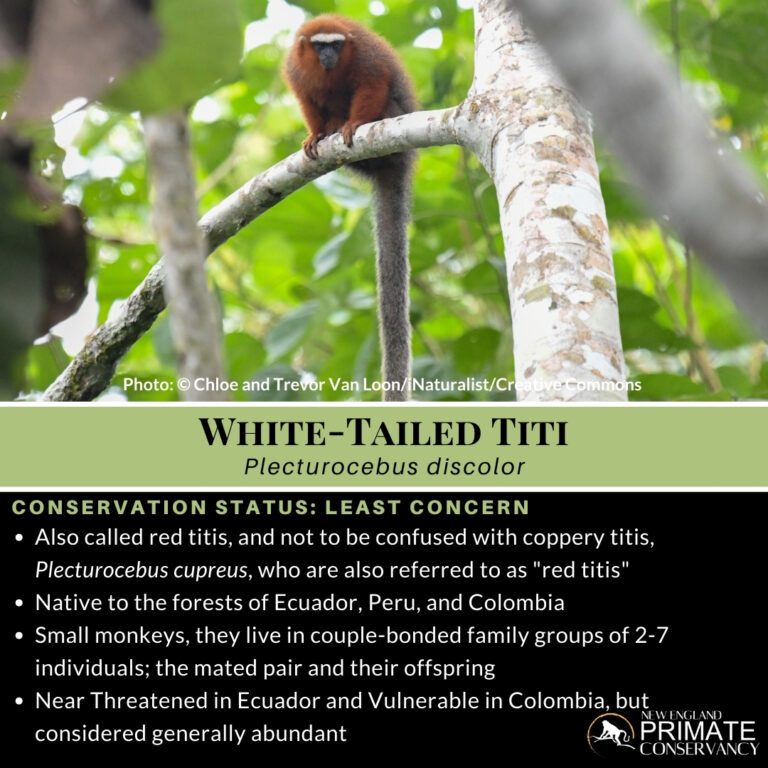
White-tailed titi monkeys, also called the red-crowned titi, white-browed titi, or simply the red titi monkey (not to be confused with the coppery titi monkey, which is also referred to as the red titi), are native to the upper Amazonian region through Peru, Colombia, and Ecuador. In Peru, they range north of the Marañon River, between the Napo and Santiago rivers, and between the Huallaga and Ucayali Rivers to the south. In Colombia, they range between the Guamués River and San Miguel. In Ecuador, they are found in the Andean foothills and range eastward to the Río and Aguarico basin and north to the Putumayo River. In Yasuní National Park and Biosphere Reserve in eastern Ecuador, the monthly temperatures average between 75 and 80º F (24 and 27º C), and have an average annual rainfall of 10.5 feet (3200 mm). Throughout their range, white-tailed titi monkeys experience very hot and humid climates.
White-tailed titi monkeys seem to prefer flooded forests but also live in lowland terra firma or non-flooded forests, which tend to be quite dry. Additionally, they reside in gallery forests that transition between wet and dry areas, white-sand forests, and tropical dry forests. They live in both primary forests that have remained undisturbed by human activities and secondary forests that have regrown from disturbance.
In 2016, titi monkeys were split from a single large genus, Callicebus, into three genera, with the addition of Cheracebus and Plecturocebus based on differences in their teeth, skulls, and genetics.

Size, Weight, and Lifespan
Titi monkeys are generally not sexually dimorphic, meaning there are no large differences in size between sexes. Female white-tailed titis tend to be slightly heavier than males, with an average weight of 2.37 pounds (1075 g) to males’ average of 2.06 pounds (935 g). Titi monkeys generally have a head and body length of 10.6–16.3 inches (270–415 mm) and a tail length of 16.5–21.7 inches (420–550 mm).
Titi monkeys in the wild are known to live around 15 years, although researchers have noted they likely live longer. Under rare, highly managed captive conditions—such as in well-resourced, professionally run institutions—some individuals have lived to 20 years.
Appearance
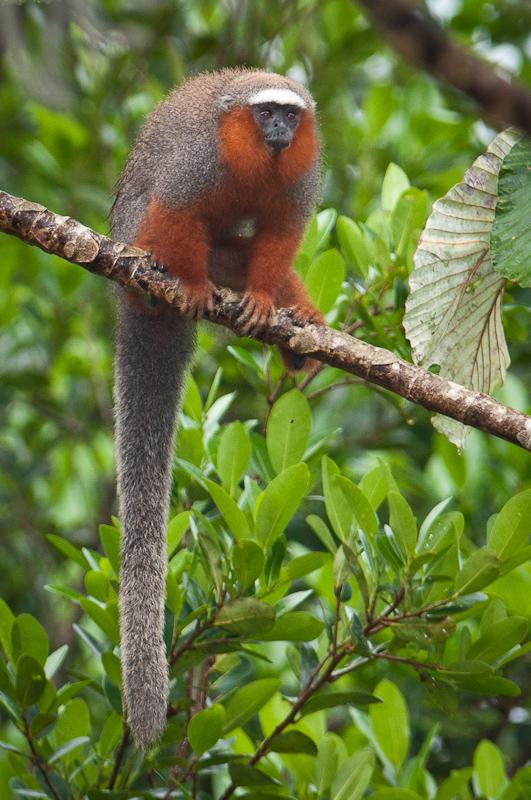
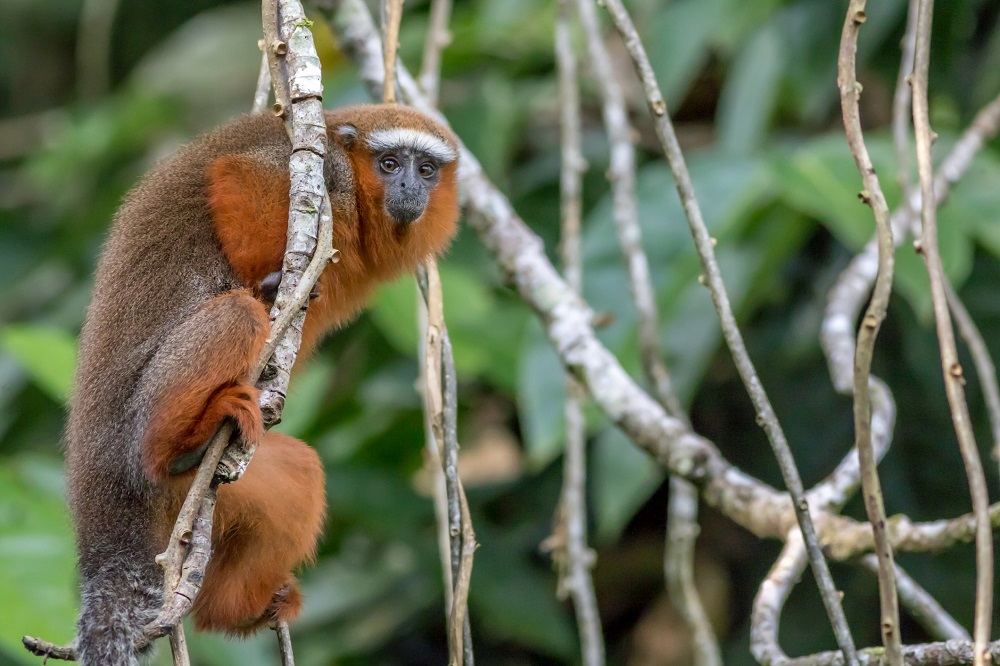
As suggested by their many names, white-tailed titi monkeys have many striking features. Their tails are indeed speckled with white fur, blending into the light brown covering the base of their tails and backs, which possibly helps them blend into the forest floor below them when being viewed by aerial predators. Their bellies and cheeks are a striking red color, contrasted by the white band above their brow. Their heads, backs, and tails are reddish-brown. Their bare faces, hands, and feet reveal their darkly colored skin. Titi monkeys are fairly small and stout in stature compared to many other primate species, giving the impression of long-tailed potatoes sitting in the branches. Their long tails not only help them balance while moving between branches, but also play an important role in bonding behaviors such as tail-twining.
Diet
White-tailed titi monkeys feed primarily on fruits and leaves, but will also eat insects, seeds, and flowers. White-tailed titis have been observed feeding from 30 different plant species, but particularly favor plants in the legume and mulberry families, as well as small trees. They also eat plants known to thrive in disturbed forests, suggesting white-tailed titi monkeys may be well-suited to inhabit secondary forests as deforestation continues.
Titi monkeys tend to have tall incisors with enlarged roots, which likely helps them use their front teeth to tear or manipulate their food while eating.
Behavior and Lifestyle
Titi monkeys are active during the day, making them diurnal. They walk along tree branches quadrupedally on all fours, leaping to close large gaps only when necessary. They are arboreal and spend most of their time above the ground in the forest subcanopy or understory, while occasionally venturing upward into the lower levels of the canopy and rarely all the way to the upper canopy. They typically spend almost half of their day foraging, while still finding time to socialize with other group members, rest, and, of course, move between foraging sites.
White-tailed titi monkeys are preyed on by harpy eagles, although likely as a light snack for the large raptors, as they usually prefer larger prey. They are also on the menu for tayras, boa constrictors, crested eagles, ornate hawk-eagles, ocelots, capuchin monkeys, and margays. When predators are present, titi monkeys usually hide in tangles of vines. However, if infants are nearby, the adults—especially the males—will alarm call and may even approach and mob predators to ward them off.
White-tailed titi monkeys sometimes rub chewed-up leaves from the Tetrathylacium tree genus on their fur, although why is currently unclear.
The genus name Plecturocebus comes from the Greek words plektos, meaning twisted or braided, and uro, meaning tail, which refers to the titi’s habit of twisting its tail together. Cebus, which you may have seen included in other primates’ scientific names, means long-tailed monkey.
Living in small family groups of 2-6 individuals consisting of a breeding pair and their offspring, white-tailed titi monkeys have a home range of 8.15 acres (3.3 hectares). The pair will typically stay near one another, though researchers suggest the male may play a critical role in maintaining this bond.
Family comes first for titi monkeys, and they have a few behaviors that help them maintain their close bonds. Both adult and juvenile titis will sit next to each other with their tails wrapped together in a tail twine. Similar to humans holding hands, tail twining helps strengthen the bond between two individuals. Families may also line up, sitting close together side by side for prolonged periods of time.
Titi monkeys wake up at sunrise and leave their sleeping site to find breakfast shortly after. As they travel throughout their home range during the day, they occasionally check the outer perimeter of their territory to ensure no other titi groups are trying to sneak in and steal their preciously guarded fruits.
Female and male white-tailed titi monkeys disperse from their natal group between 2 and 5 years of age, with the hopes of finding a bachelor or bachelorette to start their own group with. In the years before moving out, subadult titis will help take care of their siblings, giving mom and dad an occasional break.
White-tailed titi monkeys can be found alongside western pygmy marmosets, golden-mantled tamarins, Spix’s night monkey, monk sakis, equatorial sakis, common squirrel monkeys, white-fronted capuchins, tufted capuchins, Colombian red howler monkeys, common woolly monkeys, and white-bellied spider monkeys, though interactions between species are unknown.
White-tailed titi monkeys mainly rely on vocalizations to advertise their territories and warn other group members of potential threats. Their calls travel 0.3 miles (500 m) away. The breeding pair in the group will often duet first thing in the morning to remind their neighbors that no visitors are welcome. Titis are also known to have several unique calls for specific predators. They usually string two call types together to convey more information to other group members. When warning other group members of a bird of prey, they’ll begin their call sequence with chirps. Call sequences warning of terrestrial predators start with cheeps. The louder subsequent call types used in titi monkey call sequences have yet to be studied. We can speculate that these calls may indicate the location of predators or other pertinent information, or perhaps they’re simply hurling insults at the predator.
Many primate species also use scent marking to communicate with each other, typically to mark territory or advertise reproductive state. We do know they have scent glands on their chests and genitals that they rub against their hands or other surfaces. However, there has yet to be a study on how these titi monkeys may communicate with scent.
Because titi monkeys are relatively small and tend to hide among the trees and vines, they can be rather cryptic and difficult for researchers to observe. Instead of visual counts, researchers count calls from different individuals to estimate population sizes for titi monkeys.
White-tailed titi monkeys are socially monogamous and sometimes described as an example of “classical monogamy”. Maintaining a single pair bond may help reduce the energetic costs of parental care on the female.
Female titis have a gestation period (pregnancy) of about 130 days before giving birth. Once the baby is born, dad takes over as the primary caregiver except when they’re nursing. Researchers have even found that titi babies prefer their fathers and become stressed when they’re not around. Females typically aren’t ready to have another baby until about 14 months after their previous birth. Births for white-tailed titi monkeys most commonly occur between September and January.
As frugivores, white-tailed titi monkeys play an important role as seed dispersers. Many primates either consume the seeds from the fruit they feed on and subsequently pass them some distance from the original tree, or drop the seeds after removing the flesh from them. Not all seed dispersers may feed from every fruiting tree, meaning each species may spread the seeds from a different group of trees. While seed dispersal is a common role for primates as well as other fruit-eating animals, it is an incredibly important one for maintaining the biodiversity of the forest, and each seed disperser plays a unique part.
Because they also eat leaves, they likely help maintain the amount of sunlight entering lower levels of the forest. Eating insects promotes healthy population levels of various creepy crawlies that are necessary for robust ecosystems to thrive. Additionally, they themselves act as an important food source for raptors, snakes, and mammals.


The white-tailed titi monkey is classified as Least Concern by the International Union for Conservation of Nature (IUCN, 2015), appearing on the IUCN Red List of Threatened Species. Although they are generally abundant throughout their range, scientists are unsure whether populations are increasing or decreasing.
In Colombia, the white-tailed titi monkey is considered Vulnerable, primarily due to habitat loss resulting from petroleum exploration, coca plantations, and herbicide use. In Ecuador, where high levels of deforestation cause forest fragmentation, the white-tailed titi monkey is considered Near Threatened.
While they have faired well thus far, should deforestation continue in their region, forest fragmentation could cause white-tailed titi monkey populations to become separated from each other, and subadults ready to set out for a group of their own may not be able to find a mate.
In Peru, white-tailed titi monkeys are found in black markets, where they are sold as either bushmeat or as pets. Hunting primates for bushmeat is sometimes seen as taboo due to their similarities to humans. For some indigenous groups, like the native Shipibo people who live along the upper Ucayali River in Peru, hunting primates has been a necessary practice for sustenance. While woolly and spider monkeys are typically preferred, centuries of hunting pressure have largely wiped these animals out. Therefore, hunters have begun seeking out smaller-bodied species such as the white-tailed titi monkey.
White-tailed titis are also sometimes kept as pets, and are sought for their singing and calm nature. Their songs are short-lived, however, as primates do not survive more than a few months as pets.
Some folk medicine used by the Shipibo calls for the use of monkey tails, including those from the white-tailed titi, to treat insect bites or stings, but in modern day, most people choose to turn to modern creams and ointments.
White-tailed titi monkeys are listed in Appendix II of the Convention on International Trade in Endangered Species (CITES), an international agreement between governments whose goal is to ensure that international trade in specimens of wild animals and plants does not threaten their survival.
White-tailed titi monkeys inhabit many protected regions in Peru and Ecuador, although they are absent from protected areas in Colombia. Many initiatives exist to protect the habitat throughout the white-tailed titi’s range, although not necessarily targeting the protection of the species, they benefit from it.
Owning a primate as a pet is illegal in Peru; however, in rural communities, where primates such as the white-tailed titi are more readily available, these laws are not enforced.
Continued study of white-tailed titi monkeys is the first step in their conservation efforts. An accurate understanding of white-tailed titi monkeys and their habitat requirements is necessary to develop effective conservation strategies for protecting them.
- Vermeer, J., Palacios, E., de la Torre, S. & Shanee, S. 2021. Plecturocebus discolor (amended version of 2018 assessment). The IUCN Red List of Threatened Species 2021: e.T41553A192452388. https://dx.doi.org/10.2305/IUCN.UK.2021-1.RLTS.T41553A192452388.en
- De Luna, A. G., Sanmiguel, R., Di Fiore, A., & Fernandez-Duque, E. (2010). Predation and predation attempts on red titi monkeys (Callicebus discolor) and equatorial sakis (Pithecia aequatorialis) in Amazonian Ecuador. Folia Primatologica, 81(2), 86-95.
- Carrillo-Bilbao, G., Di Fiore, A., & Fernández-Duque, E. (2005). Dieta, forrajeo y presupuesto de tiempo en cotoncillos (Callicebus discolor) del Parque Nacional Yasuní en la Amazonia Ecuatoriana. Neotropical Primates, 13(2), 7-11.
- Fernandez-Duque, E., Di Fiore, A., & de Luna, A. G. (2013). Pair-mate relationships and parenting in equatorial saki monkeys (Pithecia aequatorialis) and red titi monkeys (Callicebus discolor) of Ecuador. Evolutionary biology and conservation of titis, sakis and uacaris. Cambridge University Press, Cambridge, 295-302.
- Van Belle, S., Fernandez‐Duque, E., & Di Fiore, A. (2016). Demography and life history of wild red titi monkeys (Callicebus discolor) and equatorial sakis (Pithecia aequatorialis) in Amazonian Ecuador: A 12‐year study. American journal of primatology, 78(2), 204-215.
- Byrne, H., Rylands, A. B., Carneiro, J. C., Alfaro, J. W. L., Bertuol, F., da Silva, M. N., … & Boubli, J. P. (2016). Phylogenetic relationships of the New World titi monkeys (Callicebus): first appraisal of taxonomy based on molecular evidence. Frontiers in zoology, 13(1), 10.
- Anca, E., Shanee, S., & Svensson, M. S. (2023). Ethnoprimatology of the Shipibo of the upper Ucayali River, Perú. Journal of Ethnobiology and Ethnomedicine, 19(1), 45.
- Norconk, M. A. (2011). Sakis, Uakaris, and Titi Monkeys Behavioral Diversity in a Radiation of Primate Seed Predators.. In Primates in Perspective (second, pp. 122 – 139). Oxford University.
- Snodderly, D. M., Ellis, K. M., Lieberman, S. R., Link, A., Fernandez-Duque, E., & Di Fiore, A. (2019). Initiation of feeding by four sympatric Neotropical primates (Ateles belzebuth, Lagothrix lagotricha poeppigii, Plecturocebus (Callicebus) discolor, and Pithecia aequatorialis) in Amazonian Ecuador: Relationships to photic and ecological factors. PLoS One, 14(1), e0210494.
- Cisneros-Heredia, D. F., León-Reyes, A., & Seger, S. (2005). Boa constrictor predation on a titi monkey, Callicebus discolor. Neotropical Primates, 13(3), 11-12.
- Bezerra, B., Casar, C., Jerusalinsky, L., Barnett, A., Bastos, M., Souto, A., & Jones, G. (2017). Pitheciid vocal communication: what can we say about what they are saying?. Ethnobiology and Conservation, 6.
- Dacier, A., de Luna, A. G., Fernandez-Duque, E., & Di Fiore, A. (2011). Estimating population density of Amazonian titi monkeys (Callicebus discolor) via playback point counts. Biotropica, 135-140.
- Van Roosmalen, M. G., Van Roosmalen, T., & Mittermeier, R. A. (2002). A taxonomic review of the titi monkeys, genus Callicebus Thomas, 1903, with the description of two new species, Callicebus bernhardi and Callicebus stephennashi, from Brazilian Amazonia. Neotropical primates, 10(Supplement), 1-52.
- Zhang, Y., Xiao, Y., & Bales, K. L. (2009). Primate social systems, scent-marking and their applications in mobile and static sensor networks. International Journal of Sensor Networks, 5(4), 210-222.
Written by Lina Rademacher, April 2026