
Golden-Mantle Saddleback Tamarin, Leontocebus tripartitus
GOLDEN-MANTLE SADDLEBACK TAMARIN
Leontocebus tripartitus
Geographic Distribution and Habitat
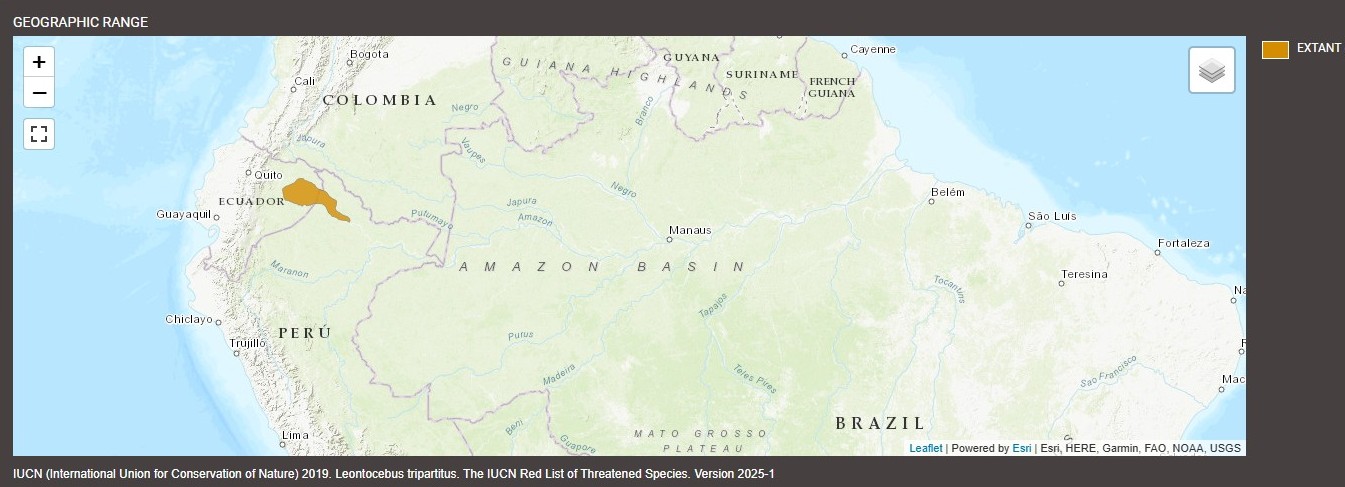
The golden-mantle saddleback tamarin, also known as the golden-mantled tamarin, is found in eastern Ecuador and northeastern Peru, with its range extending between the Curaray and Napo Rivers. They are also known to be found in lowland areas east of the Andes in both countries. These monkeys are forest-dwellers, found in evergreen and swamp forests, which can be primary, or unaffected by human-caused disturbance, or secondary, those that have recovered after a period of human-caused disturbance.
The golden-mantle saddleback tamarin was formerly considered to be a subspecies of the Andean saddleback tamarin (L. fuscicollis).
In addition, the golden-mantle saddleback tamarin was, along with all other saddleback tamarins, once grouped into the genus Sanguinus. A taxonomic and genetic review conducted in 2016 found that saddleback tamarins could be classified within their own genus (Leontocebus). However, this separation of genera is still debated among some biologists.
Size, Weight, and Lifespan
The golden-mantle saddleback tamarin has a head-body length of 8.58-9.45 inches (218-240 mm), and a tail measuring 12.4-13.4 inches (316-341 mm). The species weighs between 10.2 and 14.8 ounces (290-420 g), and sexual dimorphism is not pronounced; females and males look very much alike.
Their lifespan is not known, but the lifespan of wild Andean saddleback tamarins tends to be eight to 13 years.
Appearance
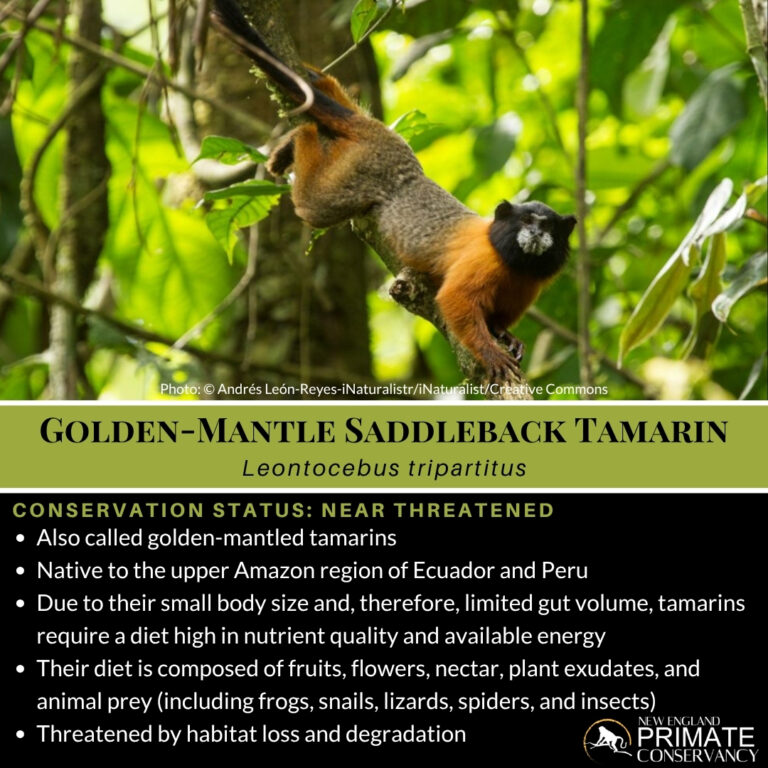
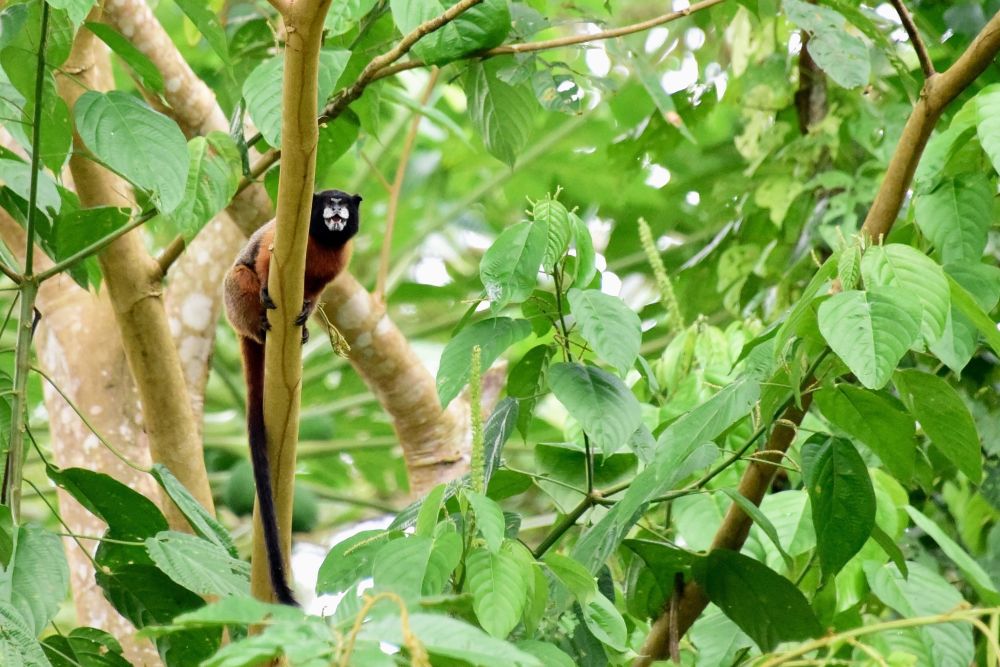
The golden-mantle saddleback tamarin is, in a word: CUTE! The head, hands, feet, tail, and ears are black, with a gray-white face and muzzle, which contrasts with their big brown expressive eyes, and vibrant orange underparts. As evident by their name, the species has a bright golden or creamy “saddle” along the back. The looooong tail is non-prehensile, that is, not used for grabbing or grasping, but rather used to aid in balancing among the tree branches. Finally, their slender yet strong limbs end with sharp-clawed hands to aid in gripping tree branches and enabling them to cling to trees for climbing as they move throughout the forested habitat. These claws are present on all of their digits except for the big toe, which instead has a fingernail, like those of us and other primates. This fingernail helps to stabilize the tamarin when moving in the habitat.

Diet
The diet is composed of fruit, flowers and their nectar, insects, occasional lizards, and finally, tree gums from holes, both natural and those originally made by pygmy marmosets (Genus Cepuella).
Why don’t golden-mantle saddleback tamarins make their own feeding holes in trees? Are they lazy? No! There are two reasons: gum makes up only a small portion of their diet, whereas pygmy marmosets are known as specialized exudativores—animals adapted to feed on tree gums and sap. Therefore, they wisely leave the excavation work to the experts. Related to this, the second reason why the golden-mantled saddleback tamarin exploits the holes made by pygmy marmosets has to do with differences in their teeth! Pygmy marmosets have highly modified lower incisors that are long, narrow, and chisel-shaped. These teeth are enlarged and protrude slightly forward (known as being procumbent), allowing them to gouge holes in tree bark efficiently. Their powerful jaw muscles and shortened face, which provides mechanical leverage, also help them to apply the force needed to cut through tough bark and stimulate the flow of gum. Tamarins, on the other hand, lack these specialized dental adaptations. Their lower incisors are not enlarged or procumbent, and their jaw muscles are not built for the sustained gouging behavior that marmosets exhibit. Instead, tamarins, including the golden-mantle saddleback tamarin, have more generalized dentition suited to their mixed diet.
Behavior and Lifestyle
Golden-mantle saddleback tamarins are diurnal, active during daylight hours, and arboreal, preferring to spend their time in the trees. They move around by walking quadrupedally, or on all fours, and leap from branch to branch in their forested habitat during their search for food. Water is lapped up from tree hollows, as well as from accumulated water in leaf or flower cups. Foraging is most active 13.1-32.8 feet (4-10 m) off the forest floor. Golden-mantle saddleback tamarins sleep at night primarily in dense vegetation or vine tangles up in the trees; there has been one observation of using a tree hole as a sleep site.
There have been no in-depth studies that have listed predators of the golden-mantle saddleback tamarin, but they likely include birds of prey, snakes, and other large predators such as ocelots, as is the case for other tamarin species. Predator-avoidance strategies include keeping cover within dense vegetation, emitting an alarm call, followed by beating a hasty retreat, and even mobbing behavior to drive the potential predator away.
According to one resource, 37.5% of their time is spent resting, 23.5% is spent traveling within their home range, 22.6% is spent foraging for food, 14.4% is dedicated to social activity such as play and grooming, and 2% to “other”.
The genus Leontocebus is informally known as the “white-mouthed group” of tamarins, in reference to the white fur found on their faces.
Golden-mantle saddleback tamarins live in small groups of typically four to nine individuals, with a single female acting as the dominant for the group. Studies regarding the golden-mantle saddleback tamarin are rather limited, so exact knowledge regarding dispersal patterns of newly mature individuals is lacking. If we look at other tamarin species from the Callitrichidae family, such as the Weddell’s saddleback tamarin (L. weddelli), there is evidence to suggest that members of both genders disperse to form groups of their own upon reaching sexual maturity.
According to one study, the size of a group’s home range is estimated at 64-99 acres (25.9-39.9 ha).
With regard to associating with other primates, according to another study conducted in 2000, there is a report of a mixed-species troop association between the golden-mantle saddleback tamarin and the Andean saddleback tamarin. However, this association has not been verified.
Not much has been studied on the communication habits of the golden-mantle saddleback tamarin. There is one noticeable method that has been studied at large for tamarins in general: chemosignaling. Chemosignaling is a communication method that uses chemical signals, often released through body odors or scent glands. Most scent marking is performed on items in the tamarin’s environment, but marking on the bodies of reproductive partners has been observed for multiple species. Tamarins often mark territorial boundaries using their scent, and it’s possible this may include the golden-mantle saddleback tamarin.
If we look at other tamarin species, such as pied tamarins (S. bicolor), they use a wide vocal repertoire of chirps, trills, whistles, and more to convey information, including meaning. Some calls are used as alarm calls upon detecting a predator or rival group, while others may be used as contact calls to maintain group cohesion during foraging. Another tamarin species, the Geoffrey’s tamarin (S. geoffroyi), along with using a variety of vocal communications, also conveys messages with piloerection, or hair bristling in response to shock or fright, as well as various body postures. Outward hand gestures and lengthening body postures, such as standing on hind legs and directly facing opponents, may be signs of aggression, and are often directed toward predators. Piloerection has been documented as another form of communication used against predators. This response is very similar to our goosebumps, which occur when we feel threatened or in danger.
Further studies are required, specifically on the golden-mantle saddleback tamarin regarding their communication methods, and how they compare with those of other tamarin species.
The reproductive traits of tamarins are interesting, and the golden-mantle saddleback tamarin is no exception!
The female golden-mantle saddleback tamarin, like other members of the Callitrichidae family, typically gives birth to twins after a 140-day gestation (pregnancy) period. In addition, tamarins exhibit a unique sexual social organization called a cooperative polyandrous group. This means that groups consist of multiple males and females, but only the dominant female is reproductively active. She uses hormonal signals present in her urine to suppress the reproductive cycles of other females in the group. Despite not being allowed to raise young of their own, all members of the group, males included, take part in raising the young of the dominant female, a process known as alloparenting.
Starting at Day One, the newborns may be carried by other group members in addition to the dominant female. Weaning from mother’s milk occurs from nine to 13 weeks, when most of the food ingested is obtained through sharing or stealing. At the juvenile stage, which begins at four to seven months, fights between the twins may occur, especially between same-sexed twins, to determine individual differences in social status. Next, the sub-adult stage begins at nine to 14 months, and the young have the same size and appearance as the adults. Puberty also takes place at this time, but the young do not reproduce. Finally, at 12-21 months, sexual maturity, and thus, adulthood and independence are achieved, and it’s here that individuals of both genders disperse to establish groups of their own.
As some of their diet consists of fruit, the golden-mantle saddleback tamarin aids in the regeneration of their forest habitat by dispersing seeds through their feces as they move around their habitat. As a prey species, they also play a role in feeding local predators within the habitat. Finally, they may also be considered pest controllers through their consumption of insects.


The International Union for Conservation of Nature lists the golden-mantle saddleback tamarin as Near Threatened (IUCN, 2015), appearing on the IUCN Red List of Threatened Species.
The forests where the golden-mantle saddleback tamarin can be found along Ecuador’s Yasuní River are remote and have suffered little impact from human activities, other than small localized encampments for petroleum prospecting. However, the occurrence of petroleum in the region, which has resulted in the construction of several roads like the Pompeya-Iro and the Eden highways, is cause for concern for the future of these forests and their wildlife. Golden-mantle saddleback tamarins are also hunted locally for their meat.
The golden-mantled saddleback tamarin is listed in Appendix II of the Convention on International Trade in Endangered Species (CITES), an international agreement between governments whose goal is to ensure that international trade in specimens of wild animals and plants does not threaten their survival.
Golden-mantle saddleback tamarins are found in Ecuador’s Yasuní National Park, which is protected, unlike the locations in which they are found in Peru. Conservation actions needed include additional research on the golden-mantle saddleback tamarin’s population size, distribution, and trends; life history and ecology; and threats. Additionally, further monitoring of population trends is needed to prevent their continued path towards endangerment and extinction.
- https://www.alltheworldsprimates.org/Members/Home/MasterPrimate.aspx?tid=1349
- https://animalia.bio/golden-mantled-tamarin
- https://bmcecolevol.biomedcentral.com/articles/10.1186/s12862-021-01848-z
- https://en.wikipedia.org/wiki/Callitrichidae
- https://en.wikipedia.org/wiki/Golden-mantled_tamarin
- https://www.iucnredlist.org/species/19824/17930113
- https://www.ncbi.nlm.nih.gov/books/NBK232183/
- https://primate.socgen.ucla.edu/index.php/multivitaminic/article/view/229
- https://primate.wisc.edu/primate-info-net/pin-factsheets/pin-factsheet-pygmy-marmoset/
- https://www.researchgate.net/publication/226034864_Exudativory_in_Primates_Interspecific_Patterns
- https://www.researchgate.net/publication/352068782_Pygmy_Marmoset_Exudate_Feeding_Stimulates_Exudate_Production
- https://strapi.eaza.net/uploads/EAZA_Best_Practice_Guidelines_Callitrichids_V14_DOI_3d9cd601a2.pdf
Written by Sienna Weinstein, Jul 2025