
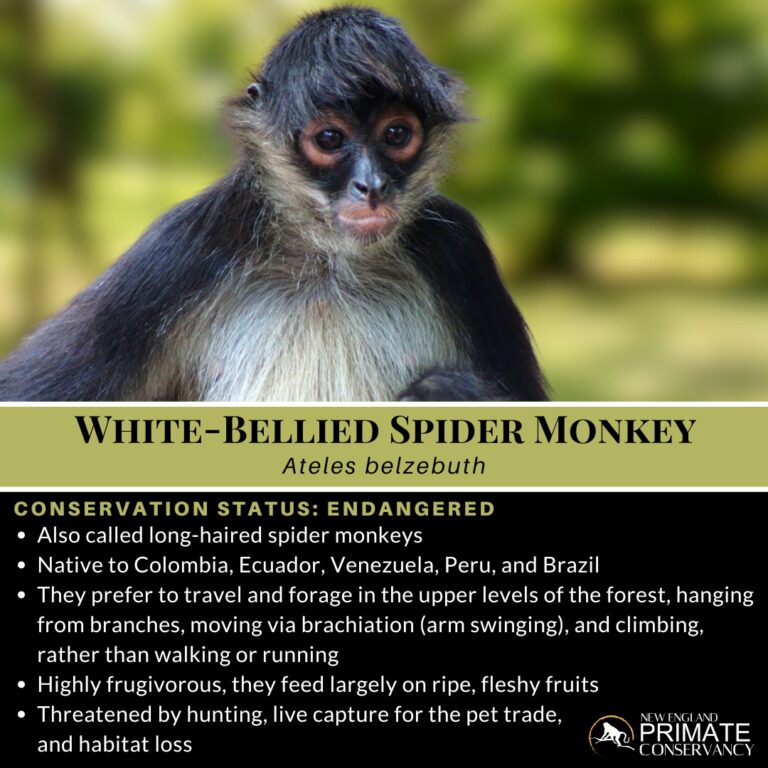
White-Bellied Spider Monkey, Ateles belzebuth
WHITE-BELLIED SPIDER MONKEY
Ateles belzebuth
Geographic Distribution and Habitat
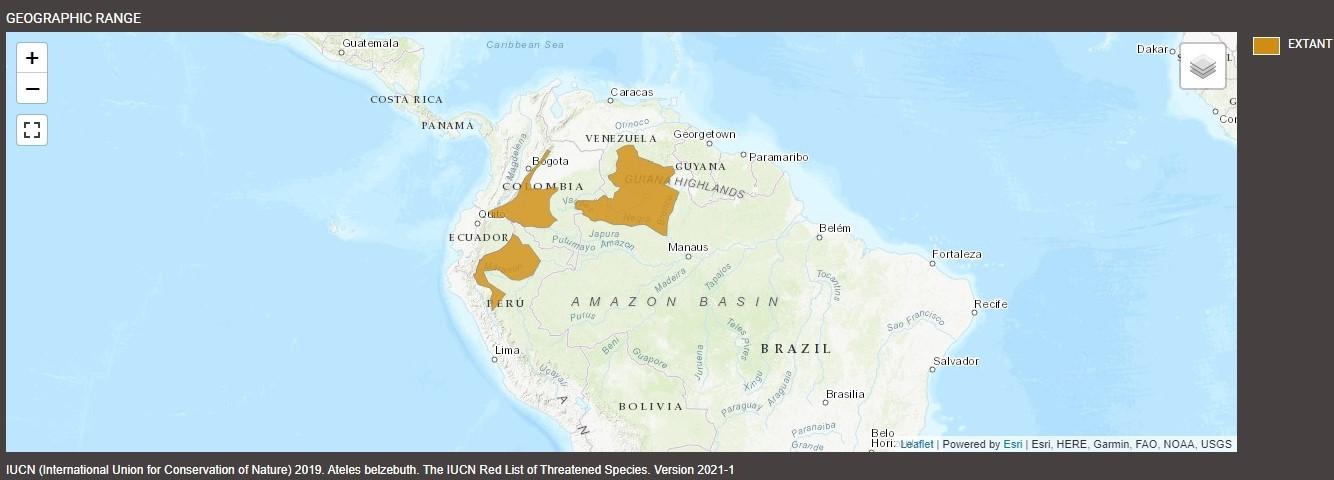
White-bellied spider monkeys, also called white-fronted or long-haired spider monkeys, live in South America in three separate areas of rainforest. The northern group lives in Colombia, the western group spans parts of Ecuador and Peru, and the eastern group inhabits parts of Venezuela and northwestern Brazil. There are geographic barriers that keep the three populations separated, including major rivers, such as the Amazon, and savannas and flooded forests that spider monkeys cannot cross without descending to ground level.
While they generally live in primary forests above the floodplain, white-bellied spider monkeys visit flooded lowland forests when fruit is plentiful there. They can be found from 252 feet (77 m) to 4,265 feet (1,300 m) above sea level. Some have been spotted as high as 5,900 feet (1,800 m). Their habitats, found in both montane and lowland forests, feature dense tree cover and high rainfall. Lowland rainforests have abundant fruit, tall trees that these spider monkeys prefer, and warmer temperatures.
White-bellied spider monkeys were first described in the seminal taxonomic paper on spider monkeys, published in 1944. Although these analyses were based on morphological characteristics, genetic investigations starting in the 1970s confirmed this as a species.
Size, Weight, and Lifespan
White-bellied spider monkeys are one of the largest of the spider monkeys. They have an average head-body length of 18 to 19.7 inches (46 to 50 cm). Their tails are even longer at 29 to 32 inches (74 to 81 cm) on average. Males are slightly larger and heavier than females. Males weigh an average of 18 pounds (8.3 kg) while females weigh 17.4 pounds (7.9 kg) on average. Their lifespan can be up to 40 years under human care, but when free-ranging, it is around 20 or 25 years.
Appearance
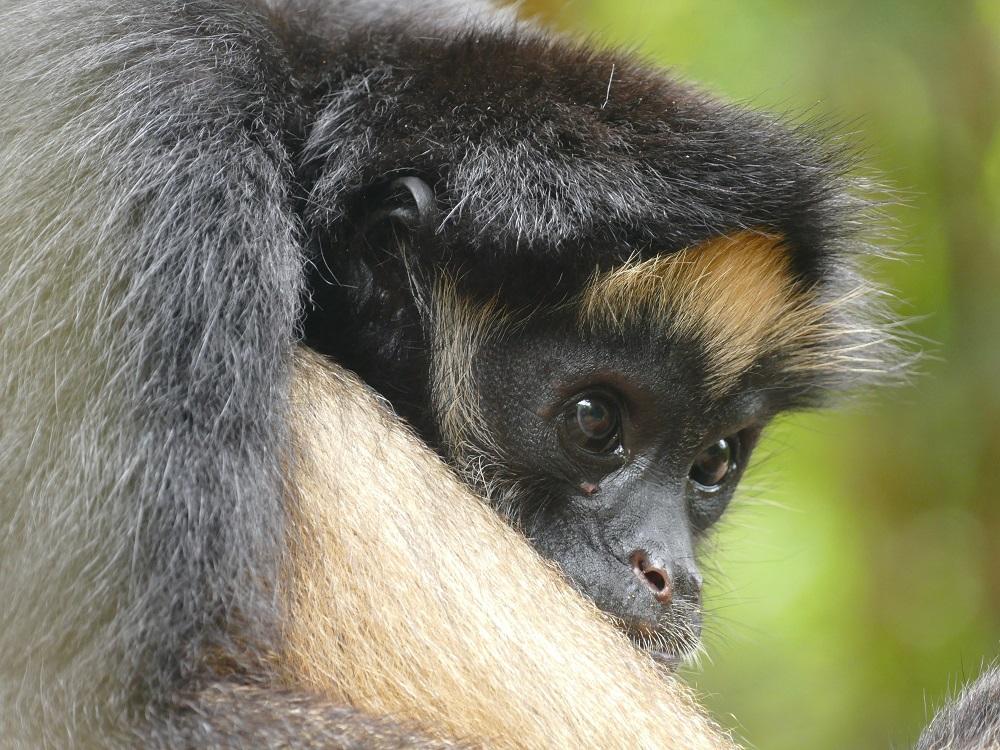
White-bellied spider monkeys are dark brown or black on the back of their bodies, but their fronts have the white or pale golden fur that inspires their name. Their fur color can vary significantly from individual to individual. Though not always present, they often have a chinstrap of light fur on their cheeks and a tuft of light fur on their foreheads. Some have pink skin around their mouths and eyes, while others have entirely black or dark grey faces. Pink skin seems more common in juveniles, but not exclusively. Their faces generally have very little hair.
Like other spider monkeys, white-bellied spider monkeys possess prehensile tails capable of supporting their full weight. Their tails are hairless at the tip and do an excellent job of gripping branches. This adaptation is especially convenient during eating— they can easily hang from their tails and use both hands to forage for food. Their thumbs are vestigial, meaning they are so reduced that they can no longer be used like the opposable thumbs of apes. Their other fingers are long and act like a hook, gripping slender branches as they swing from tree to tree. Spider monkeys have unusually flexible wrists and very long and strong limbs. Even their shoulders are built for movement through the trees, with a very wide range of motion that helps cover gaps between branches.
Diet
White-bellied spider monkeys eat mostly ripe and fleshy fruits, which comprise 80 percent of their diet. When fruit is scarce across their home range, large groups may concentrate in areas where fruit is still available. They supplement their diet with seeds, flower buds, young leaves, roots, honey, bits of decayed wood, and the occasional small insect. These spider monkeys have also been observed descending to ground level at “mineral licks” to ingest mineral-rich soils and enzymes that are missing from their fruit-heavy diet. These mineral licks are particularly common in Ecuador, Peru, and Brazil, including in protected areas where these spider monkeys live.
Behavior and Lifestyle
White-bellied spider monkeys are arboreal and diurnal, meaning they are mainly active in trees during the day. Their days are filled with traveling and foraging for ripe fruits in the upper levels of the canopy in small groups, but they reconvene into larger groups at night. They sleep within dense foliage at the tops of emergent trees, above the rest of the forest canopy, where they are safe from predators like jaguars and pumas.
Except for accessing mineral licks, white-bellied spider monkeys rarely travel to ground level, where they are most vulnerable to predators. When they do descend to exploit these sources, they form larger groups and show vigilant behavior to reduce the risk of predation.
Spider monkeys move by brachiation, or swinging, and spend very little time sitting or walking on all fours. Their long limbs and flexible wrists and shoulders make it easy for them to swing from branch to branch, even through dense forest. They also use their prehensile tails as a fifth limb, for balance or extra stability while moving through the trees.
White-bellied spider monkeys can leap over 33 feet (10 meters) to travel between trees.
Spider monkeys are named for their exceptionally long limbs and relatively small bodies, which give them a spider-like appearance as they hang from trees or move through the canopy.
White-bellied spider monkeys live in large groups of 20 to 40 individuals, though groups of up to 55 individuals have been recorded. However, the whole group is rarely all together. Spider monkeys spend most of their time in smaller groups that feed, travel, and rest together. These subgroups fluctuate in size and composition, but the groups average 3 to 5 adults plus 1 to 2 juveniles. Observed in multiple primate species, this system is referred to as a fission-fusion social structure. Because the groups are fluid and spider monkeys live high in dense forest canopy, it can be difficult for researchers to track and accurately report exact group size and composition.
Although groups tend to have more females than males, these spider monkeys are polygynandrous, with males and females having multiple partners. Males stay in their birth, or natal, groups, but females leave at sexual maturity or shortly after. Home ranges for white-bellied spider monkeys can be quite large, from 0.6 to 1.5 square miles (150 to 400 ha). Females tend to have smaller daily ranges, but males are more likely to travel across larger areas and patrol the boundaries of the group’s territory. This differs in the Ecuadorian population, where females cover similar daily distances to males, and the average home range is larger than in other populations.
Their habitats overlap with other primates, and white-bellied spider monkeys sometimes form loose foraging groups with woolly and howler monkeys. These associations are temporary and may help them spot predators. All of the species also congregate where fruit is plentiful or near known mineral licks. Juvenile white-bellied spider monkeys will sometimes play with howler monkeys and woolly monkeys. White-bellied spider monkeys tend to avoid interactions with capuchin monkeys, which are more aggressive.
White-bellied spider monkeys communicate with a variety of calls, from coughs, growls, hoots, and barks to long calls, screams, squeaks, and whinnies. Whinnies help identify individuals, squeals and screams show agitation, and loud calls are used for alarm or aggression. In the dense canopy where they may not be able to see one another, vocal communication is particularly critical. Male white-bellied spider monkeys call more often than females. It’s likely that white-bellied spider monkeys also respond to alarm calls from other species in the area that warn of predators.
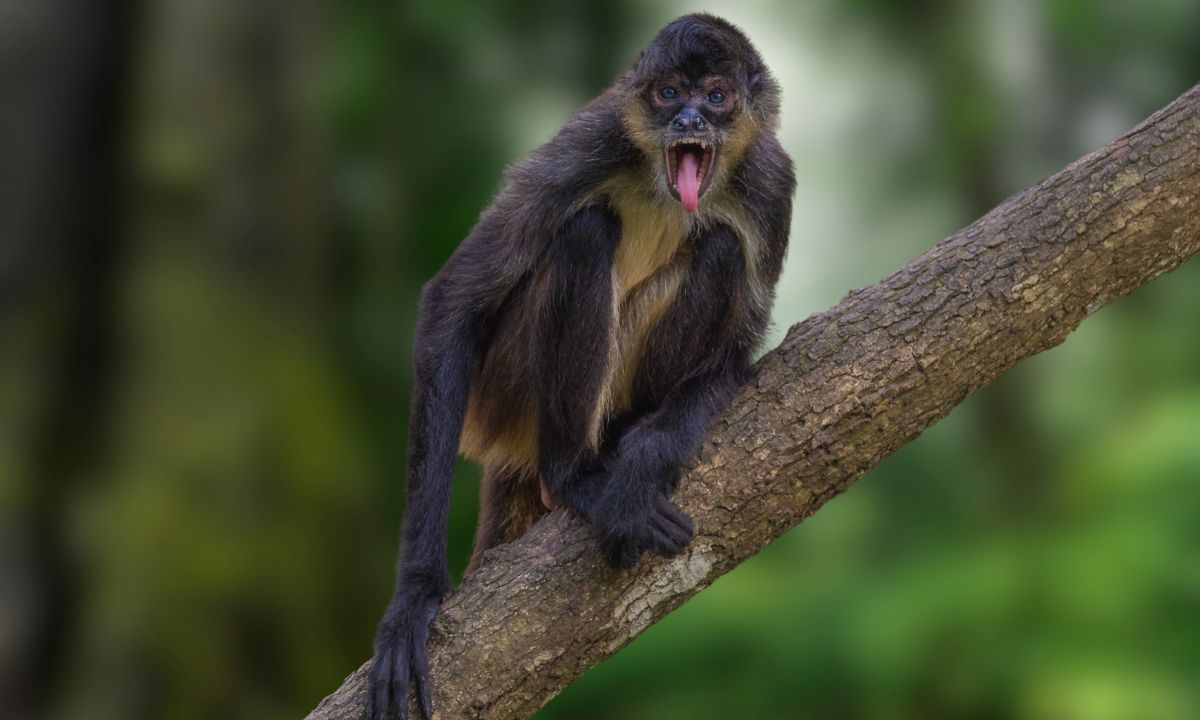
Body language is another key communication strategy for white-bellied spider monkeys, particularly at close range. To show agitation or aggression, they may shake branches, make a fixed stare, or flick their tails. Slow movements and relaxed mouth postures are often used to communicate calm and relaxation. They may drape their tails over another spider monkey to show affection. However, spider monkeys do not spend a lot of time grooming one another. This behavior is most commonly observed between mothers and their babies or between bonded females.
Spider monkeys also rub saliva and chewed plant material onto their fur, a process called self-anointing. Research suggests they engage in this behavior to protect against pests and fungus, but it may also help communicate individual and group identity or serve as a stress response.
White-bellied spider monkeys reach sexual maturity at around 4 to 5 years of age. Females leave their birth group sometime around 6 years old and may not have their first offspring until they are 7 or older. After a gestation or pregnancy period of around 7.5 months, females generally give birth to a single baby. There may be 3 or more years between births, which is the longest interbirth interval of any spider monkey. These long periods between babies complicate efforts for rapid species recovery and population growth.
Although births can occur any time of year, they are most commonly observed between May and December. Infants begin weaning off their mother’s milk between 12 and 15 months and are independent by about 1.5 years old. Though mothers are the primary caregivers, spider monkey infants are sometimes observed initiating contact and receiving care from individuals other than their mothers, including adult males. This behavior is rare and initiates with the infant rather than with the adult.
White-bellied spider monkeys are prolific seed dispersers, swallowing seeds from hundreds of different species of trees and plants. They tend to eat fruit whole, including all the seeds, which means those seeds pass through them relatively undamaged. Seeds that pass through the digestive system of spider monkeys are more likely to germinate and grow than those that are not eaten.
White-bellied spider monkeys are relatively large, allowing them to swallow and disperse large seeds that species such as small birds and bats cannot. This role makes them a keystone species for maintaining tree diversity and a healthy ecosystem in their habitats. Their relatively large home range also means they spread seeds far across the forest from the parent plant, promoting healthy diversity among the forest plant life. Their absence would have cascading detrimental effects on the rainforest ecosystem.


The white-bellied spider monkey is classified as Endangered by the International Union for Conservation of Nature (IUCN, 2019), as assessed on their IUCN Red List of Threatened Species. Population levels are experiencing declines that may cut their populations in half between 2005 and 2050. Their slow reproduction cycle makes it very difficult for the species to recover.
The main threat to spider monkeys is habitat loss. In Colombia, much of this is driven by the expansion of coca plantations. Mining, beef, soy, and logging industries also contribute to habitat loss. Fragmented habitats, where the canopy is interrupted by cleared land, separate spider monkey populations, making them more susceptible to disease, local, and global extinctions.
Hunting is another major threat, particularly in Ecuador, Brazil, and Peru. In areas where hunting is low, population densities average around 16 individuals per square kilometer. In areas with significant hunting, there may be only 1 individual on the same amount of land. White-bellied spider monkeys are also sometimes captured for the illegal pet trade. Typically, the mother will be killed and the infants taken and sold.
White-bellied spider monkeys are listed in Appendix II of the Convention on International Trade in Endangered Species (CITES), an international agreement between governments to ensure that international trade in specimens of wild animals and plants does not threaten their survival.
Though they are in decline overall, these spider monkeys are still common within protected areas. There are 28 protected areas within their range, spread across Venezuela, Peru, Ecuador, Colombia, and Brazil. Yasuni National Park and Cuyabeno Wildlife Reserve in Ecuador, Tinigua National Park in Colombia, Jaú National Park in Brazil, and Pacaya-Samiria National Reserve in Peru are all important habitats for white-bellied spider monkeys.
Several organizations work to restore and reconnect fragmented habitats within the spider monkey’s distribution. AmaZOOnico in Ecuador rehabilitates spider monkeys that have been in captivity, runs environmental education programs, and helps to manage the Selva Viva forest reserve. The Amazon Conservation Team works across Colombia, Ecuador, Peru, and Brazil to protect Amazonian forests. Several organizations are particularly focused on protecting large tracts of connected forest and reconnecting areas where there are breaks in the canopy. These actions benefit not only white-bellied spider monkeys, but many tree-living species with large home ranges. In Ecuador, a new Cuyabeno-Yasuni Connectivity Corridor spans 1,061 square miles (2,750 sq km) between two protected areas where these spider monkeys live. In Brazil, the Reconecta Project is building canopy bridges, allowing arboreal species to safely cross roads and highways without descending from the trees. Reconnecting and preserving habitats are critical conservation tasks for the future of this species.
- https://www.worldlandtrust.org/species/mammals/white-bellied-spider-monkey
- https://biodb.com/species/white-bellied-spider-monkey/
- https://www.iucnredlist.org/species/2276/191684587
- https://freethemonkeys.org/about-free-the-monkeys-campaign/
- https://www.amazonteam.org/our-work/our-strategies/
- https://projetoreconecta.com/about/
- https://www.rainforest-arcc.org/blog/cuyabenoyasuni-connectivity-corridor
Written by Courtney Daniels, Dec 2025