
Kayan River Slow Loris, Nycticebus kayan
KAYAN RIVER SLOW LORIS
Nycticebus kayan
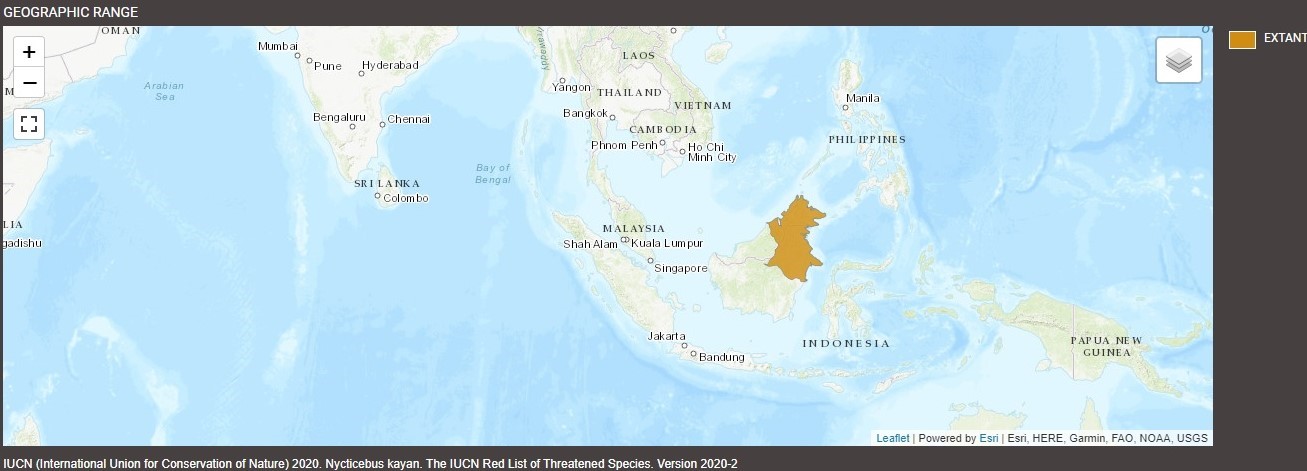
Geographic Distribution and Habitat
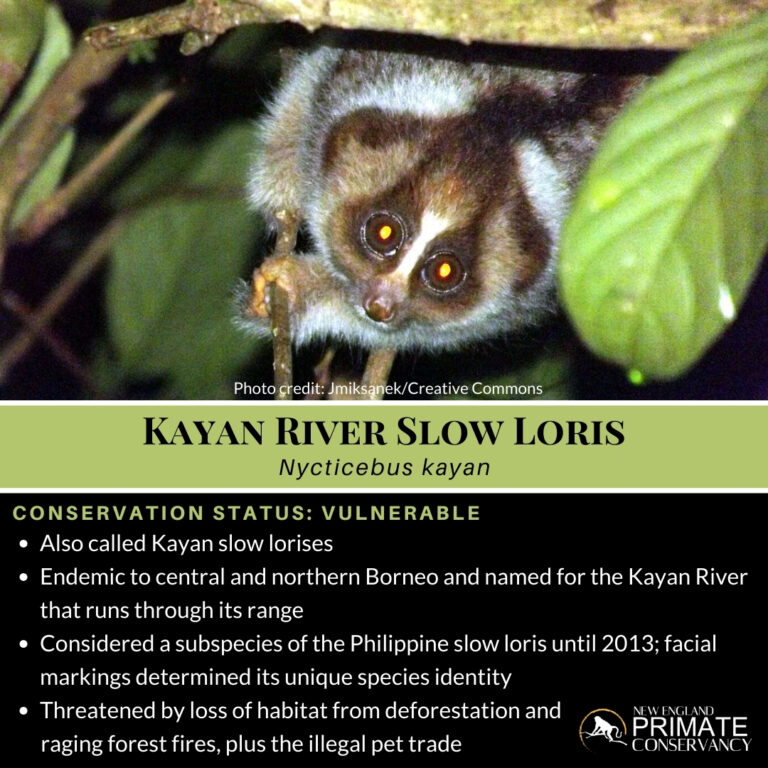
The Kayan River slow loris, also known as the Kayan slow loris, is native to central and northern Borneo, and is named for the Kayan River, which runs through the range of this species. Very little is known of this species, which will become a common theme within this profile, including their full geographic distribution. Though their range possibly spans the entire width of the island, the Kayan River slow loris does not live near the coast. Their range also includes the Malaysian states of Sabah and Sarawak, as well as parts of Kalimantan, Indonesia.
A large portion of the species’ range likely falls within some of the last intact ancient rainforests still remaining in Borneo. Known today as the “Heart of Borneo”, this area is a lush mosiac of habitats. Kayan River slow lorises possibly call many of its peat swamps, swamp forests, ironwood, heath, and montane (mountainous) forests home.
Living in an equatorial climate, the area in which the Kayan River slow loris resides is characterized by high humidity and consistent warmth year-round; average annual temperatures are typically around 80ºF (27ºC), with limited variation. The region experiences a wet season from approximately November through April, and a drier season lasting from May through October. Their forested habitats experience very high annual rainfall often exceeding 118-157 inches (3,000–4,000 mm) with little seasonality. Temperatures are generally warm, though the mountainous, high-altitude regions they inhabit offer cooler, sometimes foggy conditions compared with the lowlands. While the Kayan River slow loris can be found at lower elevations, they are specifically associated with higher inland forests, distinct from other Bornean species of slow loris. Despite this “wealth” of information, data regarding the exact metrics of elevation are not known for this species.
Until 2013, the Kayan River slow loris was considered a subspecies of the Philippine slow loris (N. menagensis). A study of museum specimens and photographs identified distinct facial markings between the species, differentiating them and thus splitting them into separate species.
Size, Weight, and Lifespan
Based on museum records and specimens, the average head-body length of the Kayan River slow loris is 10.8 inches (27.4 cm), while the average weight is 14.5 ounces (411 g).
The exact lifespan of the Kayan River slow loris has not been specifically documented, but it is generally estimated to be similar to that of other slow lorises, which can live up to 20 years in the wild.
Appearance
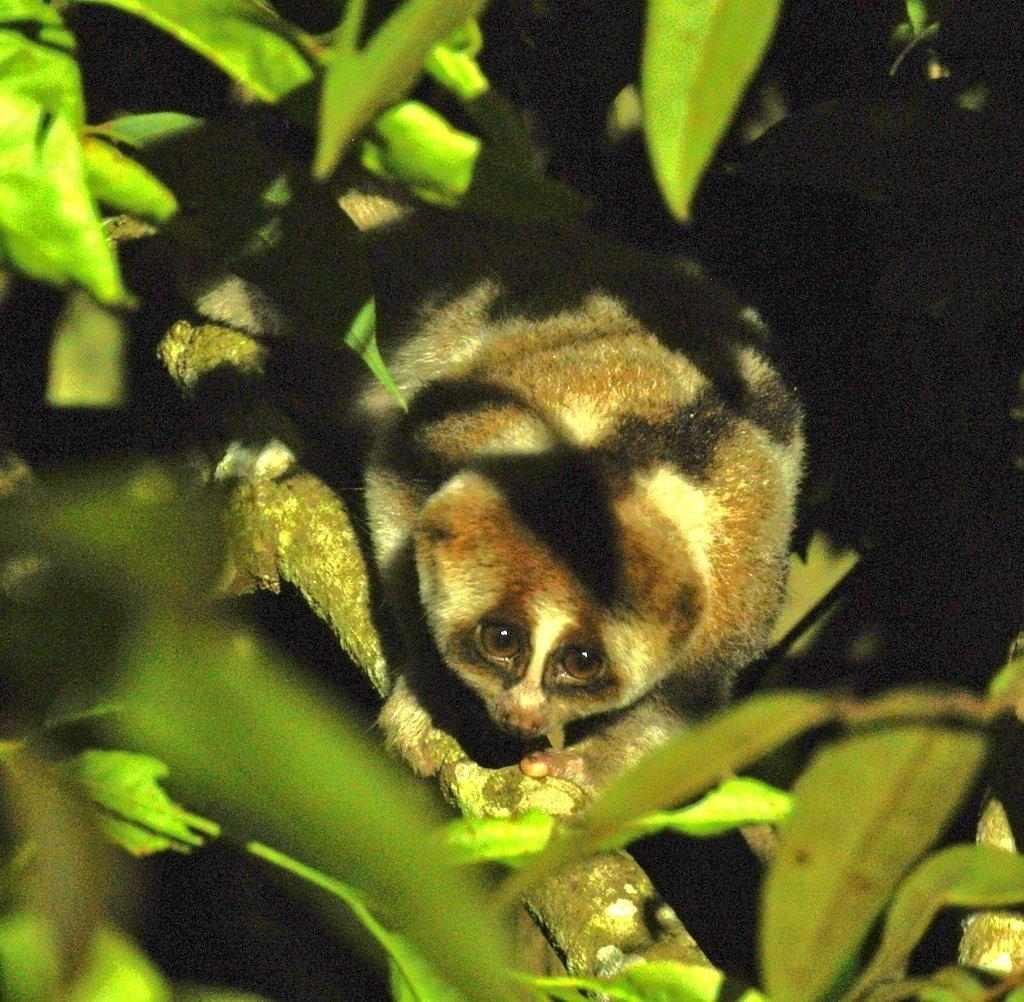
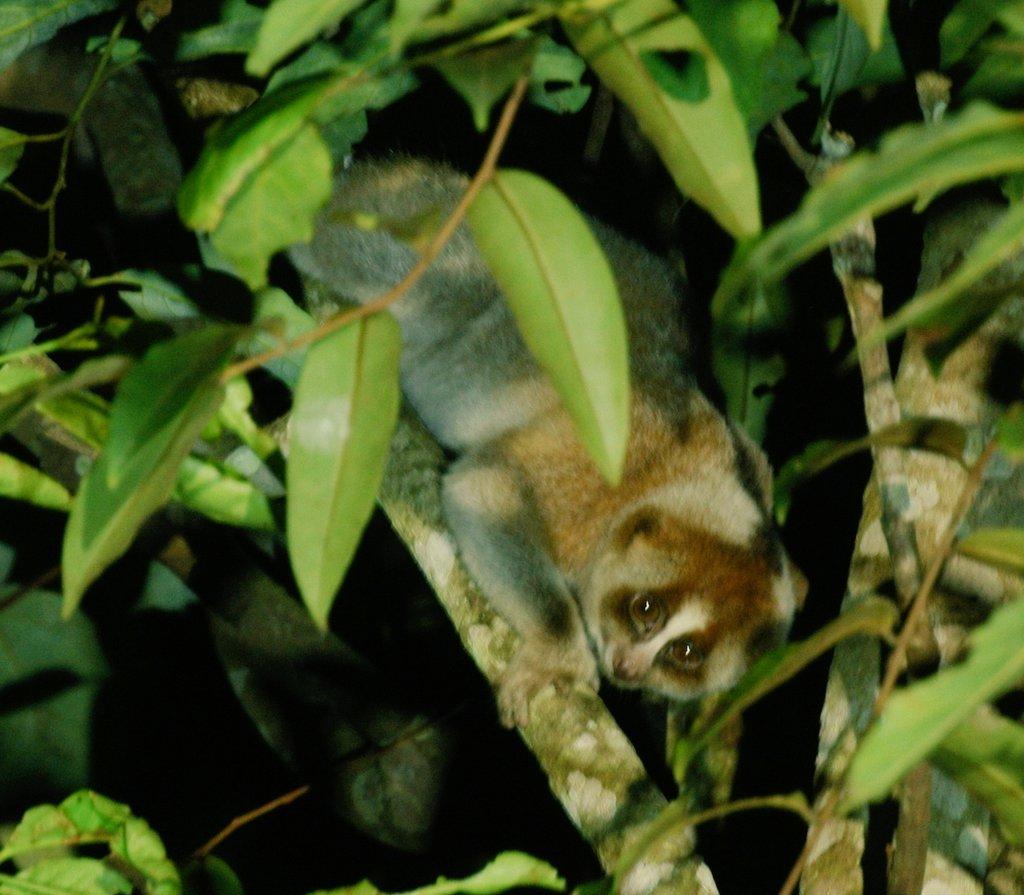
Covered in soft, dense fur with brown or gray tones, the Kayan River slow loris shares a number of characteristics with other loris species. These include: a wet nose (more on that in the Fun Facts section), a barely-visible vestigial (no longer in use, but still present) stub of a tail, a round head with a broad, flat face, short ears, needle-like teeth, and large, saucer-like eyes which reflect a bright orange eye shine. Many of these adaptations are perfect for a life in the trees and for activities performed at nighttime.
The big toe on each hind foot faces opposite the other toes, enhancing the “handy-dandy” (haha) gripping power. In addition, the second toe on each hind foot has a curved “toilet claw” which is used for scratching and grooming, while the other toenails are flat. Like all other species of loris that live in Borneo, the Kayan River slow loris lacks a second upper incisor tooth, distinguishing them from other slow lorises. This trait is a result of their evolutionary divergence, rather than a functional loss related to diet.
Diet
Like other slow lorises, the Kayan River slow loris is an omnivore, feasting on insects, tree gum, sap, nectar, and fruit. Slow lorises as a whole have also been documented feeding on arthropods, small birds and reptiles, eggs, and miscellaneous vegetation.
They are especially dependent upon sap and tree gum during the winter months, due to food scarcity and nutritional needs. The teeth of slow lorises are adapted for “gouging”, allowing them to break through tree bark to feed on sap and gum.
Behavior and Lifestyle
Like other lorises, the Kayan River slow loris is nocturnal, or active at night, and arboreal, spending most of the time in trees. It is likely that, like other lorises, they move through the forest quadrupedally (on all fours) with deliberate movements as they forage. That is, they change direction or move between supports without much noise or change in speed. Their hands are supremely adapted to climbing, thanks to their fingers and opposable thumbs, which, when clenched together, allow them a pincer-like grip like a crab or lobster!
Daytime hours are spent sleeping curled up in a ball in dense vegetation or tree holes. Starting at sunset, nighttime is dedicated to foraging for food. This is where those amazing eyes come in: because their eyes face forward, each eye sees a slightly different image, allowing the brain to judge distance. Their specialized eyesight also helps them see clearly in the dark.
Slow loris species often have signature facial markings or face masks. A Kayan River slow loris’s face mask is only subtly distinguishable from that of the Bornean slow loris (N. borneanus), which was also formerly considered a subspecies of the Philippine slow loris. The rings around the eyes are dark, rounded, and clear-cut. The white stripe that runs between the eyes is not rectangular, like a Bornean slow loris’s, but bulb-shaped. With these two varieties of slow loris being sympatric, or occurring in the same area, it is important that individuals are able to easily recognize other members of their own species.
Predators of the Kayan River slow loris specifically have not been documented, but those of other slow lorises include large snakes, monitor lizards, birds of prey such as hawk-eagles, large cats, and even orangutans! To avoid predators, slow lorises move quietly through the trees and can hide within their surroundings. They can also curl into a defensive position, mimic a cobra by swaying back and forth with the arms above the head, or use the markings around the eyes to appear like an even bigger nocturnal predator. If all else fails, Kayan River slow lorises use… venom! Yes, that’s right! VENOM! All slow lorises have a special brachial gland near their elbow, which produces a toxic oil. When mixed with their saliva, the result is venom, which, while primarily used for communication, can also be used to deliver a dangerous, deadly bite! This bite is powerful enough to send a grown human into anaphylactic shock!
Wet nose, warm heart: Along with all other lorises, as well as lemurs and galagos, the Kayan River slow loris is part of a unique clade (group) of primates known as Strepsirrhini. What does THAT mean!? Among a number of interesting traits, this clade is defined as such for having wet noses! Just like your furry, friendly neighborhood dog!
Neat freaks: Along with their toilet claw, like other members of the clade Strepsirrhini, the Kayan River slow loris also has a toothcomb (or dental comb). These are titled incisors shaped like a garden spade located at the front of the mouth on the lower jaw, and are used for grooming.
The social workings of slow lorises are not well understood at this time, and those of the Kayan River slow loris in particular have not been researched. This is due, in part, to their secretive nature and low-density population.
Despite that, imagine this: A Kayan River slow loris wakes at night. Having spent the daylight hours asleep, he emerges from his hiding spot resolved to forage. He sets off, moving delicately but persistently through the trees. He hardly makes any noise. His large eyes search the branches for his next meal. Spotting a tasty fruit, he uses his two grasping feet to anchor himself to his perch before reaching out with both hands to grab the fruit and bring it to his mouth.
Solitary and self-reliant, he spends most of his night hunting and foraging alone. However, his inclination toward solitude by no means makes him an antisocial creature. His range overlaps with several other members of his particular species. These individuals comprise what researchers call his “spatial group.” The members of this group lead mostly solitary lives. However, as they make their nightly forages, each one leaves behind scent marks. When other members happen upon one of these scent marks, they learn a great deal of information about the group member who left it. Generally, no more than two members of the same spatial group encounter one another at one time. When this happens, they may or may not completely ignore one another. If they choose to connect, they will likely spend time grooming.
Ultimately, more research is needed on the social workings and group dynamics of slow lorises, especially little-studied ones such as the Kayan River slow loris. In comparison, the social workings and group dynamics of, for example, the Sunda slow loris (N. coucang) are better understood and can help draw hypotheses for other species.
As communicators, slow lorises make fantastic use of their olfactory (scent-based) senses. As strepsirrhine primates, they have wet noses that give them better-smelling capabilities than their haplorrhine cousins, the monkeys and apes, who have evolved to have dry (and, therefore, less sensitive) noses. By relying on scent to communicate, slow lorises are able to maintain their low profiles while still keeping in touch with members of their spatial groups.
As he moves about, a slow loris leaves scent marks in his wake. He may rub the toxic oils from his brachial glands or his urine onto various surfaces as scent markers. Some evidence suggests scent marking is particularly important in mating rituals. However, this behavior has only been studied in a select few species. While Kayan River slow lorises undoubtedly communicate using scent, it is possible that they use scent marking in ways unique to their species. We will not know until this issue (as well as others) has been properly researched.
Slow lorises do not make alarm calls, as this would make their cryptic strategies for defense futile. However, for all of their efforts to remain undetected, slow lorises do use vocalizations to communicate. Of the species of slow loris that have been studied so far, their repertoires consist of a variety of calls. Whistles and short keckers are probably used to show affiliation, while snarls, grunts, screams, and long keckers are almost definitely signs of aggression. The Kayan River slow loris likely makes some, if not all of these sounds—and may even make others of which humans are not yet aware!
Research shows that Javan slow lorises (N. javanicus) make ultrasonic vocalizations that are beyond the range of human hearing. This gives them the ability to communicate at a frequency unheard by predators who might be nearby. However, this subject remains to be investigated in other slow loris species.
The ways in which slow lorises communicate are probably unique to their species—perhaps even their own spatial groups! Therefore, the methods by which Kayan River slow lorises communicate will ultimately remain unknown until research sheds light upon them. Hop to it, researchers!
Having only recently been distinguished from other species of slow loris, little is currently known about the mating rituals and familial relationships of Kayan River slow lorises. Furthermore, the nocturnal lifestyles of slow lorises as a whole make studying them difficult for researchers. Furthermore, what little has been observed in one species may not necessarily be assumed to be the case for others. Altogether, the more minute details of their habits remain difficult for us to capture and document.
Generally speaking, a female attracts a male using scent marks that likely signal to him her readiness to mate. Following her marks through the jungle, the male eventually locates her. In some species, a female initiates mating by whistling while hanging upside down from a branch by her feet. How talented!
There is some debate as to whether or not slow lorises are monogamous (having one mate) or polyandrous (females having multiple mates). It likely varies depending on the species. Whichever the case, the mother seems to take complete responsibility for raising offspring.
The birth of more than one slow loris at a time is a rare event; most females give birth to a single offspring. The mother leaves her newborn hidden in a nest while she forages. In case any predators should find the baby, she applies a preventive coat of her toxic oils to the baby’s fur before leaving to forage. Eventually, the baby develops the muscles and skills to enable leaving the nest and joining his mother on her nightly forages. From her, he learns the survival and social skills that will transform him from a helpless youth to the self-reliant creature into which a slow loris matures.
As frugivores (fruit-eaters), Kayan River slow lorises aid in the regeneration of their forest habitats by dispersing seeds through their feces as they move around the habitat. As a prey species, they also play a role in feeding local predators within the habitat. Finally, they can also be considered pest controllers, thanks to their diet consisting of insects.


The International Union for Conservation of Nature lists the Kayan River slow loris as Vulnerable (IUCN, 2015), appearing on the IUCN Red List of Threatened Species.
The Kayan River slow loris faces danger from numerous sources: deforestation for palm oil extraction, forest fires, the illegal international trade and local pet trade, and capture for use in tourism as props for human photographers. Hybridization poses a real threat to this species, both in the wild and for confiscated individuals in rescue centers. A lack of law enforcement further threatens this slow loris species across their range.
The Kayan River slow loris is listed in Appendix I of the Convention on International Trade in Endangered Species (CITES), an international agreement between governments whose goal is to ensure that international trade in specimens of wild animals and plants does not threaten their survival.
As documented in the species’ profile on the IUCN Red List website, the Kayan River slow loris is protected by Indonesian law (No. 5 of 1990), the Malaysian (Sabah) Wildlife Conservation Act (2010) Act 716, and in Sarawak (Malaysia) with the Wild Life Protection Ordinance, 1998 (Chapter 26).
Despite the assessment of the Kayan River slow loris as “vulnerable” to extinction, there remain no recovery plans, systematic monitoring of the species, or conservation management plans in place on behalf of the species. There are a few local and international trade management agreements, albeit with questionable enforcement. As a result of inadequate recognition, direct efforts to conserve the Kayan River slow loris are not currently underway. Fortunately, a number of conservation efforts do serve to benefit the lives of Kayan River slow lorises, if only indirectly. For instance, the species likely resides within a number of protected areas, including the spacious Kayan Mentarang National Park in the Indonesian province of Kalimantan.
Given the recent description of three new species of slow loris in Borneo, surveys to assess their status, including that of the Kayan River slow loris, are needed. There is a particular need for field guides for them and other nocturnal Indonesian primate species, as they are often confused in rescue centers and elsewhere. There are a number of protected areas throughout the Kayan River slow loris’s range, though their status in these locations remains uncertain. Long-term monitoring of populations and increasing the available data on the ecology, behavior, and habitat requirements should be a top priority for this species. Establishing education across their range is also important in order to address issues with the use of slow lorises in the illegal wildlife trade. Ultimately, a lot of work is needed in order to ensure the continued survival of this relatively newly named slow loris species, and the work begins with further research and studies on this endearing little primate.
- https://www.alltheworldsprimates.org/Members/Home/MasterPrimate.aspx?tid=1175
- https://animalia.bio/nycticebus-kayan
- https://d1wqtxts1xzle7.cloudfront.net/111073881/s095283690300394720240201-1-eihqop-libre.pdf?1706810745=&response-content-disposition=inline%3B+filename%3DSocial_structure_of_the_solitary_slow_lo.pdf&Expires=1770922864&Signature=Zniyq-MrjhgDgjI2Jc-bJkTj7UtJm0rtm9TPXk3DPpv~4bdIzZvYL2eXt5C8zhwHdiccGp1VjJoKoplbP1ddKvz7m24KS6osLKo6kpTyyHtkFqg1VF2IeN2Lh5DXGI8Pq09V~lLEGh~VRnH8SrDt6JfDJzhqk-44NC~nFLoB2y9F3FoxtWJC99TAT2KFYh9xJ-112cqyqGARgQlgJ6hYE6zhJzjZTRI72orzSn1lbR~brs9s7bk4gOzc5-X0nmTNtSpXeDyUmV8Vs5z3Mxbr2EwFQ3rwdKxzJ9bXExkTsAvbykWqjaQbA50j~XnLSkzr7czwhv0K20~p1EXCtVSocw__&Key-Pair-Id=APKAJLOHF5GGSLRBV4ZA
- https://www.ecologyasia.com/verts/mammals/slow-lorises.htm
- https://en.wikipedia.org/wiki/Nycticebus_kayan
- https://en.wikipedia.org/wiki/Slow_loris
- https://www.iucnredlist.org/species/163015583/163015849
- https://jvat.biomedcentral.com/articles/10.1186/1678-9199-20-43
- https://www.nbcnews.com/id/wbna50188766
- https://phys.org/news/2012-12-species-borneo-enigmatic-primate-toxic.html
- https://www.researchgate.net/publication/233958577_Taxonomy_of_the_Bornean_Slow_Loris_With_New_Species_Nycticebus_kayan_Primates_Lorisidae
Written by Sienna Weinstein, March 2026