
Philippine Slow Loris, Nycticebus menagensis
PHILIPPINE SLOW LORIS
Nycticebus menagensis

Geographic Distribution and Habitat
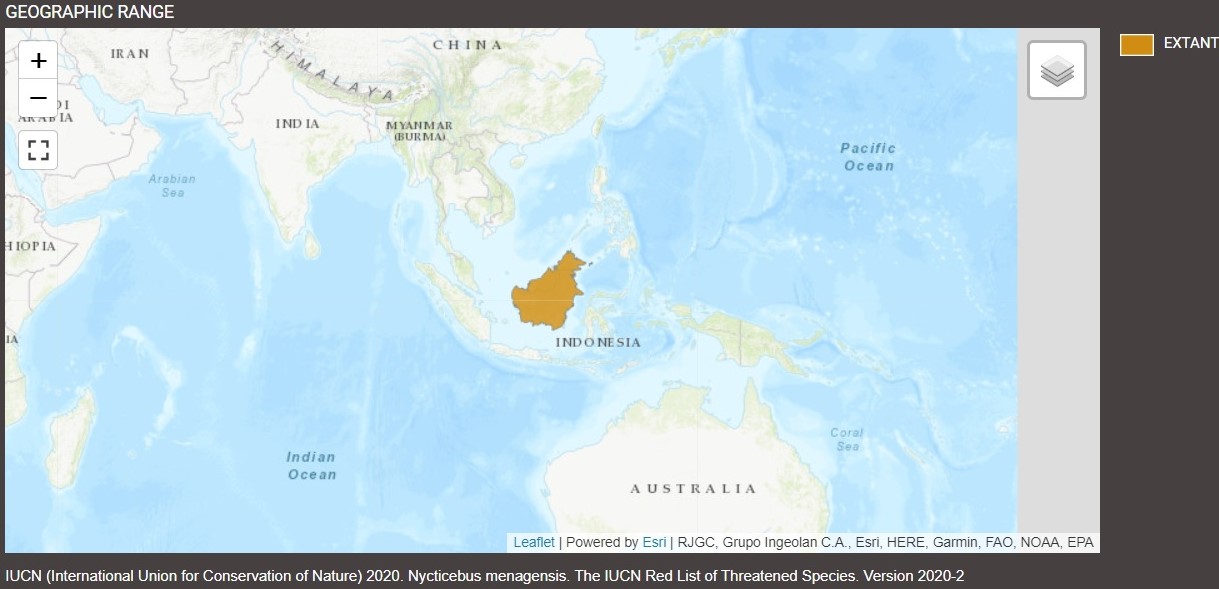
The Philippine slow loris (Nycticebus mengensis) lives along the northern and eastern coasts of Borneo, including Brunei, Sabah, Sarawak, and East Kalimantan, and on the Philippine islands of Tawi-Tawi, Bongao, Sangasanga, and possibly other small islands within the Sulu Archipelago. Unfortunately, ethnographic survey records from 2006 provide evidence of local extinction in some of the Tawi-Tawi islands. There is also speculation that some of its Philippine occurrences might be a result of human introduction, as this species is a popular pet in the area.
The species thrives in primary and secondary lowland forests and coastal regions that, when unfragmented, allow it plenty of lush jungle in which to forage. With that being said, some members of this species have been reported residing in varying habitats, such as within citrus trees and peat swamp forests, which suggests that their distribution includes a wider range of habitat types than originally thought.
The species’ official name and taxonomy have undergone several changes since it was first discovered in 1892. The Philippine slow loris was originally regarded as a subspecies of the Sunda slow loris.
As nocturnal animals, difficult to study extensively in the wild, the histories of several slow loris species are similarly chaotic. Research is only just beginning to reveal the full extent of slow lorises’ biological diversity. Where once there were only two species considered wholly distinct, there are now ten—with more possibly waiting to be recognized.
This longstanding taxonomic confusion makes it difficult to know the full geographic distribution of many slow loris species, including the Philippine slow loris. The areas in which slow lorises live may be more numerous than currently thought. Additionally, we may never know if a species might have once been found somewhere where, in the meantime, it has gone extinct. Inversely, due to being heavily trafficked, slow loris species may now exist in areas where they are not actually native.
Aside from being the smallest of the Indonesian slow lorises in the Nycticebus genus, other genetically defining traits of this species include its unique fur colorings, the lack of markings on its head, and the absence of a second upper incisor.
Size, Weight, and Lifespan
Adult Philippine slow lorises typically measure about 10 to 12 inches (26 to 30 cm) in body length, with a short tail less than 1 inch (2.5 cm) long. They usually weigh between 1 and 2 pounds (0.45 to 0.9 kilograms), depending on sex, age, and seasonal food availability.
They are estimated to live about 15 to 20 years in the wild, and up to 25 years or more in captivity under protected conditions.
Appearance
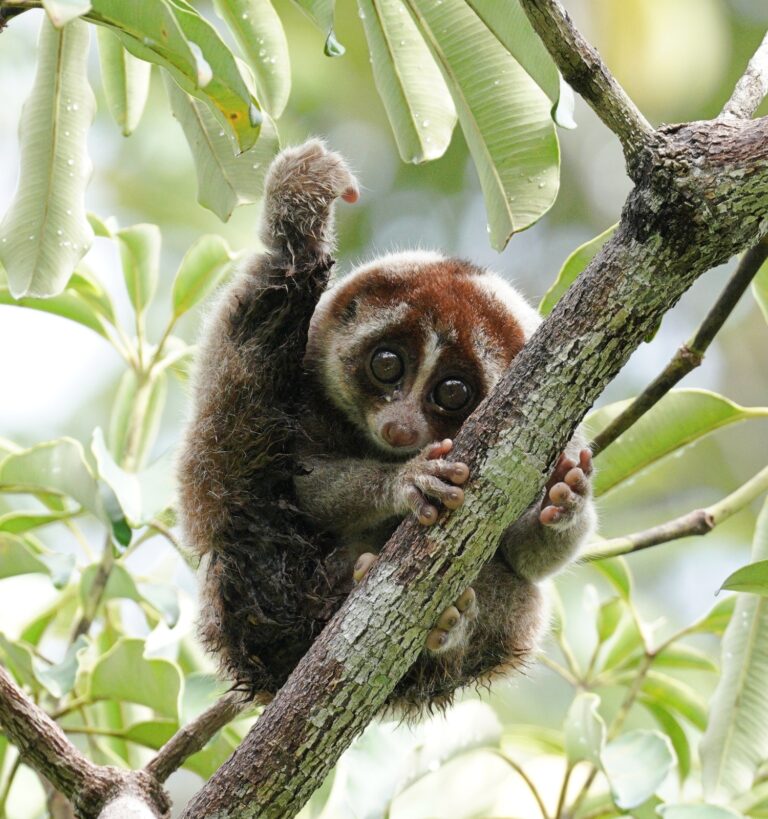
Slow loris species share the same basic appearance. Though their sizes vary, all are quite small. They have furry bodies, round heads, short ears, and broad, flat faces. The big toes on their feet are opposable, giving them the exceptional gripping power essential to moving through the trees. Their most prominent features are their large, forward-facing eyes. These capture every scrap of light available to them during their late-night forages.
Bornean species, like the Philippine slow loris, are only subtly distinct from others. Though only apparent under close examination, one distinguishing feature is their lack of a second upper incisor. Bornean species also have signature face masks, a discovery that, in 2013, split what had been considered the Nycticebus menagensis species with three subspecies into four distinct species, one of these being the Philippine slow loris, which retains the scientific name, Nycticebus menagensis.
The face mask of a Philippine slow loris is light in color. Slightly darker fur forms subtle rings around both her eyes. In some individuals, these patches extend below the cheekbones. Between her eye patches runs a narrow stripe of fur.
Slow lorises are omnivorous. They primarily forage for a variety of leaves, fruits, seeds, berries, gums, saps, and bird eggs, but also hunt arthropods and sometimes even small vertebrates like lizards.
Due to living in biodiverse habitats, a slow loris’s dietary needs are particular to the ecosystems where they live.
Saps are an especially crucial part of a slow loris’s diet. Deprived of these and other natural staples, a slow loris in captivity quickly grows malnourished and dies.
The diet of the Philippine slow loris has not been properly assessed, though local people have reported that this species has a notable fondness for citrus fruits.
Slow lorises are arboreal, with limbs uniquely adapted for this lifestyle. Their hands and feet have opposable digits that enable them to keep a firm grip at all times. Their style of locomotion closely resembles crawling; bringing one hand forward, the opposing foot follows. Their pace is slow and their movements methodical. While other arboreal primates typically swing and leap to cover gaps in the foliage, their method is far less dramatic—though still exceptionally acrobatic! With only feet latched to their perch, they reach toward the next branch with their entire body, holding themselves aloft with incredible balance and poise. When two hands are wrapped firmly around the target branch, they hoist themselves onto it, continuing on their way without skipping a beat.
With no way to actively protect themselves against attacking predators, their best defense is to keep a low profile to avoid them altogether. Moving silently and scrupulously is just one of the many cryptic strategies they use to this end. In fact, this need to remain under the radar and out of harm’s way is so key to their survival that it distinctly shapes their way of life. They elude predators by foraging under the cover of darkness. Two large and sensitive eyes provide exceptional night vision. With these, they can attend to foraging while keeping a sharp sense of smell and keen hearing attuned to their surroundings, wary of any misgivings. Of course, their cryptic maneuvers are advantageous as hunters as well. A cicada that, unfortunately, crosses a slow loris’ path will likely never realize it until it’s already in the process of being gobbled up.
Some researchers have theorized that a slow loris’s markings have evolved to mimic the form of a cobra. Though in no way a perfect imitation, it is perhaps just close enough to make a predator wary of getting close lest it is a deadly cobra in the end.
Oddly enough, like cobras, slow lorises are venomous. Specialized glands hidden in their underarms secrete a special oil. When this oil mixes with their saliva, a toxin is created. They may spread the toxin through their fur with their tongue. This not only renders them unsavory snacks for larger predators but also helps to manage and kill pesky infectious parasites. If actively under attack, they use their extremely powerful bite to inject venom into the attacker. A slow loris bite is powerful enough to send a grown human into anaphylactic shock!
Their specialized glands are also used in the ritual of scent marking. As strepsirrhine primates, slow lorises have wet noses. This feature makes them highly receptive to smell—a sense that has diminished in many of the other primate lineages. As they crawl through the rainforest, they dutifully transfer oils to the various substrates they pass. They also leave their trace by urinating wherever they go, a behavior researchers call “rhythmic urination.” Their scent marks are not used to mark their territory but as a way of communicating with other slow lorises.
Like so many primates, slow lorises are social creatures. Once more, however, their need to keep a low profile greatly influences the means by which they socialize with others. Congregating in large groups would make them far too visible and vulnerable to predators. Instead, scent marking is a way of communicating and bonding with members of their spatial group. By leaving their scent in various ways as they traverse their range, they keep members of the spatial group privy to their movements. In the same manner, they remain knowledgeable of their own. Scent marks also allow them to attract potential mates, helping them to track them down in the dense jungle. Once one has been located, the more physical means of their courting can commence.
The inner workings of slow loris social behavior are complex and not yet profoundly understood. Each species likely has its own unique set of mannerisms, rituals, and social dynamics that help individuals to recognize each other and bond as groups. For now, the socially driven behaviors of the Philippine slow loris remain uninvestigated.it’s
Fun Facts
The distinct face mask of the Philippine slow loris is the feature responsible for its 2013 recognition as a unique species.
The Philippine slow loris has a venomous bite, strong enough to send a grown human into anaphylactic shock.
Philippine slow lorises wake at night. Having spent the daylight hours asleep, they emerge from their nesting spot resolved to forage.
They set off, moving delicately but persistently through the trees. They hardly make a noise. Their large eyes search the branches for a meal. Spotting a tasty leaf, they use two grasping feet to anchor themselves to their perch before reaching out with both hands to grab it and bring it to their mouth.
Solitary and self-reliant, they spend most of the night hunting and foraging alone. Their inclination toward solitude by no means makes them unsociable creatures, however. Their range overlaps with several other members of their particular species. These individuals comprise what researchers call a “spatial group.” All members of the group lead mostly solitary lives. As they make their nightly forages, each of them leaves behind scent marks. When other members happen upon one of these scent marks, they learn a great deal of information about the group member who left it.
Generally, no more than two members of the same spatial group encounter each other at one time. When this happens, they may or may not completely ignore each other. If they choose to connect, they are likely to spend time grooming one another.
Again, the social workings of slow lorises are not well understood at this time, and those of the Philippine slow loris require further investigation.
Slow lorises make fantastic use of their olfactory sense for communication. As strepsirrhine primates, they have wet noses that give them better smelling capabilities than their haplorrhine cousins (who have evolved to have dry and, therefore, less sensitive noses). By relying on scent to communicate, slow lorises are able to maintain their low profiles while still keeping in touch with members of their spatial groups.
As they move about, slow lorises leave scent marks in their wake. They rub the toxic oils from their brachial glands onto various substrates or use their urine. Some evidence suggests scent marking is particularly important to mating rituals. However, this behavior has only been studied in a select few species.
Slow lorises do not make alarm calls as this would make futile their cryptic strategies for defense. However, for all their efforts to remain undetected, slow lorises do use vocalizations to communicate. Of the species of slow loris that have been studied so far, their repertoires consist of a variety of calls. Whistles and short keckers are probably used to show affiliation, while snarls, grunts, screams, and long keckers are almost definitely signs of aggression. The Philippine slow loris likely makes some, if not all, of these sounds—and may even make others of which we are not yet aware!
Research shows that Javan slow lorises make ultrasonic vocalizations that are beyond the range of human hearing. This gives them the ability to communicate at a frequency unheard by predators who might be nearby. However, this subject has yet to be investigated in other slow loris species.
How slow lorises communicate is probably unique to their species—perhaps even their own spatial groups! Therefore, those in which Philippine slow lorises communicate, while not altogether inconceivable, will remain ultimately unknown until research sheds light on them.
Little is currently known about the mating rituals and familial relationships of Philippine slow lorises. The nocturnal lifestyles of slow lorises make a thorough study of them difficult for human researchers. Furthermore, what little has been observed in one species cannot necessarily be assumed to be the case for others. As a result, the more minute details of their habits remain difficult for us to apprehend.
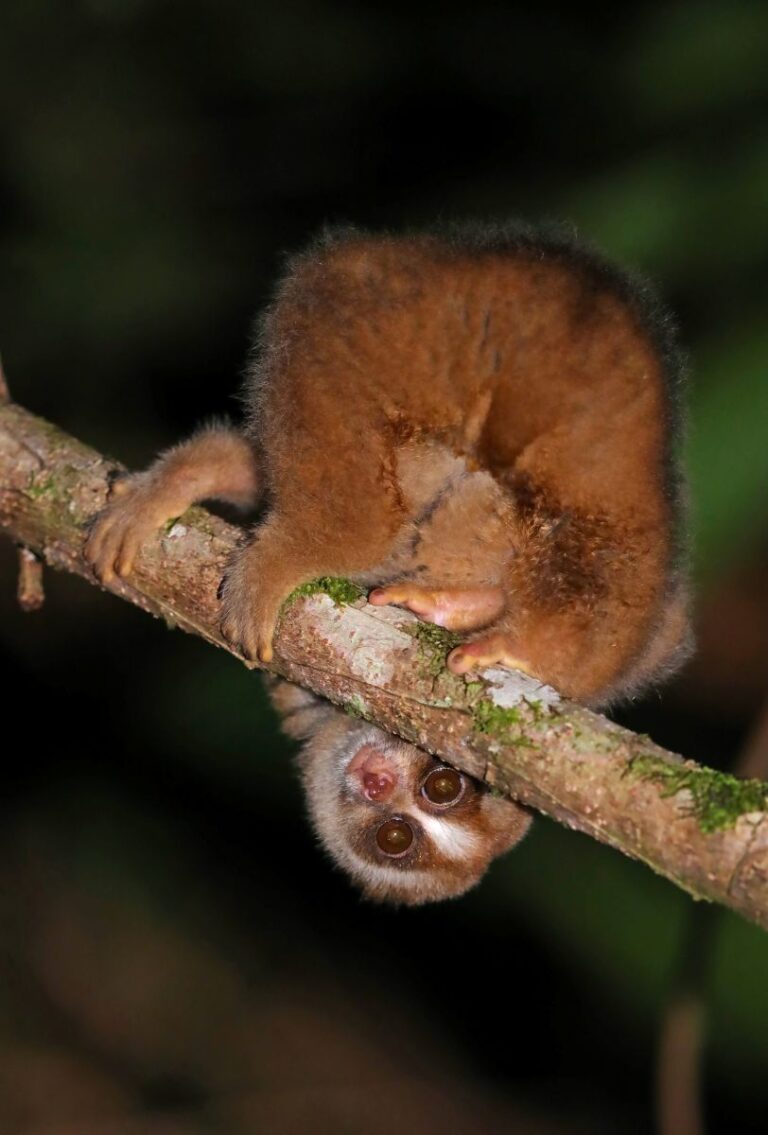
Generally speaking, a female attracts a male using scent marks that signal to him her readiness to mate. Following her marks through the forest, the male eventually locates her. In some species, a female initiates copulation by whistling while she hangs upside-down from a branch by her feet.
There is some debate as to whether or not slow lorises are monogamous or polyandrous. It likely varies depending on the species. Whatever the case, the mother seems to take complete responsibility for raising her offspring. The birth of more than one slow loris at a time is a rare event.
She leaves her newborn hidden in a nest while she leaves to forage. In case any predators should find him, she applies a coat of her toxic oils to the infant’s fur. Eventually, the baby develops the muscles and skills to leave the nest to join the mother on her nightly forages. Youngsters likely learn survival and social skills from her, the development of which will transform the baby from a helpless youth to the self-reliant creature that a slow loris ultimately becomes.
There is no specific information yet published about the ecological role of the Philippine slow loris. With that being said, several reasonable assumptions can be made about the unique roles they play in their ecosystem. Their fruit-heavy diet likely helps disperse seeds through their feces, which can increase the chances of germination thanks to the added nutrients. Depending on the season and their foraging range, they may also aid in flower cross-pollination. As omnivores, they help control insect populations by feeding on a variety of bugs. Finally, though unfortunate for the Philippine slow loris, they likely serve as prey for local predators such as birds of prey, snakes, and various feline species.


The Philippine slow loris is classified as Vulnerable by the International Union for Conservation of Nature (IUCN, 2015), appearing on the IUCN Red List of Threatened Species. This change from no population or threat evaluation to being assessed as Vulnerable was just announced in the summer of 2020. It is estimated that their populations have experience more than 30% reduction over three generations (approximately 21-24 years), and continuing suspected decline is expected at the same rate based on ongoing extensive harvest of individuals for the pet trade and extensive habitat loss of more than 15% from burning and conversion of forests to oil palm plantations over the last decade, and more than 30% over the next 25 years.
Although relatively adaptable to anthropogenic habitats, they might be less affected by forest loss than some other primate species, forest loss has been so severe in the region that it is likely to have had negative impacts. The species is collected locally for the pet trade; subsequent uncontrolled release of pets in some areas is also a threat, resulting in hybridization with other slow loris species. Captured wild animals are also used as tourist attractions in some hotels or tourist camps in Borneo. The 2015 forest fires on Borneo have been the worst since 2004, and acres of forest have been burned, leading to a significant decrease in the habitat of this species. Lack of law enforcement further threatens the slow loris species across their range.
The taxonomic saga that preceded the 2020 assessment announcement sheds light on the risks of unintentionally misrepresenting species based on insufficient data. When species are more biologically diverse than science previously assumed, it takes years for conservation efforts to catch up. In that time, the situations in which those previously unrecognized species find themselves are likely to grow more precarious.
Indeed, misunderstanding the taxonomy of slow loris species has proven problematic for their conservation both generally and locally. While researchers wrestle with the raw data, conservationists may occasionally misidentify the individual slow lorises that wind up in their care. Since taxonomy determines what they should be fed, how they should be socialized, and where they should be released if they are eventually rehabilitated, proper care and rehabilitation are dependent on proper species identification.
This issue of taxonomy is doubly important given the sheer number of slow lorises that end up in rescue and rehabilitation centers. The biggest threat to all slow loris species is their value as commodities in the exotic pet trade and for traditional medicines. Slow lorises are illegally trafficked and sold all over the world. Buyers rarely have any concern about what variety of slow loris they are receiving. When rescued from these circumstances, a slow loris is inevitably already in rough shape. Suffering from infection, malnutrition, and blindness, and highly stressed by his ordeal, there is no room for error in getting him what he needs as fast as possible. Therefore, proper rapid identification is essential to his rescuers’ success.
Unfortunately, poached from the wild, a slow loris’s chances of survival are small, and rehabilitation leading to their release is even smaller. Even if they are brought back to optimal health, a single consequence of their ordeal will remain that will permanently prevent their eventual release. When first taken, their captors prepared them for sale by removing their teeth—an incredibly painful procedure typically done without any kind of anesthetic. This prevents them from biting future owners and injecting them with venom, which can prove fatal. However, with this one action, the slow loris, a competent and self-reliant creature, is rendered helpless and dependent for the rest of their life. Without teeth, they cannot eat or cannot defend themselves. Ultimately, they have no hope of ever rejoining the wild.
While life in the wild is certainly preferable to life in captivity, slow lorises who avoid becoming pets are still threatened by human encroachment into their natural habitats. When left to their own devices, slow lorises often prove to be quite adaptable and capable of surviving in suboptimal conditions. In many places where they live, however, forests have been degraded to the point where they significantly and adversely affect their rates of survival—and fragmentation of their ranges inevitably inhibits healthy gene flow between spatial groups. What’s more, such trends put them at even greater risk of being found, captured, and sold into the pet trade.
Some populations of Philippine slow lorises likely live in one of the last and largest stretches of continuous ancient forest left in Southeast Asia. Known as the Heart of Borneo, this vast stretch of forest is less than half of what the island once supported. The majority of forested area is concentrated at the center of the island, however, and only small stretches extend to the coastal regions where Philippine slow lorises tend to live. In the last thirty years alone, illegal logging, the construction of dams and other infrastructure, mining, slash-and-burn agriculture, and many other human activities have drastically depleted Borneo’s wilderness, putting the animals that call it home—including many humans themselves—at great risk.
The Heart of Boreno, for now, remains intact. But these trends have not let up. Compounded with the overarching effects of climate change, the future for the Philippine slow loris’s home appears bleak. Slash-and-burn agriculture has become especially problematic over the years. With its peat forests and swamps, Borneo is highly vulnerable to fire. When a fire ignites in one of these environments, it can smolder invisibly underground for weeks. In the wake of such fires, the scorched soil more easily erodes, preventing the forests from ever recovering. September 2019 saw some of the worst fires on record, many of which had been set intentionally in order to clear the land for palm oil plantations. So long as forests remain at risk, so too does the Philippine slow loris.
In lieu of the 2013 study that established multiple subspecies of Nycticebus menagensis to be separate species altogether, the Philippine slow loris is still awaiting renewed evaluation by the IUCN. While its status on the Red List of Threatened Species draws important attention to the need for its conservation, the species is likely to be in even worse shape than its Vulnerable status indicates. More research regarding the species’ taxonomy, distribution, and behaviors would paint a clearer picture of how to best conserve this unique species of primate.
Though the species does appear in Appendix I of the Convention on International Trade in Endangered Species (CITES) and is protected under Indonesian law, direct efforts to conserve the Philippine slow loris are scarce. Fortunately, a number of conservation efforts serve to benefit the lives of Philippine slow lorises, if only indirectly. For instance, the species likely resides within a number of protected areas across Borneo.
The Philippine slow loris must also benefit from the Heart of Borneo Initiative. This is a trilateral agreement among three countries of Borneo (Indonesia, Brunei, and Malaysia) to work in cooperation to sustainably manage the last remaining rainforests of Borneo, using the largest of them—the one known as the Heart of Borneo—as their focal point. Their efforts to protect, research, and educate others about the biodiversity of these ancient rainforests are paramount to the survival of the Philippine slow loris—not to mention all of the creatures for whom these rainforests are home.
Researchers in 2020 collected all of the published studies on nonhuman primates (NHPs) of Philippine origin to identify research gaps; ultimately, there were only 107 studies published from 1989 to 2019. Of this number, only 4.63% of the research/publications were about the Philippine slow loris. Furthermore, over 30% of the research conducted focused on captive animals or within laboratory settings, highlighting the limited understanding of these species’ behaviors in the wild. Ultimately, the study revealed that although research on Philippine NHPs has increased, there remains a clear bias in the species and locations studied, as well as a lack of diversity in research approaches—including a complete absence of conservation-driven studies.
References:
- http://www.sci-news.com/biology/article00775/
- https://www.researchgate.net/publication/233958577_Taxonomy_of_the_Bornean_Slow_Loris_With_New_Species_Nycticebus_kayan_Primates_Lorisidae
- https://jvat.biomedcentral.com/articles/10.1186/1678-9199-20-43
- https://www.biorxiv.org/content/biorxiv/early/2017/04/19/078535.full.pdf
- https://wwf.panda.org/knowledge_hub/where_we_work/borneo_forests/borneo_deforestation/
- http://www.heartofborneo.org/about-us/
- https://news.mongabay.com/2007/05/experts-borneo-in-urgent-need-of-protection/
- https://www.iucnredlist.org/species/39760/10263652
- https://www.nationalgeographic.org/photo/bog-borneo/
- https://www.nytimes.com/2019/09/17/world/asia/indonesia-fires-photos/
- https://www.wwf.or.id/en/about_wwf/whatwedo/forest_species/where_we_work/kayan_mentarang/
- https://www.wwf.or.id/en/about_wwf/whatwedo/forest_species/where_we_work/kayan_mentarang/collaborative_management.cfm
- http://pin.primate.wisc.edu/factsheets/entry/slow_loris/behav
- https://www.int-res.com/articles/esr2015/28/n028p087.pdf
- https://jvat.biomedcentral.com/articles/10.1186/1678-9199-19-21
- https://www.ncbi.nlm.nih.gov/pmc/articles/PMC5698378/
- https://animalia.bio/philippine-slow-loris
- https://www.mammaldiversity.org/taxon/1001068/
- https://www.worldlandtrust.org/species/mammals/philippine-slow-loris/
- https://link.springer.com/article/10.1007/s10329-020-00847-w
Written by Zachary Lussier, May 2020; Revised by Hannah Broadland, Oct 2025