
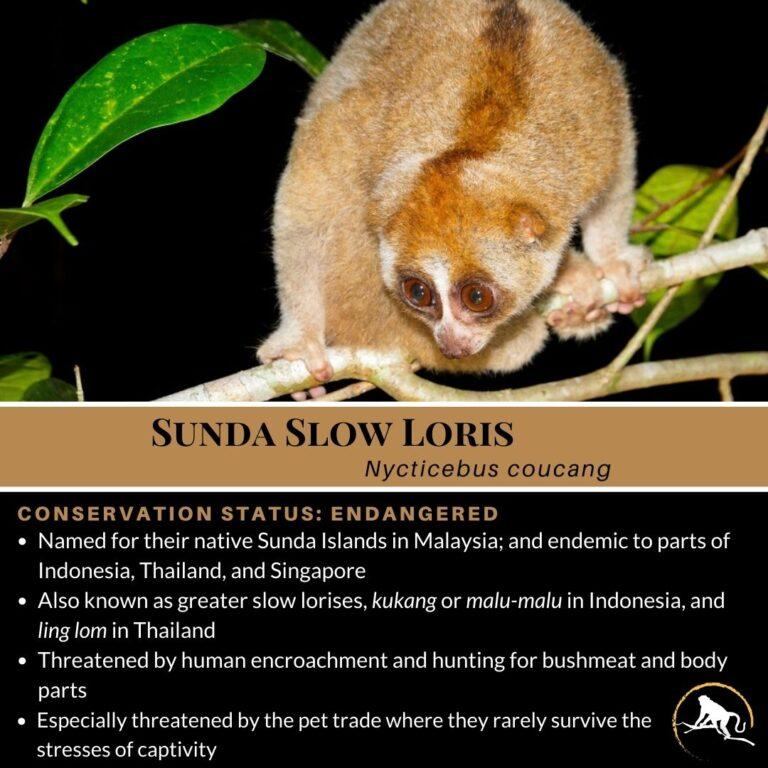
Sunda Slow Loris, Nycticebus coucang
SUNDA SLOW LORIS
Nycticebus coucang
Geographic Distribution and Habitat
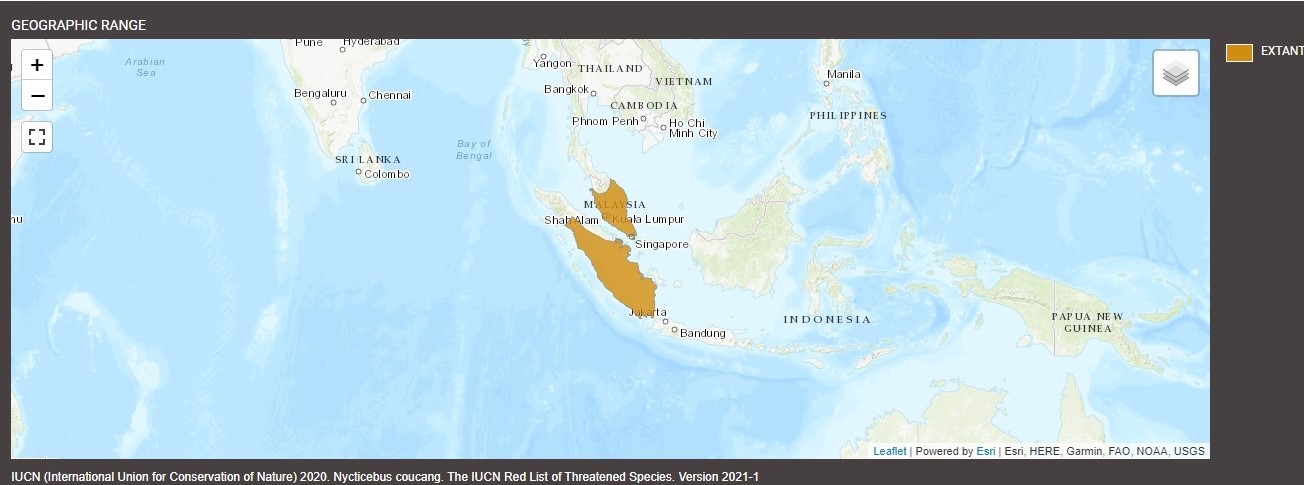
The Sunda slow loris (Nycticebus coucang), also known as the greater slow loris, is found in Malaysia, in the peninsula and the island of Pulau Tioman, where it inhabits tropical rainforests, timber forests, isolated forest patches near plantations, swamp forests, and some logged primary forests.
Sunda slow lorises are also native to parts of Indonesia, Singapore, and Thailand.
In Indonesia, they live in southern Sumatra at an altitude of 4,200 feet (1,300 m) above sea level, the Riau Archipelago, and the North Natuna Islands. Although they thrive in primary and secondary lowland rainforests, they are adaptable, also residing in logged and degraded forests, on plantations, and in people’s gardens.
In Singapore, these lorises live in primary timber forests, parks, scrubland, and secondary forests. Individuals have even been spotted on a military training island called Pulau Tekong, which is considered one of the country’s most protected forested areas.
In the southern peninsula of Thailand, they are present from the isthmus of Kra southward, and populations also inhabit Tai Rom Yen National Park, side by side with Bengal slow lorises.
The Sunda slow loris first appeared in scientific literature in 1770, when a Dutchman named Arnout Vosmaer described it as a type of “sloth”. Although they may, at first glance, look similar to sloths, they are not at all related to them. They belong to the strepsirrhine primate order (which also includes lemurs, galagos, and pottos). Pieter Boddaert, a Dutch naturalist, made the connection and correctly reclassified these little creatures as “lorises” in 1785. Over the years, many other lorises were identified, but in 1953, primatologist William Charles Osman Hill published a comparative anatomy of primates in which he decided to lump them all into a single species. Only in 2010 was the Sunda slow loris finally classified as a unique species.
According to the latest IUCN Red List report, some of the lorises in southern Thailand may be hybrids of the Sunda slow loris and the Bengal slow loris. It is also possible that some of the slow lorises found in northern Sumatra, in the Natuna Islands, may need to be classified differently. However, more taxonomic studies are needed to verify these assumptions and get a better assessment of the species distribution in that part of the world.
Size, Weight, and Lifespan
These notoriously cute creatures weigh about 24 ounces on average (599-685 g), and their head and body length is approximately 10 inches (26-27 cm). There is no difference in size and weight between males and females.
In the wild, they can live up to 20 years. In captivity, the estimated lifespan is 25 years.
Appearance
The Sunda slow loris’s small size and large, round eyes make it look like a cuddly little toy—which is both a blessing and a curse. Because of their “cuteness”, they are coveted as pets in some regions of the world. As a result, the illegal pet trade is a primary factor in their Endangered status.
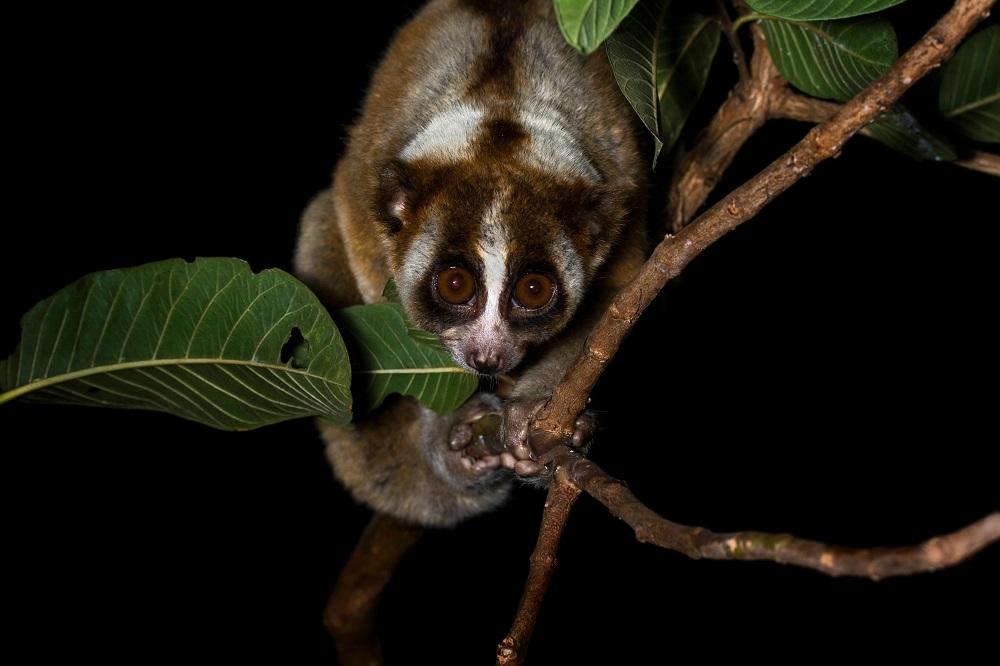
A Sunda slow loris’ body is covered in a short, dense pelage (its coat) that can be various shades of brown. A darker brown stripe that ends on top of the head and looks like a fork with two prongs above the eyes. Large round eyes are surrounded by dark rings. The nose is white, and a strip of whitish hair extends from the nose to the forehead. The head is small (about 0.9 inches / 2.5 cm) with a short muzzle and a wet rhinarium (nose). Two little round ears sit erect on each side of the head.
The presence of a dorsal stripe that differs in color from the rest of the body is thought to be an evolutionary marking that may help lorises blend in with the scenery and confuse predators. Indeed, the counter-shaded hair coloration matches the color of the bark of the trees in which they typically feed. The fact that their belly area is a lighter shade may also indicate that the darker coloring on the back of the animal may be useful against UV rays and may help with thermoregulation.
The limbs of the Sunda slow loris are short and are perfectly suited for their mode of locomotion. Slow lorises typically walk on all fours or crawl. Both hands and feet have opposable thumbs and big toes, which can rotate almost 180 degrees and allow slow lorises to firmly grasp branches. Their index fingers are significantly reduced in length. This, combined with the opposable thumb, creates an extremely strong pincer-like grip that is essential to their slow, deliberate movements through the canopy. Their tail is vestigial—meaning it’s almost non-existent—and covered in fur.
Diet
Slow lorises feed on fruit, nectar, parts of nectar-producing plants, saps, and gums. They also consume spiders and other arthropods, insects, bird eggs, and occasionally small vertebrates such as geckos or crickets. Fruit consumption only accounts for 22% of the adults’ diet; the bulk of their intake is from sap (35%) and nectar (31%). In Thailand, they have been observed eating molluscs, including the giant land snail, Achatina fulica. They feed more upon waking(between 6 pm and 7 pm) to increase their energy. Infants feed mostly on floral nectar and complete their diet with plant sap and small quantities of insects.
Sunda slow lorises share a large portion of their food resources with members of their own spatial group or with passing individuals. They forage vertically (up and down the trees) depending on the type of vegetation present in their habitat and the type of food they are looking for.
They use their hands and mouths to feed. “Gouging” is one technique. They bite through the bark of a tree with their sharp canines until a hole is formed, then they lick the sap or gum. They use their hands to grab insects, flowers, or a piece of fruit. They also use a method called “reeling” by bringing food closer to the mouth with one hand, but if a food item is already close, they just use their mouth. Note that they often smell their food before eating it. In captivity, Sunda slow lorises have been observed holding a coconut shell full of water with both hands and drinking from it.
Behavior and Lifestyle
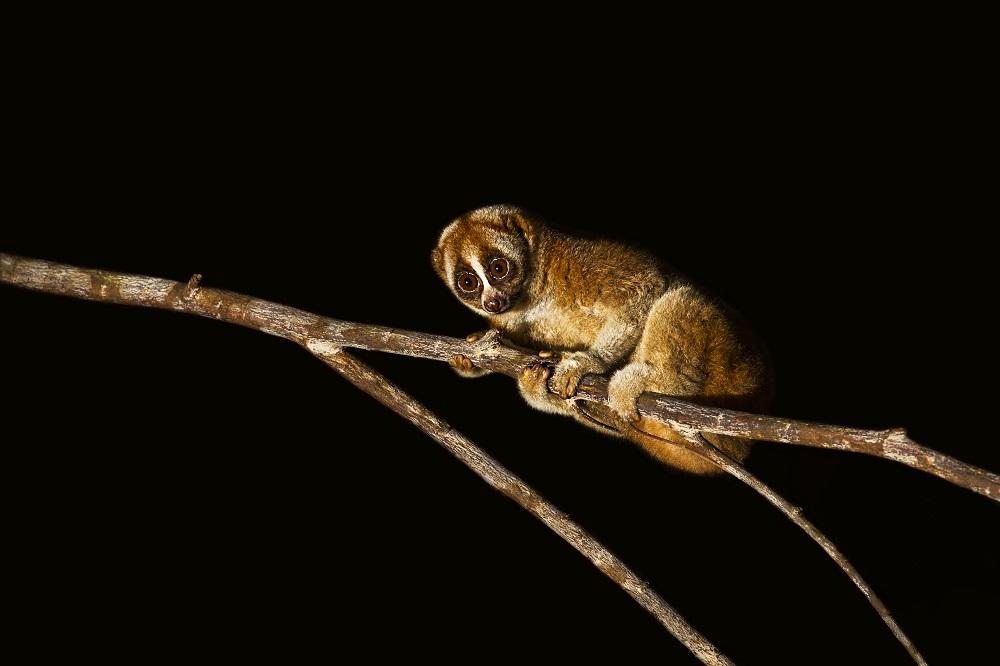
Sunda slow lorises are arboreal and nocturnal. They are most active between sunset and sunrise. While active, they walk, climb, or hang using all four limbs, progressing through the trees at a steady pace. As their name indicates, these are slow-moving animals, but that does not prevent them from traveling up to 5 miles (8 km) each night to forage (depending on their habitat). Because they cannot jump, they have found an original way of moving between trees by using their body to form a “bridge” between branches.
Males travel more often than females, most likely because they mark their territory. When not in motion, they rest—either standing, sitting on a branch, or sleeping curled up in a ball. The length of time they spend resting is influenced by seasonal temperature variations, but also by light. For instance, they appear less active on nights when the moon shines. It is estimated that they spend almost 30% of their time traveling, 25% feeding, 24.5 % foraging, about 13% grooming, and the rest of the time resting.
Upon waking and before retiring to their sleeping quarters, they like to clean their fur. To do so, they groom themselves or groom each other (an activity referred to as “allogrooming”).
Lorises are the only venomous primate species. They secrete a toxic oil from glands on the insides of their elbows—the composition of which is particular to each species. When grooming, they apply their tongue or toothcomb in repetitive and frictional movements to various body parts, thereby spreading the toxic oil to the entire body. When hiding is not possible and they are threatened by a predator, Sunda slow lorises fill their mouth with the toxin from their special gland and try to bite their assailant. Their defense posture mimics that of a Cobra thanks to an extra vertebra that allows them to undulate their body as they quickly move to strike. The toxin mixed with saliva is fatal to small animals like mice, and can cause festering wounds and even anaphylactic shock in larger animals (including humans). If they are not successful at fending off their assailant with a bite, they roll into a ball, thereby exposing their toxic saliva-covered fur, and drop from the trees. Before foraging and before leaving her infant, a mom similarly covers her baby’s coat to protect them from predation.
Once they are done grooming, they emit “click calls” as they move toward the tree where they will feed (at sunset) or sleep (just before dawn).
Sunda slow lorises are named after the Sunda Islands in the western part of the Malay Archipelago. They are also known by different names by the local people where the species is from. In parts of Indonesia, Thailand, and Singapore, they are called kukang, which is used as the species’ scientific name, but spelled as “cougang”.
Another common name for this animal is malu-malu, which means “shy”.
In Thailand, slow lorises are called ling lom, or “wind monkey”, an allusion to how quietly they move through the trees.
Sunda slow lorises are solitary and have been thought to be monogamous, although due to lack of studies, it has not yet been determined whether they are actually polyandrous or monogamous. They form what researchers call “spatial groups’ that are composed of one adult female, one adult male, and a number of sub-adults or infants. Their typical home territory covers 5 to 37 acres (2 to 15 ha), depending on the forest type. Home ranges are smaller in primary forests. In the wild, Sunda slow lorises cross paths occasionally. They are not aggressively territorial, even if they scent mark to delineate their kingdom. Upon encountering one another, they may acknowledge each other by making pant-growls or click-calls, or just ignore one another. In captivity, though, they are quite social and make many contact calls.
During the day, Sunda slow lorises settle in trees (palm, lianas, or shrubs) at heights ranging from 6 feet (1.8 m) to 115 feet (35 m) above ground level for a well-deserved rest. They rarely use the same sleeping site more than two nights in a row, and they sleep either alone, with one companion, or as a trio composed of two adults and an infant. Tree foliage provides camouflage from predators, and they can rest peacefully.
Sunda slow lorises communicate with vocalizations and scent marking. They use whistles and short keckers in amiable situations, such as playing or mating. Females, in particular, use whistling to alert and attract nearby potential mates. Alternate click-calls are sharp click sounds emitted alone or in short series by two lorises. Snarls, grunts, long keckers, and screams are used to signal aggression between lorises. Being solitary primates who rely on their ability to hide and stay out of harm’s way, lorises do not use alarm calls to warn each other about approaching predators.
Infants make clicking sounds, or click-calls, when separated from their mother or when in distress. Researchers have also detected young lorises making ultrasonic vocalizations, beyond the range of human hearing, when exploring new environments. This could be a way to communicate their nervousness or a strategy to self-soothe. Another species of loris, the Javan slow loris, was found to use ultrasonic communication almost constantly. It seems likely that this behavior would extend to all species of slow lorises, but that has yet to be confirmed.
As mentioned previously, lorises secrete a toxic oil from the glands on their elbows to leave scent marks wherever they pass. They deposit the oil using their tongues, licking their glands, and spreading it in the desired location. Sunda slow lorises have another of these special glands near their anus, and since lorises habitually pee during locomotion—a behavior referred to as ‘rhythmic urination’—they can deposit a mixture of urine and toxic oil by rubbing their behinds against a substrate.
Lorises have also been observed using some forms of body language and facial communication. For instance, lorises bare their teeth when antagonized or fearful. But this expression is also common during moments of social play. Infant lorises who find themselves in stressful situations seem to express their anxieties by grinning.
The Sunda slow loris species is generally thought to be monogamous due to its solitary nature. Research on the reproductive behaviors of wild slow lorises is scarce. It is not yet known whether they are a polyandrous or monogamous species. And the case might be different for each loris species. Given that lorises so rarely encounter one another in the wild, it seems unlikely to some researchers that they would have more than one mate. However, some evidence for polyandry has been recorded, including instances where a female was tracked by up to six males who each attempted to mate with her. It is important to note that the difficulty of studying lorises in the wild (being the nocturnal, chiefly solitary, and unassuming creatures that they are) means that most of what humans do know about their reproductive behaviors is gathered from captive studies. While such research may provide some insight into the nature of the Sunda slow loris, it is not necessarily consistent with their behaviors in the wild.
Females do not exhibit any signs of estrus and are receptive several times during the year. Females become able to reproduce between the ages of 18 and 24 months, whereas males are ready for action at about 17 months old.
When a female is receptive, males follow her scent marks. She then initiates the mating by urine-marking, hanging from a branch, and vocalizing. Once the deed is done, the male may create a mating plug, thereby ensuring that no other male can mess with his female.
One baby is born after a gestation period of approximately 192 days. Occasionally, twins are born, but it is very rare. The baby is born with eyes open and covered in fur. It clings to its mother’s belly as she navigates through the canopy. The father is not involved in infant care at all. Once the baby is a week old, the mother is comfortable enough to “park” it while she goes off looking for food. However, the baby remains dependent on its mother for 4 to 6 months until it is weaned.
The Infant sleeps on branches in constant contact with the body of its mother. Sometimes another adult will sleep in close contact with the mother and infant for extra safety. When traveling around, two individuals may accompany the infant as it walks on a branch.
Since Sunda slow lorises eat fruit and travel through the canopy, they most likely spread seeds through their feces and contribute to regenerating the forest. By eating insects, they help with insect population control. The wounds they inflict on the trees to feed on sap probably help birds feed as well. So overall, their presence has a positive ecological impact on the forests in which they live.


The International Union for Conservation of Nature lists the Sunda slow loris as Endangered (IUCN, 2020), appearing on the IUCN Red List of Threatened Species.
Natural predators of the Sunda slow loris include reticulated pythons, hawk-eagles, and, in some areas where they overlap, Bornean orangutans. However, their most dangerous predators are humans who encroach on their natural environment to exploit it. Over the last quarter century, the Sunda slow loris population has declined by 50% due to deforestation. The development of timber and palm oil plantations depletes regular sources of food and results in the fragmentation of their habitat. As their ranges shrink, so does their access to potential mates. This has the effect of slowing, if not altogether halting, gene flow between spatial groups. Human civilization also affects lorises in less direct ways. Though it is somewhat rare, roads and highways that intersect lorises’ ranges put them at risk of being hit and killed by automobiles. There is also some evidence that their activities are negatively affected by the bright lights that accompany urban development and infrastructure. Additionally, lorises found in agricultural areas or gardens are often shot as pests.
These cuties are also hunted for the illegal pet trade, which represents a yearly revenue of 7-23 billion dollars for organized crime. The animals are captured and sold throughout Southeast Asia. Buyers most interested in acquiring lorises as pets are located in Southeast Asia, as well as China, Japan, the Middle East, Russia, and Europe. They are held captive not only as pets but also as commodities for tourist attractions, photo shoots, or entertainment. In some cases, their body parts are used for folk remedies (in the case of Sunda slow lorises, the blood is used). Several organizations dedicate their time and efforts to rescuing these animals, but in some cases, they don’t have the necessary knowledge.
Release of captive lorises in the wild needs to be carefully coordinated to ensure the preservation of the gene pool of each species. Unfortunately, in some instances, different loris species are released in areas where the Sunda slow lorises live, leading to unwanted hybridization of the Sunda slow lorises. This could be fatal to the conservation of the species, especially in Singapore, Thailand, and Sumatra. In Thailand, for instance, Bengal slow lorises are recklessly being released on the island of Phuket in the territory of Sunda slow lorises.
All these factors (deforestation, illegal pet trade, and hybridization) combined lead researchers to estimate that current populations of Sunda slow lorises will be halved within the next 20 years.
The Sunda slow loris is listed in Appendix I of the Convention on International Trade in Endangered Species (CITES), an international agreement between governments whose goal is to ensure that international trade in specimens of wild animals and plants does not threaten their survival.
The inclusion of the Sunda slow loris in CITES I dates back to June 2007, when researchers expressed serious concerns regarding the illegal trade of this animal.
Sunda slow lorises are found in several protected areas in Sumatra (Bukit Barisan Selatan National Park, Kerinci Sebelat National Park, Berbak National Park, Way Kambas National Park, and Bukit Tigapuluh National Park), as well as in Thailand, but more studies are needed to confirm their conservation status and distribution.
The species is also protected by various local laws. In Singapore, its protection falls under the Endangered Species Act 2006, and in Peninsular Malaysia, it falls under the Protection of Wildlife Act 1972. In Indonesia, Decree No. 66 of 1973 of the Ministry of Agriculture and Act No. 5 of 1999 serve the same function. In Thailand, Sunda slow lorises are protected under the Wildlife Protection Act 1992.
However, enforcement of regulations is always a challenge. This is one of the reasons the ASEAN Wildlife Enforcement Network was created. This regional inter-agency and inter-governmental initiative is the largest wildlife law enforcement network working across 10 Asian countries. They work with CITES authorities, customs, police, prosecutors, and specialized governmental wildlife-law enforcement organizations. The animals they confiscate from the criminal rings are often dyed a different color to make them more appealing to buyers, and they are poorly cared for. Many are malnourished, dehydrated, and underweight. Under such duress, infants rarely survive. To prevent human traffickers from getting injured, the lorises’ teeth are often pulled with nail clippers and without anesthesia, resulting in infections and even death of the precious creatures before they even reach the international markets. Confiscated animals are examined by a veterinarian and provided the care they need. Once rehabilitated, they are released into the wild. Lorises that don’t have teeth, though, cannot be released in the wild because they would not be able to feed themselves.
ACRES, “Animal Concerns Research & Education Society”, in Singapore, is another organization dedicated to the rescue of slow lorises trapped in human dwellings or in dire straits from the illegal pet trade.
Appeal for these cute animals is fueled by videos showing them being handled by people as if they were regular pets, which they are not. Unfortunately, despite communication efforts from researchers, such videos continue to be available on the web.
Overall, the illegal pet trade is such a big issue that more rescue centers are needed, not only to care for them but also to collect data on their ecology, behavior, and habitat requirements. Translation of field guides is also sorely needed as these animals are not always properly identified, even in rescue centers.
The Little Fireface Project (LFP), started in 1994 as a subsidiary of the Nocturnal Primate Research Group, is especially noteworthy. It concentrates its efforts on the conservation of all loris species, including the Sunda slow loris. The group established specific guidelines for the rescue and rehabilitation of rescued lorises, as well as for their care in captivity. The organization developed non-invasive ways to study lorises when they collar them and do not need to use anesthetics, as anesthetics are notoriously bad for slow lorises, who are highly stressed by their effects and aftereffects. They also use red lights when out in the field. This practice not only protects slow lorises’ eyes but also helps the lorises to distinguish researchers from potential poachers.
Education programs go a long way, and more need to be implemented throughout Southeast Asia to promote understanding of the importance of the slow lorises conservation. The Love Wildlife Foundation, in Thailand, focuses on education programs, school talks and their Youth Ecological Network to bring awareness and inform the general public about the plight of slow lorises. They are working in close collaboration with the Little Fireface Project led by Professor Anna Nekaris, as well as with the Thai Department of National Parks, Wildlife and Plant Conservation.
Another very successful education program in Indonesia was developed by The Little Fireface Project. Their program engages children in creative ways. The kiddos are asked to draw slow lorises and write a story that includes information about the species. Teachers then engage them in an interactive lesson about slow lorises using songs and games. Children then go home with Dr Nekaris’s book: “Slow Loris Forest Protector’ (in its original Bahasa Indonesian language) and a set of educational cards.
Ex-situ conservation with a captive breeding system is also necessary to ensure the survival of the Sunda slow loris species. In Indonesia, the Primates Research Center (PRC), IPB University, serves such a purpose.
All these initiatives provide hope for the future of the Sunda slow lorises.
- IUCN redlist 2020
- nocturama.org
- Utilization Practices and Conservation Impacts of Endangered Wildlife in Asian Countries – Nurfatiha Akmal Fawwazah Abdullah-Fauzi, Nursyuhada Othman, Hidayah Haris, Nur Hartini Sariyati, Farah Farhana Ramli, Suliadi Firdaus Sufahani, Badrul Munir Md-Zain, Abd Rahman Mohd-Ridwan, Nor Rahman Aifat, Mohd Sanusi Mohamed, Ibnu Maryanto and Muhammad Abu Bakar Abdul-Latiff
- Daily behaviour and home range of adult rehabilitant Javan slow loris (Nycticebus javanicus É. Geoffroy, 1812) in Gunung Sawal Nature Reserve, Ciamis, West Java —Dolly Priatna, Aris Hidayat, Yossa Istiadi, Ammy Nurwati, Ahmad Yanuar. Adi susilo
- acres.org.sg – ACRES Wildlife Rescue Center
- lovewildlife.org
- wikipedia.org
- Aposematic signaling and seasonal variation in dorsal pelage in a venomous mammal – K. Anne-Isola Nekaris, Marco Campera, Anna R. Watkins, Ariana V. Weldon, Katherine Hedger, Thais Q. Morcatty
- Feeding behavior and food palatability of Sunda slow loris (Nycticebus coucang) at the Primates Research Center, IPB University – dies Mauridzka Natasya, Puji Rianti, Huda Shalahudin Darusman, and Tetri Widiyani.
- Behavior and Ecology of Wild Slow Lorises (Nycticebus coucang): Social Organization, Infant Care System, and Diet – Frank Wiens
- https://www.rekoforest.org/field-stories/wildlife-of-rer-the-sunda-slow-loris/ – Wildlife of RER; The Sunda Slow Loris
- https://static.thainationalparks.com/species/sunda-slow-loris
- Evaluating the Use of Chemical Weapons for Capturing Prey by a Venomous Mammal, the Greater Slow Loris (Nycticebus coucang) – Grace Fuller, Wirdateti, K. A. I. Nekaris
- Popular Science – Venomous Slow Loris May Have Evolved To Mimic Cobras – Don’t be fooled by those big brown eyes – Alissa Zhu
- https://pmc.ncbi.nlm.nih.gov/articles/PMC5698378/ Hiding in the dark: Local ecological knowledge about slow loris in Sarawak sheds light on relationships between human populations and wild animals – Priscillia Miard, K A I Nekaris, Hatta Ramlee
- ASEAN-WEN Detect Investigation presentation – Slow Loris Information, Identification, Care & Handling – Emerging Wildlife Conservation Leaders – Slow Loris Group – Tricia Parish and Dr Kai Nears of Oxford Brookes University
- Welfare Impacts of the Illegal Wildlife Trade in a Cohort of Confiscated Greater – Slow Lorises – G. Fuller, W.F. Eggen, W. Wirdadeti, K.A.I. Nekaris
- The Week – BBC wildlife doc brings calls to ban YouTube’s slow loris clip
- https://www.nocturama.org/en/slow-loris-forest-protector/
Written by Sylvie Abrams, July 2025