
Rondo Dwarf Galago, Paragalago rondoensis
RONDO DWARF GALAGO
Paragalago rondoensis
Geographic Distribution and Habitat
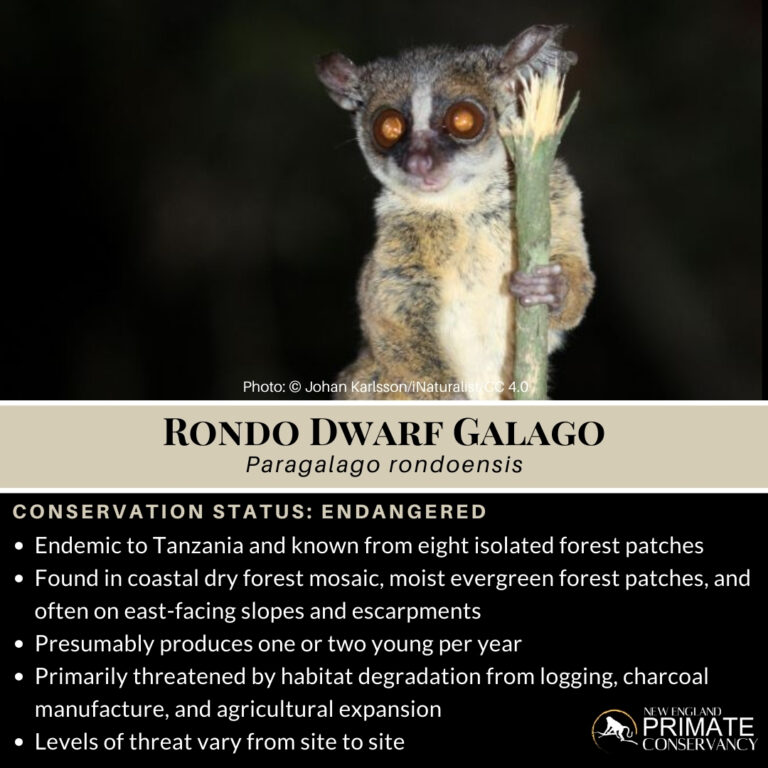
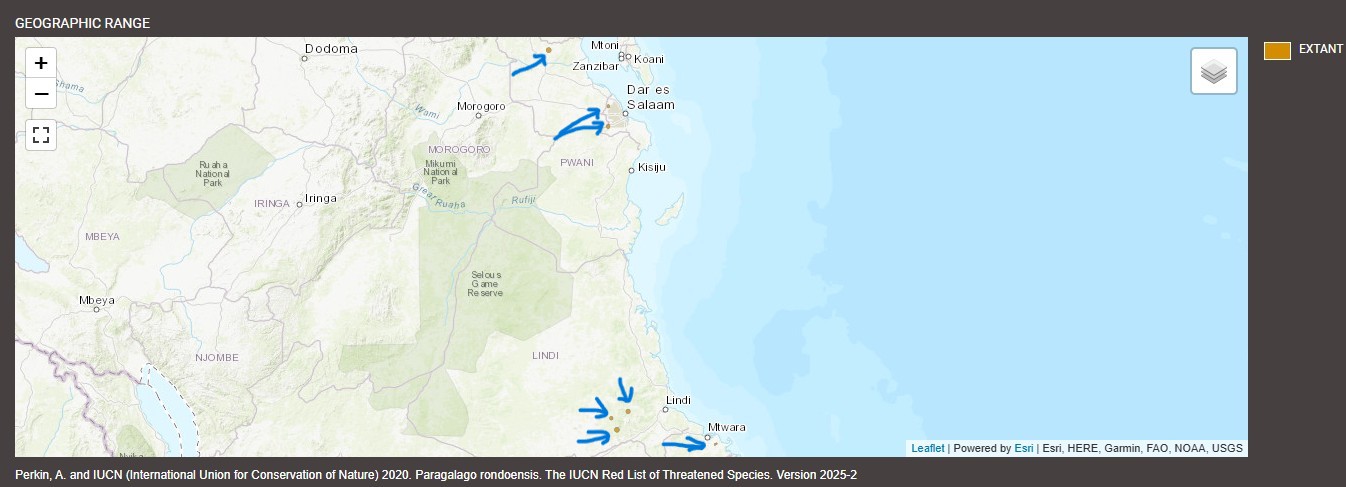
The Rondo dwarf galago (Paragalago rondoensis), also known as the Rondo bushbaby, is an uncommon primate species endemic to the coastal forests of Tanzania. Rondo dwarf galagos are found in only eight small patches of forest: the Zaraninge forest in Saadani National Park, Pande Game Reserve, the Rondo Nature Reserve, and Pugu Kazimzumbwi, Ruyu South, Ruawa, Chitoa, and Noto Forest Reserves. This confined range is unusual in comparison to that of other galago species, which are more tolerant and adaptive and therefore have a broader geographic distribution.
Two fragments of the Rondo dwarf galago populations are clustered in two areas. One is north of the Rufiji River and close to the city of Dar es Salaam. About 249 miles (400 km) to the south is the other population cluster in southwest Tanzania, close to the coastal towns of Lindi and Mtawara.
In the past, Rondo dwarf galagos have also been spotted in the Litipo and Ziwani forest reserves. However, because this has not happened since 1992, it is likely that they are no longer there. A population of Rondo dwarf galagos on the Newala plateau became locally extinct after the forest was cleared to build cashew plantations in the 1960s-1970s. Now, the total area of coastal forests that are home to the Rondo dwarf galago is only 33.7 mi² (87.4 km²).
For the most part, Rondo dwarf galagos typically occupy elevations of 656-2,953 feet (200-900 m), though they have been found as low as 328 feet (100 m). They live in moist, evergreen forests–typically on the east side of any slopes–and prefer the high canopy.
Due to the Rondo dwarf galago’s restricted range, fractured habitat, and nocturnal and tree-dwelling habits, direct observations are difficult. This means the species is under-studied.
Rondo dwarf galagos originally had the scientific name Galagoides rondoensis and were considered to be part of the genus Galagoides. The species in this genus mostly looked similar, but there were small differences in their skull shape and size, as well as their vocalizations. When scientists began studying the DNA of these species, they realized not all Galagoides species shared a common ancestor.
In 2017, scientists proposed a new genus called Paragalago. The Rondo dwarf galago was reclassified under this new genus, along with the Kenya coast galago (Paragalago cocos), Mozambique dwarf galago (Paragalago granti), mountain dwarf galago (Paragalago orinus), and Tanzania coast dwarf galago (Paragalago zanzibaricus). This separation also fell conveniently along geographic divides—those that were reclassified were those found in Eastern Africa, while Galagoides species in western Africa retained their original genus.
Growing evidence also suggests that the Rondo dwarf galagos of the northern cluster may be a different species from those in the southern region. This is based on differences in their vocalizations and reproductive anatomy.
Size, Weight, and Lifespan
As you might have guessed from the name, Rondo dwarf galagos sure are tiny critters! Galagos in general are among the smallest primates on Earth. But Rondo dwarf galagos are the smallest of all the galago species, coming in at an average weight of .13 pounds (60 grams)—that’s about the weight of a tennis ball!
Measured from the top of their head to their rump, Rondo dwarf galago’s bodies are typically 4.8-5.4 inches (12.3-13.7 cm) long. Their lifespan is unknown, although other dwarf galago species have lived up to thirteen years in captivity under optimal professional human care. However, they were more than twice the size of the Rondo dwarf galago and may naturally have a longer lifespan.
Appearance
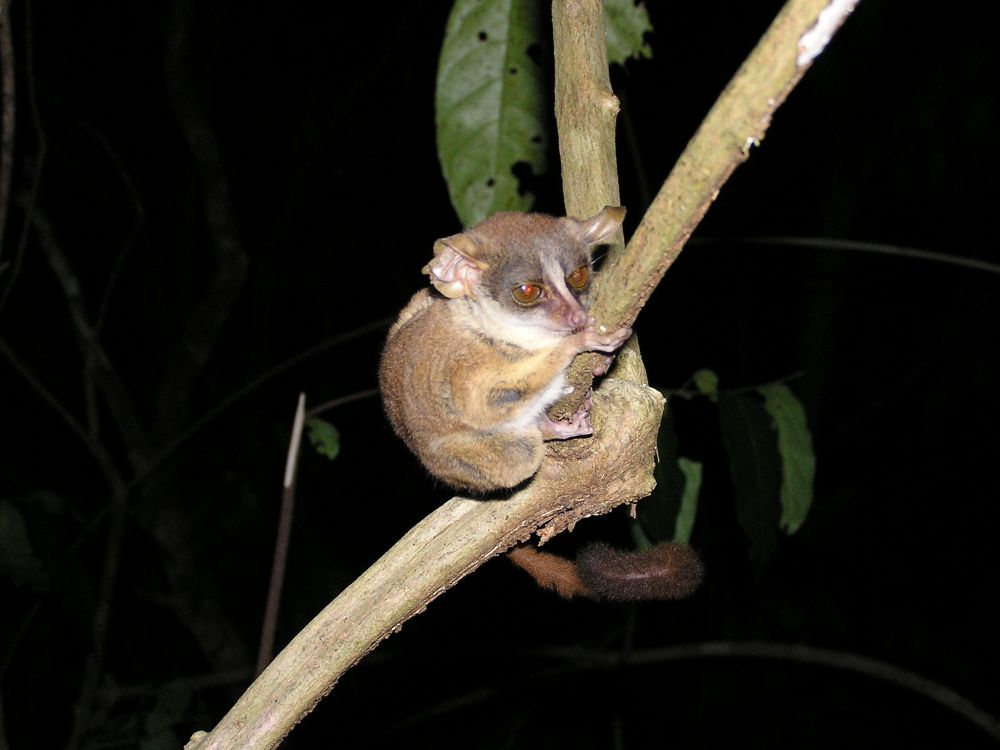
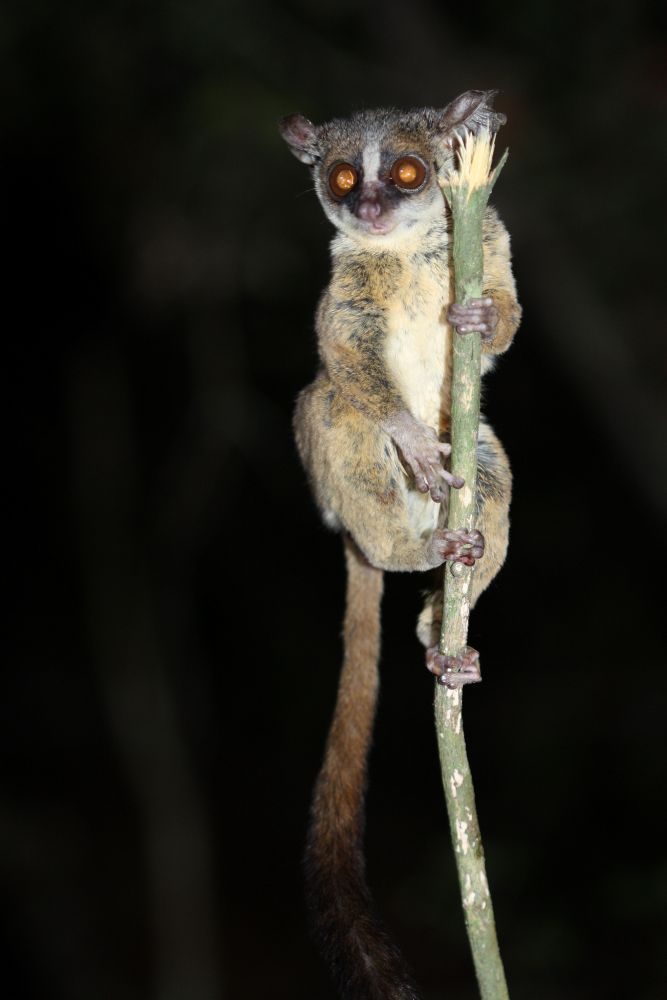
The body of the Rondo dwarf galago is covered in a short, dense fur that’s mostly medium brown and grey, save for the belly, which is a pale yellow color. Their long tails are shaped like a bottle brush and end in a fluff of dark brown fur.
Some noticeable facial features include the stripe of lighter fur that runs along the nose bridge before ending in a tiny, pointed snout. This moist, hairless nose helps the Rondo dwarf galago waft in smells to better navigate the forest at night. Other evidence of how Rondo dwarf galagos have adapted to their nocturnal lifestyle includes large ears for better hearing and wide, saucer-like eyes that enhance what they can see when it’s dark out. Rondo dwarf galagos cannot see colors, but have heightened depth perception. A layer of reflective tissue behind their eyes bounces back light, which helps them see better and also makes their eyes shine and glow in head-on photos.
Their hands and feet, which are hairless, have slender, bony digits that end in a rounded tip. Rondo dwarf galagos also have a shorter index finger that, in combination with a strong thumb, enables a pincer-like grip that helps them perch in the treetops and leap between branches.
The Rondo dwarf galago is a prosimian, belonging to a group of primates that also includes other galagos as well as lemurs and lorises. Like other prosimians, Rondo dwarf galagos have two handy hygiene tools built into their bodies. The first is a group of lower teeth arranged in a “toothcomb” that they can run through their fur to help stay clean. Second is the “grooming claw.” While the Rondo dwarf galago mostly has flat nails, like ours, the second nail on their feet stands out with a long, pointed shape. Rondo dwarf galagos use it to clean their ears and groom the fur on their head and neck.
Diet
Rondo dwarf galagos eat a diet of insects, small reptiles, and dried fruit. To find insects to eat, they often follow ant trails, perched in the branches above, and jump down to grab some to eat. They can also find food by scavenging near the forest floor.
Behavior and Lifestyle
This species is nocturnal, meaning they are most active at dawn, dusk, and night. They use leaves to build nests in the forest canopy, where they spend the day sleeping. Rondo dwarf galagos often cling vertically to branches and get around by leaping through the shrubby understory. Like all galagos, they have muscular legs and are strong jumpers. To facilitate their leaping, they urinate on their hands and feet to provide a better grip, as other galagos are known to do.
Rondo dwarf galagos are sometimes preyed on by nocturnal predators like owls, genets, palm civets, and snakes.
In 1953, when the Rondo dwarf galago was first discovered in Southeast Tanzania, the species was first thought to be Demidoff’s dwarf galago (Galago demidovii), which is found in the Congo basin. Later, the Rondo dwarf galago was thought to be the mountain galago dwarf (Galago demidovii orinus) from Tanzania’s Uluguru mountains. In 1996, they were finally recognized as a new species.
Based on what we understand about other dwarf galagos, it is likely that Rondo dwarf galagos have a polygynous mating system, where one male mates with several females. When a male dwarf galago reaches sexual maturity, usually around one year old, he will leave his birth group to find mating partners. Dwarf galago mating groups are often comprised of one male and two or more females.
Because they are active at night, Rondo dwarf galagos primarily rely on sounds—rather than visual cues—to communicate. They produce a distinctive “double unit rolling call” that distinguishes them from other dwarf galagos. This call is composed of two soft units–the first is higher-pitched and can be repeated up to six times at a constant tempo.
To warn of approaching danger or to identify a mate, Rondo dwarf galagos make “single unit rolling calls.” These sounds, known as advertisement calls, have been described as “twittering,” “buzzy alarms,” “mobbing yaps.” These are the most frequently made sounds, and are similar to those made by other species in the Paragalago genus.
Like other prosimians, Rondo dwarf galagos have a keen sense of smell and likely use scent marking to communicate. Scent glands on the undersides of their bodies, when pressed against surfaces, can leave chemical signals that help potential mating partners identify and find them.
As far as scientists can tell from this rare species, Rondo dwarf galagos likely give birth to one or two babies each year. Beyond that, little is known about how they reproduce, though it is likely similar to the closely-related Tanzania coast dwarf galago, which has some range overlap.
Female Tanzania coast dwarf galagos reach sexual maturity at nine months old, while the males become mature at one year old. Pregnancies in that species last for three months. The mother carries the newborn in her mouth until the baby is old enough to cling to her body, usually after a few weeks. She nurses the baby for four months—the father isn’t involved in raising the young.
Just by eating their natural diet, Rondo dwarf galagos contribute greatly to the health of their forest habitat. When they eat seeds and later excrete them somewhere else, they promote biodiversity by dispersing the native plant life. Rondo dwarf galagos also provide pest control by eating insects, which helps keep the ecosystem balanced.


The International Union for Conservation of Nature lists the Rondo dwarf galago as Endangered (IUCN, 2020), appearing on the IUCN Red List of Threatened Species. This species occupies only a small area of coastal Tanzania, in eight patches of forest that are threatened by logging, charcoal manufacturing, and agricultural development. Rondo dwarf galagos are not only at risk of losing their habitat to deforestation, but also face the declining quality of their forest home as these activities continue.
Populations of the Rondo dwarf galago living in forests closer to the city of Dar es Salaam are especially threatened by the local demand for timber and charcoal. Across the board, historic deforestation going decades into the past has also had a lasting impact.
The Rondo dwarf galago is listed in Appendix II of the Convention on International Trade in Endangered Species (CITES), an international agreement between governments whose goal is to ensure that international trade in specimens of wild animals and plants does not threaten their survival.
The entire geographic range of this species already falls within protected areas. Not all of these locations, however, have the resources and capacity to monitor and enforce effective habitat protection. Rondo dwarf galagos in the Zaraninge forest, part of the comparatively well-resourced Saadani National Park, are the most well-protected population of the species. In second place come those in the Rondo Nature Reserve and Noto Forest Reserve. Other populations of Rondo dwarf galagos, unfortunately, are under rather strong pressure from human development.
Helpfully, Rondo dwarf galagos are also protected by national legislation in Tanzania known as the Wildlife Act, which protects the species from unlawful hunting, killing, capturing, or trapping. However, these activities are not a major threat to Rondo dwarf galagos.
- https://www.iucnredlist.org/species/40652/17962115
- https://www.worldlandtrust.org/species/mammals/rondo-dwarf-galago/
- https://www.edgeofexistence.org/wp-content/uploads/2017/06/Survival_Blueprint_2019_Galagoides-rondoensis.pdf
- https://www.worldlandtrust.org/news/2021/04/rondo-bush-baby-appeal/
- https://academic.oup.com/zoolinnean/article-abstract/181/1/229/2976136?redirectedFrom=fulltext
- https://news.mongabay.com/2017/02/african-bush-babies-gain-a-new-genus/
- https://trco.or.tz/tanzania-rondo-dwarf-galago-conservation-project/
- https://www.globalwildlife.org/wp-content/uploads/2019/10/Primates-in-Peril-2018-2020-2.pdf
- https://bionames.org/archive/issn/1093-8966/2/75.pdf
Written by Jiayu Liang, January 2026