
Mozambique Dwarf Galago, Paragalago granti
MOZAMBIQUE DWARF GALAGO
Paragalago granti
Geographic Distribution and Habitat
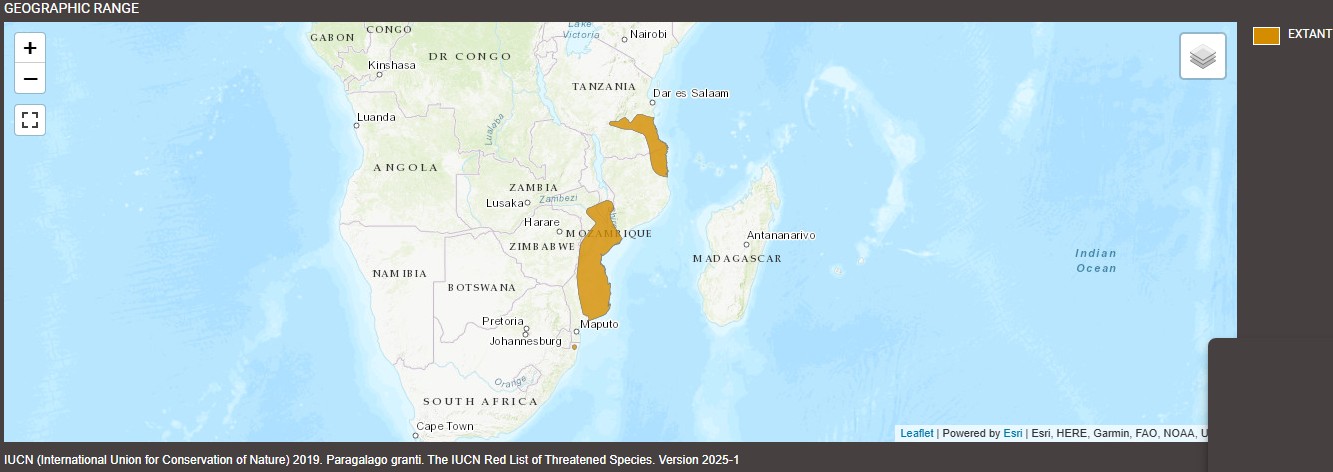
The Mozambique dwarf galago, also known as Grant’s bushbaby or the Mozambique lesser bushbaby, lives across several countries on the southeast coast of Africa. As the name suggests, this galago is found primarily in Mozambique, but they also live in southeast Tanzania, southern Malawi, eastern Zimbabwe, and northeastern South Africa. Their territory ranges from the Kilombero-Rufiji River and Udzungwa Mountains in Tanzania to Tshanini Nature Reserve in the northeastern corner of South Africa. These galagos have been spotted at up to 5,900 feet (1,800 m) above sea level.
The Mozambique dwarf galago occupies a variety of forest types—dry coastal forests, evergreen and semi-evergreen forests, and sand forests. They’re usually found near the coast and in areas near rivers, but separate populations live further inland.
All dwarf galagos used to be classified together in one genus across Africa. Scientists analyzed their morphology, genetics, and vocalizations to classify distinct species. Since 2017, dwarf galagos of eastern Africa have been separated from their western counterparts into their own genus of five distinct species.
Size, Weight, and Lifespan
Mozambique dwarf galagos weigh around 4.7 to 5.4 ounces (135-155 g). From head through body, they measure around 5.5 to 7 inches (14-18 cm) long—smaller than a squirrel. Their tails are even longer at 7.8 to 10.6 inches (20-27 cm) on average. However, during historical surveys, the Mozambique dwarf galago was often confused with another species, the southern lesser galago, which is a very similar size. Some data may be imprecise for that reason. Their lifespan is relatively unknown, as they are one of the least studied primates. Captive galagos have lived to their mid-teens, but this data generally comes from larger galagos that may have longer lifespans.
Appearance
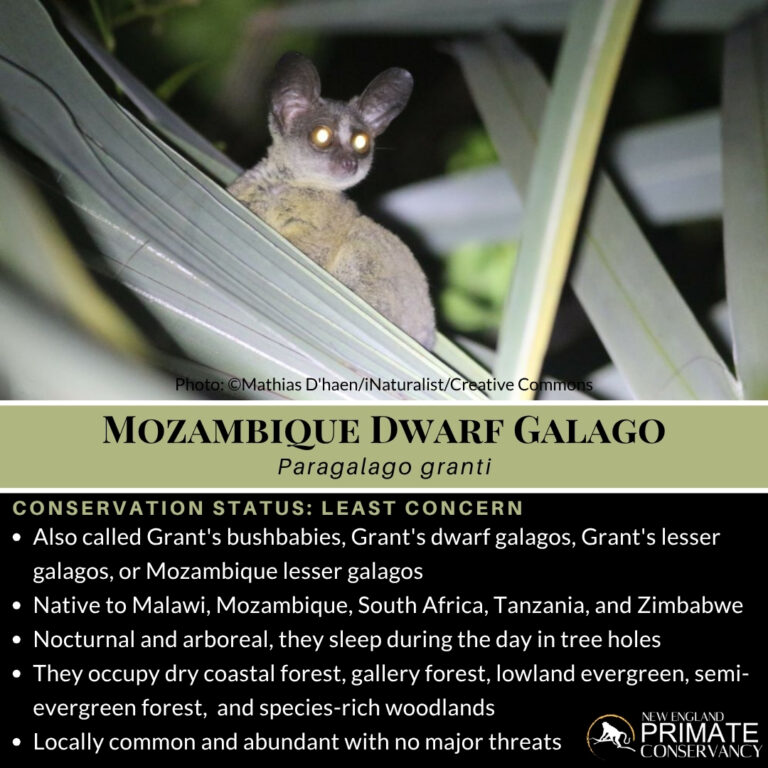
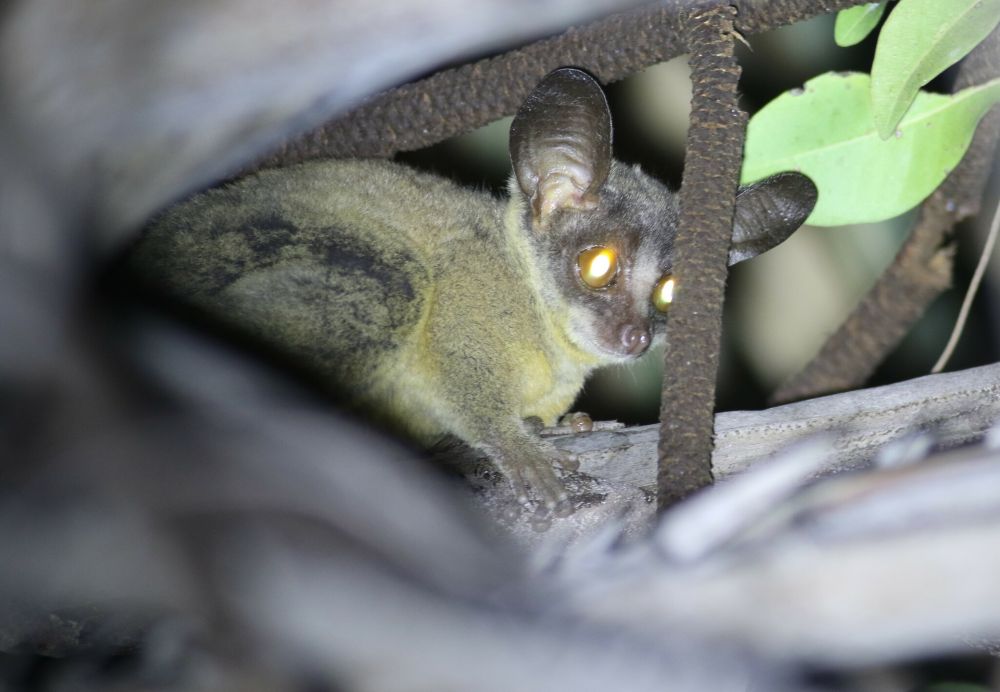
Like other galagos, which are nocturnal, Mozambique dwarf galagos have large eyes with a layer of reflective tissue behind the retina to enhance vision in low-light conditions. This reflective tissue is what causes their eyes to glow in photos. Mozambique dwarf galagos use their large ears to help them detect flying insects. They can also fold their ears while leaping or resting. Their tails are long and slender and used to help them balance, especially during leaps from tree to tree.
These galagos are light brown with cream-colored chests and necks. Their faces are generally grey with a white strip of fur down the nose. Their ears and tail are dark brown or black at the tips. They have strong hands and feet that are ideal for gripping branches. Galagos have a modified second toe on their hind feet known as a ‘grooming claw’ or ‘toilet claw’, which they use for grooming and cleaning their fur and ears.
Diet
Specific information about the Mozambique dwarf galago’s diet is scarce. If they have a similar diet to other dwarf galagos, they are omnivores and eat mostly insects such as beetles, moths, grasshoppers, and crickets. They may also eat fruits, nectar, and the gum from trees.
Behavior and Lifestyle
Mozambique dwarf galagos are nocturnal and spend the majority of their waking hours alone. During the day, they sleep in groups, sharing tree holes or nests they construct from leaves and twigs. They wake up after sunset and return to their sleeping sites before sunrise. They are arboreal and spend most of their time in the dense understory. These galagos are agile jumpers and use quadrupedal motion when climbing and walking.
There is little data on the species’ natural predators, but they are likely to include snakes and owls. Small carnivores such as genets, civets, and mongooses live in overlapping territory with Mozambique dwarf galagos, but there is not enough data to determine whether they prey on these galagos.
Mozambique dwarf galagos use their ears, which move independently, to locate insects. They can even snatch flying insects out of the air.
Their habitat spans an area in southeast Africa called the dry miombo woodland—a biome of savannas, grasslands, and shrublands.
Dwarf galago species tend to be polygynous, but there is no definitive research on the Mozambique dwarf galago’s mating system or social structure. In many galago species, females stay together and males disperse to find new territory, but this pattern has not been verified for the Mozambique dwarf galago specifically. Sources have reported that these galagos spend the majority of their waking time alone.
Galagos make a wide variety of vocalizations, such as chirps, barks, clicks, and hoots. Dwarf galagos often have high-pitched and rapid calls compared to larger galagos, but information on the Mozambique dwarf galago is scarce. If they are like other galagos, they make loud, repeated calls to declare their territory and possibly attract mates. There are also short, high-pitched chirrup sounds that tend to come in a rapid series, which might serve as a mild warning or alert to other dwarf galagos. Dwarf galagos also produce alarm calls when threatened, usually in short, sharp bursts.
Male galagos coat their hands and feet with urine to spread their scent through their territory. As they move about the forest, they leave a trail of scent ‘breadcrumbs’ for interested females to find them.
Dwarf galagos use some body language to communicate, such as tail flicks or staring. Since they spend most of their time alone, this type of communication may only be in situations such as territorial disputes, mating, and maternal interactions with offspring.
Information is scarce about this species’ reproduction, but if they are similar to other dwarf galagos, then twins are fairly common, and they may give birth twice per year, depending on food availability. Females likely reach sexual maturity at around 9 to 12 months old, and males a little later.
Dwarf galago gestation periods are around 3.5 to 4 months. Infants spend the first few weeks clinging to their mothers and may be weaned sometime between 6 and 10 weeks of age. The juveniles will stay with their mothers to learn foraging and jumping for several more months at least. Males are not involved in infant care.

Dwarf galagos have an important role in their habitats—pest control! By keeping the insect population in check, dwarf galagos help keep a healthy forest environment. They may also disperse some seeds or pollinate plants by eating fruit or tree gum.


The Mozambique dwarf galago is classified as Least Concern by the International Union for Conservation of Nature (IUCN, 2016), appearing on the IUCN Red List of Threatened Species. The IUCN data show that their population is decreasing, but these galagos are still common and widespread species. However, there have been very few dedicated population surveys, particularly since the dwarf galagos were split into their own genus in 2017. The population data that is available may include other similar galagos and, therefore, may not be accurate for this species. Greater study would help determine the level of vulnerability for this species and other dwarf galagos.
We do know that Mozambique dwarf galagos are experiencing habitat loss from clear-cutting of forests and from increased agriculture and human populations. They’re also threatened by slash-and-burn agricultural practices, when people set fires intentionally to clear land for agriculture, stimulate grass growth, or maintain open areas. Burning reduces tree cover and destroys nesting sites the dwarf galagos need, in addition to disrupting insect populations they rely on for food. Though they are too small to generally be a target for bushmeat hunters, these galagos can still be caught in snares and other traps set by hunters.
Mozambique dwarf galagos are listed in Appendix II of the Convention on International Trade in Endangered Species (CITES), an international agreement between governments whose goal is to ensure that international trade in specimens of wild animals and plants does not threaten their survival.
These galagos are found in protected areas like Chimanimani National Park in Zimbabwe and Gorongosa National Park in Mozambique, though illegal logging and burning still occur in areas that are technically protected.
Biodiversity was severely threatened during the civil war in Mozambique from 1977 to 1992, particularly in Gorongosa National Park. An aerial survey in 1994 spotted only 7,000 animals total in the park. However, local conservation organizations have had major impacts in this area. The Gorongosa Restoration Project, for example, trains rangers, engages with the local community, and monitors biodiversity in the park. The Project employs 99% local people to care for the park, fighting illegal activities like poaching and logging. After decades of work, Gorongosa National Park is now one of the best-protected areas in East Africa. As a result, it has seen an astonishing turnaround; in 2024, another aerial survey counted over 110,000 large animals while only covering around 60 percent of the park area.
- https://www.inaturalist.org/taxa/1127569-Paragalago-granti
- https://www.iucnredlist.org/fr/species/91970347/17962454
- https://www.wildsolutions.nl/vocal-profiles/galagoides/mozambique-dwarf-galago-galagoides-granti/
- https://gorongosa.org/conservation/
- https://news.mongabay.com/2017/02/african-bush-babies-gain-a-new-genus/
- https://globalrewilding.earth/gorongosa-the-silent-landscape-transformed-into-an-ecosystem-teeming-with-biodiverse-life/
- https://nationalzoo.si.edu/animals/southern-lesser-galago
- https://www.tandfonline.com/doi/abs/10.1080/15627020.2019.1583081
- https://gorongosa.org/wp-content/uploads/2024/11/GorongosaAerialWildlifeCount-October-2024.pdf
Written by Courtney Daniels, Nov 2025