
White-Fronted Langur, Presbytis frontata
WHITE-FRONTED LANGUR
Presbytis frontata
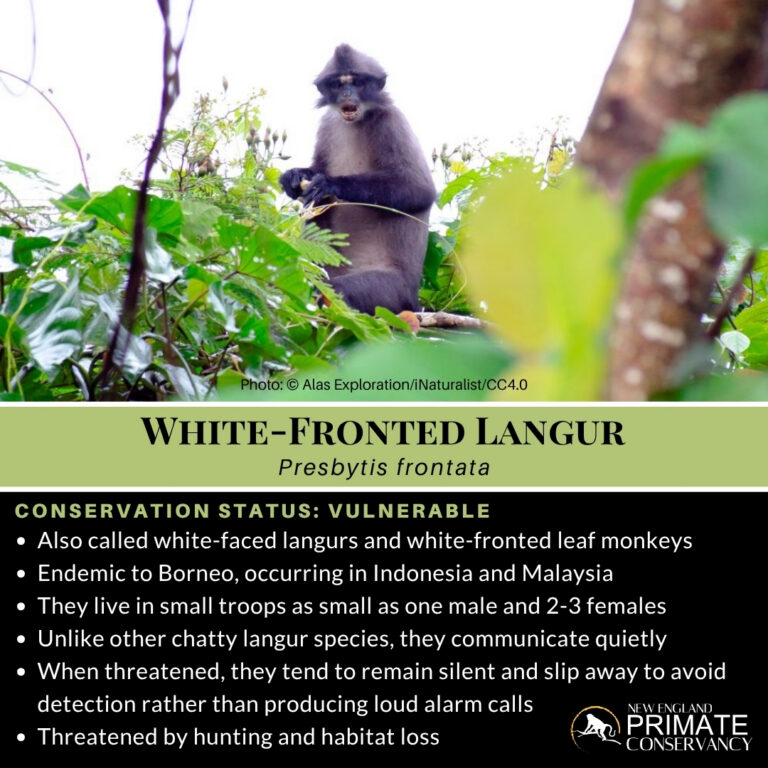
Geographic Distribution and Habitat
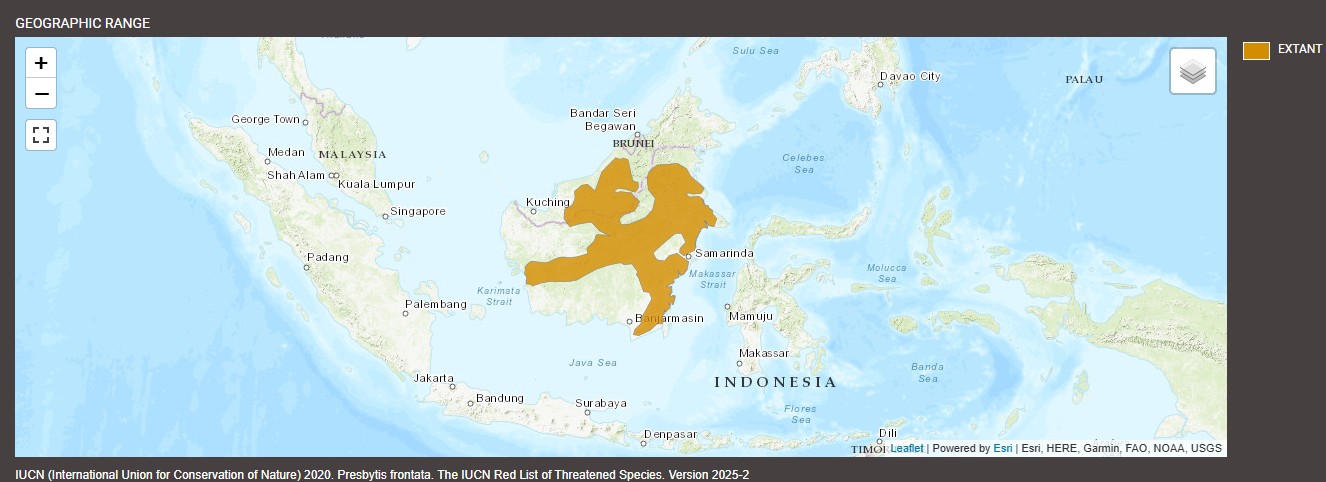
White-fronted langurs inhabit the southern region of Borneo, which is politically divided among Indonesia, Malaysia, and Brunei. They thrive in Kalimantan (Indonesia) and Sarawak (Malaysia).
These primates prefer warm tropical forests, particularly dipterocarp forests, characterized by tall trees and dense canopies. Additionally, you can often find them in plantations and secondary growth forests that have successfully regenerated after events like fire or logging.
Although research on white-fronted langurs is limited, scientists gather much of their knowledge about the species from studying closely related primates in the region.
People commonly refer to white-fronted langurs as white-faced langurs, white-fronted surili, or white-fronted leaf monkeys. They are locally known as Lutung Dahi Putih.
The white-fronted langur is visually distinct from other langurs and has long been considered a separate species. Some early researchers proposed that white-fronted langurs consisted of two subspecies: Presbytis frontata frontata from Indonesia and Presbytis frontata nudifrons from Malaysia. The main difference reported between the two was that P. f. nudifrons possessed a dark line of fur running through the white patch on the forehead. However, researchers have not identified any major anatomical or structural differences between langurs from these regions. They are now thought to represent the same species, with the variation most likely reflecting natural differences in fur coloration.
Size, Weight, and Lifespan
White-fronted langurs are slender-bodied monkeys that weigh between 12.3 and 12.8 pounds (5.6–5.8 kg). Males are slightly larger than females, although this difference can be difficult to distinguish in the wild. Male body length ranges from 19.7 to 21.3 inches (50–54 cm), while females measure between 18.5 and 19.7 inches (47–50 cm). Their tails are longer than their bodies, measuring 27.6 to 29.1 inches (70–74 cm) in males and 24.8 to 27.6 inches (63–70 cm) in females.
There are currently no reliable lifespan records for this species in the wild. However, based on related langur species, white-fronted langurs are estimated to live 15-20 years.
Appearance
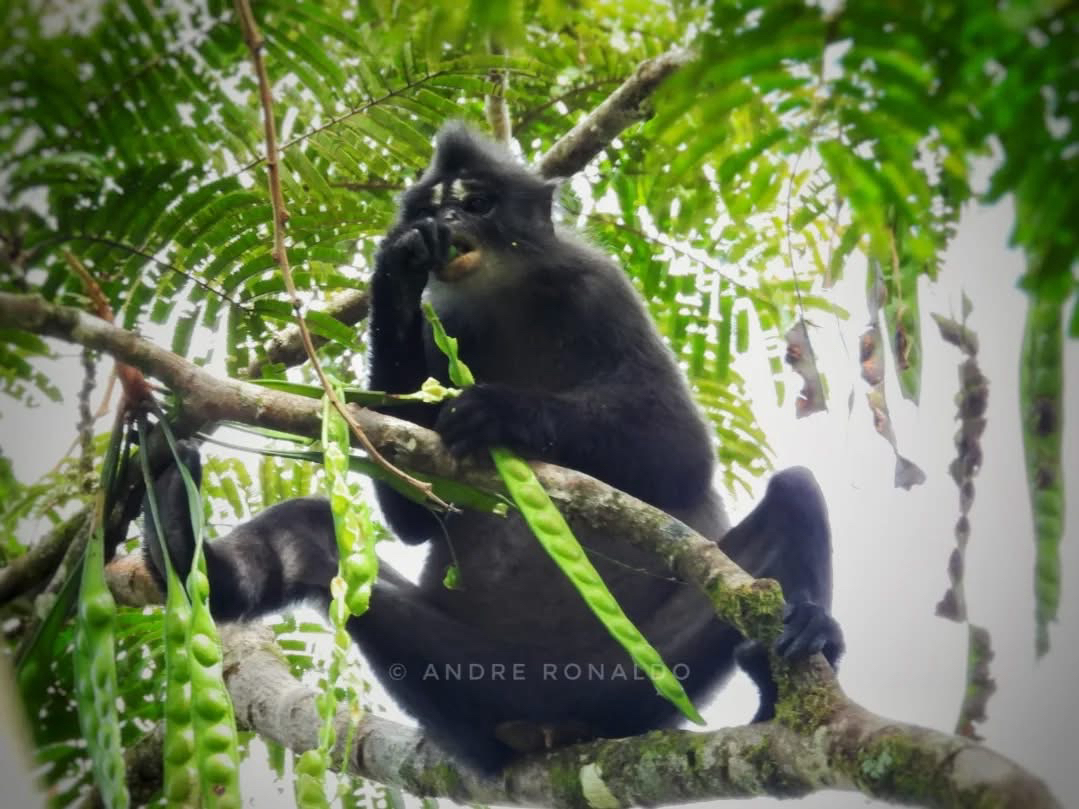
The white-fronted langur is a distinctive-looking primate, recognized by the white diamond-shaped patch on its forehead and the dark, curling crest that peaks along the middle of its head. The rest of the body is covered in dark brown-gray fur along the back, contrasting with the paler yellow-brown belly. Apart from the crest, the cheeks and brow are also covered in darker fur. White whiskers along the lower chin blend into the pale throat, giving the face a striking appearance.
Their faces are relatively small compared to the rest of their bodies, while their long arms, hands, legs, and feet can give them a somewhat gangly appearance. Their tails are much longer than their bodies and are used for balance as they leap and move through the trees.
Diet
Langurs are often called “leaf monkeys” because of their folivorous, or leaf-dominant, diet. White-fronted langurs primarily feed on young leaves, which are softer and easier to digest than mature leaves. Still, they also consume shoots, fruits, and other plant material. Because these fiber-rich foods take a long time to break down, langurs have several adaptations that help them extract as many nutrients as possible from their diet.
Like other langurs, white-fronted langurs possess a sacculated, or multi-chambered, stomach that allows food to remain in the digestive system longer, improving the breakdown of tough plant matter. Their enlarged salivary glands produce large amounts of digestive enzymes, and their sharp molars grind leaves into smaller pieces to aid digestion. Additionally, they have specialized gut bacteria that digest the remaining cellulose.
White-fronted langurs have also been observed eating soil and dirt, particularly from termite mounds. This behavior, known as geophagy, is common among many animals and is thought to help supplement minerals and nutrients, such as calcium, iron, and salt, that may be limited in a leaf-based diet.
Behavior and Lifestyle
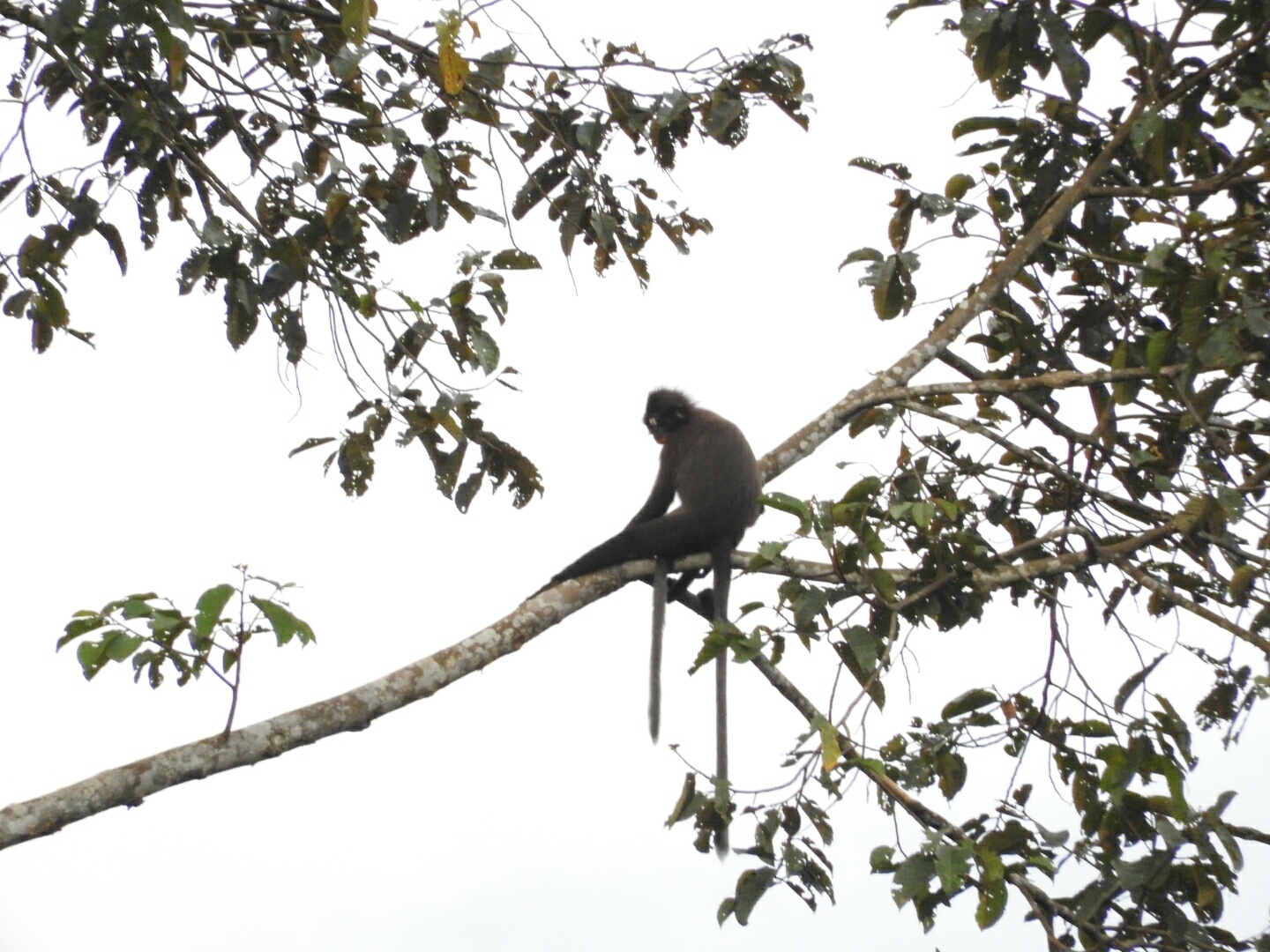
White-fronted langurs are arboreal (tree-dwelling) and diurnal (active during the day). They use their long limbs to grasp branches and move through the canopy, often traveling arm-over-arm between trees. Their long tails help them maintain balance while walking quadrupedally along branches and when leaping across gaps in the canopy. If the distance between trees becomes too great, they will descend to the forest floor to continue traveling.
White-fronted langurs are shy and secretive monkeys who often hide or flee when they encounter humans or predators. Despite spending much of their lives in the trees, they typically respond to threats by freezing in place, quietly moving away, and then descending to the ground before escaping through dense undergrowth. This anti-predator behavior is effective because their dark coloration, small group size (typically 2–4 individuals), and natural caution make them difficult to detect in the forest.
Their cryptic or secretive nature is also one of the reasons why studying white-fronted langurs remains challenging. Understanding their behavior requires long-term observation and some level of habituation to human researchers. However, this is difficult to achieve when the animals actively avoid people, an understandable response given that humans hunt these primates.
White-fronted langurs can be identified by the diamond-shaped white patch on their foreheads.
Unlike other langur species, they communicate quietly using low voices.
Although they are primarily active during the day, researchers have also observed them communicating softly at night.
When confronted with a threat, white-fronted langurs tend to freeze and gradually lower themselves to the ground before fleeing.
The daily activities of langurs are heavily influenced by their habitat and diet, which means activity patterns can vary even among closely related species living in the same region. There is little behavioral information for white-fronted langurs, but we can make some inferences based on their general biology.
Leaves contain large amounts of fibrous cellulose, which is difficult to digest. As a result, folivorous langurs must consume large quantities of plant material to obtain enough energy and nutrients to meet their daily needs. White-fronted langurs rely on their sacculated, or multi-chambered, stomachs to hold this large volume of leaves while digestive enzymes slowly break down the plant material and release nutrients such as sugars and proteins. Consequently, white-fronted langurs dedicate much of their active time to foraging, feeding, and resting while the slow digestive process occurs.
The social behavior of white-fronted langurs remains poorly studied because they live in small groups within dense forest foliage and actively avoid human observers. Compared with many other langur species, they are relatively quiet and communicate with soft vocalizations. This subdued communication suggests that family members remain close together, reducing the need for loud calls to maintain group cohesion.
Most langurs are known for their loud and complex vocalizations, which are often used to defend territory or maintain troop cohesion. In many other langur species, especially among males, loud vocalizations are commonly used to intimidate predators and alert other group members. White-fronted langurs differ from the typical behavior seen in this group by being relatively quiet and secretive. When threatened, they usually remain silent and quietly slip away to avoid detection rather than giving loud alarm calls.
Researchers have occasionally observed soft vocalizations exchanged between white-fronted langur group members before they move away from a disturbance. These quieter calls are thought to help maintain group cohesion. Because groups are typically small, often consisting of only a few closely spaced individuals, there may be little need for loud calls that could attract unwanted attention. Another unusual aspect of their communication is the frequent use of soft nocturnal vocalizations between 8 p.m. and 1 a.m, when they rest together at night.
Beyond these observations, relatively little is known about the communication behavior of white-fronted langurs. Even among sympatric langur species (closely related species living in the same region), their vocal behavior appears unusually subdued and distinct.
White-fronted langurs are found in two main social group types: monogamous pairs consisting of one male and one female, and polygynous groups in which a single male lives with multiple females and their offspring. Family groups are relatively small, usually ranging from 2 to 10 individuals. Compared to many other langur species, white-fronted langurs tend to live in notably smaller and more secretive groups
There are currently no detailed studies on the reproduction of white-fronted langurs. Based on the biology of closely related langur species, their gestation period (the length of pregnancy) is estimated to last around 5 to 6 months. Females typically give birth to a single infant, as twins are rare among langurs. Mothers provide extensive parental care and are unlikely to give birth again for approximately two years.
When males reach sexual maturity, they leave their natal troop (the group into which they were born) and disperse to establish families of their own. During this transition period, young males are sometimes observed traveling alone through the forest.
Folivores such as the white-fronted langur play an important ecological role in tropical forests, where dense tree canopies can block sunlight and limit the growth of smaller plants below. By consuming large amounts of leaves, langurs help create small gaps in the canopy, allowing more light to reach the forest floor. These light gaps support the growth and photosynthesis of understory vegetation, contributing to greater plant diversity within the forest ecosystem.
Although leaves make up most of their diet, white-fronted langurs also consume fruits and may act as seed dispersers. Seeds that pass through or are dropped away from the parent plant have a better chance of germinating in less crowded areas with greater access to sunlight and nutrients. This process helps maintain forest regeneration and benefits many other species that rely on fruiting trees for food and shelter.
White-fronted langurs also share their habitat with sympatric species such as the maroon leaf monkey (Presbytis rubicunda). Competition between these closely related species may be reduced because white-fronted langurs tend to occupy wetter and swampier forest habitats.
These langurs also form part of the food chain, as they are likely preyed upon by predators such as tigers, leopards, and large eagles.


The International Union for Conservation of Nature lists white-fronted langur as Vulnerable (IUCN, 2015), appearing on the IUCN Red List of Threatened Species.
Although suitable habitat exists across much of their range, white-fronted langurs are unevenly distributed and occur in relatively low densities, with an estimated 2 to 4 groups per 0.38 square miles (1 square kilometer).
The greatest threat to white-fronted langurs is habitat loss due to human development. Large-scale activities such as hydroelectric dam construction, mining, logging, and agricultural forest clearing continue to reduce and fragment the forests they depend on.
White-fronted langurs are also hunted for bushmeat and are sometimes used in traditional local medicines, placing additional pressure on already decreasing populations.
The white-fronted langur is listed in Appendix II of the Convention on International Trade in Endangered Species (CITES), an international agreement between governments whose goal is to ensure that international trade in specimens of wild animals and plants does not threaten their survival.
National laws in Indonesia and Malaysia provide legal protection for white-fronted langurs and prohibit hunting them. Much of their habitat is also protected within national parks and other conservation areas where these langurs occur. Enforcing these protections is still challenging. Large-scale development projects often occur in intact tropical forests and watersheds. Additionally, the expansion of roads and human settlements increases access to previously isolated habitats. This growing human presence leads to forest fragmentation and elevates the risk of hunting pressure on white-fronted langur populations.
- GBIF (n.d.) Presbytis frontata. Available at: https://www.gbif.org/species/5219559 (Accessed: 22 May 2026).
- Cheyne, S., Traeholt, C., Setiawan, A., Nijman, V. and Meijaard, E. (2020) ‘Presbytis frontata’, The IUCN Red List of Threatened Species, 2020, e.T18127A17954836. Available at: https://dx.doi.org/10.2305/IUCN.UK.2020-2.RLTS.T18127A17954836.en (Accessed: 22 May 2026).
- Napier, J.R. and Napier, P.H. (eds.) (1970) Old World Monkeys: Evolution, Systematics, and Behavior: Proceedings. New York: Academic Press.
- Hooijer, D.A. (1962) ‘Quaternary langurs and macaques from the Malay Archipelago’, Zoologische Verhandelingen, 55(1), pp. 1–64.
- Payne, J., Francis, C.M. and Phillipps, K. (1985) A Field Guide to the Mammals of Borneo. Kota Kinabalu: The Sabah Society.
- Fithria, A., Mubaroq, H. and Nasution, A.F. (2023) ‘Distribution and habitat characteristics of the lutung dahi putih (Presbytis frontata) in the Senakin Mining Area of PT Arutmin Indonesia’, Journal of Hunan University Natural Sciences, 50(10).
- Davies, A.G. and Baillie, I.C. (1988) ‘Soil-eating by red leaf monkeys (Presbytis rubicunda) in Sabah, Northern Borneo’, Biotropica, 20(3), pp. 252–258.
- Brandon‐Jones, D. (1996) ‘Presbytis species sympatry in Borneo versus allopatry in Sumatra: an interpretation’, in Edwards, D.S., Booth, W.E. and Choy, S.C. (eds.) Tropical Rainforest Research — Current Issues. Monographiae Biologicae, vol. 74. Dordrecht: Springer, pp. 71–76. Available at: https://doi.org/10.1007/978-94-009-1685-2_7.
- Supriatna, J. (2022) Field Guide to the Primates of Indonesia. Cham: Springer Nature.
- Ramlee, H. (2013). Distribution, Ecology, and Systematics of Presbytis hosei and Other Leaf Monkey Species in North Borneo. [Thesis].
- The Forest Forever (n.d.) White-fronted langurs. Available at: https://www.theforestforever.com/white-fronted-langurs (Accessed: 22 May 2026).
- Weitzell, V., Yang, C.M. and Groves, C.P. (1988) ‘A catalog of primates in the Singapore Zoological Reference Collection, Department of Zoology, National University of Singapore (formerly the Zoological Collection of the Raffles Museum)’, Singapore Zoological Reference Collection, 38(1).
- Nijman, V. and Nekaris, K.A.I. (2013) ‘Loud calls, startle behavior, social organization, and predator avoidance in arboreal langurs (Cercopithecidae: Presbytis)’, Folia Primatologica, 83(3–6), pp. 274–287.
- Ang, A. and Roos, C. (2024) ‘Asian langurs (Presbytis) Conservation Action Plan 2024–2034 and Colobine Monkey Day’, Oryx, 58(6), pp. 692–692.
- Nijman, V. (2022) ‘Ecology of sympatric and allopatric Presbytis and Trachypithecus langurs in Sundaland’, in The Colobines: Natural History, Behavior and Ecological Diversity. Cambridge: Cambridge University Press, pp. 199–214.
- Groves, C.P. (1993) ‘Order Primates’, in Wilson, D.E. and Reeder, D.M. (eds.) Mammal Species of the World. 2nd edn. Washington, DC and London: Smithsonian Institution Press, pp. 243–277. Available at: http://doi.org/10.5281/zenodo.7353122.
Written by Acima Cherian, May 2026