
White Bald-Headed Uakari, Cacajao calvus
WHITE BALD-HEADED UAKARI
Cacajao calvus
Geographic Distribution and Habitat
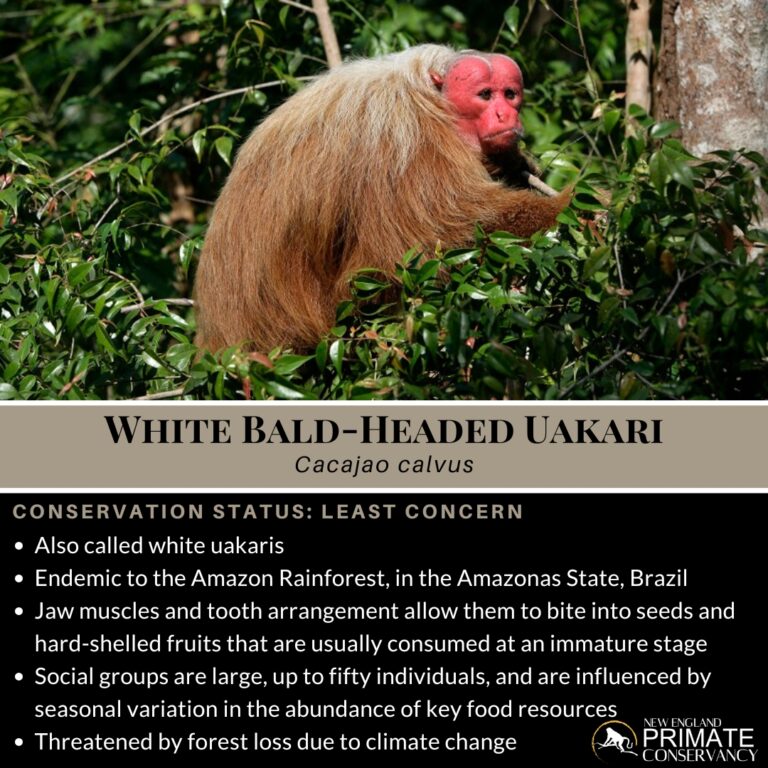
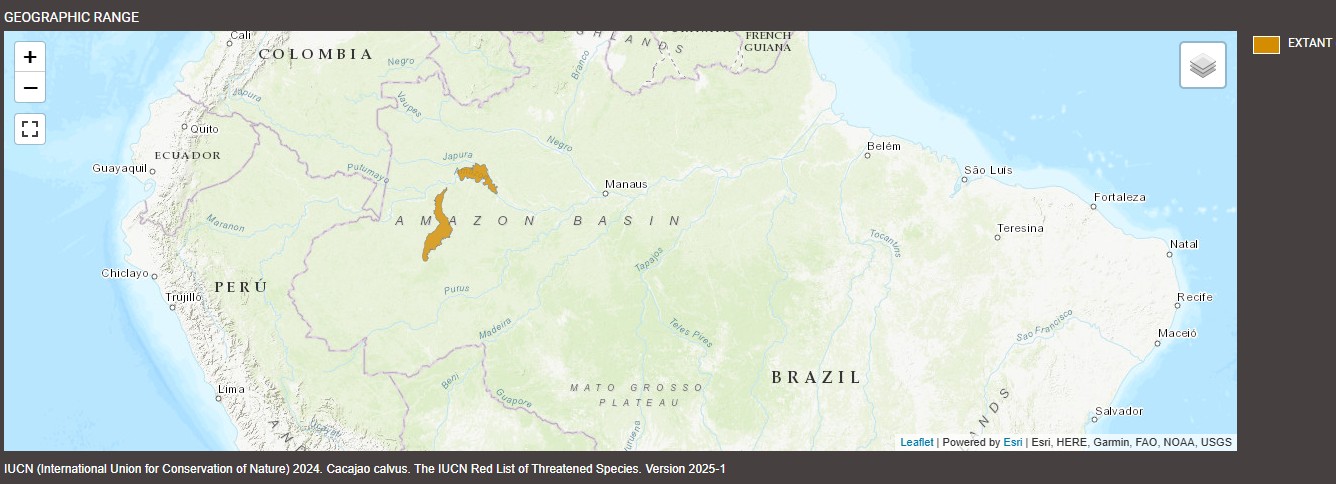
White bald-headed uakaris (pronounced “wak-AR-i”) are endemic to the western Brazilian states of Amazonas and Acre. Populations occur along the Jurupari, Pauini, and Tarauacá Rivers, regions characterized by tropical rainforests that experience seasonal flooding. These primates are well adapted to flooded forest environments, and their movements correspond closely to the rise and fall of river levels. During the rainy season, when water submerges the forest floor, uakaris spend most of their time in the upper canopy. When the water recedes, they descend to the ground to forage.
They are also called white uakaris.
The taxonomy of bald uakaris has undergone multiple revisions. In 1987, Hershkovitz classified all bald uakaris (including the white bald-headed uakari) as four subspecies under a single species, Cacajao calvus. These subspecies were mainly distinguished by coat color and geographic range. However, later research showed that these visible traits did not reflect genetic differences. In 2022, DNA analyses led scientists to reclassify each subspecies as a separate species. They also described a new species, Kanamari Bald Uacari (Cacajao amuna), which had previously been considered a geographically isolated population of the white bald-headed uakari.
Size, Weight, and Lifespan
Adult white bald-headed uakaris typically weigh between 4.4 and 8.8 pounds (2–4 kg). Males are generally larger (6.6–7.7 pounds or 3–3.5 kg) than females (4.4–6.6 pounds or 2–3 kg). Body length, measured from the head to the base of the tail, ranges from 15 to 22 inches (38–57 cm) in males and 14 to 22 inches (36–56 cm) in females. Their tail is about a third of their body length, averaging 5.5 to 7.4 inches (14–19 cm).
While males show a slight size advantage, the difference is subtle and often difficult to distinguish in mixed-age social groups. Overall, the species is considered sexually monomorphic (males and females display similar external appearance).
Bald uakaris can live between 15 and 20 years in the wild and up to 30 years in captivity.
Appearance
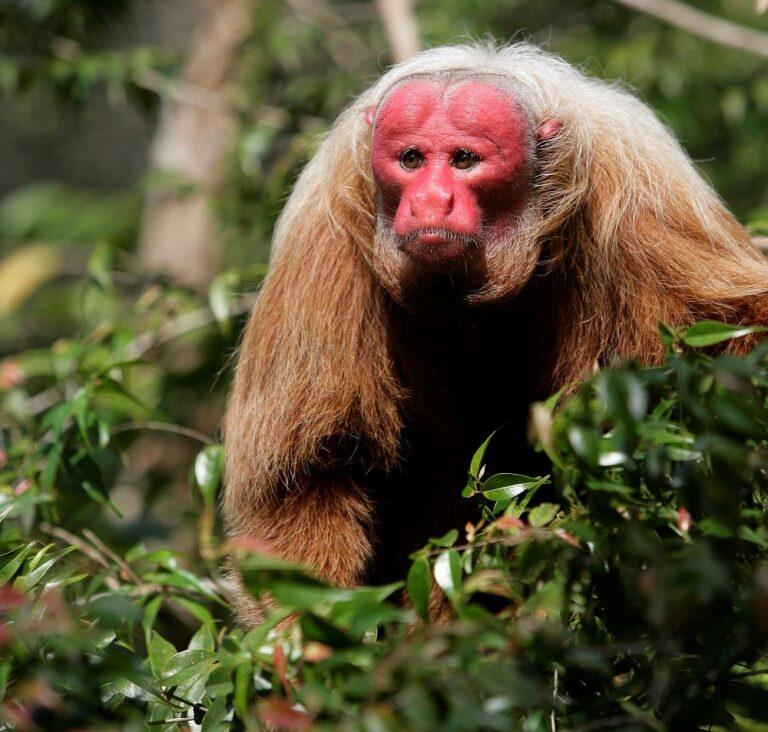
All bald uakaris are easily recognized by their bright red, hairless faces and bulbous foreheads. White bald-headed uakaris are named for their distinctive gray-white fur, which covers most of the body and contrasts sharply with their vivid facial coloration. They differ from other bald uakari species by having a yellowish-orange tint along the belly, sides, and arms, giving them a slightly warmer overall tone. The fur is coarse in texture and drapes in a cape-like manner over the shoulders. Their tails are short, bushy, and non-prehensile (not capable of wrapping around or grasping branches).
Their facial skin lacks pigment, such as melanin. Instead, the red color comes from an extensive network of blood vessels located just beneath the thin layer of skin. These capillaries are larger and more complex than those found in other Latin American primates. Researchers suggest that the redness of the face directly reflects an individual’s health or stress level because the color intensity is linked to blood flow and oxygenation. Similar to how humans appear pale when ill or frightened, a uakari’s face may turn pale when the animal is sick, and become brighter when excited or in good condition.
Some scientists propose that this blood-flow-based coloration is an adaptation related to the presence of blood parasites known as trypanosomatids, which can cause anemia (a reduction in red blood cells). The thin facial skin and visible blood network provide an honest visual signal of health, allowing other group members to identify individuals who are infected or weakened. In this way, face color may play a role in mate selection by helping uakaris avoid pairing with unhealthy partners.
Diet
Bald uakaris have strong jaws and specialized teeth that let them crack open the hard-shelled seeds that make up most of their diet. Their large canines pierce and split the tough outer layer of the seed, and their forward-leaning incisors scoop out the softer inner parts. Finally, their low-crowned molars work like a pestle and mortar, grinding the seeds before swallowing. These dental and chewing adaptations help them get the most nutrition out of their food.
They prefer younger seeds because they contain more fat and energy. When fruits are less available, uakaris also eat leaves, buds, and stems. Their feeding habits change with the seasons. During the dry months, when fruits and seeds are scarce, white bald-headed uakaris have been seen eating caterpillars and other invertebrates to supplement their diet.
Behavior and Lifestyle
Not much is known about the behavior of wild bald uakaris, mainly because their dense, seasonally flooded forest habitat makes long-term field studies difficult. Much of what is understood about the species comes from observations of captive or semi-captive individuals.
Bald uakaris are diurnal (active during the day). They are both arboreal (skilled at climbing and moving through the canopy) and terrestrial (traveling along the forest floor when needed). In the trees, they typically move with their bodies held parallel to the branches (a pronograde posture) and walk on all fours (quadrupedal locomotion). Young uakaris are often seen chasing, wrestling, and playfully leaping through the canopy, showing a high level of energy and social interaction.
The white bald-headed uakari was reclassified from a subspecies to a distinct species in 2022.
Males are color-blind, and their bright red faces likely signal good health to females, who have full color vision.
Allogrooming (grooming one another) is uncommon, even though these primates live in large social groups of up to 50 individuals.
Young white bald-headed uakaris are playful and spend much of their time wrestling with one another.
Little is known about the detailed ecology and behavior of bald uakaris. They spend much of their time moving through the canopy and feeding. Their main food (unripe, hard-shelled fruits) requires effort to find and open, so they must eat large quantities to maintain their energy needs. Uakaris are active travelers with wide home ranges, often covering long distances to find food and avoid flooded areas of the forest. Their home ranges can extend between 123 and 135 acres (500–550 hectares), depending on habitat conditions and seasonal changes.
Bald uakaris spend their mornings foraging and take short breaks to rest in the afternoon. Before sunset, the troop gathers in the mid-canopy to settle for the night. They choose sleeping sites that are partly hidden by leaves and branches, offering protection from flying predators like vultures. These mid-level spots also keep them out of sight from above, and the timing helps—by dusk, most raptors have stopped hunting.
Bald uakaris often live in large family groups, or troops, of up to 50 individuals. These troops follow a fission–fusion social system, where the main group splits into smaller subgroups that forage on their own. When fruit is plentiful during the rainy season, these subgroups reunite to form the larger troop again.
They live in multimale-multifemale societies. While studies on their social systems are lacking, there is some evidence to suggest that female uakaris have their own hierarchy system where more dominant females have access to the best food sources.
There are not many studies that describe in detail how bald uakaris communicate, but since they are social primates that live in large groups, some forms of communication are easy to recognize. They use sounds, body signals, and scents to interact with one another. Their vocalizations include alarm calls that warn the group when predators are nearby.
In captive bald uakari groups, researchers have identified two main types of vocalizations based on volume. High-amplitude calls, such as “hic” and “kreek,” are louder and likely used for long-distance communication. Low-amplitude vocalizations, including “hiss” and “purr” sounds, are softer and may be used during close social interactions.
One of the most visible ways bald uakaris communicate is through the bright red color of their face and head. This coloration reflects blood circulation and oxygen levels, signaling good health and strong physical condition. Interestingly, male bald uakaris are color-blind and cannot distinguish between red and green. This suggests that the bright red facial color is mainly a signal directed toward females, who can perceive these color differences. Females are likely to prefer males with deeper red faces, as this indicates better health and vitality compared to males with paler faces, who may be less healthy or affected by disease.
White bald-headed uakaris also use scent to send messages. They have scent glands near the genital area that help signal reproductive readiness. When females are fertile, they rub their scent on tree branches to let males know they are hormonally ready to mate. Other bald uakaris engage in “urine-washing,” rubbing urine on their bodies and along the branches they travel on to spread their scent and communicate with others.
White bald-headed uakaris reach sexual maturity at around three and a half years of age for females, and even later for males. When a female enters estrus (the period when she is fertile and ready to mate), she rubs her genital area on branches to leave her scent. This scent-marking attracts nearby males, who respond by investigating and initiating mating behavior.
The gestation period, or pregnancy, lasts about six months, after which the female gives birth to a single infant. Infants depend on their mothers, who nurse them for three to five months. By the time they are about one year old, juveniles are fully weaned and able to feed on their own. This long developmental period and low birth rate contribute to the species’ slow population growth.
White bald-headed uakaris live in large multimale–multifemale groups that can include up to 50 individuals. These groups are generally peaceful, with few signs of aggression. Studies of female behavior suggest that older and more dominant females have first access to the best feeding areas. In related bald uakari species, males have been observed forming all-male groups, where interactions are usually affiliative, meaning they get along and cooperate rather than compete. Allogrooming (when individuals comb through or clean each other’s fur) is rare and not a significant part of their social behavior. Juveniles spend much of their time playing and engaging in light “fights,” which help them develop coordination and social skills.
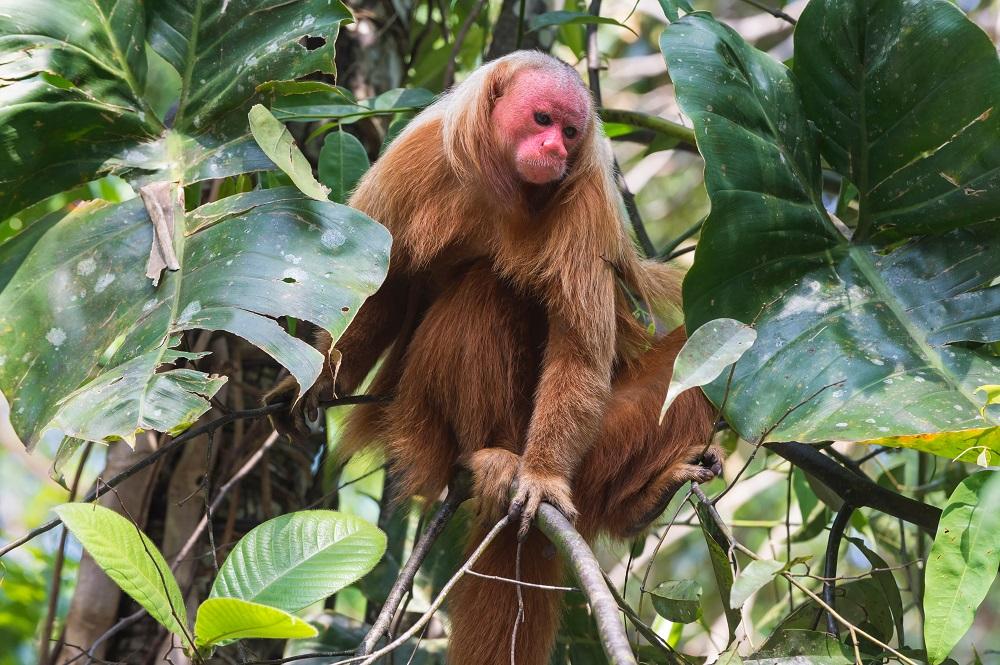
Flooded forests generally support fewer mammal species because navigating the waterlogged terrain is difficult. Uakaris are one of the few mammals that thrive in these environments due to their agility and ability to move vertically through the forest canopy.
White bald-headed uakaris usually forage in the mid-canopy, feeding on hard-shelled fruits that are inaccessible to most other frugivores. This diet makes their ecological niche highly specialized and largely free from competition. Their feeding behavior also benefits other species. As uakaris use their powerful jaws and forward-angled incisors to crack open seeds, they often drop nutrient-rich fragments to the forest floor, where different animals feed on them. Observations have even noted fish gathering below feeding trees to consume the fallen fruits, and at times, even the uakaris’ feces. In this way, uakaris contribute to the vertical transfer of nutrients from the canopy to the forest floor and waterways, linking multiple levels of the ecosystem.
Because many trees produce far more seeds than can germinate, uakaris play a vital role in regulating this overproduction. By consuming and dispersing hard seeds that few other animals can process, they help maintain balance within the flooded forest.
Their position in the canopy also shapes predator dynamics. Vultures, toucans, and large raptors are among the main predators of uakaris, which serve as a significant food source for these birds of prey.


The International Union for Conservation of Nature lists white bald-headed uakari as Least Concern (IUCN, 2024), appearing on the IUCN Red List of Threatened Species.
Their habitat is largely protected from logging and deforestation, and because this region of the Amazon consists mainly of dense, seasonally flooded forests, human encroachment remains minimal. White bald-headed uakaris are also not typically hunted. Although their environment faces few direct human threats, these uakaris occupy a highly specialized niche. Their survival depends on the availability of hard-shelled fruits and tree species that rely on regular flooding. This narrow ecological dependence makes them especially sensitive to environmental change, particularly to shifting rainfall patterns and altered flooding cycles caused by climate change. In addition, their slow development and low population growth make recovery a greater challenge if their numbers are ever reduced in the future.
White bald-headed uakari is listed in Appendix I of the Convention on International Trade in Endangered Species (CITES), an international agreement between governments whose goal is to ensure that international trade in specimens of wild animals and plants does not threaten their survival.
Bald uakaris are charismatic primates that embody the distinctive character of the Amazon’s flooded forests, making them an important flagship species for this unique ecosystem. They are protected from hunting under national law and by several designated reserves, including the Jutaí River Extractive Reserve and the Uacari Sustainable Development Reserve. The Mamirauá Sustainable Development Reserve (Mamirauá SDR), which encompasses much of the white bald-headed uakari’s range, was explicitly established to safeguard this species and its specialized habitat.
- Barnett, A.A. and Brandon-Jones, D. (1997) ‘The ecology, biogeography and conservation of the uakaris, Cacajao (Pitheciinae)’, Folia Primatologica, 68(3–5), pp. 223–235.
- Barnett, A.A., Bowler, M., Bezerra, B.M. and Defler, T.R. (2013) ‘Ecology and behavior of uacaris (genus Cacajao)’, in Evolutionary Biology and Conservation of Titis, Sakis and Uacaris. pp. 151–172.
- Corso, J., Bowler, M., Heymann, E.W., Roos, C. and Mundy, N.I. (2016) ‘Highly polymorphic colour vision in a New World monkey with red facial skin, the bald uakari (Cacajao calvus)’, Proceedings of the Royal Society B: Biological Sciences, 283(1828), p. 20160067.
- Ennes Silva, F., Valsecchi do Amaral, J., Roos, C., Bowler, M., Röhe, F., Sampaio, R., Cora Janiak, M., Bertuol, F., Ismar Santana, M., De Souza Silva Júnior, J., Rylands, A.B., Gubili, C., Hrbek, T., McDevitt, A.D. and Boubli, J.P. (2022) ‘Molecular phylogeny and systematics of bald uakaris, genus Cacajao (Primates: Pitheciidae), with the description of a new species’, Molecular Phylogenetics and Evolution, 173, p. 107509.
- Gron, K.J. (2008) Primate Factsheets: Uakari (Cacajao) — Conservation. Primate Info Net, Wisconsin National Primate Research Center. Accessed 19 October 2025.
- Hermosilla-Albala, N., Silva, F.E., Cuadros-Espinoza, S., Fontsere, C., Valenzuela-Seba, A., Pawar, H., Gut, M., Kelley, J.L., Ruibal-Puertas, S., Alentorn-Moron, P. and Faella, A. (2024) ‘Whole genomes of Amazonian uakari monkeys reveal complex connectivity and fast differentiation driven by high environmental dynamism’, Communications Biology, 7(1), p. 1283.
- Pereira, S., Mayor, P., Azul Monteiro Evangelista, J.S., Felipe Lima, A.K. and Barros Monteiro, F.O. (2024) ‘Reproductive physiology with emphasis on endometrial cycles of woolly and uakari monkeys—A literature review’, American Journal of Primatology, 86(2), p. e23585.
- Mayor, P., Mamani, J., Montes, D., González-Crespo, C., Sebastián, M.A. and Bowler, M. (2015) ‘Proximate causes of the red face of the bald uakari monkey (Cacajao calvus)’, Royal Society Open Science, 2(7), p. 150145.
- Kuderna, K., Boubli, J.P. and Marques-Bonet, T. (n.d.) Whole genome approach to the structure and dynamics of Cacajao wild populations.
- Silva, F.E. (2020) Systematics, Biogeography and Conservation of Bald Uakaris (Cacajao Lesson, 1840). University of Salford (United Kingdom).
- Silva, F.E., de Queiroz, H.L., Ravetta, A.L. and Boubli, J.P. (2025) ‘Cacajao calvus’, The IUCN Red List of Threatened Species 2025: e.T3419A258886875. Accessed 12 October 2025.
- Silva, F.E., Lemos, L.P., Ravetta, A.L., Röhe, F., Sampaio, R., Franco, C.L.P. and Boubli, J.P. (2021) ‘On the geographic distribution of the bald uakaris (Cacajao calvus ssp.) in Brazilian Amazonia’, Primate Conservation, 35, pp. 69–86.
- Walker, S.E. and Ayres, J.M. (1996) ‘Positional behavior of the white uakari (Cacajao calvus calvus)’, American Journal of Physical Anthropology, 101(2), pp. 161–172.
Written by Acima Cherian, Oct 2025