
Structured to Survive
STRUCTURED TO SURVIVE
How Primate Features Help Them Thrive
A LESSON FOR 4TH GRADE STUDENTS

Hi! My name is Brandi, and I teach fourth grade.
One of the things we explore in my classroom is how different features of an animal help them survive!
Every plant and animal has structures that are specially designed to help them survive.
In this lesson, we are exploring the different structures of primates. Then, we will compare two different primate species. Finally, you will be ready to present your findings in a way that’s easy for others to understand.
For Educators: Educational Standards
Let’s Get Started
Animals are built for survival. Every animal has features—like teeth, claws, fur, hands, wings, or tails—that do important jobs to help them live in the wild. Scientists call the relationship between a body part and what it does structure and function.
This lesson explores two very different primates—a tiny marmoset and a giant gorilla—and reveals how their body features help them survive where they live.
GOALS:
| We are going to: | |
|---|---|
| 1. | Describe structures of two or more primates that help them survive |
| 2. | Compare the structure of different primates |
| 3. | Present our findings |
Here are some vocabulary words scientists use when studying animals. They include:
| Word | Meaning |
|---|---|
| Feature | A body part or trait you can see |
| Structure | A feature or body part that has a special job |
| Function | What the feature or structure does — its job |
| Adaptation | A feature or behavior that helps an animal survive |
| Habitat | The place where the animal lives |
Take a moment to look closely at the photos of the two primates below.
What differences do you see right away?
What questions do these differences make you think about?
How do you think each one survives where it lives?

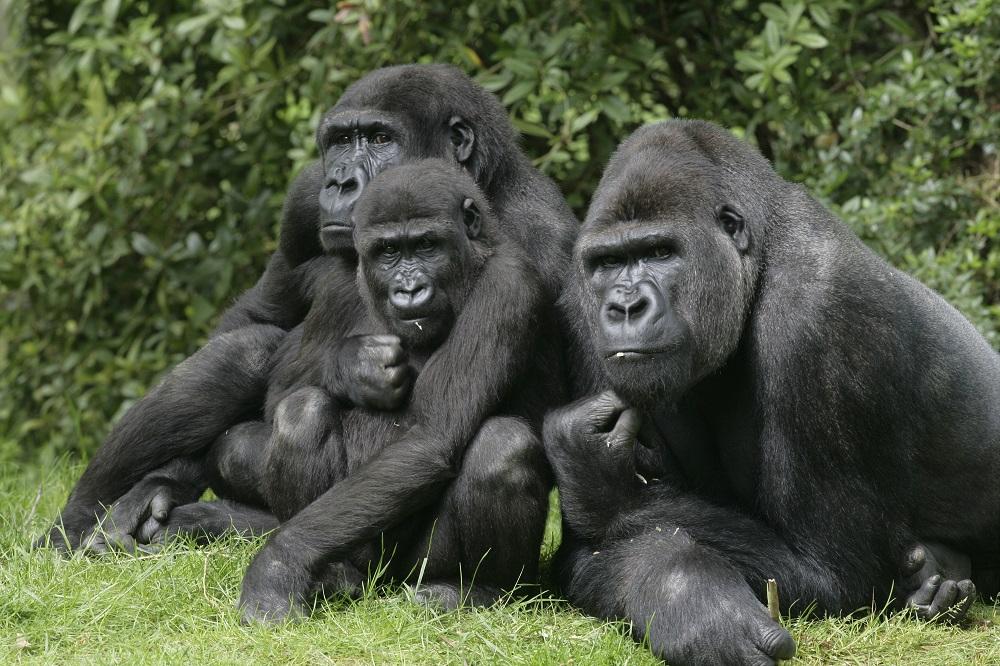
As we look for answers, you may find things you’ve never thought about before. That’s the amazing part—Nature gives every species the tools it needs to survive and thrive.
Let’s begin by looking at the species one at a time and noticing their physical features or structures.
Let’s Do One Together!
COMMON MARMOSET
Look at this picture of a common marmoset family. The common marmoset is a small monkey that lives in Brazil. The average male grows to be about 9 ounces (0.255 kg), a little heavier than a hamster. Females are slightly smaller. What external structures do you notice? That means what important features can you see?
Label the photo with the physical features, also called structures, that help common marmosets survive in their habitats.

To download this image for printing, right-click on the image, choose “Open image in new tab,” and print it from the new tab that opens.
Use this WORD BANK if you need help.
- Small body size
- Long tail
- Claws on fingers and toes (instead of flat nails like other monkeys)
- Large eyes
- Forward-facing eyes (binocular vision)
- Large, noticeable ears
- Mottled pattern on fur
- Wide-set nose
- Sharp, peg-like teeth
- Slim limbs adapted for quick climbing
- Small hands with a strong grip
- Non-opposable thumbs
Think about what you know about what animals need to survive (or what we need to survive).
Animals need food, shelter, protection from threats (other animals, humans, weather), and to reproduce (have babies to keep their species alive).
How do you think the features we identified for the common marmoset help them survive? We are making a hypothesis or an educated guess.
Some things to think about:
- What might those claws help the marmoset do?
- How might the long striped tail help it survive?
- How could fur color help in the rainforest?
Hints:
- Think about how their nails might help them access food?
- How might having their long, patterned fur help with protection?
Visit the Primate Species Profile and Become a Primate Pro lesson about the common marmoset to learn more about this monkey!
Helpful videos:
Discovering Primates video playlist.
What have we learned now about how specific features help the common marmoset survive?
Now Try This One
WESTERN LOWLAND GORILLAS
Now, let’s examine the western lowland gorilla. The western lowland gorilla is a great ape that lives in Central Africa. They are smaller than other gorillas, but can still grow to be over 400 pounds (181.5 kg). That’s about the size of a refrigerator!
What structures do you notice about this gorilla?
Label the diagram with the physical features, also called structures, that help western lowland gorillas survive in their habitats.
To download this image for printing, right-click on the image, choose “Open image in new tab,” and print it from the new tab that opens.
Use this WORD BANK if you need help.
- Large body size and powerful build
- Broad chest and shoulders
- Strong, long arms
- Knuckle-walking hands
- Large hands and feet with opposable thumbs
- Facial structure (prominent brow ridge, flat nose, large nostrils)
- Small ears
- Eyes forward-facing (binocular vision)
- Thick dark fur
- Large, strong jaw/teeth
- Silverback markings (if adult male)
- No tail
- Posture
- Social grouping
Some things to think about:
- How does being strong help survival?
- Why might large teeth be important?
- How might hands and feet help climbing?
- How do social groups help survival?
Hints:
- How does their large size benefit them in their habitat?
- What are the benefits of having opposable thumbs?
Visit the Primate Species Profile and Become a Primate Pro lesson about the western lowland gorilla to learn more about this great ape!
Helpful videos:
Discovering Primates video playlist.
What have we learned now about how specific features help the western lowland gorilla survive?
Compare
Compare the marmoset and the gorilla!
What is different about them, and how do their differences help them survive? For example, an adult common marmoset could probably fit in the palm of a small gorilla!
- What surprised you most about how primates survive?
- Which feature do you think is most important for survival, and why?
- How does comparing animals help us understand biodiversity?
Helpful videos:
Discovering Primates video playlist.
Your Turn
You can keep going! Visit the Become a Primate Pro lesson, the Primate Species Profiles, or the Discovering Primates video series, and choose another primate to learn about.


Start by looking at pictures of the primate you selected and make your own notes.
Then, read about your primate. Identify how your primate’s specific features help them survive.
Compare them to other primates.
Present Your Findings!
A good scientist shares their findings in a way that is easy for others to understand.
Now that you have researched your primates and their helpful structures, it’s time to share.
- Create a poster
- Write an essay
- Create a diagram for a primate you chose (like the ones we used at the beginning) to show important features


FOR EDUCATORS
EDUCATIONAL STANDARDS
GOALS & OBJECTIVES
Students will be able to describe various structures (parts of the body) of a primate.
Students will be able to describe how a given structure functions, and how that function supports primate survival.
Students will be able to compare and contrast different primate structures and describe potential reasonings for differences and similarities between primates.
Standard(s)*
4-LS1-1. Construct an argument that animals and plants have internal and external structures that support their survival, growth, behavior, and reproduction.
*Massachusetts Science Standards, Massachusetts SEL Standards
When available, Common Core Standards are used. Otherwise Massachusetts State Standards will be used for reference.
Know
Standard Bottom Line
Animals are diverse and have specialized adaptations that help them survive and thrive in their environments, and students can use evidence to explain these concepts.
Structures (from standard) of the part of the plant or animal body
- Animals: legs, wings, fins, feathers, trunks, claws, horns, antennae, eyes, ears, nose, heart, stomach, lung, brain, and skin.
- Plants: leaves, roots, stems, bark, branches, flowers, fruit, and seeds.
Functions is what they do:
- Roots absorb water (survival, growth)
- Flowers attract pollinators (reproduction)
- Camouflage helps animals hide from predators (behavior, survival)
- Lungs take in oxygen (growth, survival)
Show
Construct an argument (use evidence + reasoning) to explain:
- How specific structures help an animal or plant survive, grow, behave, or reproduce
- Compare different structures for the same purpose (e.g., fins vs. legs for movement)
Use observations or research to support their ideas
- Diagrams, labeled parts, or written explanations
- Simple cause-effect reasoning (“Because ___, the ___ helps the plant…”)
- Communicate clearly in writing, orally, or in a visual presentation
Lesson and Standards developed by Brandi Bellacicco, Nov 2025
Copyright © New England Primate Conservancy 2025. You may freely use, copy and share these Learning Activities for educational purposes.
For questions or comments, e-mail us at info@neprimateconservancy.org.