
Peters’ Mouse Lemur, Microcebus myoxinus
PETERS' MOUSE LEMUR
Microcebus myoxinus
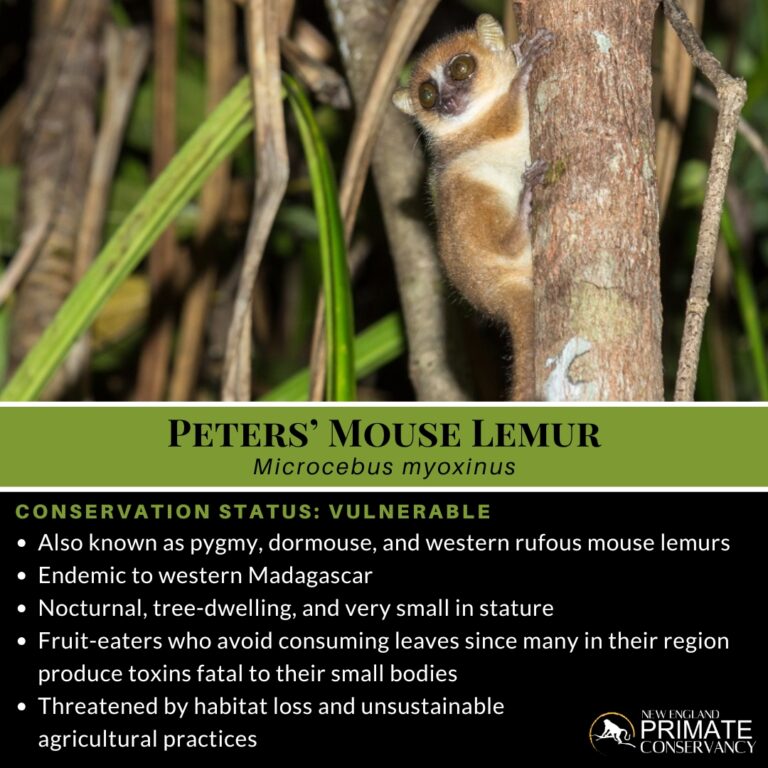
Geographic Distribution and Habitat
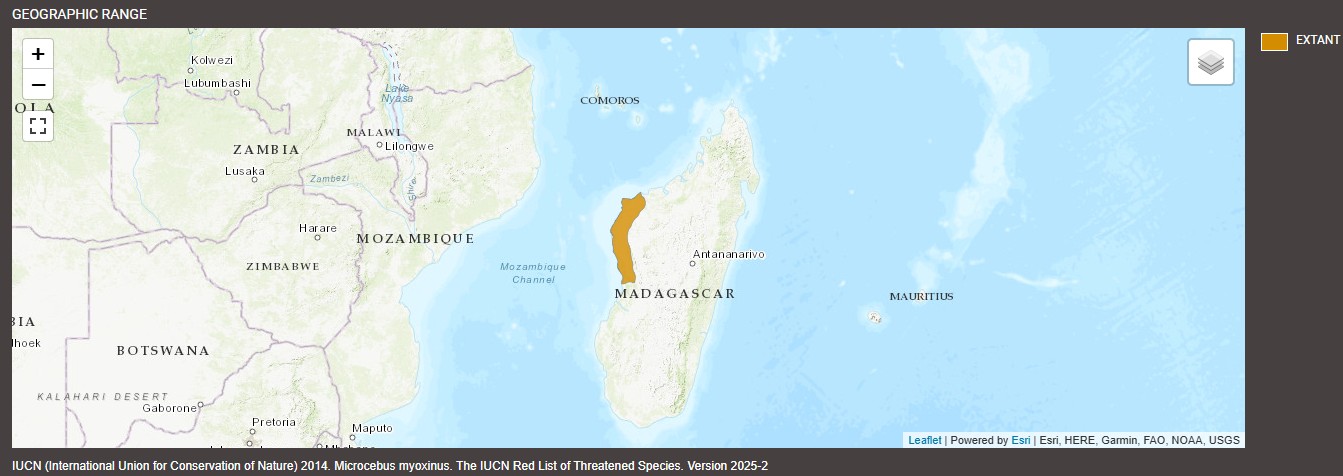
Peter’s mouse lemur, also known as the pygmy mouse lemur, the dormouse lemur, or the western rufous mouse lemur, is endemic to western Madagascar, where they range from the northern banks of the Tsiribihina River to at least the Soalala Peninsula and Baie de Baly. Across this region, Peters’ mouse lemur inhabits several protected and unprotected areas, including Tsingy de Bemaraha National Park and Nature Reserve, Tsingy de Namoroka National Park, the forests north of Belo-sur-Tsiribihina, Aboalimena, and areas near the village of Andramasay. Peters’ mouse lemur occupies habitats from sea level to elevations of nearly 2,950 feet (900 m), allowing it to inhabit a variety of landscapes within western Madagascar.
Within these regions, Peters’ mouse lemur inhabits the dry deciduous forests that characterize much of western Madagascar’s sub-tropical climate. These forests experience pronounced seasonal changes, with temperatures ranging from about 48°F (9°C) during the coolest months to 100°F (38°C) during the hottest periods, with average annual temperatures around 77°F (25°C). Annual rainfall averages approximately 39 to 59 inches (100-150 cm), with a wet season that typically extends from November through March and a dry season lasting from April through October. These seasonal patterns influence vegetation growth and the availability of food resources throughout the year, and many trees shed their leaves during the long dry season.
At Aboalimena, Peters’ mouse lemur occupies an ecotone, a transitional zone between habitats, where heavily degraded dry deciduous forest meets savanna. These landscapes are part of a historically dynamic region, with evidence from studies of mouse lemur evolution suggesting that Madagascar’s western habitats were once connected to more transitional wooded environments, creating a mosaic of dry forests and savannas that shaped the distribution of modern species. Peters’ mouse lemur has also been recorded in mangrove habitats at two localities, suggesting that they can use a wider variety of environments than previously recognized.
In Tsingy de Bemaraha, Peters’ mouse lemur is sympatric with the gray mouse lemur (Microcebus murinus), meaning that they share the range but remain distinct species.
Peters’ mouse lemur (Microcebus myoxinus) is recognized as a distinct species within the diverse Microcebus genus. Although they were first described by W.C.H. Peters in 1852, scientists later questioned whether they were truly a separate species and, for many years, classified them together with the grey mouse lemur (Microcebus murinus).
Research in the 1990s, followed by genetic studies, showed that Peters’ mouse lemur is a distinct species. Although scientists continue to study the relationships among Madagascar’s mouse lemurs, Peters’ mouse lemur is now widely accepted as a species.
Size, Weight, and Lifespan
Peters’ mouse lemurs are among the smallest primates, with a compact and specialized body plan that reflects their nocturnal lifestyle in Madagascar’s dry western forests.
Their head-and-body length averages about 4.87 inches (12.37 cm), placing them firmly within the smallest size range for primates. In contrast to their bodies, their tails are noticeably long, averaging about 5.79 inches (14.70 cm). This extended tail is not only important for balance during rapid arboreal movements but also stores fat reserves. Like other mouse lemurs, Peters’ mouse lemurs can accumulate significant energy stores in their tails and hind limbs, sometimes amounting to as much as a third of their total body weight, which are later used during periods of food scarcity.
Despite their extremely small size, Peters’ mouse lemur retains well-developed sensory structures that support nocturnal life. The ears are prominent relative to their body size, enhancing their ability to detect movement and sound in low-light environments. Their canine teeth are very small at approximately 0.09 inches (0.22 cm), reflecting their insect- and fruit-based diet and the general dental pattern seen across mouse lemurs.
In terms of body mass, Peter’s mouse lemur typically weighs around 1.73 ounces (49 g), which is roughly the weight of a standard chicken egg or a small snack bar. Individuals generally fall within a narrow range of about 1.5-1.9 ounces (43-55 g). This consistently low body weight places the species among the smallest living primates and highlights the extreme energetic constraints under which they live.
Even so, Peters’ mouse lemur maintains a surprisingly dynamic physiology that responds closely to seasonal change. One of the most interesting aspects of their biology is how body size and weight shift between males and females throughout the year. There is no fixed size difference between the sexes overall, but during the mating season, males become noticeably heavier than females. This increase is closely linked to reproductive activity, particularly the enlargement of the testes and heightened investment in mating behaviour. These seasonal shifts reflect the tight coupling between reproduction and environmental conditions in mouse lemurs, where food availability and energy balance strongly shape physiological investment.
Peters’ mouse lemur is thought to live between six and eight years in the wild, although more research is needed to confirm this estimate.
Appearance
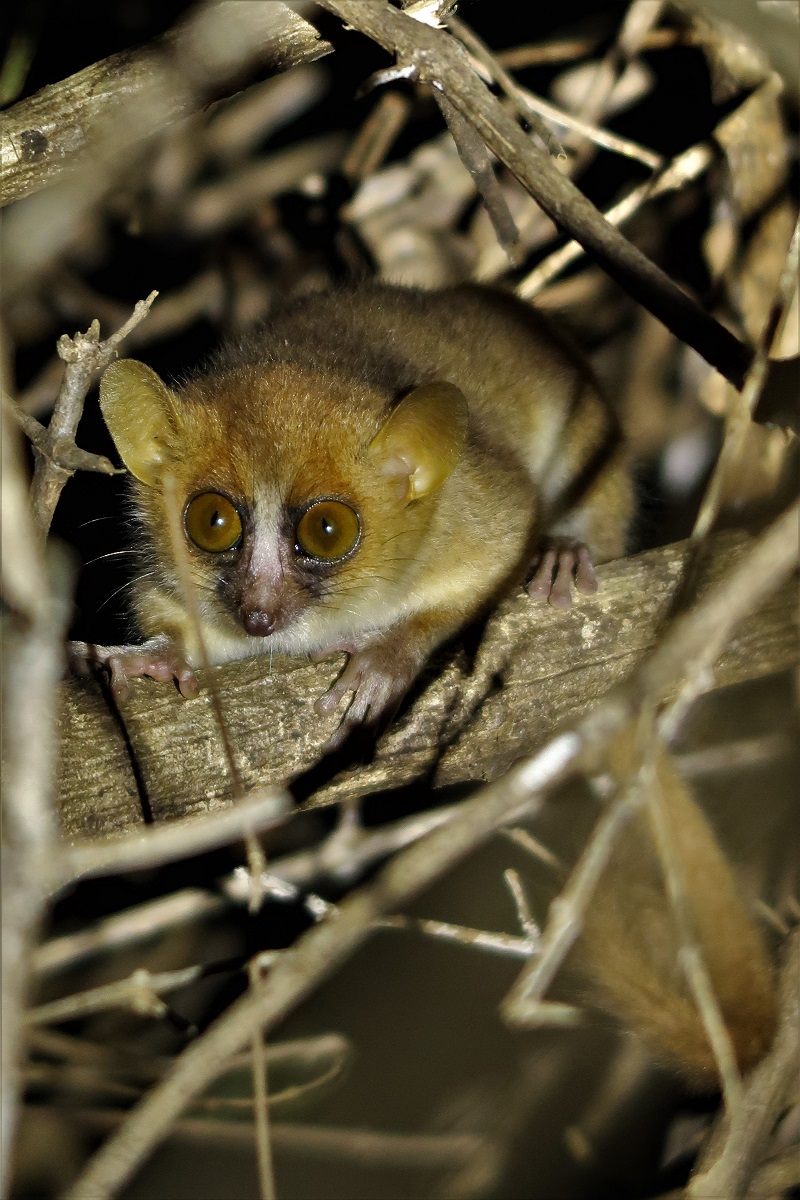
To blend into the dry forests of western Madagascar, where dappled light and bark textures dominate the landscape, Peters’ mouse lemur has a finely patterned and subtly colored coat. On their backs, the fur is a mix of light and medium browns, yellow-brown, and warm reddish-brown tones, with each hair darker at the base and lighter toward the tip. A clear light brown stripe runs along the middle of the back, starting behind the shoulders and continuing to the base of the tail, giving them a gently marked dorsal pattern that is visible without being bold. Their undersides are paler, with the central belly area a soft cream color, while the sides of the body blend cream with light grey. Beneath this outer coat, the underfur across both back and belly is dark grey, adding depth to the overall coloring.
Their faces carry some of the most distinctive markings. Large forward-facing eyes gather as much available light as possible, allowing Peters’ mouse lemur to navigate, forage, and detect predators after dark. Between their eyes is a small patch of off-white mixed with light cream and a hint of warm brown, and the fur around the eyes shifts into a slightly richer reddish-brown tone. The mouth contains a specialized toothcomb formed by six elongated, tightly packed lower front teeth, four incisors and two canines, that angle forward to resemble a comb. This adaptation helps Peters’ mouse lemur groom their coats by removing dirt and parasites and may also assist in scraping tree gums or collecting nectar when these foods are available. Prominent ears provide keen hearing, helping locate insects and other prey while also alerting the primate to approaching danger.
The tail continues the same subtle patterning. The upper side is striped in light brown and reddish-brown along most of its length, gradually becoming darker toward the tip, where it can appear deep brown to very dark brown. The underside of the tail is lighter and more variable, ranging from cream to light brown and sometimes mixed with pale grey tones. This subtle variation helps them remain camouflaged as they move through branches and shadows.
Their hands and feet are covered in pale grey to off-white fur, which reduces visual contrast against tree bark and lichen-covered surfaces during movement. This balance of soft browns, creams, and grays that closely match the textures and lighting of the forest habitat makes Peters’ mouse lemur highly inconspicuous in the wild.
Diet
Peters’ mouse lemurs are frugivorous, meaning they mainly feed on fruits. Their small size allows them to forage among the thin branches, vines, and dense vegetation that larger animals cannot easily reach, providing access to fruits growing throughout the forest.
Although fruit is the primary food source, Peters’ mouse lemur takes advantage of whatever foods are seasonally available in Madagascar’s dry forests. They consume insects, flowers, and tree gums, shifting between resources as availability changes across the year. Insects provide an important source of protein, particularly when fruit is less abundant, while flowers add additional seasonal variety to the diet. Evidence from Madagascar’s dry forest lemurs suggests that tree gums may provide benefits beyond nutrition. In addition to supplying energy, some tree exudates contain bioactive compounds with antibacterial properties. Researchers have proposed that consuming these gums may contribute to health maintenance, although whether lemurs intentionally select them for medicinal purposes remains unknown.
Behavior and Lifestyle
Peters’ mouse lemurs are nocturnal, arboreal primates, meaning they spend most of their lives in the trees of Madagascar’s dry western forests and are active at night. During the day, individuals retreat into tree holes or other natural shelters, which protect them from predators and buffer against strong daily temperature fluctuations. The availability of suitable tree holes is therefore an important structural factor influencing habitat use.
Mouse lemurs are most active at night and forage within the forest canopy. Their movement is primarily quadrupedal, meaning on all fours, with travel along branches occurring in rapid bursts. This includes running and frequent short leaps between supports, a typical locomotor pattern for mouse lemurs. Although they occasionally descend to the ground, mouse lemurs are overwhelmingly adapted to arboreal locomotion, that is, in trees. Their small body size also allows access to the smallest branches, enabling them to exploit dense shrubs and tangled vines that are inaccessible to larger primates.
Activity patterns and spatial behaviors shift seasonally, particularly during the mating period. Males expand their home ranges significantly and travel longer distances at night in search of receptive females, while females maintain smaller and more stable ranges. This seasonal difference in ranging behavior reflects the strong reproductive pressures that shape movement and energy use in the species.
Another key feature of Peters’ mouse lemurs’ lifestyle is their ability to conserve energy through daily torpor during the cool, dry season. Individuals may spontaneously enter short periods of reduced activity and lowered metabolic rate, with torpor bouts typically lasting several hours. During this state, body temperature drops near ambient conditions, and metabolic rates are dramatically reduced, allowing substantial energy savings. Arousal from torpor occurs in a two-stage process: passive warming as ambient temperatures rise, followed by active metabolic heating once body temperature begins to increase. Females are more likely than males to enter torpor, particularly under natural conditions, which can influence seasonal differences in activity patterns and even observed sex ratios in populations. However, in warmer environments, prolonged torpor becomes more difficult to maintain, leading to more balanced activity budgets between sexes.
Peters’ mouse lemur can survive harsh dry-season conditions by entering torpor, a kind of energy-saving ‘shutdown mode’ where their body temperature and metabolism drop dramatically, almost like pressing pause on life for several hours at a time.
Males can dramatically expand their nightly travel range during the breeding season, moving long distances through the forest in search of mates.
Peters’ mouse lemurs are often called solitary, but that doesn’t mean they avoid others completely. Individuals regularly cross paths, sometimes share sleeping sites, and may even tolerate close contact in resting spots: more like independent roommates with flexible boundaries than truly solitary animals.
Peters’ mouse lemur has long been described as a largely solitary primate, a conclusion drawn from early field observations showing individuals foraging alone and typically sleeping in isolation within tree holes or dense tangles of vegetation. This pattern fits well with the ecology of small nocturnal foragers, where food resources such as insects, fruit patches, and tree gum sites are often dispersed or too limited to be shared, making solitary feeding an efficient strategy.
However, more recent research has added important nuance to this view. While mouse lemurs do not form cohesive social groups like many diurnal primates, their communities are better understood as part of a dispersed social system. In such systems, individuals forage independently but still encounter one another regularly within overlapping home ranges. These encounters create opportunities for interaction beyond simple avoidance, including mating, shared use of sleeping sites, and occasionally feeding at the same resource patches. Studies of closely related mouse lemurs show that individuals may sometimes share sleeping sites or remain in proximity within resting locations for extended periods, suggesting a measurable degree of social tolerance. Although Peters’ mouse lemurs occasionally share sleeping sites, they seldom feed side by side. The fruits, insects, flowers, and tree gums that make up their diet are often small and widely dispersed throughout the forest, making it more practical for each individual to search for food independently.
Importantly, these interactions are not structured by clear dominance hierarchies. No consistent male or female dominance has been detected in Peters’ mouse lemur, further supporting the idea of a flexible, loosely structured social system rather than a rigid group hierarchy.
However, it is important to note that not all studies observe Peters’ mouse lemur under natural conditions. Some observations come from studies in which individuals were temporarily kept in enclosed settings rather than observed entirely in the wild. In these situations, they were more likely to share sleeping sites, a behavior that may have been influenced by stress or disturbance, meaning it may not reflect how Peters’ mouse lemurs naturally behave in their forest habitat.
The daily life of Peters’ mouse lemur is best characterized as primarily solitary but socially permeable.
Direct studies on communication in Peters’ mouse lemur are limited, and most understanding is inferred from research on closely related mouse lemur species within the genus Microcebus. As a nocturnal primate with a largely solitary foraging lifestyle, communication is expected to rely less on continuous social signaling and more on short-range and context-specific cues.
Chemical communication is likely to play a central role. Like other mouse lemurs, Peters’ mouse lemur is presumed to use scent marking to signal presence, reproductive status, and territorial use of space. This form of communication is particularly effective in low-light environments where visual signals are limited, and individuals frequently encounter one another only briefly within overlapping home ranges.
Vocal communication is also likely to be important, especially during nocturnal activity and mating periods. Mouse lemurs are known to produce a range of calls used to maintain contact, advertise reproductive readiness, and mediate social encounters between individuals that otherwise forage alone. These vocal signals help coordinate interactions without requiring prolonged physical proximity.
In addition to scent marking and vocalizations, Peters’ mouse lemurs use touch, known as tactile communication, during close encounters. Brief physical contact, such as grooming or resting together in the same sleeping site, may help individuals recognize one another, reduce aggression, and signal reproductive readiness during the breeding season. Although Peters’ mouse lemurs are mostly solitary, these short interactions are important when they come together.
Peters’ mouse lemur follows the general primate pattern seen in the genus Microcebus, which is characterized by very high reproductive rates and one of the fastest life histories among primates. Within this framework, reproduction is highly seasonal and closely linked to environmental conditions in Madagascar’s dry forests.
The breeding season is short and concentrated, occurring mainly between September and October. During this period, marked physiological and behavioral changes take place, particularly in males. Testes increase significantly in size, reflecting heightened reproductive activity and investment in sperm production. Males also tend to become heavier than females during the mating season, a pattern that reverses outside the breeding period when females are often heavier.
Reproductive behavior is consistent with a multi-male, multi-female mating system in which females are not synchronized in their estrus cycles. This lack of synchrony, combined with overlapping male home ranges and increased male movement during the breeding season, creates conditions for frequent mating opportunities and high levels of competition. Evidence for this includes the presence of vaginal sperm plugs in females, suggesting that males may attempt to reduce the likelihood of subsequent mating by rivals.
Despite these intense reproductive interactions, Peters’ mouse lemurs do not form stable family groups. Individuals typically sleep alone in vegetation tangles and forage independently throughout the year. During the mating season, male spatial behavior changes noticeably, with males ranging more widely, sometimes travelling long distances in a single night and overlapping with multiple female home ranges. Females, in contrast, maintain more stable and restricted ranges. Scientists are unsure whether males or females leave this ‘neighborhood’ that they grew up in when they reach maturity.
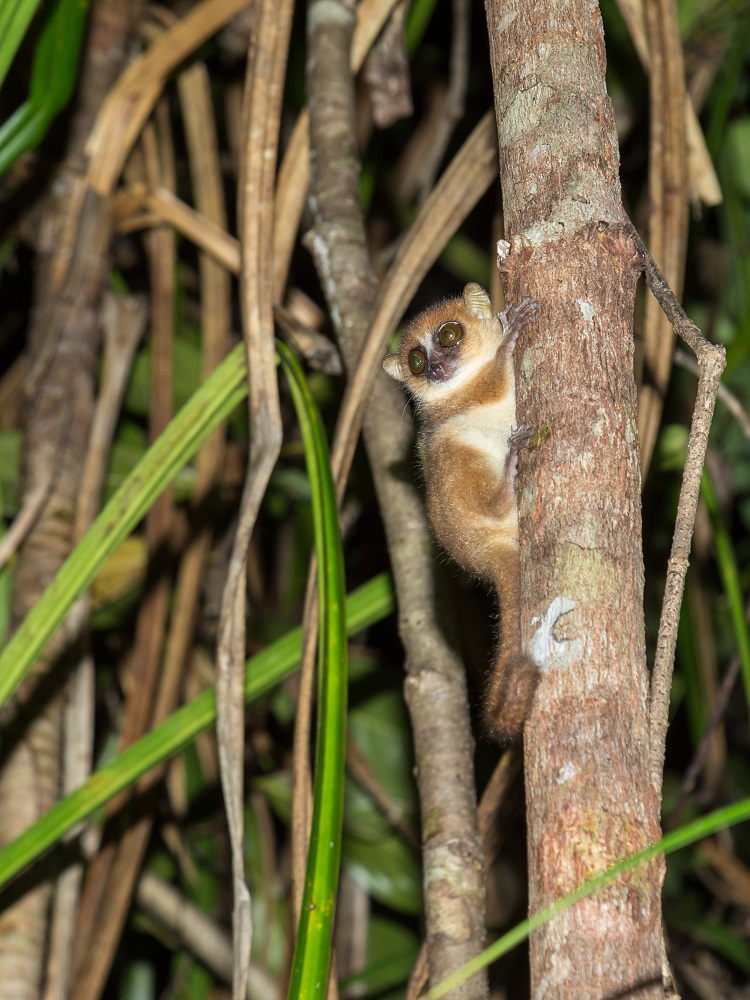
Peters’ mouse lemur occupies a dual ecological role in Madagascar’s dry western forests, serving as a key prey species and contributing to forest regeneration through seed dispersal. As a small-bodied, nocturnal primate, Peters’ mouse lemur is vulnerable to a wide range of predators, including raptors, civets, mongooses, snakes, and occasionally domestic dogs. The lemur’s position in the food web reflects the tight ecological constraints of a small nocturnal primate living in a predator-rich environment.
Despite this high predation risk, Peters’ mouse lemurs play an important positive role as a seed disperser. By consuming fruits and moving through the canopy while foraging, individuals help transport seeds away from parent trees, promoting plant regeneration and maintaining forest structure. Even a small primate has a disproportionately important impact on ecosystem dynamics.


The International Union for Conservation of Nature lists Peters’ mouse lemur as Vulnerable (IUCN, 2012), appearing on the IUCN Red List of Threatened Species.
This listing is based on evidence suggesting that Peter’s mouse lemur population declined by at least 30% between approximately 1997 and 2012 (about three generations) primarily due to ongoing habitat loss, fragmentation, and degradation. These pressures are linked largely to unsustainable agricultural practices, including land conversion and repeated disturbance of dry forest ecosystems. Importantly, these drivers have not ceased and are not easily reversible, meaning that both historical and ongoing habitat change continue to shape population trajectories.
Beyond direct habitat loss, fragmentation is particularly significant for Peters’ mouse lemurs because of their fine-scale dependence on forest structure and dispersed resources. Phylogeographic studies suggest that historical landscape connectivity across Madagascar has changed dramatically over time, while genetic evidence indicates that, during parts of the Pleistocene, dispersal across the island was more widespread, implying a more continuous or at least more permeable mosaic of forested habitats. In contrast, the modern landscape is highly fragmented, with eastern rainforests and western dry forests now separated by the Central Highlands, an area dominated today by anthropogenic grassland and savanna-like vegetation.
While there is ongoing debate about how natural this separation originally was, genetic patterns in mouse lemurs suggest that the Central Highlands likely once functioned as a mosaic of wooded savanna and transitional habitats, facilitating movement between forest blocks. The current fragmentation, therefore, represents not only a reduction in habitat area but also a loss of historical connectivity that may have supported gene flow among populations.
Peters’ mouse lemur is listed in Appendix I of the Convention on International Trade in Endangered Species (CITES), an international agreement between governments whose goal is to ensure that international trade in specimens of wild animals and plants does not threaten their survival.
Peters’ mouse lemur resides within several protected areas in western Madagascar, including Tsingy de Bemaraha National Park and Tsingy de Namoroka National Park, as well as associated reserve zones within this broader protected landscape. These areas provide some refuge from the most intense forms of habitat conversion, although protection on paper does not always fully prevent localized habitat degradation or fragmentation.
Ex-situ conservation is not currently part of their management, as no individuals are known to be held in captivity. This makes the preservation of wild populations and habitats even more critical, since there are no captive assurance populations to support future reintroduction or population reinforcement efforts.
A key conservation priority for Peters’ mouse lemur is improving understanding of the species’ true distribution. Current knowledge is based on relatively limited sampling, and there is a need for targeted surveys between known localities to determine whether populations are more continuous or fragmented than currently assumed. In particular, further research is required to assess whether they also occur in less-studied habitats such as mangrove or transitional forest zones.
- https://link.springer.com/article/10.1023/A:1005511129475
- https://www.mdpi.com/2297-8739/10/11/575
- https://www.iucnredlist.org/ja/species/13325/16113437
- https://doi.org/10.48580/dgxsq
- https://link.springer.com/article/10.1007/s003600050008
- https://pmc.ncbi.nlm.nih.gov/articles/PMC4961119/
- https://www.researchgate.net/publication/13533817_A_Cytogenetic_Study_of_Microcebus_myoxinus
- https://www.semanticscholar.org/paper/A-preliminary-study-of-spatial-distribution-and-of-Schwab/677678944abb8aca5bb55d4127a208a9ba47cf5d
- https://pmc.ncbi.nlm.nih.gov/articles/PMC6525410/
- https://primate.wisc.edu/primate-info-net/pin-factsheets/pin-factsheet-mouse-lemur/
- https://www.newscientist.com/article/mg14719861-700-return-of-the-little-lemur/
- https://www.nationalgeographic.com/animals/mammals/facts/mouse-lemurs
- https://doi.org/10.17638/03188170
- https://alltheworldsprimates.org/
- https://www.inaturalist.org/taxa/74592-Microcebus-myoxinus
- https://a-z-animals.com/articles/the-lemurs-secret-weapon-why-these-primates-have-a-built-in-toothbrush/
- https://animaldiversity.org/accounts/Microcebus_myoxinus/
Written by Brenda Awuor, May 2026