
Niemitz’s Tarsier, Tarsius niemitzi
NIEMITZ'S TARSIER
Tarsius niemitzi
Geographic Distribution and Habitat
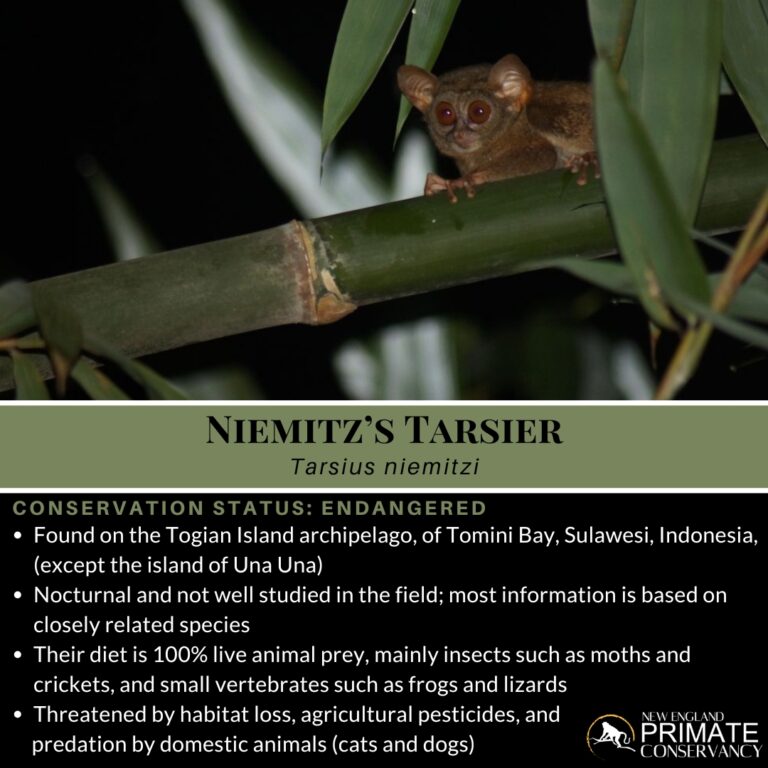
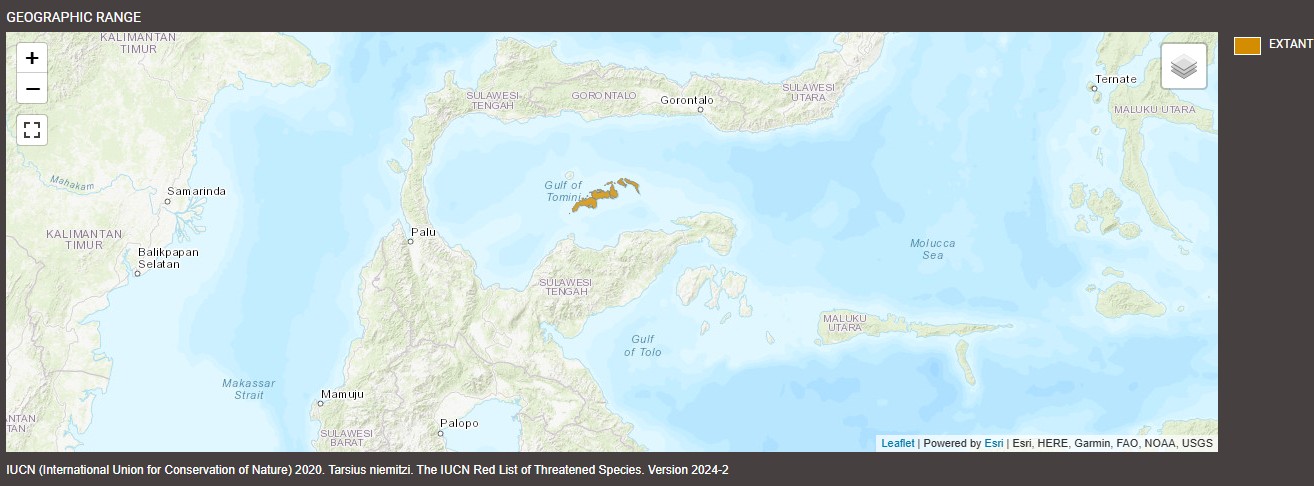
The Niemitz’s tarsier is endemic to (meaning only found in) the archipelago of the Togian Islands in the Gulf of Tomini off the Indonesian island of Sulawesi. The only island they are not found on is the island Una Una, which is farther from the rest of the islands. They occur in an area smaller than 772.20 square miles (2,000 square km).
The Togian Islands have a tropical marine climate and feature tropical lowland forests, mangroves, and human settlements, including farmlands. It is difficult to say exactly which habitats the Niemitz’s tarsier frequents the most since they have not been studied in the wild. They likely can be found in shrubby areas that provide plenty of cover, similar to habitats utilized by closely related species.
Tarsiers have caused taxonomists many headaches since their discovery. At one point thought to be a strange type of opossum, but scientists eventually realized tarsiers were in fact primates. Tarsiers still couldn’t make things simple, though, and contradicted the nice and tidy suborders researchers had established for primates: simians and prosimians.
While at first appearing to have more in common with prosimians, sharing many ancestral traits, tarsiers also have several key characteristics more similar to simian primates, for some researchers to agree with this classification. One of these controversial characteristics was the tarsier’s nose, which, like simian primates, is dry, unlike the moist nose common in prosimian primates. Researchers proposed two new infraorders, all because of tarsiers: strepsirrhines (wet-nosed primates) and haplorrhines (dry-nosed primates). In the primate evolutionary family tree, tarsiers are haplorrhines that represent an intermediate form between simians (monkeys and apes) and prosimians (lemurs, galagos, angwantibos, pottos, and lorises).
Size, Weight, and Lifespan
Although the amount of research we currently have on the Niemitz’s tarsier is limited, we do have some measurements from five individuals (two females and three males). Because this sample size is limited, it is entirely possible for these numbers to change in the future.
Female Niemitz’s tarsiers weigh 0.23–0.24 pounds (104–110 g), and males weigh 0.28–0.30 pounds (125–138 g)—which suggests this species is sexually dimorphic, given the size difference between males and females. Although body length was not recorded, we know that most adult tarsiers measure about 4 to 6 inches (10 to 15 cm) from head to body. We do have the tail measurements for the Niemitz’s tarsier, with females having tails 9.65–10.28 inches (24.5–26.1 cm) long, and males having tails 9.69–10.16 inches (24.6–25.8 cm) long.
With the lack of research on the species in the wild, the lifespan of the Niemitz’s tarsier is currently unknown. Generally speaking, the average lifespan range for tarsiers overall is roughly 12 to 20 years, depending on species, habitat quality, and human impact.
Appearance
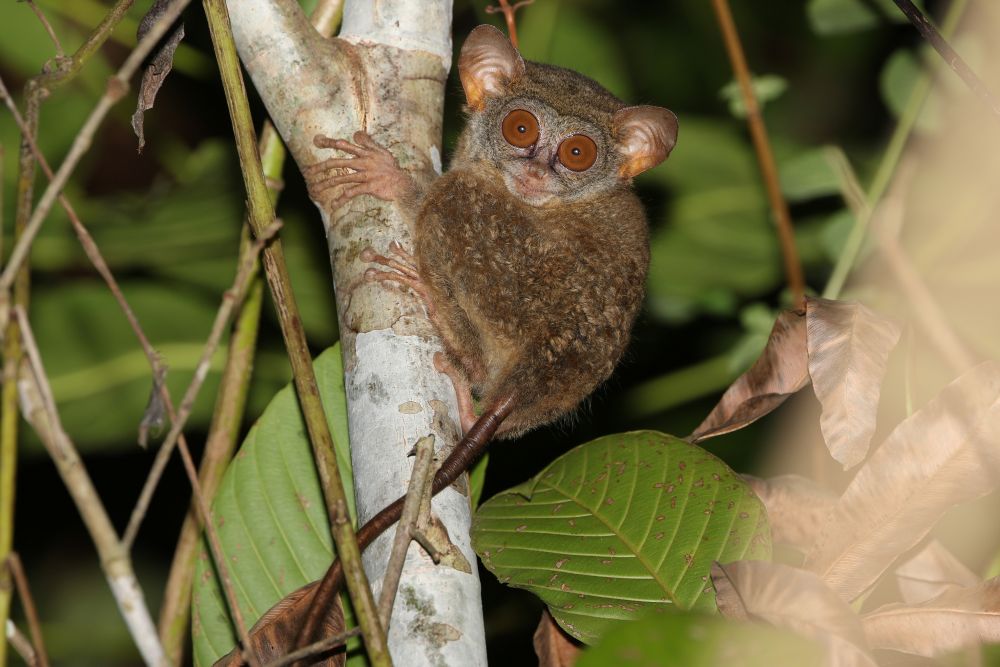
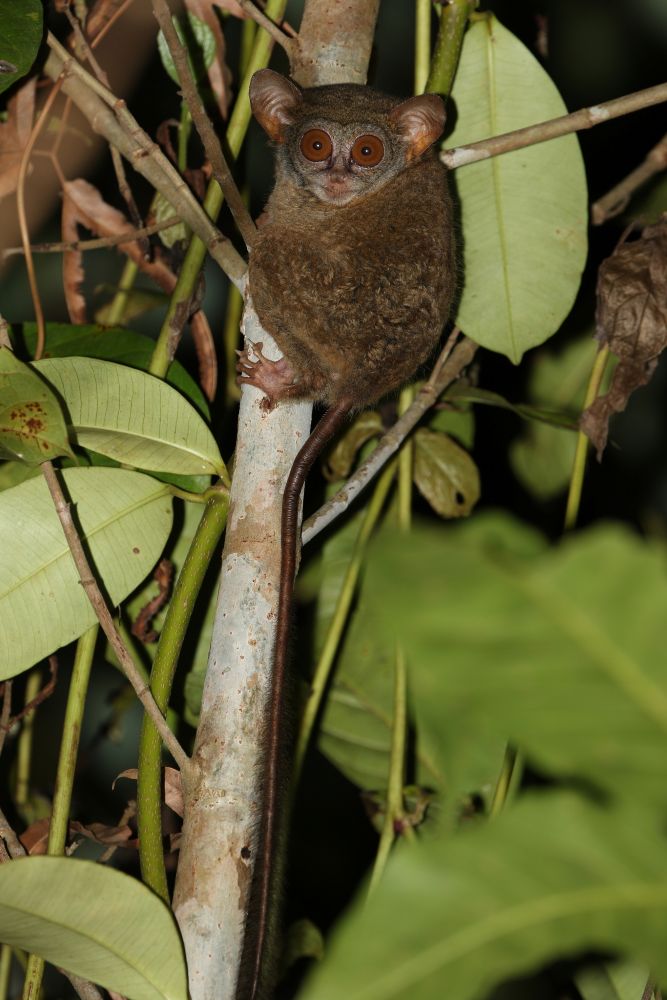
The Niemitz’s tarsier has darkly pigmented skin, especially on the tail. Their fur is dark brown, with the exception of their faces, which are dark gray. Older individuals seem to be darker in color. Their tails are bare until halfway down, where the hair becomes thicker towards the end (similar to a mascara brush). This is unusual among small island-dwelling tarsiers, which typically have a reduced tail tuft.
Tarsiers are characterized by their huge eyes, which help them pick up every bit of light in the nighttime. Too big to turn in their eye sockets, tarsiers can turn their heads 180 degrees to see their surroundings. Their eyes are comparable in size only to their large ears that can pick up the buzz of even tiny insects. Always ready to jump on their prey, the Niemitz’s tarsier has hind legs that stay bent inwards, giving them a posture similar to that of a frog.
Diet
Tarsiers are the only primates that are completely carnivorous, and like other tarsiers, Niemitz’s tarsiers likely primarily eat insects. Other tarsiers have also been known to eat small vertebrates, such as lizards, so we can guess that these are also on the menu for the Niemitz’s tarsier.
Behavior and Lifestyle
Because the Niemitz’s tarsier has not been formally studied in the wild, our understanding of their specific behaviors is very limited. This lack of research is unsurprising, as scientists have only recently begun studying tarsier behavior and ecology. This is largely due to the small size of tarsiers, which makes them difficult to find. On top of that, tarsiers are nocturnal and are only active at night, so studying them in the wild would require special equipment and possibly adjustments to researchers’ sleep schedules. Making observing tarsiers even more difficult, they also lack a tapetum lucidum, which is a special reflective layer behind the eye of many mammals that gives the characteristic eyeshine you’ve probably seen in your dog or cat at home. The research that has been done on other tarsier species has proven to scientists that tarsier behavior is just as unusual as every other aspect of these tiny primates.
With the help of their frog-like legs, tarsiers move primarily by vertical clinging and leaping (or VCL) between the tree branches. While technically arboreal, tarsiers are typically only found about six feet from the forest floor.
Predation of the Niemitz’s tarsier has not been recorded, but they are possibly hunted by the owl species that also live on the Togian islands.
Named after Dr. Carsen Niemitz, who is recognized as the father of tarsier field biology.
Locally known as bunsing, tangkasi, and podi.
Researchers typically identify tarsier groups by which individuals sleep together. Some species sleep in small groups of 2–11 individuals, and others are solitary, with the exception of mother-infant pairs and possibly courting pairs of opposite sexes. Because the sleeping habits of the Niemitz’s tarsier have not been observed, we cannot be sure which social structure they may follow. Tarsiers may be monogamous, forming long-term pair bonds, or polygamous, mating with multiple partners. With current knowledge, however, it’s difficult to say which strategy Niemitz’s tarsier follows.
Tarsiers typically sleep in dense vegetation such as clusters of vines or tree hollows during the day, and often utilize between two and three potential sleeping sites. They start dark and early, just after sunset, to begin foraging. Groups will head back to their sleeping site just before dawn and perform a territorial duet to let other tarsiers know to stay away from their territory before tucking in for the day.
Niemitz’s tarsiers share the Togian islands with many other unique species, including a species of wild pig known as the Togean Islands barbirusa. The only other primate found on the archipelago is the Tonkean macaque.
Because the Niemitz’s tarsier hasn’t been thoroughly studied in the wild, many specifics of their communication remain unknown. However, their large ears suggest that, like many nocturnal primates, vocalizations are likely their most important form of communication. In fact, researchers first suspected the Niemitz’s tarsier might be a distinct species based on differences in their territorial duets compared to other tarsiers in the same region. Their calls are much simpler than those of other tarsiers, typically following a call-and-response pattern, with males replying to a single female call with two to three of their own.
Tarsiers are also known to scent mark, another common communication tactic among nocturnal primates with more dispersed social systems. By either rubbing special scent glands or urinating on tree branches and other surfaces, tarsiers can let each other know where their territory is and possibly also communicate reproductive status.
Based on other tarsier species, the Niemitz’s tarsier likely has a gestation period of about six months. As far as we are currently aware, all tarsiers give birth to a single infant, which makes sense given that baby tarsiers are up to 25% of their mother’s body weight at birth. Instead of letting their (relatively) big babies ride around on mom’s back or chest like many other primates do, tarsier moms are known to park or cache their babies nearby while she forages for food. Once she’s done feeding in the area, mom will pick up her baby with her mouth by the scruff of its neck and move to a different location to forage for bugs and other prey.
It is thought that, historically, tarsiers may have been capable of producing multiple offspring at a time. This hypothesis comes from several features of their biology: their bicornuate uterus, which has two separate chambers fused at the base, can accommodate two embryos simultaneously, and they possess two to three pairs of mammary glands, more than the single pair typically needed for one infant. Interestingly, these traits are also found in strepsirrhine primates, which often give birth to multiple babies at once. However, tarsiers usually produce a single offspring, a trait more characteristic of haplorrhine primates, whose reproductive biology is adapted for one infant at a time. This combination of features—some resembling strepsirrhines, others resembling haplorrhines—is one reason scientists have long struggled to determine exactly where tarsiers fit within the primate order.
While, like many aspects of the Niemitz’s tarsier’s biology, their specific ecological role has not been determined. However, since we know that, like other tarsiers, they have a primarily insectivorous diet, the Niemitz’s tarsier may act as pest control for the forest. Although insects also have unique ecological roles to play, if any one species gets too overpopulated, it can be ultimately detrimental for the ecosystem. Insectivores like the Niemitz’s tarsier help keep insect populations in check, and therefore likely help maintain the overall balance of their ecosystem.


The Niemitz’s tarsier is classified as Endangered by the International Union for Conservation of Nature (IUCN, 2020), appearing on the IUCN Red List of Threatened Species. Their population size is predicted to decrease. One of their major threats is habitat loss, primarily due to illegal logging and the conversion of forests into farmland. It is estimated that the islands’ remaining forests account for only 40% of the land area.
Agricultural pesticides also pose a danger by reducing insect numbers, and therefore depleting the tarsiers’ food source. Niemitz’s tarsiers may also be preyed on by domestic dogs and cats. Locals commonly mistake tarsiers as crop pests and may try to eradicate any tarsiers found on their farms, when in fact the tiny carnivorous primates likely serve to protect farmers’ crops by eating potentially harmful insects. Niemitz’s tarsiers are captured and sold in the pet trade.
Niemitz’s tarsiers are listed in Appendix II of the Convention on International Trade in Endangered Species (CITES), an international agreement between governments whose goal is to ensure that international trade in specimens of wild animals and plants does not threaten their survival.
Conservationists call for local education to help people understand that tarsiers are not a threat to their crops and are likely beneficial to have around. Conservationists recognize the Sulawesian region (which includes the Togian Islands) as a conservation hotspot, as it contains many unique species that cannot be found anywhere else. Identifying each distinct tarsier species helps researchers assess the biodiversity of the region and the urgency for conservation efforts, meaning the recognition of the Niemitz’s tarsier as a separate species is already a conservation win.
While most of the Togian Islands are unprotected, the Niemitz’s tarsier is known to occur in the protected Togean Marine National Park, although protections are ineffectively enforced.
- Shekelle, M. 2020. Tarsius niemitzi. The IUCN Red List of Threatened Species 2020: e.T162337005A171341769. https://dx.doi.org/10.2305/IUCN.UK.2020- 3.RLTS.T162337005A171341769.en
- Shekelle, M., Groves, C. P., Maryanto, I., Mittermeier, R. A., Salim, A., & Springer, M. S. (2019). A new tarsier species from the Togean islands of central Sulawesi, Indonesia, with references to Wallacea and conservation on Sulawesi. Primate Conservation, (33).
- Supriatna, J., Shekelle, M., Fuad, H. A., Winarni, N. L., Dwiyahreni, A. A., Farid, M., … & Zakaria, Z. (2020). Deforestation on the Indonesian island of Sulawesi and the loss of primate habitat. Global Ecology and Conservation, 24, e01205.
- Jati, A. S., Broto, B. W., Dri, G. F., Rejeki, I. S., & Mortelliti, A. (2024). Developing a monitoring protocol for a threatened species in a developing country: Lessons learned from monitoring the Togean Islands babirusa. Journal for Nature Conservation, 82, 126757.
- Gursky, S. (2011). Tarsiiformes. In Primates in Perspective (second, pp. 79 – 90). Oxford University.
Written by Lina Rademacher, Oct 2025