
Black Crested Mangabey, Lophocebus aterrimus
BLACK CRESTED MANGABEY
Lophocebus aterrimus
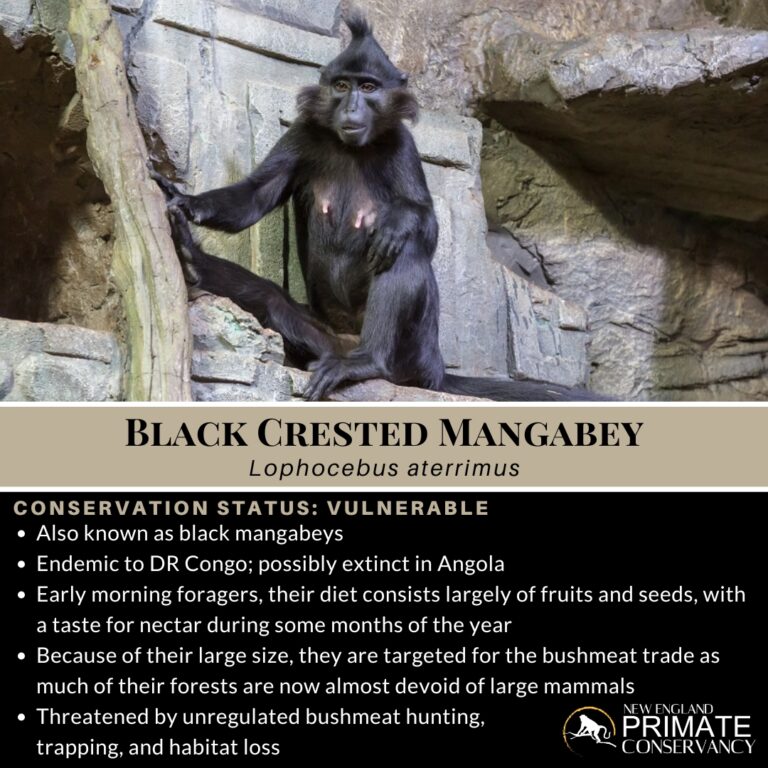
Geographic Distribution and Habitat
Black crested mangabeys (Lophocebus aterrimus) are native to the Central African nation of the Democratic Republic of the Congo (DRC). They inhabit rainforests south of the Congo River and extend into northern Angola. However, extensive hunting and years of civil conflict may have led to their extirpation (local extinction) in Angola. The Kasai and Kwango Rivers form the eastern and western limits of their range.
These mangabeys are adaptable and use multiple layers of the rainforest, from the high canopy to the forest floor. However, they appear to prefer the middle and upper canopy, typically at heights between 59 and 137 feet (18–42 m).
They are also commonly known as black mangabeys.
Classifying mangabeys into different genera and species has been challenging because they share traits with several other primate groups. Black crested mangabeys were thought to be guenons, another group of long-limbed, slender monkeys. As a result, they were originally placed in the genus Cercopithecus. Some older research on the species was published under the former scientific name Cercopithecus aterrimus.
Subsequent studies of molecular and skull morphology have helped differentiate mangabeys based on their unique physical and behavioral characteristics. As a result, black crested mangabeys, which possess traits such as a prominent crest of fur on their heads and an arboreal lifestyle, were reclassified into the genus Lophocebus, or baboon-like mangabeys.

Size, Weight, and Lifespan
Males are significantly larger than females, weighing approximately 15% to 30% more on average. Adult males typically weigh between 13 and 24 pounds (6–11 kg), while females weigh between 9 and 15 pounds (4–7 kg). Body length varies with sex and age, but most adults measure between 18 and 26 inches (45–65 cm). Their tails are considerably longer than their bodies, measuring 32-34 inches (80–85 cm), and help them maintain balance as they move through the canopy.
On average, black crested mangabeys live for about 20 years in the wild. The oldest recorded wild individual was estimated to be 32 years old. In captivity, where food is consistently available and predation is absent, individuals can live even longer. The oldest recorded captive black crested mangabey was a 37-year-old male.
Appearance
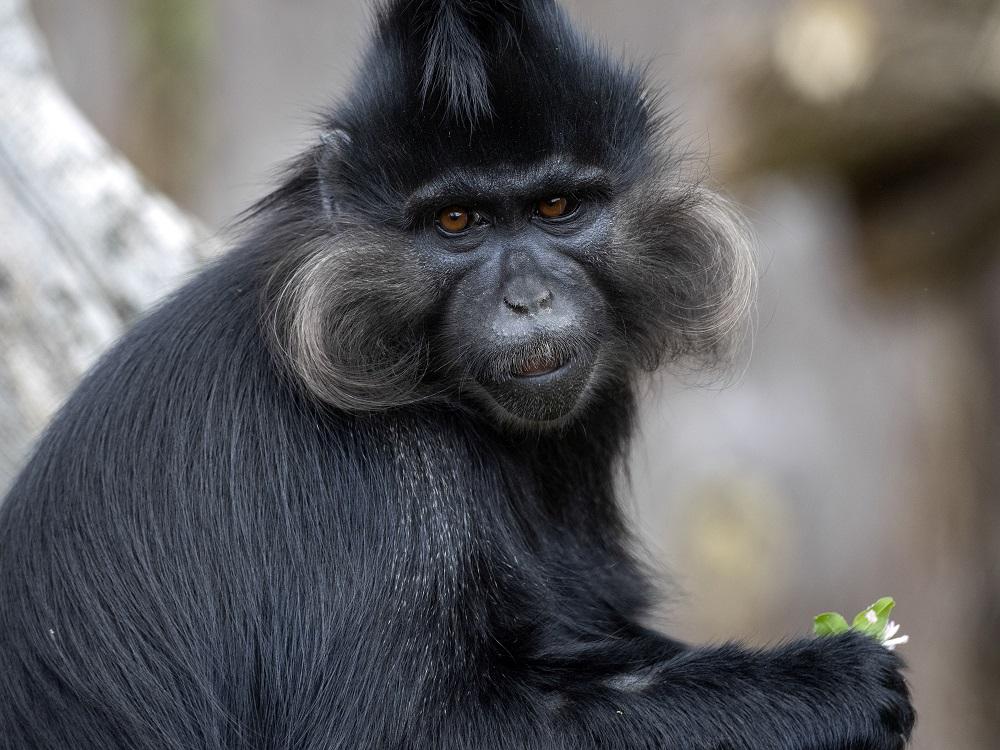
As their name suggests, black crested mangabeys have characteristic black coloration throughout their bodies and a large crest of fur that rises to a point on top of their heads. They also have an impressive set of gray-white whiskers and cheek fur that curls away from the face. Like other mangabeys, they have cheek pouches that temporarily store food, which can make their cheeks appear exaggeratedly round.
Male mangabeys have enlarged canines that are used primarily for social displays and establishing dominance. You can read more about the role of these impressive teeth in the “Daily Life and Group Dynamics” section.
These primates also have thickened, hairless skin pads called ischial callosities on their buttocks. These dull-colored, toughened pads allow mangabeys to sit comfortably on branches for extended periods while feeding, resting, or socializing.
These slender monkeys have long arms, opposable thumbs (their thumb can reach and touch other fingers), and non-prehensile tails (tails cannot grasp objects) that are longer than their bodies and help them maintain balance. Together, these traits make them well-suited for gripping branches and moving through the forest canopy.
Although black coloration is typical, individuals with patchy cream-colored fur or even entirely pale fur have been documented. These unusual color morphs result from genetic conditions known as leucism and albinism. Leucistic individuals lack pigment-producing cells called melanocytes in certain areas of the body, resulting in patches of white fur while typically retaining their normal dark-colored eyes. Albino individuals lack melanin, one of the primary pigments responsible for dark coloration in primates. This results in an overall paler appearance and lighter-colored eyes, which can sometimes appear blue or red.
While lighter-colored eyes can impair vision and pale fur may make individuals more visible to predators, many leucistic and albino mangabeys survive to adulthood and successfully reproduce. As a result, these conditions are uncommon but regularly documented in wild populations.
Diet
Black crested mangabeys primarily feed on seeds and fruit. They are considered omnivores because they sometimes consume insects, small rodents, bark, and nuts. They have strong teeth with a thick layer of enamel that helps them crack through the tough husks that protect nuts and seeds.
They also have cheek pouches (small pockets inside their cheeks) where they can temporarily store food while foraging. This adaptation allows them to gather food quickly when they are more vulnerable to predators because their attention is focused on feeding. Once their cheek pouches are full, they can retreat to a safer location high in the canopy to eat their food away from potential threats.
These long-limbed, dexterous monkeys can climb into the highest parts of the canopy and descend to forage on the forest floor. This ability gives them access to a wide variety of fruits and other plant materials, providing an advantage over primates with more specialized diets or those that cannot reach the less sturdy branches high in the trees.
Mangabey diets tend to fluctuate seasonally as fruit availability changes. During periods when fruit is scarce, they shift to feeding more on insects, bark, and other available food sources. They also appear to have a well-developed spatial memory, maintaining a mental map of productive feeding sites within their home range. When favored fruiting trees come into season, they often travel directly to them, suggesting they rely on their memory of reliable food sources.
They obtain almost all of their water requirements from the food they eat. However, on rare occasions, they have been observed scooping up and drinking water collected in tree cavities.
Behavior and Lifestyle
Black crested mangabeys are rather shy animals that tend to flee into the dense canopy when they detect potential threats, including humans. This makes them difficult for researchers to observe and study over long periods. In one study, researchers spent 10 days locating and observing a group of black crested mangabeys before the monkeys became sufficiently habituated to their presence and resumed their normal activities. This wariness is one reason why relatively few ecological and behavioral studies have been conducted on the species.
Black crested mangabeys are almost entirely arboreal (tree-dwelling). Their slender bodies, long tails and limbs, strong digits (fingers and toes), and opposable thumbs enable them to navigate the complex network of branches in their rainforest habitat.
They typically move on all fours, using their tails for balance, but they can also walk bipedally (on two legs) to reach fruit above them. Their strong toes allow them to cling to small vertical supports while sitting on a more stable horizontal branch. They can hang from a branch with one arm while reaching for fruit on otherwise inaccessible limbs. Sometimes they are observed clinging to tree trunks (much like a sloth) with both feet and one arm while reaching below them. On rare occasions, they have even been seen hanging upside down by their feet to access food.
They are diurnal, meaning they are active during the day and spend most of their daylight hours foraging. Before sunset, they gather high in the canopy, away from many nocturnal predators, and sleep together in groups.
Not all black crested mangabeys are black. Leucistic and albino individuals with cream-colored or white fur have been documented in wild populations.
They can hang by one arm, cling to tree trunks, and even hang upside down by their feet to reach food.
Black crested mangabeys store food in special cheek pouches, allowing them to quickly gather fruit and retreat to a safer spot before eating.
They maintain a mental map of productive fruit trees and can travel directly to them when they come into season.
Black crested mangabeys are often seen in multi-species groups with more eyes watching for predators such as crowned hawk-eagles.
As diurnal primates, black crested mangabeys begin their day early, usually around 6 a.m. They sleep in groups, and as they wake, they vocalize to rouse other members and begin foraging. Most of their active time is spent searching for food or feeding. Mangabeys typically rest during the hottest part of the day. During this time, some adults sleep, many groom each other (especially females), and younger monkeys play together. At night, they travel back to familiar sleeping sites. Overall, their time is roughly divided into 36% foraging, 38% resting, 24% socializing, and the remaining time spent traveling or engaged in other activities.
Black crested mangabeys are highly social primates that live in multi-male, multi-female groups of 14–19 individuals. Larger groups may split into smaller subgroups, making foraging more efficient because fewer individuals are competing for food at the same feeding site. Subgroups may sleep at separate sleeping sites, which are usually about 0.3 miles (400 m) apart.
The social structure of mangabeys is complex, and we lack detailed data on black crested mangabeys specifically. However, observations suggest that they are rarely alone. Even when adult males leave the troop, they often travel in pairs and return to their group by nightfall.
Because black crested mangabeys have not been studied in much detail, many of these social behaviors are inferred from observations of closely related mangabey species.
In the gray-cheeked mangabey (Lophocebus albigena), a close relative of the black crested mangabey, male rank is an important factor in social interactions. Most aggressive encounters between males occur over access to females during the breeding season, with older and more dominant males usually winning contests. Males advertise their physical superiority by displaying their enlarged canines. Older or larger males generally have bigger canines, signaling that they are more likely to win a physical confrontation. This display is often enough to deter smaller males from further challenges, leading them to accept a subordinate position within the hierarchy.
Mangabey males tend to move in and out of the core social group, which is centered around females and their offspring. Most males remain close to females and are referred to as “central” males. In contrast, some males spend much of their time a few hundred meters away from the group and are known as “peripheral” males.
Because males frequently move between groups, turnover among dominant males is likely high. Infanticide, in which a newly dominant male kills infants fathered by the previous dominant male, appears to be relatively common. This behavior causes females to stop lactating and return to a reproductive state sooner, allowing the new dominant male to sire offspring of his own.
Females have their own social hierarchy, with older females and those who have successfully raised more offspring generally occupying the highest ranks. More dominant females often gain access to the best food resources first, which can improve the survival chances of their young.
Black crested mangabeys are commonly found foraging alongside other arboreal primates, including the red-tailed guenon (Cercopithecus ascanius), Angolan colobus (Colobus angolensis), and Allen’s swamp monkey (Allenopithecus nigroviridis).
Mangabeys are extremely vocal, which is particularly useful in dense forest canopies where direct visual contact is often limited. They have inflatable vocal sacs in their throat, which are well-developed in males, that resonate and amplify the sounds they make. Studies of black crested mangabey vocalizations have found that their calls are nearly identical to those of the gray-cheeked mangabey. These closely related species have been studied more extensively.
The most iconic mangabey call is the loud “whoop-gobble,” which can be heard throughout the day but is most common during the early morning and peak feeding periods. This call is thought to help maintain contact between group members and promote group cohesion. Most documented whoop-gobbles have been produced by males, who tend to be more vocal overall. However, females are also capable of making the call.
Males frequently interact with neighboring groups and rival males and often play a leading role in group defense, which may explain why they rely more heavily on long-distance vocal communication. In contrast, females spend much of their time caring for their young. They may avoid drawing attention to themselves unless they or their offspring are threatened.
Another commonly heard vocalization is the “staccato bark,” a short, loud, two-syllable call produced by all group members, regardless of sex or age class (except infants). These calls are often repeated by other mangabeys that hear them and function as alarm calls, warning troop members of potential dangers such as humans, eagles, or other predators.
Grunts are softer, lower-pitched, single-syllable sounds made when individuals are in close proximity. They are commonly used during everyday social interactions. They are especially frequent among males during agonistic (competitive or aggressive) encounters, particularly when competing for access to females.
Visual communication is also important. Males often yawn or grimace to display their enlarged canines, signaling their strength and social status. These displays are often enough to resolve conflicts without physical fighting, reducing the risk of injury. Because larger and older males typically possess larger canines, they are more likely to win these dominance contests and gain priority access to receptive females.
While olfactory (scent-based) communication has not been well studied in black crested mangabeys, it likely plays a role in reproduction. Females may emit scent cues when they are in estrus (the period when they are receptive to mating). Combined with visual signals such as swelling of the reproductive region, these cues can attract males and trigger competition among them for mating opportunities.
Mating is initiated when females become hormonally receptive, a condition known as estrus. During this period, their reproductive region swells, turns reddish, and changes in hormone levels produce scent cues that signal their reproductive status to males. These visual and scent signals attract males, who may gather around the female and compete for access to mate with her. Males typically establish dominance by baring their large canines, grunting, and sometimes chasing rival males. One male will usually emerge as the dominant individual and gain priority access to the female. However, in larger troops, females may also mate with subordinate males when the dominant male is absent or unable to monopolize access.
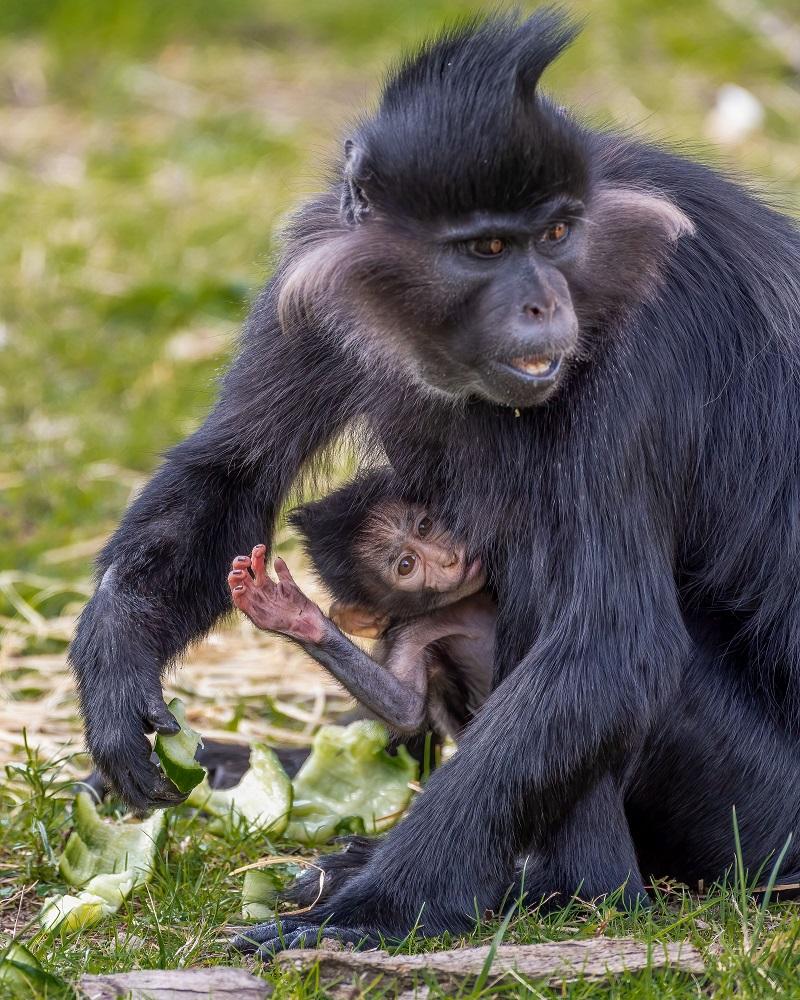
Black crested mangabeys have a gestation period (the length of pregnancy) of 5.5 months. Females usually give birth to a single infant weighing between 1 and 1.3 pounds (0.5–0.6 kg). Newborns have pink faces, hands, and feet, but otherwise resemble adults in fur coloration. Over the following weeks, their faces gradually darken and develop the characteristic pigmentation seen in mature individuals.
Infants cling to their mother’s belly and are completely dependent on her for food, transportation, and protection. Males do not appear to provide significant parental care. However, related females, such as sisters and aunts, may assist by carrying, grooming, or watching the infant while the mother feeds or rests. By about six months of age, young mangabeys begin feeding regularly on solid foods.
As they mature, juvenile males typically leave the troop in which they were born. While they may occasionally travel alone, they more often join other males or transfer into a new group. Male dispersal occurs throughout the year because female estrus is not strongly seasonal or predictable. This movement of males between groups helps maintain genetic diversity by reducing the likelihood of mating between closely related individuals.
Mangabeys are part of the rich biodiversity of the Congo rainforest, where they play several important roles in the ecosystem. Their varied diet reduces their dependence on any single food source, making them adaptable to seasonal changes in food availability and reducing competition with more specialized species. They also occupy an important position in the food web as both seed dispersers and prey for larger predators.
Black crested mangabeys often collect fruit in their cheek pouches and travel to denser areas of the canopy, where they are less exposed to predators, before sitting down to peel and eat it. In the process, they disperse seeds throughout the forest. This helps fruiting trees regenerate away from the parent plant, reducing competition for light, water, and nutrients.
These primates are also an important prey species for crowned hawk-eagles. These powerful raptors are well adapted to hunting in dense forests. The presence of these aerial predators is thought to be one reason black crested mangabeys often associate with other arboreal primates, such as guenons. Larger mixed-species groups provide more individuals to detect and warn of approaching danger.
Black crested mangabeys are also preyed upon by bonobos (Pan paniscus), which occasionally hunt small and medium-sized mammals, including other primates.


The International Union for Conservation of Nature lists black crested mangabey as Vulnerable (IUCN, 2018), appearing on the IUCN Red List of Threatened Species.
Hunting for bushmeat is a major threat to the survival of black crested mangabeys. These monkeys are often easy for hunters to locate because of their relatively large size and vocal nature. Increased access to firearms has also made it easier for poachers to kill black crested mangabeys before they can escape into the high canopy.
Large areas of the Congo rainforest have also been cleared or degraded by logging, mining, and agricultural expansion. While these industries contribute to economic development, they often come at the cost of biodiversity, including wildlife such as the black crested mangabey. As forests are cleared and road networks expand, previously remote habitats become more accessible to human settlements and poachers, increasing pressure on mangabey populations.
As human activities bring people into closer contact with wildlife, disease transmission becomes an additional concern. Black crested mangabeys can carry several disease-causing pathogens, including the simian immunodeficiency virus (SIV), a close relative of the human immunodeficiency virus (HIV). Many of these pathogens do not appear to cause severe illness in the mangabeys that carry them. However, increased contact between humans and wildlife raises the risk of zoonotic disease transmission, in which pathogens cross from animal hosts to human populations. Studying diseases carried by mangabeys can therefore provide valuable insights into the origins, evolution, and potential spread of emerging infectious diseases.
Black crested mangabey is listed in Appendix II of the Convention on International Trade in Endangered Species (CITES), an international agreement between governments whose goal is to ensure that international trade in specimens of wild animals and plants does not threaten their survival.
Black crested mangabeys are protected from hunting and trade through international agreements and national conservation laws. In the Democratic Republic of the Congo (DRC), they receive partial legal protection. Within the DRC, black crested mangabeys occur in several protected areas, including Salonga National Park and Lomami National Park. These reserves are patrolled by anti-poaching teams that help reduce illegal hunting and protect remaining forest habitat. Outside of these reserves, particularly near mines and logging areas, hunting continues unchecked.
Despite these protections, enforcement can be challenging in remote regions, and habitat loss and bushmeat hunting continue to threaten many populations. Continued conservation efforts, habitat protection, and law enforcement are therefore essential for ensuring the long-term survival of the species.
- Abelló, M.T., ter Meulen, T. and Prins, E.F. (2018) *EAZA Mangabey Best Practice Guidelines*. Barcelona: Parc Zoològic de Barcelona and GaiaZOO.
- Arlet, M.E., Isbell, L.A., Molleman, F., Kaasik, A., Chancellor, R.L., Chapman, C.A., Mänd, R. and Carey, J.R. (2014) ‘Maternal investment and infant survival in gray-cheeked mangabeys (*Lophocebus albigena*)’, *International Journal of Primatology*, 35(2), pp. 476–490.
- Bessone, M., Kühl, H.S., Hohmann, G., Herbinger, I., N’Goran, K.P., Asanzi, P., Da Costa, P.B., Dérozier, V., Fotsing, D.E., Ikembelo, B.B. and Iyomi, D.M. (2023) ‘Assessing the effects of survey-inherent disturbance on primate detectability: Recommendations for line transect distance sampling’, *Primates*, 64(1), pp. 107–121.
- Eppley, T.M., Hickey, J.R. and Nibbelink, N.P. (2010) ‘Observation of albinistic and leucistic black mangabeys (*Lophocebus aterrimus*) within the Lomako-Yokokala Faunal Reserve, Democratic Republic of Congo’, *African Primates*, 7(1), pp. 50–54.
- Groves, C.P. (1978) ‘Phylogenetic and population systematics of the mangabeys (Primates: Cercopithecoidea)’, *Primates*, 19(1), pp. 1–34.
- Horn, A.D. (1987a) ‘The socioecology of the black mangabey (*Cercocebus aterrimus*) near Lake Tumba, Zaire’, *American Journal of Primatology*, 12(2), pp. 165–180.
- Horn, A.D. (1987b) ‘Taxonomic assessment of the allopatric gray-cheeked mangabey (*Cercocebus albigena*) and black mangabey (*C. aterrimus*): Comparative socioecological data and the species concept’, *American Journal of Primatology*, 12(2), pp. 181–187.
- Janmaat, K.R., Byrne, R.W. and Zuberbühler, K. (2006) ‘Evidence for a spatial memory of fruiting states of rainforest trees in wild mangabeys’, *Animal Behaviour*, 72(4), pp. 797–807.
- Janmaat, K.R., Olupot, W., Chancellor, R.L., Arlet, M.E. and Waser, P.M. (2009) ‘Long-term site fidelity and individual home range shifts in *Lophocebus albigena*’, *International Journal of Primatology*, 30(3), pp. 443–466.
- Ma, Y., Yang, L. and Yang, Y. (2025) ‘First isolation of viable *Toxoplasma gondii* from a black mangabey (*Lophocebus aterrimus*) reveals the emergence of the Africa 1 lineage in East Asia’, *PLOS Neglected Tropical Diseases*, 19(7), p. e0013133.
- Maisels, F., Hart, J. and Laudisoit, A. (2020) *Lophocebus aterrimus (amended version of 2019 assessment)*. *The IUCN Red List of Threatened Species*, e.T12310A166607638.
- McGraw, W.S. (2017) ‘Mangabeys (*Cercocebus* and *Lophocebus*)’, in *The International Encyclopedia of Primatology*. Hoboken, NJ: Wiley, pp. 1–3.
- Olupot, W. and Waser, P.M. (2005) ‘Patterns of male residency and intergroup transfer in gray-cheeked mangabeys (*Lophocebus albigena*)’, *American Journal of Primatology*, 66(4), pp. 331–349.
- Surbeck, M., Fowler, A., Deimel, C. and Hohmann, G. (2009) ‘Evidence for the consumption of arboreal, diurnal primates by bonobos (*Pan paniscus*)’, *American Journal of Primatology*, 71(2), pp. 171–174.
- Takemura, T., Ekwalanga, M., Bikandou, B., Ido, E., Yamaguchi-Kabata, Y., Ohkura, S., Harada, H., Takehisa, J., Ichimura, H., Parra, H.J. and Nende, M. (2005) ‘A novel simian immunodeficiency virus from black mangabey (*Lophocebus aterrimus*) in the Democratic Republic of Congo’, *Journal of General Virology*, 86(7), pp. 1967–1971.
- Arlet, M.E., Grote, M.N., Molleman, F., Isbell, L.A. and Carey, J.R., 2009. Reproductive tactics influence cortisol levels in individual male gray-cheeked mangabeys (Lophocebus albigena). Hormones and Behavior, 55(1), pp.210-216.
Written by Acima Cherian, June 2026