
Red-Tailed Monkey, Cercopithecus ascanius
RED-TAILED MONKEY
Cercopithecus ascanius
Geographic Distribution and Habitat
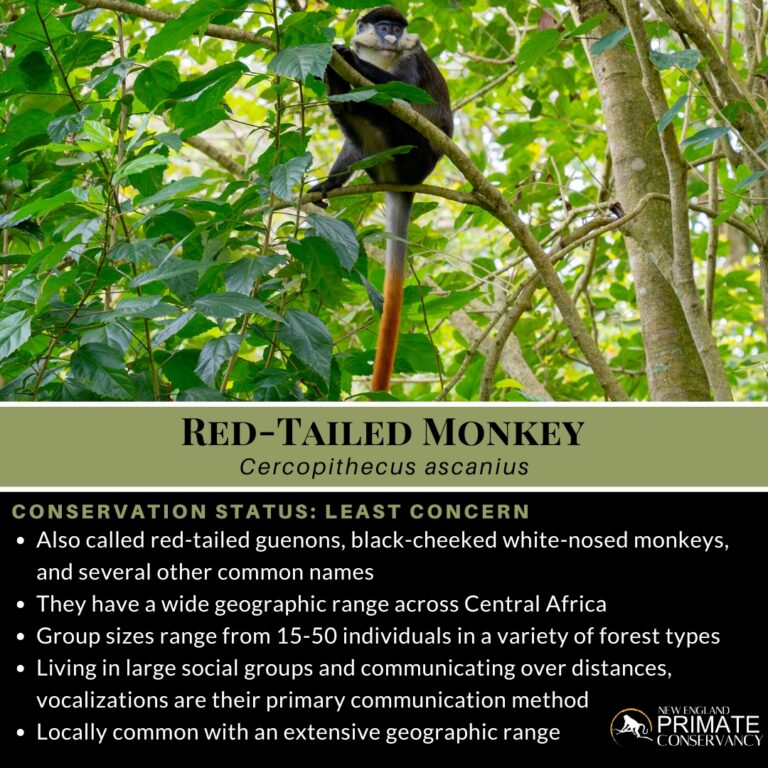
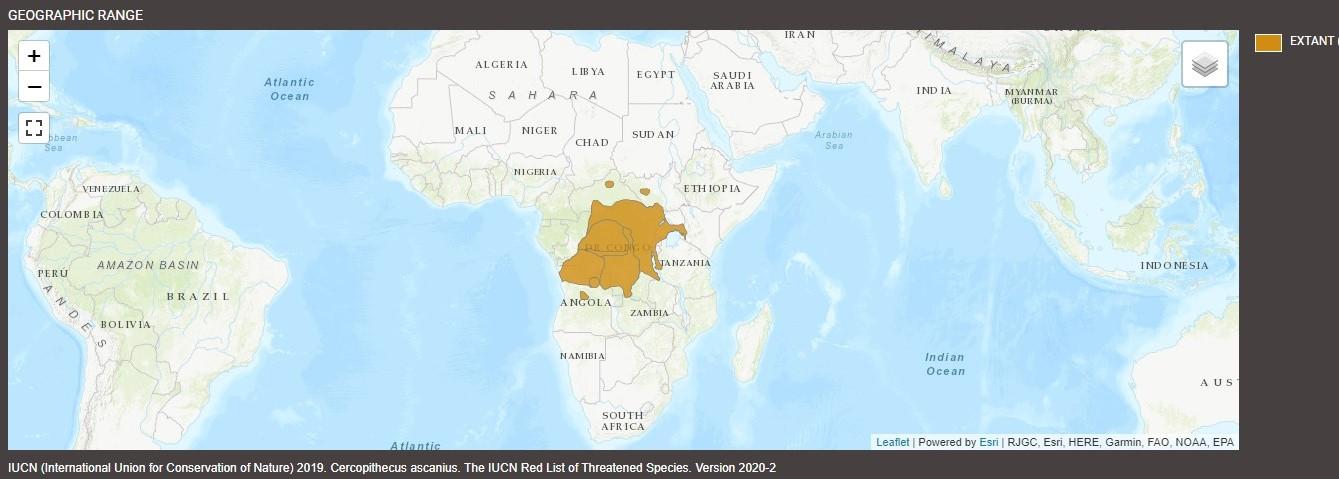
The red-tailed monkey is recognized by various names across its five subspecies, including: the black-cheeked white-nosed monkey, the black-nosed red-tailed monkey, the Katanga red-tailed monkey, the Congo Basin red-tailed monkey, and Schmidt’s guenon. They have a wide range, and are found in Angola, western Burundi, along the Congo-Ubabgui River system in the Central African Republic and the Democratic Republic of the Congo, in Rwanda, South Sudan, Tanzania, Uganda, western Kenya, and north-west Zambia.
Red-tailed monkeys occupy habitats as variable as their names, but tend to like their forests on the damper side, often found in moist lowland forests, montane forests along mountains, flooded forests, swamps, riverine forests along rivers, and gallery forests which act as the gradient between more wet forests and dry shrub or savanna habitat. They can also be found in human-modified habitats such as secondary forests and regenerating forests that have regrown after human disturbance, and plantations. They prefer forest edges and are rarely found in deep primary forests.
Size, Weight, and Lifespan
As is common among guenons, red-tailed monkeys are sexually dimorphic, meaning the one sex is noticeably larger than the other. With primates, it is typically the male that is larger, and this is true for the red-tailed monkeys. Males have a head and body length of 15.94–24.76 inches (405–629 mm) while females’ head and body length is 12.60–19.41 inches (320–463 mm). Red-tailed monkey’s namesake tails are striking not only in color, but also in length, with males having a tail length of 24.69–35.12 inches (627–892 mm) and females 20.87–30.67 inches (530–779 mm). Having such long tails helps the red-tailed monkeys balance while climbing through the forest canopy. Males weigh between 5.62–13.75 pounds (2.55–6.24 kg), and females between 5.46–7.55 (2.48 – 3.43 kg).
Red-tailed monkeys live to be roughly 28 years old.
Appearance
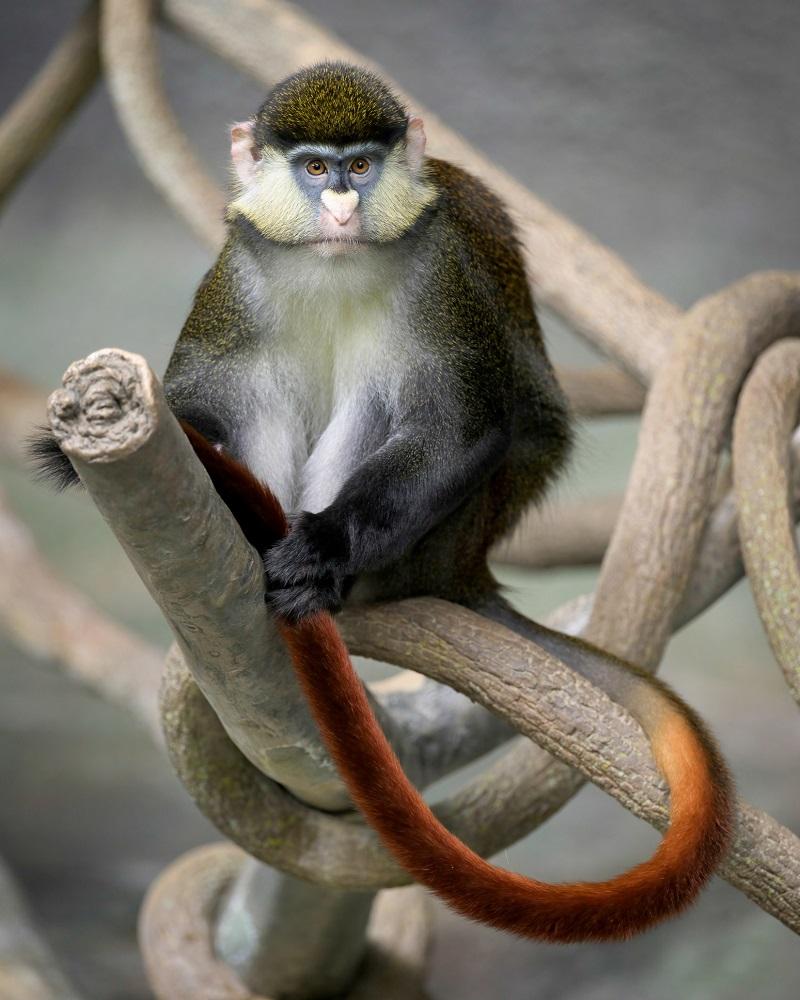
Guenons are recognized as the most colorful group of primates, which researchers think helps individuals more easily distinguish members of their own species from other guenons. Red-tailed monkeys contribute to their colorful classification with their namesake red tail, which fades at the base into the dark brown fur that covers their legs, arms, back, and the top of their head. Their stomachs and inner thighs are white, along with the throat and cheek patches that almost look like big white mutton-chop side burns. They have a white, heart-shaped spot on their nose (unfortunately, Cupid’s monkey didn’t make the name cut), although in some subspecies it may be yellowish or even orange or black. Their lips and eyelids are a pale pinkish color, while the mask surrounding their eyes is a deep blueish or purplish color (red-tailed bandit monkey also failed to reach the final selection of names).
Diet
Red-tailed monkeys are known as frugivores-insectivores, reflecting the primary role fruit and insects play in their diet. Although most of their feeding time is spent snacking on fruit and other plant parts, insects provide an important, and more efficient, nutritional contribution to the red-tailed monkey’s diet. While it’s difficult for researchers to tell which insects the monkeys are eating a lot of the time, they think red-tailed monkeys particularly enjoy cicadas, caterpillars, and grasshoppers. The monkeys will typically catch insects by grabbing them off leaves or from tree trunks and branches.
Like other guenons, red-tailed monkeys have special adaptations that help them eat their favorite fruit snacks. They have low, rounded molar cusps for munching on fruit, simple stomachs (unlike the complicated “ruminant-like” ones of leaf-eating monkeys), and cheek pouches that allow them to take their snacks on the go.
Red-tailed monkeys will also eat leaves, particularly younger ones that are easier to digest, mostly as a “fall-back food” during times that fruit is harder to come by. Fungi also act as an important fall-back food, accounting for about 3% of their diet.
Rarely, red-tailed monkeys have been observed hunting and eating pigeons and other small birds. Hybrids of red-tailed monkeys and blue monkeys have been observed hunting bats, although there has yet to be evidence in either species partaking in these batty bites on their own.
The variety in diet red-tailed monkeys enjoy allows them to occupy the wide range of habitats they are found in. The composition of their diet (i.e., the specific percentage of fruit vs. insects consumed) varies between groups based on the habitat their range is in, and this flexibility is likely also what has allowed red-tailed monkeys to persist in humanized environments.
Behavior and Lifestyle
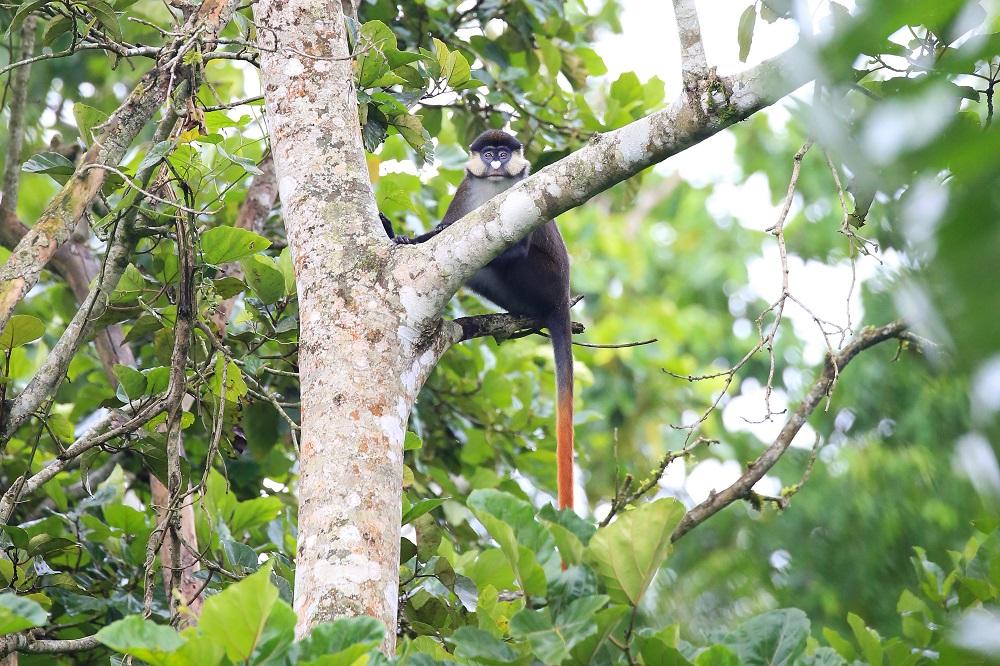
Red-tailed monkeys are largely arboreal, meaning they hardly ever venture to the forest floor and spend most of their time climbing, leaping, or quadrupedally (on all fours) walking along the tree branches. They are diurnal and are active during the day, sleeping through the night. While many primates are known to have specific sleeping trees they’ll return to at the end of the day, red-tailed monkeys seem to be comfortable tucking into whichever tree is nearest to them once their day has come to an end.
Although rare, leopards, crowned-hawk eagles, and chimpanzees have been known to prey upon red-tailed monkeys. Red-tailed monkeys will mob or harass larger birds such as owls, even with species not known to prey on the monkeys, to ward off any potential predatory attacks.
Red-tailed monkeys live in large groups consisting of one male and multiple adult females, subadults, juveniles, and infants. Group size ranges from 15–50 individuals, although once a group reaches the upper end of the size range, it will typically break up into separate groups.
During the breeding season, a group may also take on extra males, particularly if there are many sexually receptive females, making it more difficult for the resident male to fend off competitors. While multiple males are present, they will form a hierarchy. Males may also travel alone while searching for a new group to join, or sometimes they’ll come together and form a bachelor group.
Female red-tailed monkeys are not known to have a defined social hierarchy. They mostly socialize with each other by grooming. They are also known to team up against intruding males and will defend each other’s babies from infanticide, a practice by which a new high-ranking male kills the troop’s infants to force females into readiness to mate with him and produce his babies. Females play a strong role in protecting the group’s borders from neighboring groups trying to sneak in to take advantage of their best fruiting trees.
While on their daily foraging excursion, red-tailed monkeys typically won’t cross over their path, meaning they won’t visit the same place within their range twice in a day. Their home ranges tend to be 69.19–168.03 acres (28–68 ha), and a group will typically travel 0.73–0.99 miles (1.17–1.59 km) of that range in a day. The group range distance varies based on food availability, where groups with less available food in their range have to travel farther. Groups also tend to range less during dry-season months when temperatures are higher.
Red-tailed monkeys are fairly sociable and are known to associate with blue monkeys, red colobuses, gray-cheeked mangabeys, vervet monkeys, black-and-white colobus, Allen’s swamp monkey, Wolf’s guenon, and Angolan colobus monkeys. They’ll even associate with red duikers (which look like tiny deer), although this association is a bit one-sided, as the duikers follow the monkeys and eat the fruit bits they drop on the forest floor. Where their ranges overlap, red-tailed monkeys have been known to produce fertile hybrids with blue monkeys. Because red-tailed monkeys and blue monkeys have very similar ecological niches (meaning they play similar roles in their environment and utilize many of the same resources), associating with one another may seem contradictory. However, researchers think that the two monkeys may benefit from their association by helping each other find food.
Living in a large social group often requires being able to communicate with multiple group members at once over varying distances. Because of this, vocalization is the red-tailed monkey’s main method of communication. All group members, except adult males, use contact calls, which sound like phased grunts, to keep in touch with other group members when they’re out of sight. To alert other group members of the presence of a predator, males will produce a ka alarm call, and adult females and juveniles will produce a chirp. If attacked, females and juveniles will scream to let other group members know they need help. When hearing calls from other monkey species nearby, red-tailed monkeys will typically respond with a pop or hack sound. When males are fighting, they will produce a nasally waa call.
Female red-tailed monkeys reach sexual maturity between 48–60 months. Males take a bit longer, reaching sexual maturity at about 72 months, at which time they’ll leave their natal group to find a group of their own.
We don’t know the exact gestation period for red-tailed monkeys, but it is likely similar to blue monkeys, which have a gestation period of 162–190 days. Females will not only mate with the resident male in their group, but will also sneak away with visiting solitary males and even resident males of neighboring groups. To show interest in mating, females will often follow the male, pucker her lips, and, to really get the point across, present her hindquarters.
With fruit being a staple of their diet, red-tailed monkeys help maintain the biodiversity of the forest by acting as seed dispersers. When eating fruits with larger seeds, red-tailed monkeys will often spit the seeds out, cleaned of any fruit material. Researchers have found that this helps the seeds to germinate with less of a risk of being attacked by seed-eating animals or fungi that would be attracted to the rotting pulp that would be left if the fruit had simply fallen from its tree. While seed dispersal is a common ecological role among primates, each one is important to maintaining the plant composition of the forest, as each primate species will have different preferred fruits they help germinate, and different methods of doing so.


The red-tailed monkey is classified as Least Concern by the International Union for Conservation of Nature (IUCN, 2018), appearing on the IUCN Red List of Threatened Species. Although common where they are found, red-tailed monkey populations are predicted to decrease in the future.
Red-tailed monkeys’ persistence in human-modified environments is likely due to their ability to adapt to many different habitat types. While some population densities (or the number of monkeys in an area) have been found to be lower in some heavily logged forests (compared to lightly or unlogged forests), others seem to still support a higher population of red-tailed monkeys. While their versatility helps them persist, red-tailed monkeys are threatened by habitat loss, primarily due to agricultural development, logging, mining, and the development of roads, powerlines, and other industrial systems. Food availability has been shown to be 3.5 times higher in unlogged areas than in logged areas. Due to lower food availability, group sizes in logged areas tend to be smaller, with more overlap in groups’ ranges. Researchers have also found that due to reduced food intake and lack of diversity in diet, with fewer food options available, red-tailed monkeys in heavily logged forests have more difficulty meeting their daily nutritional needs.
Red-tailed monkeys are retaliated against by farmers for crop raiding and hunted for bushmeat, although they are not a very popular target for hunters due to their smaller body size.
Red-tailed monkeys are listed in Appendix II of the Convention on International Trade in Endangered Species (CITES), an international agreement between governments whose goal is to ensure that international trade in specimens of wild animals and plants does not threaten their survival.
While there are few specific programs for red-tailed monkeys, they benefit from protections for other threatened species with which they share their habitat. Red-tailed monkeys are also found in several protected National Parks, including Kibale, Mahale Mountains, Gombe, Queen Elizabeth, Semliki, Ruwenzori, and Tayna Gorilla Reserve. Red-tailed monkeys are listed under Class B of the African Convention on the Conservation of Nature and Natural Resources.
- de Jong, Y.A. & Butynski, T.M. 2019. Cercopithecus ascanius. The IUCN Red List of Threatened Species 2019: e.T4212A17947340. http://dx.doi.org/10.2305/IUCN.UK.2019-3.RLTS.T4212A17947340.en
- Schulze, T., Bovee, W., Loos, J., Stewart, F., & Piel, A. (2025). Mycophagy in primates of the Issa valley, Tanzania.
- McLester, E., Brown, M., Stewart, F. A., & Piel, A. K. (2019). Food abundance and weather influence habitat‐specific ranging patterns in forest‐and savanna mosaic‐dwelling red‐tailed monkeys (Cercopithecus ascanius). American Journal of Physical Anthropology, 170(2), 217-231.
- McLester, E. (2022). Contact call acoustic structure is associated with inter-individual distances during antiphonal vocal exchanges in wild red-tailed monkeys (Cercopithecus ascanius schmidti). Behaviour, 159(10), 915-939.
- Rode, K. D., Chapman, C. A., McDowell, L. R., & Stickler, C. (2006). Nutritional correlates of population density across habitats and logging intensities in redtail monkeys (Cercopithecus ascanius). Biotropica, 38(5), 625-634.
- Furuichi, T. (2006). Red-tailed monkeys (Cercopithecus ascanius) hunt green pigeons (Treron calva) in the Kalinzu Forest in Uganda. Primates, 47(2), 174-176.
- McLester, E., Sweeney, K., Stewart, F. A., & Piel, A. K. (2019). Leopard (Panthera pardus) predation on a red-tailed monkey (Cercopithecus ascanius) in the Issa Valley, western Tanzania. Primates, 60(1), 15-19.
- Baranga, D., Basuta, G. I., Teichroeb, J. A., & Chapman, C. A. (2012). Crop raiding patterns of solitary and social groups of red-tailed monkeys on cocoa pods in Uganda. Tropical Conservation Science, 5(1), 104-111.
- Fornof, L. J., Stewart, F. A., & Piel, A. K. (2023). Multiple antipredator behaviors in wild red-tailed monkey (Cercopithecus ascanius) groups reveal spatially distinct landscapes of fear. Behavioral Ecology, 34(4), 528-538.
- Detwiler, K. M. (2002). Hybridization between red-tailed monkeys (Cercopithecus ascanius) and blue monkeys (C. mitis) in East African forests. In The guenons: Diversity and adaptation in African monkeys(pp. 79-97). Boston, MA: Springer US.
- Lile, C. W., McLester, E., Stewart, F. A., & Piel, A. K. (2020). Red-tailed monkeys (Cercopithecus ascanius) prey upon and mob birds in the Issa Valley, western Tanzania. Primates, 61(4), 563-566.
- Bryer, M. A., Chapman, C. A., Raubenheimer, D., Lambert, J. E., & Rothman, J. M. (2015). Macronutrient and energy contributions of insects to the diet of a frugivorous monkey (Cercopithecus ascanius). International Journal of Primatology, 36(4), 839-854.
- Matthew Richardson, Kate Detwiler. Cercopithecus, ascanius. © All the World’s Primates. N Rowe, M Myers, eds. (alltheworldsprimates.org) Downloaded 9/21/2025
- Jaffe, K. E., Isbell, L. A., (2011). The Guenons Polyspecific Associations in Socioecoglogical Perspective. In Primates in Perspective (second, pp. 277–300). Oxford University.
- Lambert, J. E. (2001). Red-tailed guenons (Cercopithecus ascanius) and Strychnos mitis: evidence for plant benefits beyond seed dispersal. International Journal of Primatology, 22(2), 189-201.
Written by Lina Rademacher, Sep 2025