
L’Hoest’s Monkey, Allochrocebus lhoesti
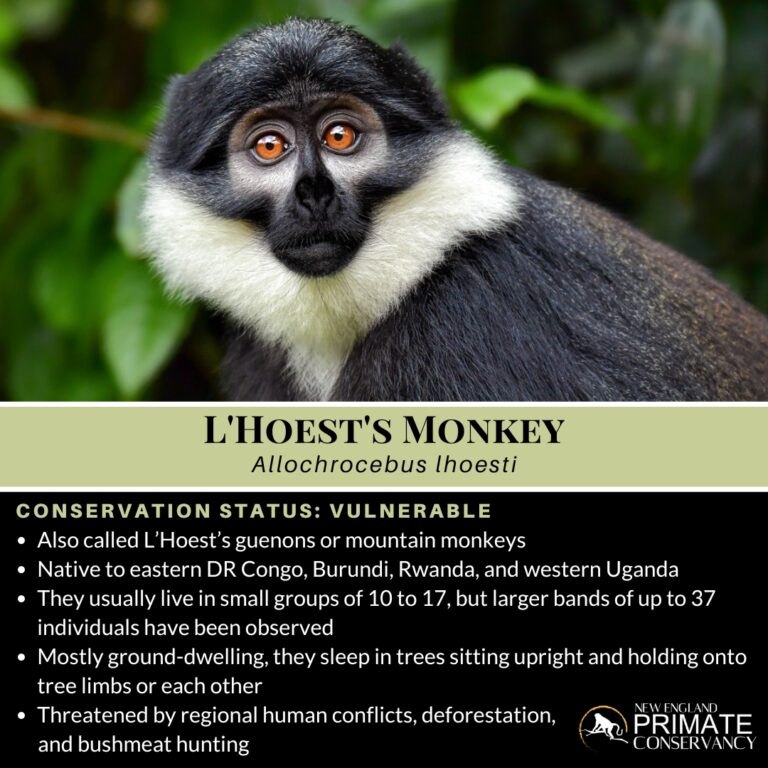
L'HOEST'S MONKEY
Allochrocebus lhoesti
Geographic Distribution and Habitat
L’Hoest’s monkeys, also known as mountain monkeys, can primarily be found living in the tropical forests of Central and East Africa, most commonly in the eastern Democratic Republic of Congo, Burundi, Rwanda, and western Uganda. Their range extends only east of the Lualaba River, through the Ituri Forest, down toward the Itombwe Massif, well into the mountains of the Ruwenzori region, and likely along the eastern bank of the Congo River. Some of the protected zones they can be found in include Virunga, Kahuzi-Biega, Nyungwe, Kibira, Kibale, Kalinzu, Maramagambo, Bwindi Impenetrable, and the Ruwenzori Mountains National Parks. More research is needed to determine how far south they occur.
Their adaptability is highlighted by the wide range of forest environments that they can survive in, including primary and secondary lowlands, and submontane and montane forests within the Albertine Rift—a long valley in Africa that is a biodiversity hotspot. They live at elevations up to about 9,500 feet (2,900 meters), where the climate is typically warm, rainy, and humid year-round. While they do not occupy places like deserts, cities, or rocky cliffs, they do sometimes live along forest edges, where the forest meets agricultural plots. In places like Bwindi Impenetrable National Park, conflicts with nearby farmers arise at the park’s edges, where monkeys eat the people’s crops.
The L’Hoest’s monkey has gone through several taxonomic changes, with some scientists still debating its exact placement. While it was originally assigned to the tree-living, or arboreal, guenons (genus Cercopithecus), it was recognized in 2013 to be part of the ground-dwelling, or terrestrial, guenons (genus Allochrocebus). Many older sources still use the Cercopithecus name to identify the species. Molecular studies conducted in 2003 showed that L’Hoest’s monkeys are more genetically distinct from the other guenons they had previously been grouped. L’Hoest’s monkeys were also once combined with Preuss’s monkey and the sun-tailed monkey as a single species, but these two are now regarded as distinct and separate species within the same genus.

Size, Weight, and Lifespan
L’Hoest’s monkeys are medium-sized monkeys with slim bodies, long limbs, and sometimes even longer tails! Adult males are larger than females: males typically have a head-and-body length of about 21-28 inches (54-70 cm), while females measure around 18-22 inches (45-55 cm) Their tails are about 20-30 inches (50-76 cm) in males and 18-26 inches (46-67 cm) in females. Males usually weigh between 13-22 pounds (6-10 kg), while females are around 7-11 pounds (3.4-5 kg).
There is insufficient evidence to determine an accurate lifespan for this particular guenon species. Scientists are still unsure of their age range in the wild, though some sources claim they can live upwards of 30 years. There is one documented instance of a L’Hoest’s monkey reaching 24 years old in captivity.
Appearance
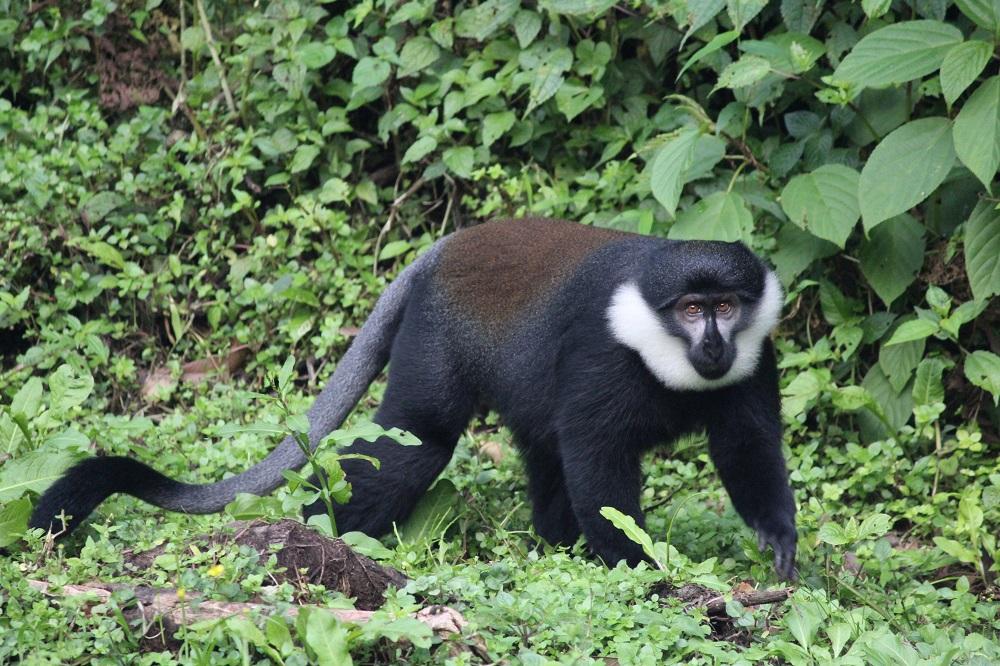
These eye-catching monkeys are nearly all black, aside from a chinstrap of white fur that extends down their neck and a patch of reddish-brown fur that covers most of their back. Their long tails often show a dusting of white or gray hairs, and their dense coat gives them a soft, cushioned appearance. They also have narrow feet that help them move easily through the forest.
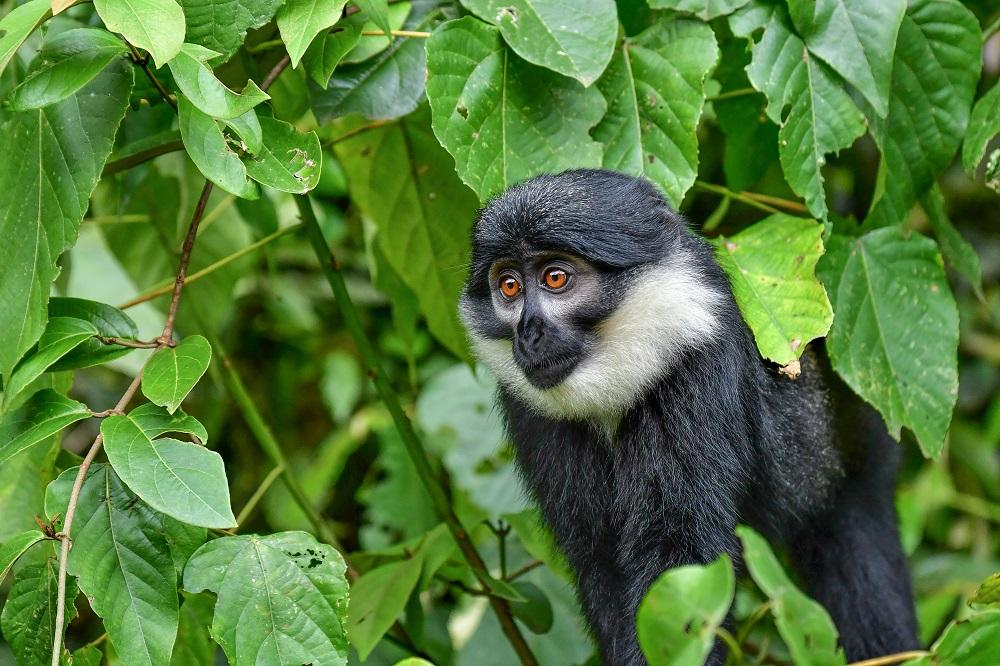
Their faces are graced with big orange-brown eyes and narrow noses that extend down their faces. The sparse fur around their eyes creates a shape that looks a bit like ski goggles, and although their ears are usually hidden, they end in small, curled points when visible. Like many guenons, they have expandable cheek-pouches that let them stash food as they forage. This adaptation allows them to collect meals quickly and retreat to safer locations before eating.
While males and females share the same overall coloring, they do differ in one notable way: males have a bright blue scrotum.
Diet
L’Hoest’s monkeys are omnivores with quite a diverse diet, which allows them to thrive in a range of forest habitats. About a third of their diet comes from the ground layer of the forest, where they forage together for mushrooms, herbs, and other plants. Fruits are another major staple, accounting for about 20-30% of their daily diet. Aside from that, other plant-based foods on their menu include flowers and young leaves. They also can eat various invertebrates—such as insects, earthworms, spiders, ants, and grasshoppers—and have been observed hunting small vertebrates, like lizards.
Their diet is highly dependent on their habitat. Groups living deeper in the forest tend to eat more leaves, while those near farmland may include tree bark, roots, sap, and even crops like potatoes, maize, beans, and sorghum in their meals, often leading them into conflict with nearby farmers. Their ability to use different forest layers and eat a wide range of foods makes them well-suited for survival in a diverse range of environments.
Behavior and Lifestyle
L’Hoest’s monkeys are diurnal, meaning they are active during the day, with this species being particularly lively in the early morning and late afternoon. They spend much of their time on the ground, where they travel, forage, or search for food, and interact with their group. Because foraging on the forest floor exposes them to more predators, their cheek-pouches offer a key advantage: they can gather food rapidly and then move to safer spots before consuming it. They also forage throughout different layers of the forest.
At night, each monkey returns to its favorite sleeping spot and rests while sitting upright, either holding onto a branch or leaning against another group member to stay balanced. Their balance is further aided by ischial callosities—the thickened, calloused pads on their rear ends that provide stability and a bit of comfort during long periods spent seated on hard surfaces. Sleeping sites, most typically located in or around fruiting trees, are reused regularly, and groups may have more than a dozen preferred spots.
L’Hoest’s monkeys are known to respond to predators in different ways. If a threat approaches from the ground, they quickly rush into the trees and try to stay as still as possible to avoid detection. But when the danger comes from above, such as an attack by a predatory bird, they do the opposite and escape by dropping to the forest floor.
This species was originally named Cercopithecus lhoesti in 1898 by Philip Lutley Sclater, in honor of François L’Hoëst, the director of the Antwerp Zoo in Belgium. It was L’Hoëst who originally brought these monkeys back to Belgium during colonial expeditions to the Congo Basin in the 1890s.
Perhaps not a “fun” fact, but an interesting one: L’Hoest’s monkeys can become infected with Simian Immunodeficiency Virus, or SIV, which becomes HIV when transmitted to humans.
L’Hoest’s monkeys live in small, tightly bonded groups that usually include one adult male, 10-17 related females, and their young, with some troops having as many as 40 members. These groups travel, forage, and sleep together, with females strengthening their relationships through grooming and by helping care for each other’s infants.
Males, however, follow a very different path. Young males leave their birth group and often join all-male “bachelor” groups, where they wait for a chance to challenge the single male leading a group of females. Because competition is intense, the resident male rarely holds his position for more than a year or two, with some stints being as short as only a few weeks.
Group dynamics shift depending on the habitat they occupy. Troops living along fragmented forest edges tend to travel farther each day and stay more alert, while those in the forest interior move about less and face fewer disturbances. Both types of groups defend their own territories, with edge groups holding home ranges of about 210 acres (85 hectares) and interior groups maintaining slightly smaller ranges of around 163 acres (66 hectares).
Although L’Hoest’s monkeys share their forests with many species, they rarely interact with other species, keeping mostly to themselves and their own social circles.
L’Hoest’s monkeys communicate using a mix of vocal, visual, and social signals to stay coordinated and safe in their forest habitats, as do most primates. They produce at least five distinct alarm calls, each signaling a different type of danger, which helps the group respond quickly when predators are nearby. Both males and females use visual threat displays, including staring, raising their eyebrows, stretching facial skin, moving their ears back, bobbing their heads, or opening their mouths while concealing their teeth with their lips.
A newer study published in 2020 looked into L’Hoest’s monkeys ‘sensitivity to conspecifics’ informational states’, a skill sometimes called ‘mind-reading.’ What does this mean? Essentially, scientists were studying the monkeys’ abilities to be aware of what other monkeys in their group do or don’t know based on non-verbal cues. In the experiment, a group of monkeys living in captivity was shown a box containing either something tasty (mealworms), something scary (a toy raptor), or something neutral (bark chips). The first monkey to check the box looked at other monkeys more often when the box had something scary. It also looked more frequently at monkeys who already knew what was in the box than at those who didn’t, especially if they were nearby. This suggests that L’Hoest’s monkeys pay attention to what other monkeys know, showing a basic ability to consider others’ knowledge, something previously thought to be mostly human.
Interestingly, despite being highly social, these monkeys seem unusually quiet compared to other primates. Researchers now believe that much of their communication occurs in infrasound, very low-frequency calls that are too deep for humans to hear. This adaptation likely helps them stay in touch with group members across dense forest vegetation while avoiding detection by predators.
L’Hoest’s monkeys are polygynous, meaning one male mates with multiple females within a group.
Females give birth to a single infant about every two years, with gestation, or pregnancy, lasting around 5 months. Births usually occur at the end of the dry season, from June to August, which is ideal because it means the young will be nursed during the wetter months when food is more abundant. Greater food availability supports milk production and improves the infant’s chances of survival.
Infants are born with open eyes and a full coat of fur. Their fur is slightly lighter in color than that of adults, however, and after two to three months, their coats darken to match the shade of the adults’ colors.
Other females in the group often help tend to the infant, a behavior called allomothering, but only the mother is responsible for nursing their baby. Nursing decreases after the first few months of life, with the infant being fully weaned off by around one year of age. Young monkeys show affectionate behaviors, such as entwining their tails with their mothers’.
While females remain in their natal groups, male infants leave their birth group to join bachelor groups or seek their own opportunities to reproduce once they reach sexual maturity.
With their fruit-heavy diet, L’Hoest’s monkeys play an important role in spreading seeds. Seeds that pass through their digestive system are more likely to germinate with the added nutrients from their feces. They also eat flowers when available. This, paired with their movement across the forest, may also contribute to cross-pollination during certain seasons. As omnivores, they also help keep insect populations in check by consuming a variety of bugs. Additionally, they form part of the food chain themselves, serving as prey for local predators such as crowned hawk-eagles.


L’Hoest’s monkeys are classified as Vulnerable by the International Union for Conservation of Nature (IUCN, 2016), appearing on the IUCN Red List of Threatened Species, with their population having declined around 30% between 1995 and 2025. Many of the threats to their livelihood stem from human-based interactions; their habitat coincides with areas that have experienced years of armed conflict and growing human-led development, which contribute to depleting natural resources and habitat loss. This habitat loss is of the greatest concern, driven by deforestation to create space for agriculture and mining. Mining is especially harmful because it opens previously remote areas, making monkeys more accessible to poachers. There have been accounts of their bushmeat being sold in local markets.
They also face natural threats from predators such as leopards, crowned hawk-eagles, and even chimpanzees in some parts of their range. Overall, human activities, combined with natural predation, put severe pressure on their populations, making conservation efforts critical to prevent further decline.
L’Hoest’s monkeys are listed in Appendix II of the Convention on International Trade in Endangered Species (CITES), an international agreement between governments whose goal is to ensure that international trade in specimens of wild animals and plants does not threaten their survival.
Though much more work is still needed, L’Hoest’s monkeys do benefit from a range of conservation efforts across their natural habitat, which includes several protected areas in central Africa. Important parks and reserves include Virunga, Kahuzi-Biega, and Maiko in the Democratic Republic of the Congo, Kibira in Burundi, Nyungwe in Rwanda, the Kalinzu and Maramagambo forests in Uganda, and the Bwindi, Kibale, and Ruwenzori Mountains. These protected areas help provide safe spaces for the monkeys.
Parks like Nyungwe National Park, a biodiversity hotspot, are particularly important as they host not only L’Hoest’s monkeys but also numerous other primate and plant species, making these areas critical for preserving the ecological balance of the region.
L’Hoest’s monkeys are also included in the European Endangered Species Programme, managed by Edinburgh Zoo, where they serve as ambassadors for public education on wildlife threats and conservation.
Further conservation efforts include projects by organizations like The Rufford Foundation, which work to protect habitat, monitor populations, restore food resources, and teach local communities about eco-tourism and wildlife management.
- https://link.springer.com/article/10.1023/A:1010716001014
- https://ruffordorg.s3.amazonaws.com/media/project_reports/20.05.06%20Detailed%20Final%20Report.pdf
- https://www.iucnredlist.org/species/4220/92345122#geographic-range
- https://www.iucnredlist.org/species/4220/92345122#threats
- https://www.sciencedirect.com/science/article/pii/S0168159124001552
- https://animalia.bio/lhoests-monkey?taxonomy=364#mating
- https://biodiversitypmc.sibils.org/collections/plazi/CE199B17FFF1FFF4FF286627F714FB0E
- https://animalia.bio/lhoests-monkey?taxonomy=364#google_vignette
- https://www.iucnredlist.org/species/4220/92345122#taxonomy
- https://www.inaturalist.org/taxa/566540-Allochrocebus-lhoesti
Written by Hannah Broadland, Nov 2025