
Bornean White-Bearded Gibbon, Hylobates albibarbis
BORNEAN WHITE-BEARDED GIBBON
Hylobates albibarbis
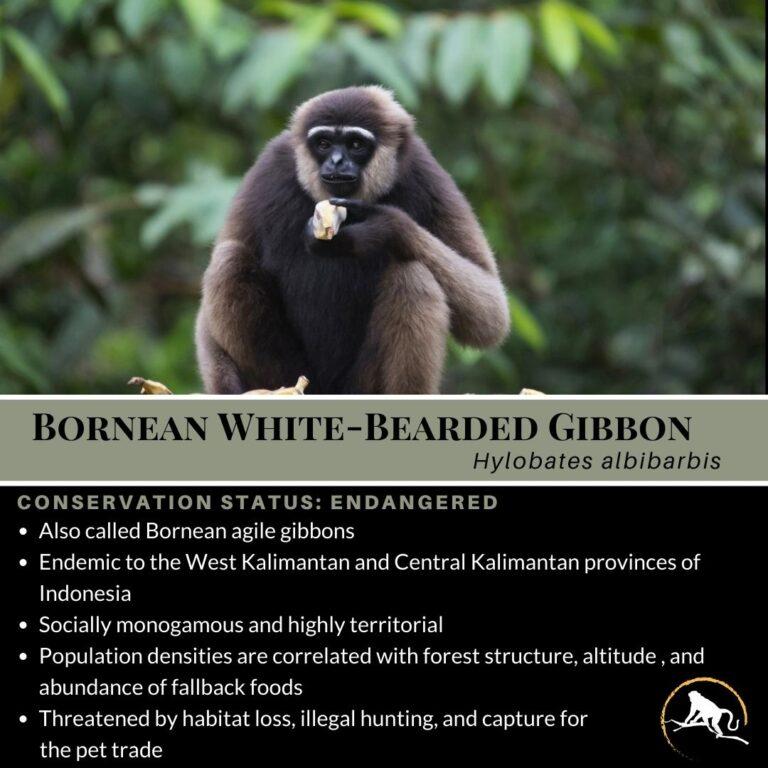
Geographic Distribution and Habitat
The Bornean white-bearded gibbon, also known as the Bornean agile gibbon or southern gibbon, is only found on the island of Borneo. These gibbons live in the West Kalimantan and Central Kalimantan provinces in Indonesia, in territory south of the Kapuas River and west of the Barito River.
Bornean white-bearded gibbons live in primary, secondary, and selectively logged forests. Their habitat is generally tropical evergreen forests, particularly peat swamp forests. These forests are generally found along the coasts and around inland lakes. These gibbons prefer habitats with a continuous high canopy but can adapt to smaller trees and gaps in the canopy. They can be found in elevations up to 3,937 feet (1,200 meters) above sea level, but population densities are higher in lowland forests.
Until recently, Bornean white-bearded gibbons were considered a subspecies of the agile gibbon (Hylobates agilis) on nearby Sumatra. Genetic analyses in the early 2000s confirmed the separation between the two species.
Size, Weight, and Lifespan
Bornean white-bearded gibbons are fairly small, with a head to body length of 16 to 20 inches (40-50 cm). Males are only slightly bigger than females at around 13-15 pounds (6-7 kg), while females weigh around 12-14 pounds (5.5 to 6.4 kg). They live around 25 years on average, but can live longer in captivity.
Appearance
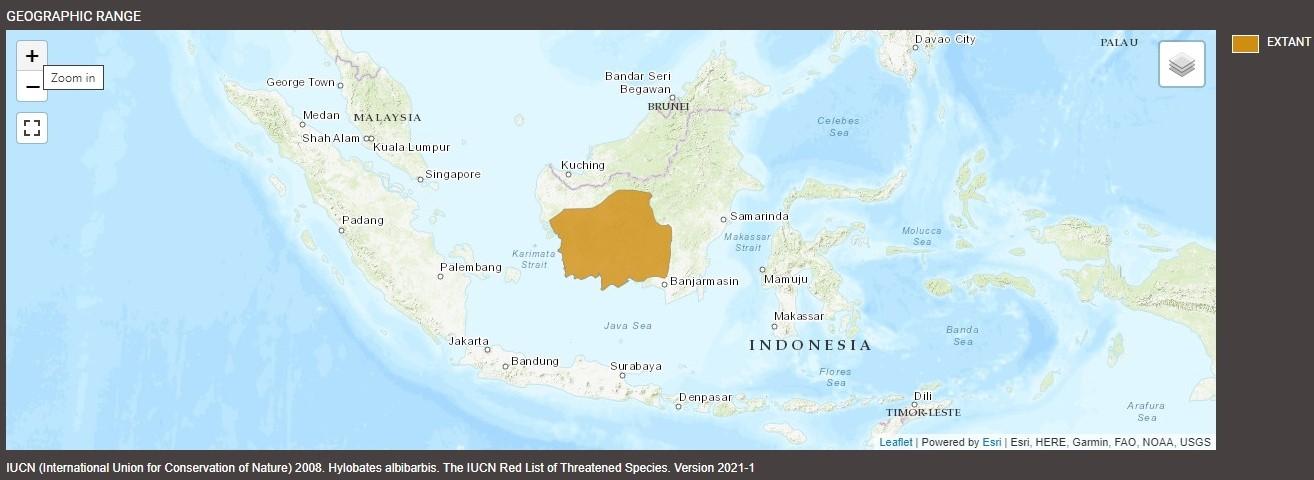
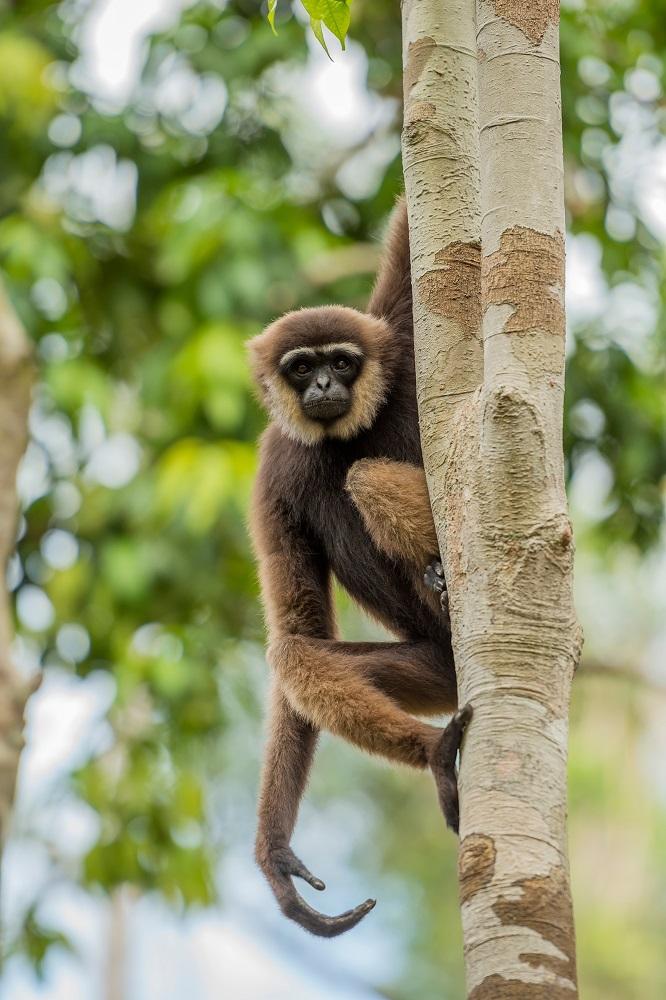
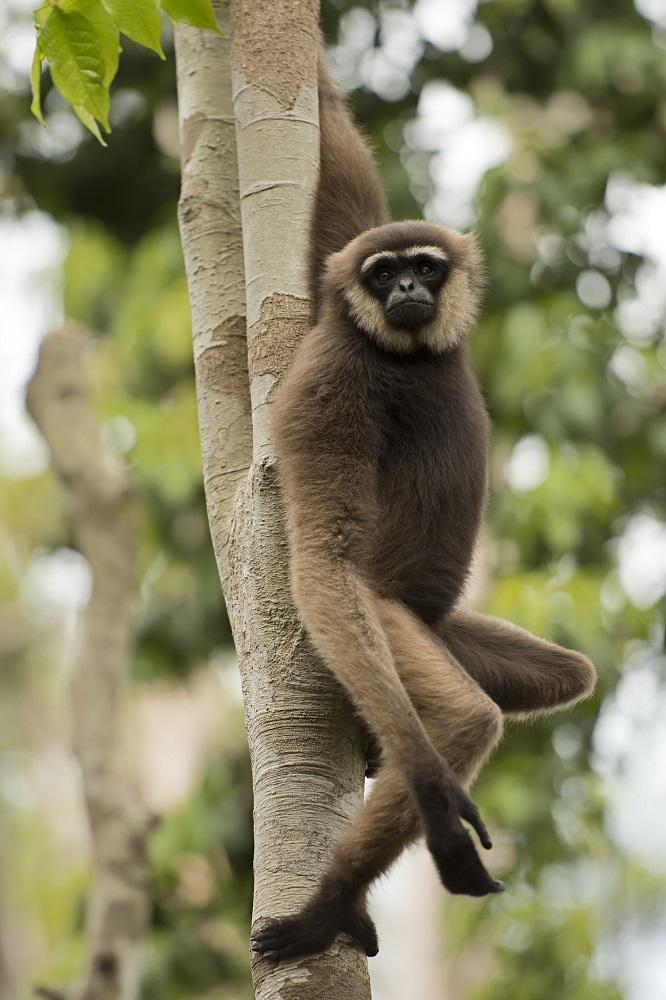
Bornean white-bearded gibbons are brown, with slightly darker fur on their chest and head. They have black hands and feet. As the name suggests, they have white fur framing their cheeks as well as above their eyes. Gibbons have very long limbs and long fingers and toes, especially compared to their body size. The average gibbon has arms 1.5 times longer than its legs. They have an opposable thumb on each hand and an opposable toe on each foot, aiding them in gripping branches. Like all apes, they lack visible tails.
Bornean white-bearded gibbons have short snouts and shallow faces. They also have ischial callosities, also known as sitting pads. These are hardened pads of skin on their rears, like a portable seat cushion. Female Bornean white-bearded gibbons also have small genital swellings that change shape and color during estrus.
Diet
Bornean white-bearded gibbons are primarily frugivores. They prefer ripe sugary fruits, especially figs, which make up around 25 percent of their diet. When ripe fruit is not abundant, they will eat unripe fruit, immature leaves, insects, and flowers. Both male and female gibbons have long canine teeth. They use their long canines to puncture the husks and thick peels of fruit. They will puncture the fruit and then use their canine teeth to peel back the husk and access the soft inner flesh of the fruit.
Behavior and Lifestyle
Bornean white-bearded gibbons are arboreal; they virtually never descend to the ground level. They spent most of their time in the middle and upper levels of the canopy. Gibbons move mostly by two-armed brachiation, swinging from branch to branch. They move quickly—up to 34 miles per hour (55 km/hr)—and can be very acrobatic. They can throw themselves from one tree to another over gaps in the canopy of over 32 feet (10 m). They use slower movement when feeding, utilizing their hands and feet to grip branches as they climb.
These gibbons are diurnal. They’re active during the day, spending their time from 49 to 82 feet (15-25 m) above the ground. At night, they sleep in mature trees above the main canopy. Their major predators include clouded leopards, eagles, and pythons.
Scientists have discovered a group of hybrid offspring of Bornean white-bearded gibbons and Bornean gibbons (Hylobates muelleri). Their vocalizations show a combination of characteristics between the two species.
Gibbon vocalizations can be heard up to 1.25 miles (2 km) away.
Bornean white-bearded gibbons are socially monogamous. They live in groups generally composed of an adult male, adult female, and up to four of their dependent offspring. Occasionally, groups will have a spare adult of either sex, and researchers have observed extra-pair matings in these groups.
These gibbons are fiercely territorial. Their home range is around 0.2 square miles (roughly 0.5 square kilometers). They defend their territory with daily vocalizations and occasional intergroup conflict. Physical confrontation is most common over territorial disputes or when one adult is forced out of the group and replaced by another.
Bornean white-bearded gibbons have been known to interact with Bornean gibbons, orangutans, macaques, and maroon leaf monkeys (Presbytis rubicunda). They’re known to cooperate particularly with maroon leaf monkeys in interactions known as “predator mobbing.” Both species will approach and begin to harass a predator, such as a clouded leopard, while making alarm calls to others. One gibbon was observed grabbing a clouded leopard’s tail. This “mobbing” behavior is most effective against predators like leopards that hunt by stealth and will often leave an area once their presence is detected.
Bornean white-bearded gibbons spend about 10 percent of their time vocalizing. Mated pairs make calls each morning in a duet, establishing territory and warning off other groups. This duet starts with the female making something called the “great call.” This starts with a loud whooping noise and then a succession of quick, short vocalizations. There’s a loud climax in the middle of the song. The male part in the duet is called a “coda,” comprising short notes in rapid succession. The duets are produced by adult gibbons, but the juveniles and young adults in the group will often join in the song.
These gibbons primarily communicate through vocalizations, but they also engage in bouts of social grooming and can communicate with facial expressions and gestures.
Bornean white-bearded gibbons mate year-round, but they only have a single offspring every few years. Gestation (pregnancy) lasts around 7 to 9 months. Infants will cling to their mothers for the first months of their lives and won’t wean completely until two years of age. The female is the primary caregiver for infants, but male parents engage in play and grooming with their young as they grow. Juvenile gibbons spend much of their time playing and practicing their calls with their parents.
Young gibbons stay with their birth group for many years. These gibbons don’t reach sexual maturity until they are at least four years old. Once they reach this point, their same-sex parent will generally eject them from their birth group. Both sexes leave their birth group to find a new group.
Like many frugivores, Bornean white-bearded gibbons play an important role in seed dispersal. They eat fruit and then disperse seeds far away from the parent plant, spreading diverse plant species across the forest.


The Bornean white-bearded gibbon is classified as Endangered by the International Union for Conservation of Nature (IUCN, 2015), appearing on the IUCN Red List of Threatened Species. Scientists suspect their population reduced by 50 percent between 1990 and 2019, a trend expected to continue.
The main threat to these gibbons is habitat loss, primarily because of agriculture, the palm oil industry, logging, and forest fires. Borneo has lost one percent of its forest cover every year from 1973 to 2017. Bornean white-bearded gibbons are also facing threats from hunting and the illegal pet trade.
Bornean white-bearded gibbons are listed in Appendix I of the Convention on International Trade in Endangered Species (CITES), an international agreement between governments whose goal is to ensure that international trade in specimens of wild animals and plants does not threaten their survival.
These gibbons live in several national parks within Indonesia, including Sebangau National Park, Gunung Palung National Park, Tanjung Putting National Park, and Bukit Baka Bukit Raya National Park. Sebangau Forest represents the largest contiguous forest remaining in Borneo and is home to a large population of Bornean white-bearded gibbons. The species has a highly stable population when their habitat is protected and hunting is absent, but even in national parks, they are at risk from hunting and habitat loss.
There are many local and international organizations working to preserve habitat in Indonesia. Planet Indonesia, for instance, works with local communities to create sustainable businesses, teach anti-wildlife trafficking skills, and fund education projects in West Kalimantan. In Central Kalimantan, the Borneo Nature Foundation Project involves local residents in forest patrols to prevent illegal logging, respond to forest fires, and lead reforestation efforts. The Natural Laboratory of Sebangau Peat-Swamp Forest is home to researchers and projects critical to these gibbons’ habitat, including acoustic projects to capture the distinctive calls of gibbons and other wildlife in the area.
- https://www.sciencedirect.com/topics/immunology-and-microbiology/hylobates
- https://www.iucnredlist.org/species/39879/17967053
- https://brill.com/view/journals/ijfp/93/1/article-p97_8.xml
- https://scicomm.plos.org/2019/10/21/peeling-away-the-natural-history-of-gibbon-canine-teeth/
- https://nationalzoo.si.edu/animals/news/how-long-are-gibbons-arms-and-more-gibbon-facts
- https://www.borneonaturefoundation.org/uncategorized/acoustic-project-kickstarted-natural-laboratory-sebangau-peat-swamp-forest/
- https://www.planetindonesia.org/where-we-work
- https://news.mongabay.com/2017/03/predator-mobbing-watch-gibbons-monkeys-team-up-to-fight-off-leopard/
Written by Courtney Daniels, Oct 2025