
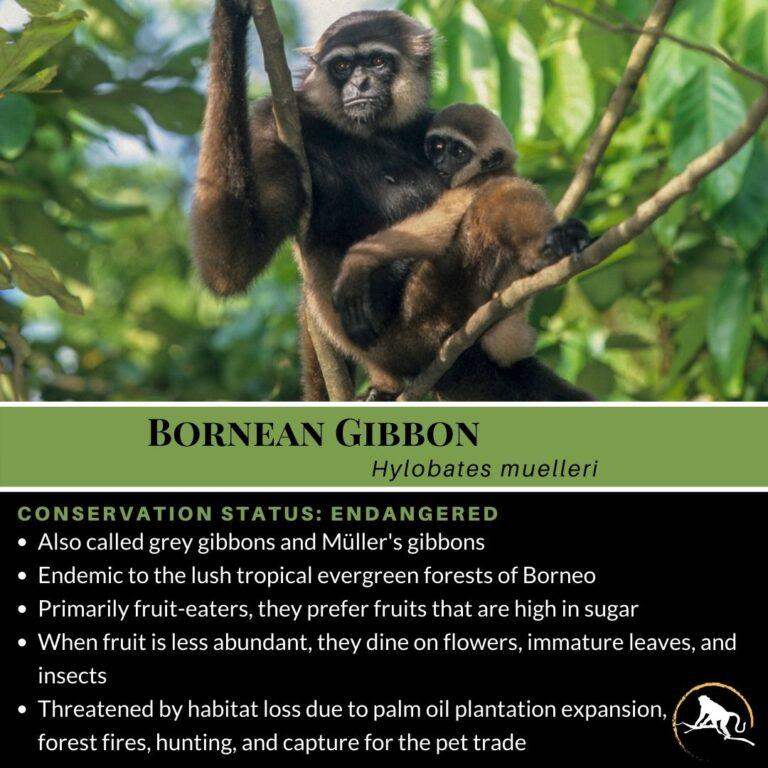
Bornean Gibbon, Hylobates muelleri
BORNEAN GIBBON
Hylobates muelleri
Geographic Distribution and Habitat
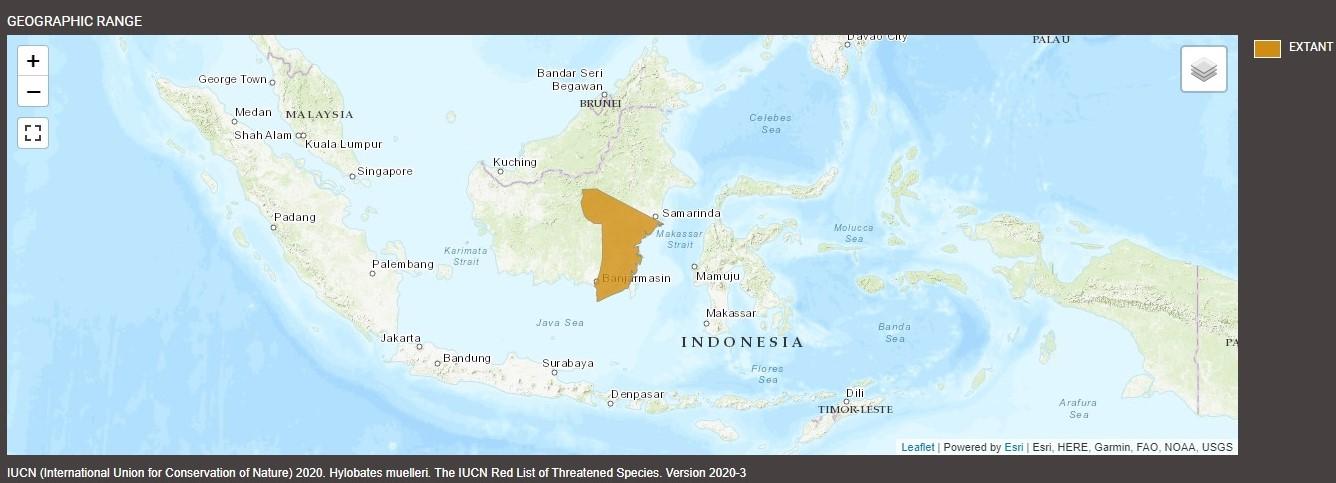
The Bornean gibbon (Hylobates muelleri), also referred to as Müller’s Bornean gibbon, is endemic to the beautiful island of Borneo, located in the Malay Archipelago. Situated southeast of the Malay Peninsula, west of Sulawesi, and east of Sumatra, Borneo’s territory is divided between three Asian countries: Indonesia, Malaysia, and Brunei, and is the third largest island in the world.
Bornean gibbons live on the island’s most southeastern part, sometimes referred to as “South Kalimantan”. Borneo’s rainforests are incredibly rich with plant and animal biodiversity, which is supported by ideal weather conditions and accessible water sources. In the wild, Bornean gibbons typically inhabit tropical evergreen forests of primary and secondary forest types, or selectively logged forests. Sandwiched between riverine barriers, they are typically found south of the Mahakam River and east of the Barito River in Borneo.
Regarding weather patterns, Borneo experiences a rainy and dry season each year. The rainy season, which typically lasts between the months of November to February, has very heavy rainfall, even though the showers are short-lived. The average rainfall during each month of this period is about 10 inches (250 centimeters) of rain. This rain is accompanied by high humidity, and temperatures can range anywhere between 75 to 95 degrees Fahrenheit (23.9 to 35 degrees Celsius). The dry season, which offers less rain, generally lasts from April to September and has the most optimal weather conditions, making it an ideal climate for wildlife.
Size, Weight, and Lifespan
The average body length of a Bornean gibbon is between 17.31 to 25 inches (44 to 63.5 centimeters). Additionally, the average weight of a Bornean gibbon is about 8.8 to 17.67 pounds (4 to 8 kilograms), making them one of the smallest gibbon species.
Unlike many other gibbon species, there are very few sexual dimorphic differences between male and female Bornean gibbons. By definition, sexual dimorphism is the distinct difference in size or appearance between the sexes of an animal, in addition to the difference between the sexual organs themselves. Besides their reproductive parts, males and females appear almost identical to one another.
In the wild, the average lifespan of a Bornean gibbon is estimated to be around 25 years.
Appearance
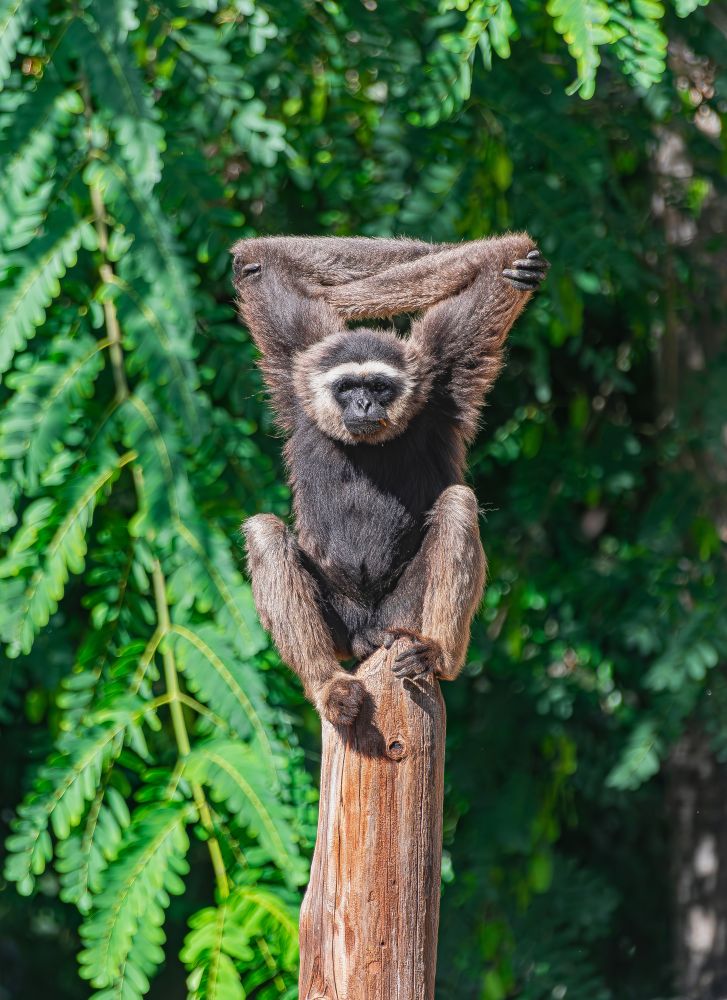
Besides the palms of their hands and feet, a Bornean gibbon’s fur covers the majority of their body, including all underparts. Their fur’s coloration is a unique mix of gray, orange, brown, and black. In color, the chest and head are darker than the rest of their body, which is further complemented by unique facial features that set them apart from other gibbon species.
In general, gibbons have small heads with round faces, typically framed by fur. Specifically for Bornean gibbons, a ring of white fur encircles their face, stopping just above the eyebrows and below their chin. Interestingly, this contrast against their dark brown eyes and black muzzle creates the illusion of a double-layered mask.
Both male and female Bornean gibbons also possess four long, prominent canine teeth that are equal in length. These sharp, dagger-like teeth are prominent and can measure between 0.5 to 1 inch (1.27 to 2.54 centimeters) long. Due to their size, these canines are often utilized as weapons in displays of aggression, often as a defensive tactic.
Like all apes, Bornean gibbons do not have tails. Evolutionarily speaking, primatologists believe that not having a tail actually proves beneficial because it allows them to develop a more upright posture. Good skeletal posture is critical for efficient movement, especially when swinging through tree branches, also known as brachiation. In fact, with proper skeletal alignment, they are able to waste less energy during their movements, which allows for quicker and more agile movement. This can be especially important when an individual is looking for food or trying to escape predators.
Diet
Bornean gibbons are frugivorous primates, meaning their diet is primarily composed of fruit and fruit products. Although they eat other foods such as leaves, flowers, or insects, these food types only supplement their main diet. In fact, about 63% of their diet is made up of fruit, while the remaining is made of 28.8% of young or immature leaves, 13.4% flowers, and about 0.8% insects.
In Borneo, fruit season peaks between March to May. Bornean gibbons can be very selective with their fruit varieties, generally only eating fruits that tend to be smaller than 1.6 inches (4 centimeters) wide and that have high sugar contents. Some of these varieties include: figs (Ficus), tarap (Artocarpus odoratissimus), and mata kuching (Artocarpus odoratissimus).
Although Bornean gibbons generally eat more fruits than flowers, when wild flowers are high in abundance, they may spend more of their time and energy feeding on flowers or leaves, instead of fruits. Flowers are considered optimal for eating between the months of January and September, so when fruit is scarce, the most important flowering plants for Bornean gibbon individuals include brown laurel (Cryptocarya crassinervia), gnetum (Gnetum microcarpum), and erycibe (Erycibe maingayi).
Behavior and Lifestyle
Bornean gibbons are arboreal primates that spend the majority of their days hanging out amongst the trees of the rainforest. They are also diurnal, which means they are primarily active during the daytime and rest at night. In fact, their daily behaviors and activities are strongly aligned with the sunlight cycle of each day.
To get around, their chosen form of movement is brachiation—a form of locomotion where an animal primarily uses its arms to swing from one support to another. Most apes brachiate when swinging between tree branches, using their forelimbs to propel in a specific direction. Physically, gibbons have long arms and hook-shaped hands that help them move between branches, in addition to rounded shoulder joints that allow for a greater range of motion. This is especially important when they perform acrobatic-like movements such as swinging or climbing.
In the wild, Bornean gibbons have few natural predators. Some of these predators include large cats like the Sunda clouded leopard (Neofelis diardi), birds of prey like the white-bellied sea eagle (Icthyophaga leucogaster) or the mountain serpent-eagle (Spilornis kinabaluensis), and large arboreal snakes like the king cobra (Ophiophagus hannah) or Sumatra pit viper (Trimeresurus sumatranus). Due to their size, young individuals are especially vulnerable to predation.
Although the songs of gibbons might appear similar to human listeners, each individual possesses a distinct call that sets them apart from others within their species. This has been revealed through scientific analysis of their vocal patterns.
For instance, researchers examine the acoustic characteristics of a gibbon’s song by considering elements such as note types, rhythm, frequency modulation, and overall song structure. Using these parameters, scientists can differentiate songs between individual gibbons with an impressive accuracy of 85.5%!
Bornean gibbon troop sizes are usually made up of between 2 to 6 individuals. Each troop has one adult female, one adult male, in addition to a few juveniles and infants.
During the daytime, Bornean gibbons engage in behaviors such as foraging, socializing, and navigating their environment. On average, about 65% of a Bornean gibbon’s day is spent traveling. Individuals can reach speeds up to 35 miles per hour (56.33 kilometers per hour) and leap distances of up to 50 feet (15.24 meters). When they are not swinging between trees via brachiation, Bornean gibbons may walk in a bipedal fashion along branches, moving swiftly and holding their arms out for balance. On the rare occasion that they visit the forest floor, they do the same. Their long arms and shorter legs make quadupedal travel almost impossible. Because of this, gibbons walk upright more than any other wild ape.
After foraging for food, gibbons spend a significant amount of their time sitting on branches, either resting or feeding. Due to the branches’ roughness, buttocks pads, called ischial callosities, provide gibbons with a supportive cushion to comfortably sit for long periods at a time. Not only does the buttock pad offer comfort against a hard surface, but it also offers stability. At night, gibbons sleep upright in the trees, unlike some other primates who build nests. The support that buttocks pads provide is especially important because it may prevent an individual from falling from high elevations while asleep, which could be the difference between life and death.
When it comes to interacting with other primates, there are few primate species Bornean gibbons engage with. The most notable species to engage with them is the Bornean white-bearded gibbon (Hylobates albibarbis), also known as the Bornean agile gibbon or southern gibbon. Both species share a home range and food sources, so they interact with one another frequently. In fact, hybrid offspring of the two species have been identified in the wild and are known to survive successfully.
Bornean gibbons establish the boundaries of their territory through distinctive territorial songs. Each morning, just before the sun rises, males begin their songs. At some point between sunrise and 10 a.m., females join them. Both males and females perform unique songs that eventually blend together to create harmonious duets. In these duets, females take the lead and dominate the song. Known as her “great call”, the female’s song involves a series of loud whopping, followed by a rapid succession of notes. The adults are often accompanied by immature juveniles and offspring, who learn to mimic the adult female’s chosen song following her lead.
To attract potential mates, unpaired males tend to sing more loudly than paired males, whereas unpaired females are less likely to sing at all. In total, the performance will last about 15 minutes.
Other forms of communication include grooming, social play, facial expressions, and body posture.
Because there is very little sexual dimorphism between the two sexes, both adults use their dental features and bodies during territory defense to communicate and convey messages to outsiders. Unlike other mammals that use their horns or antlers for threatening displays, Bornean gibbons rely on their long canines as potential weapons. Females, known for being more aggressive than their male counterparts, use their teeth to assert dominance over other primates, both within their troop and outside of it
Bornean gibbons are monogamous primates, meaning they exhibit a pair-bonding behavior where one male and one female form a lifelong, or long-term, mating relationship. Within their troop, both males and females share territories, perform mutual grooming habits, and split the responsibilities of taking care of infants and juveniles.
Once pregnant, adult females have a gestation period, or length of time between conception and birth, of about 7 months. After this period, the female will give birth to one infant that weighs around 1 pound (452.6 grams). Newborns cling to their mother’s abdomen for the first few months of their lives and will receive extensive parental care for the first two years. Infant care, which includes carrying, grooming, feeding, etc., is performed by the mother, father, and juvenile siblings. As they mature, infants begin exploring and learning from their parents and siblings, which allows them to gain a sense of independence. Sexual maturity for Bornean gibbons occurs when an individual reaches the age of between 6 to 9 years old.

As frugivores, Bornean gibbons play an important ecological role as seed dispersers throughout their ecosystem.
By definition, a seed disperser is an animal that helps transport plant seeds away from their parent plant to new locations, evidently facilitating plant colonization and survival. Bornean gibbons disperse 81% of the seeds they consume, so once a seed is ingested and passes through their digestive system, they will deposit the seeds elsewhere in their environment through defecation. Once deposited back into the environment, the seed will regeneratively grow, restoring the health of the ecosystem and maintaining its biodiversity. The process of seed dispersing also reduces the competition between an offspring and its parent plant for resources like sunlight or water, which increases the likelihood of survival for both individuals.


The International Union for Conservation of Nature lists the Bornean gibbon as Endangered (IUCN, 2015), appearing on the IUCN Red List of Threatened Species.
As of the date of the last population assessment, noted above, the total estimated population of Bornean gibbons was between 80,000 to 100,000 individuals. According to the IUCN Red List of Threatened Species, the Bornean gibbon is considered Endangered based on a suspected overall population decline of 50% or more from the past two generations, which occurred between the years 1990 to 2019. Driven by the continued loss of suitable habitat, this decline is expected to continue throughout the current generation. Over the next 30 years, if conditions do not change, it is estimated that more than 50% of suitable habitat will be lost.
Besides habitat loss due to logging and the expansion of agricultural plantations, other major threats to this species include illegal hunting and live capture.
The Bornean gibbon is listed in Appendix I of the Convention on International Trade in Endangered Species (CITES), an international agreement between governments whose goal is to ensure that international trade in specimens of wild animals and plants does not threaten their survival.
Bornean gibbons occur in several protected areas across their range, including Betung Kerihun National Park, Kutai National Park, Sungai Wain Protection Forest, and Sultan Adam Forest Park. To protect this species, specific conservation actions are needed. Such actions include: site area protection, resource and habitat protection, site and area management, species management, formal education, and compliance and enforcement.
- Bezanson, Michelle. (2016). Primate Positional Behavior Development and Evolution. Annual Review of Anthropology. 46. 1-20. 10.1146/annurev-anthro-102116-041503.
- Liu DX, Gilbert MH, Wang X, Didier PJ, Veazey RS. Reactive amyloidosis associated with ischial callosititis: a report with histology of ischial callosities in rhesus macaques (Macaca mulatta). J Vet Diagn Invest. 2012 Nov;24(6):1184-8. doi: 10.1177/1040638712463919. PMID: 23104953; PMCID: PMC3954784.
- Michilsens F, Vereecke EE, D’Août K, Aerts P. Functional anatomy of the gibbon forelimb: adaptations to a brachiating lifestyle. J Anat. 2009 Sep;215(3):335-54. doi: 10.1111/j.1469-7580.2009.01109.x. Epub 2009 Jun 10. PMID: 19519640; PMCID: PMC2750765.
- Yi Y, Mardiastuti A, Choe JC. How to be a good partner and father? The role of adult males in pair bond maintenance and parental care in Javan gibbons. Proc Biol Sci. 2023 Jun 28;290(2001):20230950. doi: 10.1098/rspb.2023.0950. Epub 2023 Jun 28. PMID: 37369349; PMCID: PMC10299859.
- https://malaysianwildlife.org/borneo-is-an-island-not-a-country/#:~:text=Borneo%20is%20an%20island%20not,interior%20parts%20that%20remain%20unexplored.
- https://www.iucnredlist.org/species/39888/17990934
- https://www.nathab.com/know-before-you-go/asia-the-pacific/borneo/weather-climate#:~:text=Borneo%20has%20a%20tropical%20rainforest,warmer%20temperatures%20and%20more%20rainfall.
- https://www.inaturalist.org/guide_taxa/178740
- https://scicomm.plos.org/2019/10/21/peeling-away-the-natural-history-of-gibbon-canine-teeth/
- https://pursuit.unimelb.edu.au/articles/why-don-t-humans-have-tails#:~:text=%E2%80%9CHumans%20belong%20to%20a%20group,to%20this%20type%20of%20locomotion.%E2%80%9D
- https://www.ifaw.org/animals/gibbons
- https://www.gibboncenter.org/gibbon-basics.html#:~:text=How%20do%20gibbons%20communicate%3F,but%20sing%20a%20different%20song.
- https://news.mongabay.com/2017/03/predator-mobbing-watch-gibbons-monkeys-team-up-to-fight-off-leopard/#:~:text=Gibbons%20have%20predators%2C%20including:%20*%20**Sunda%20Clouded,issued%20warning%20calls%20for%20over%20two%2Dand%2Da%2Dhalf%20hours.
- https://nationalzoo.si.edu/animals/news/how-long-are-gibbons-arms-and-more-gibbon-facts#:~:text=Gibbons%20don’t%20live%20in,that%20can%20cause%20serious%20damage.
- https://www.gibbonssp.org/vocalizations
- https://leakeyfoundation.org/five-fun-facts-about-gibbons/
Written by Brooklynne Mitchell-Arno, Jul 2025