
Black-Faced Black Spider Monkey, Ateles chamek
BLACK-FACED BLACK SPIDER MONKEY
Ateles chamek
Geographic Distribution and Habitat
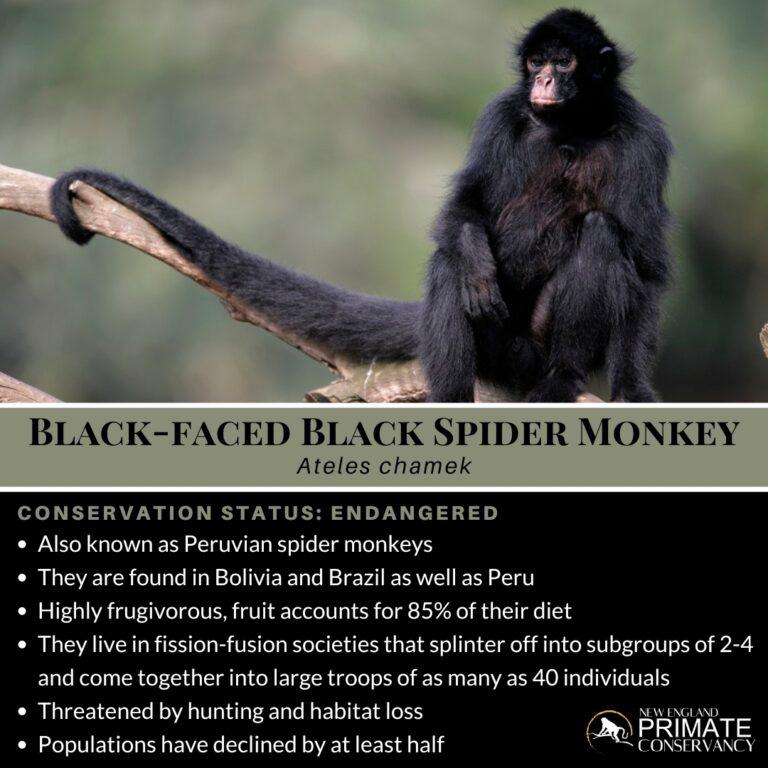
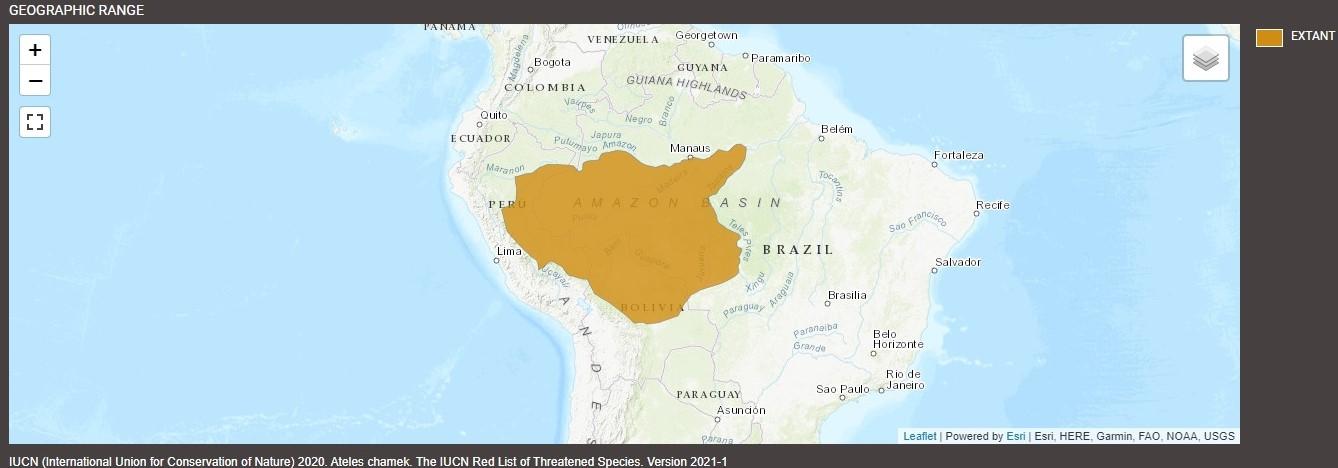
Also known as the Peruvian black spider monkey, black spider monkey, or chamek spider monkey, (but not to be confused with the Guiana spider monkey, which is also sometimes referred to as the black spider monkey) the black-faced black spider monkey’s range crosses the Ucayali River in northeastern Peru, extends south along the eastern cordillera (or chain of mountains) into the lowlands of northern and central Bolivia and into Brazil to the Rio Teles Pires and Rio Tapajós. In the parts of their range where they are not hunted, the black-faced black spider monkey is fairly common. Black-faced black spider monkeys can be found in lowland terra firme forests (a type of forest defined by how dry it is), and in forests along rivers and flooded forests. They have also been known to visit the Cerrado savannas of central Brazil, which is one of the most biodiverse ecosystems in Brazil (second only to the Amazon), and the most biodiverse savanna in the world.
Black-faced black spider monkeys are almost exclusively found in primary forests, or forests that have remained untouched by habitat degradation. This habitat provides them with plenty of tall trees to climb in. While not ideal, they have been recorded and even persisted in some fragmented forests (forests separated into small patches due to habitat destruction) so long as there was no hunting pressure. Black-faced black spider monkeys are only found in 28% (358,207 square miles, or 927,754 square km) of the range they are known to occur in due to habitat loss. Of that 28% of area occupied, only 32% is within protected areas.
Originally considered a subspecies of the red-faced spider monkey based on morphological similarities such as fur color and length, and later a subspecies of the white-bellied spider monkey, based on skull and dental characteristics. As genetic research advanced in the mid-1990s, so did our understanding of spider monkey taxonomy—to a point. More recent studies using genetics give us the current view that the black-faced black spider monkey and the white-bellied spider monkey are distinct species, but are members of the same clade along with the white-cheeked spider monkey (meaning they share their most recent common ancestor). Based on genetic data indicating that spider monkeys may have first evolved in the same region black-faced black spider monkeys currently inhabit, some scientists also think the black-faced black spider monkey may represent the original form of the Ateles genus, but other scientists disagree.
Size, Weight, and Lifespan
Black-faced black spider monkeys are sexually dimorphic (meaning one sex tends to be different in size than the other), with males having a head and body length 17.72–23.62 inches (450–600 mm), and females having a head and body length of 15.87–20.47 inches (403–520 mm). The tails of either sex can be as long as 34.64 inches (880 mm), which is necessary to help them balance high up in the trees. Males weigh up to 15.43 pounds (7 kg), and females are typically 11.02 pounds (5 kg).
The specific age the black-face black spider monkey can live up to in the wild has not been recorded, but spider monkeys may live around 30 years in captivity.
Appearance
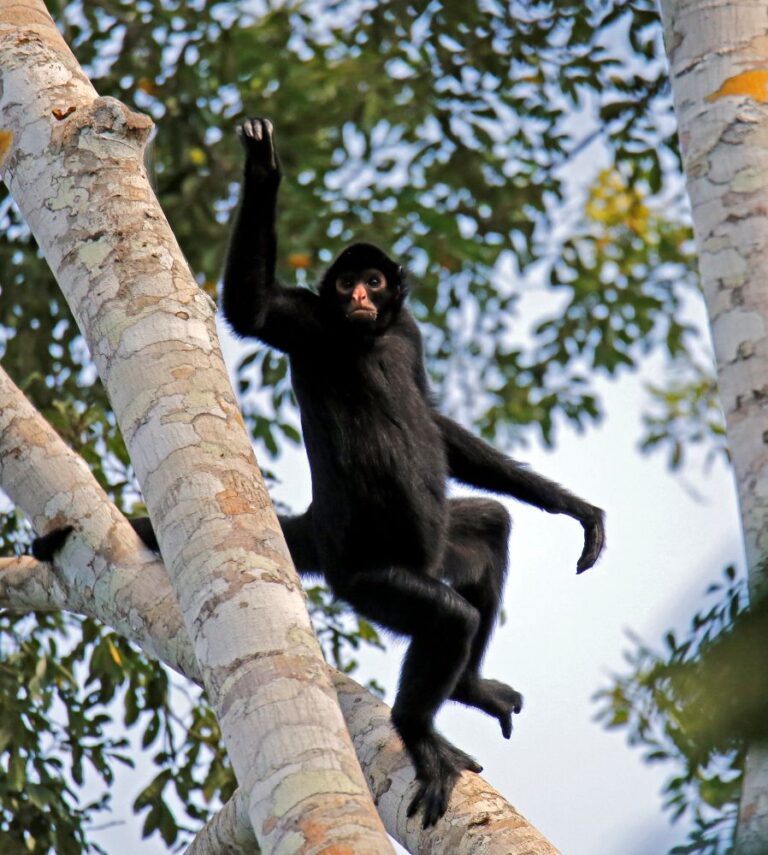
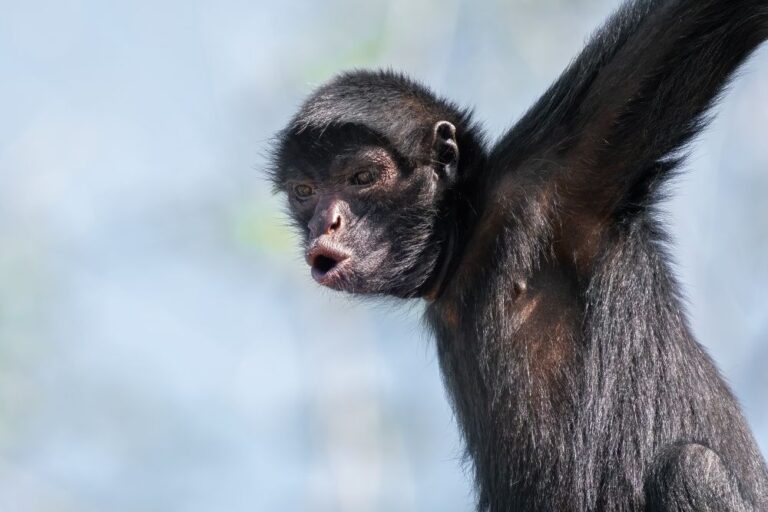
True to their name, the black-faced black spider monkey has a stark black coat covering their body, matching their black face (although some individuals sport pinkish skin that peeks out around their eyes, nose, and mouth, particularly when they’re young and haven’t had as much sun exposure). The fur on the top of their heads creates a small peak in the middle (some even sport hairstyles that could land them in a mid-2000s emo boy band). They have slender bodies, with long, lanky arms and legs that extend into long fingers and toes—perfect for hanging on tight in the upper forest canopy.
Diet
Like other spider monkeys, black-faced black spider monkeys are primarily frugivores, with 75–90% of their foraging time spent eating ripe fruit. They have been reported to feed on 63 different plant species, but of them all, figs are the black-faced black spider monkey’s favorite food, making up almost 50% of their diet. This is particularly interesting as figs have often been regarded as a “fallback food”, or a food that animals typically will only eat when their main food source is not readily available. However, figs make the perfect snack for a large-bodied frugivore such as the black-faced black spider monkey. Figs are high in several nutrients, including calcium, and include added protein from the wasp larvae that are intertwined in the figs’ life cycle. Some researchers have noticed that black-faced black spider monkeys will also eat some fruits that are infested with insects, and think this could be a feeding strategy used by the spider monkeys to keep up the amount of protein in their diet when figs are unavailable.
Black-faced black spider monkeys will also sometimes eat leaves, spending about 13% of their foraging time feeding mostly on leaf buds and immature leaves, which contain more protein than mature leaves. Particularly when fruits are scarcer, they’ll also eat flowers, flower buds, bark, decaying wood, honey, and sometimes insects (other than fig wasps).
While it has been observed infrequently, black-faced black spider monkeys have been observed to perform geophagy (or more simply, dirt eating) from aerial ant nests. This has been observed in lactating females, who possibly needed some extra minerals added to their diet due to the taxing nature of lactation and pregnancy.
Behavior and Lifestyle
Black-faced black spider monkeys are diurnal (meaning they are active during the day) and arboreal, almost never descending to the forest floor, and spend most of their time in the higher levels of the forest canopy, over 66 feet (20m) above the ground. They move by swinging, climbing, or simply walking on all fours among the tree branches. Like other spider monkeys, they can semi-brachiate. While spider monkeys have long arms and extended hands similar to those of the true brachiating gibbons and siamangs, they’re not quite as well adapted to swinging from branch to branch using only their arms and do so with the assistance of leaping and the use of their prehensile tail. While not their most common method of travel, black-faced black spider monkeys have been reported to sometimes swim across rivers.
They have large home ranges of 0.59–0.89 square miles (153–231 ha). In a day, black-faced black spider monkeys may travel 0.29–3.54 miles (460–5690 m). This range will vary between males and females, with males typically traveling more than females, and by seasonal changes in fruit availability.
Black-faced black spider monkeys live in large multi-male-multi-female groups with 37-55 individuals. They have a fission-fusion social system, where individuals will move between smaller sub-groups typically of 2-4 individuals, and may even travel alone within the group’s home range. Researchers think having large groups with fission-fusion dynamics helps to mitigate the costs and benefits of group living. Because having a larger group also increases their territory, feeding competition is reduced. Sub-groups are sometimes referred to as “sex-segregated” as males will often socialize with only each other, and females will only socialize with their dependent young and occasionally other females. Males will typically travel more within the group’s range than the females will, and patrol the perimeters of the territory to ensure no other spider monkey groups try to sneak in.
After waking up in their sleeping tree, black-faced black spider monkeys will typically travel the most first thing in the morning, and later in the evening when heading back to their sleeping site. Allocating travel to these times helps reserve energy, as these times are cooler. Once the spider monkeys have finished their breakfast, they’ll rest and nap through the late morning and early afternoon when temperatures are highest.
Black-faced black spider monkeys are territorial and do not overlap group range with other groups (unless they’re being sneaky). Likewise, they rarely associate with other primate species, except for occasional periods of tolerance when a tree is fruiting enough to provide enough fruit to go around. Despite this seemingly anti-social nature, black-faced black spider monkeys have been reported to hybridize with white-bellied spider monkeys and white-cheeked spider monkeys where their ranges overlap.
Likely due to them only somewhat recently being recognized as a separate species, there are few studies specifically describing how the black-faced black spider monkey communicates. However, we do have some studies from other species of spider monkeys (including the closely related A. belzebuth) to give us some ideas. Because spider monkeys live in large groups, vocalizations that can be heard over some distance are their most important form of communication. Because they are so territorial, one of the main vocalizations used by black-faced black spider monkeys is an ook-bark emitted by males during encounters with other groups, which can continue for an hour. Spider monkeys also use “barks” to warn others of nearby predators and other potential threats. Bouts of whoops and wails are emitted to locate other group members. When subgroups are joining together (the “fusion” part of their fission-fusion social dynamic), spider monkeys will give a “whinny” vocalization reciprocally between subgroups. When subgroups diverged from each other (or “fissioned”), parting individuals would give a tschook sound.
Spider monkeys reach sexual maturity at about 4-5 years of age. Upon reaching maturity, females will leave their natal group (the group they were born in) to join a new one—which is typical of Latin American primates. Males will typically remain in their home group their entire lives, and as such have much stronger social bonds between each other than they do with the females of the group, or between the females themselves.
Females mate promiscuously (with multiple males—sometimes even in the same day), including during times when they are most likely to conceive. Otherwise, not much is known about mating behavior in spider monkeys as they tend to be quite shy about their “bedroom” activities, doing so out of view of other group members—particularly other males—and subsequently, human observers.
After a 226-232-day gestation period, females give birth to a single offspring. Infants look like bald miniature versions of their parents, and will use their long little fingers to cling to their mother’s fur until they’ve become comfortable clinging to the trees on their own. In the wild, females will typically go a little over 2 years between births. Lactating females spend less time resting than other group members, which they replace with increased foraging time.
Spider monkeys are known to be one of the primary seed dispersers in the Amazon. While eating fruits, black-faced black spider monkeys will also end up eating fruit seeds, and spread them throughout the forest as they move and subsequently “pass” the seeds along. Researchers found that over 90% of seeds consumed by black-faced black spider monkeys are consumed and passed undamaged, meaning they have a good chance to germinate after catching a ride in a spider monkey—and even have a nutrient-dense package to grow from. Seed dispersers are very important to the long-term health of the forest and help maintain the overall tree diversity needed for a healthy forest.


The black- faced black spider monkey is classified as Endangered by the International Union for Conservation of Nature (IUCN, 2015), appearing on the IUCN Red List of Threatened Species. Their population is decreasing—estimated to have declined by at least 50% over the last 45 years. Further, scientists predict that 31-40% of the black-faced black spider monkey’s habitat will be lost by 2050. Their primary threats are hunting and habitat loss, and they are also sometimes captured as infants and sold as pets. Habitat loss is driven by agricultural development, primarily for soy and cattle farming. Other infrastructural developments, such as dams and highways, also pose a threat to spider monkey habitat.
Black-faced black spider monkeys are listed in Appendix II of the Convention on International Trade in Endangered Species (CITES), an international agreement between governments whose goal is to ensure that international trade in specimens of wild animals and plants does not threaten their survival.
In the Cerrado, WWF (the World Wildlife Fund) works alongside farmers to help them make their practices more sustainable and reduce agricultural expansion without sacrificing production.
In the lower Madre de Dios area of southern Peru, black-faced black spider monkeys had gone locally, likely disappearing from the region in the late 1980s. Reintroduction efforts of black-faced black spider monkeys that had previously been kept as pets have been established in the Tambopata National Reserve within this region with some success. Reintroducing animals into the wild is never an easy task, and they often have to overcome a harsh learning curve before showing any promise of benefiting the species being reintroduced. Since beginning reintroductions of black-faced black spider monkeys in 2010, several newly wild groups have established themselves, which researchers have found to increase the success of newly reintroduced individuals. Researchers have also noted that having human caretakers who the monkeys know stay with them for a few days after being released helps them gain the confidence they need to explore their new home.
Fortunately, black-faced black spider monkeys occur in a number of protected areas throughout the countries where they are found. In moving forward in conservation of the species, researchers call for forest restoration efforts that increase the connectivity of forest patches.
- https://www.iucnredlist.org/species/41547/191685783
- https://cites.org/eng/app/appendices.php
- https://www.worldwildlife.org/places/cerrado
- Nunes, A. V. (2014). Report of a black spider monkey (Ateles chamek) swimming in a large river in central-western Brazil. Neotropical Primates, 21(2), 204-206.
- Felton, A. M., Felton, A., Wood, J. T., & Lindenmayer, D. B. (2008). Diet and feeding ecology of Ateles chamek in a Bolivian semihumid forest: the importance of Ficus as a staple food resource. International Journal of Primatology, 29, 379-403.
- Wallace, R. B. (2006). Seasonal variations in black‐faced black spider monkey (Ateles chamek) habitat use and ranging behavior in a southern Amazonian tropical forest. American Journal of Primatology: Official Journal of the American Society of Primatologists, 68(4), 313-332.
- Lange, L. R., & Robson, N. M. (2019). Demography, habitat use and activity budget of a wild group of black-faced black spider monkeys (Ateles chamek) in Las Piedras, south-eastern Perú. Neotropical Primates, 25(1), 21-29.
- Wallace, R. B. (2001). Diurnal activity budgets of black spider monkeys, Ateles chamek, in a southern Amazonian tropical forest. Neotropical Primates, 9(3), 101-107.
- Felton, A. M., Felton, A., Wood, J. T., Foley, W. J., Raubenheimer, D., Wallis, I. R., & Lindenmayer, D. B. (2009). Nutritional ecology of Ateles chamek in lowland Bolivia: how macronutrient balancing influences food choices. International Journal of Primatology, 30, 675-696.
- Pottie, S., Bello, R., & Donati, G. (2021). Factors influencing establishment success in reintroduced black-faced spider monkeys Ateles chamek. Primates, 62(6), 1031-1036.
- Rabelo, R. M., Gonçalves, J. R., Silva, F. E., Rocha, D. G., Canale, G. R., Bernardo, C. S., & Boubli, J. P. (2020). Predicted distribution and habitat loss for the Endangered black-faced black spider monkey Ateles chamek in the Amazon. Oryx, 54(5), 699-705.
- dos Santos-Barnett, T. C., Cavalcante, T., Boyle, S. A., Matte, A. L., Bezerra, B. M., De Oliveira, T. G., & Barnett, A. A. (2022). Pulp fiction: Why some populations of ripe-fruit specialists Ateles chamek and A. marginatus prefer insect-infested foods. International Journal of Primatology, 43(3), 384-408.
- Morales-Jimenez, A. L., Disotell, T., & Di Fiore, A. (2015). Revisiting the phylogenetic relationships, biogeography, and taxonomy of spider monkeys (genus Ateles) in light of new molecular data. Molecular phylogenetics and evolution, 82, 467-483.
- [Matthew Richardson, Scott Suarez]. [Ateles, chamek, ]. © All the World’s Primates. N Rowe, M Myers, eds. (alltheworldsprimates.org) Downloaded 6/20/2025
- Di Fiore, A., Link, A., Campbell, C. J. (2011). The Atelines Behavior and Socioecological Diversity in a New World Monkey Radiation. In Primates in Perspective (second, pp. 155–188). Oxford University.
- ANDEZ, G. R. F. (2008). Communication in spider monkeys: the function and mechanisms underlying the use of the whinny. Spider monkeys: Behavior, ecology and evolution of the genus Ateles, 55, 220.
Written by Lina Rademacher, June 2025