
Coquerel’s Giant Mouse Lemur, Mirza coquereli
COQUEREL'S GIANT MOUSE LEMUR
Mirza coquereli
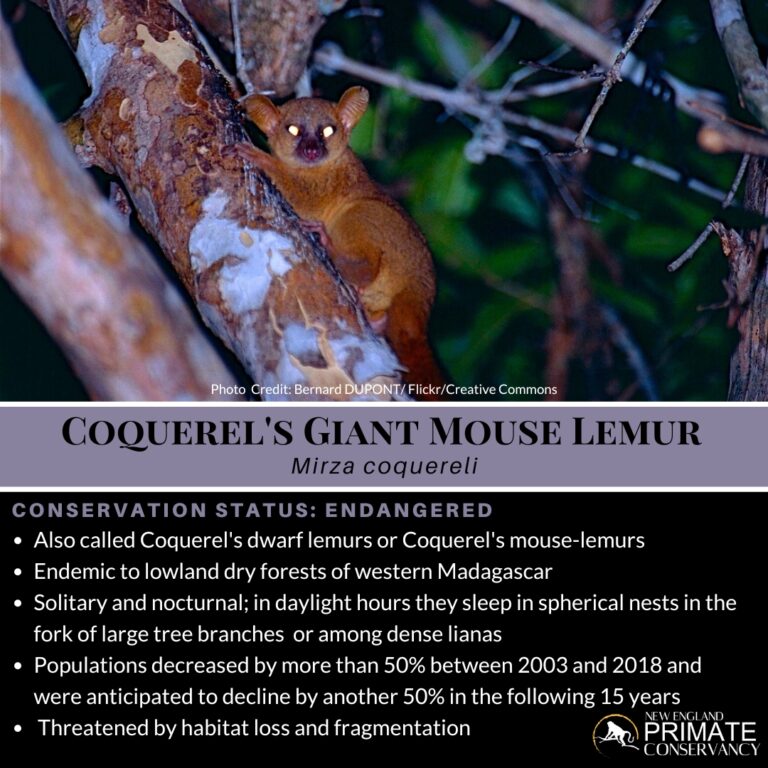
Geographic Distribution and Habitat
The Coquerel’s giant mouse lemur, also known as the Coquerel’s dwarf lemur, the Coquerel’s mouse lemur, and scientifically as Mirza coquereli, is, like all lemurs, endemic to Madagascar. This means they are found on this island and nowhere else in the world.
These lemurs are found in lowland dry, deciduous, and gallery forests of western Madagascar, inhabiting the areas between the Onilahy and Tsiribinha Rivers. The altitude of their habitats ranges from sea level to 2,296.6 feet (700m). They have been found in the Zombitse-Vohibasia National Park and are unconfirmed in Isalo National Park. Coquerel’s giant mouse lemurs live in fragmented habitats across the deteriorating Malagasy dry forest region. More research is needed to identify which species of giant mouse lemur are living in Namoroka and Tsingy de Bemaraha National Parks, Beanka Protected Area, and Morombe municipality.
Coquerel’s giant mouse lemur was first described in 1867 by Grandidier and was the only member of its genus until 2005, when the northern giant mouse lemur (M. zaza) was described. While they are presently considered two distinct species based on thorough genetic testing and visual observation, there is still some confusion in areas where their habitats overlap. A full understanding of the distribution of each of these species will require more research attention.
Size, Weight, and Lifespan
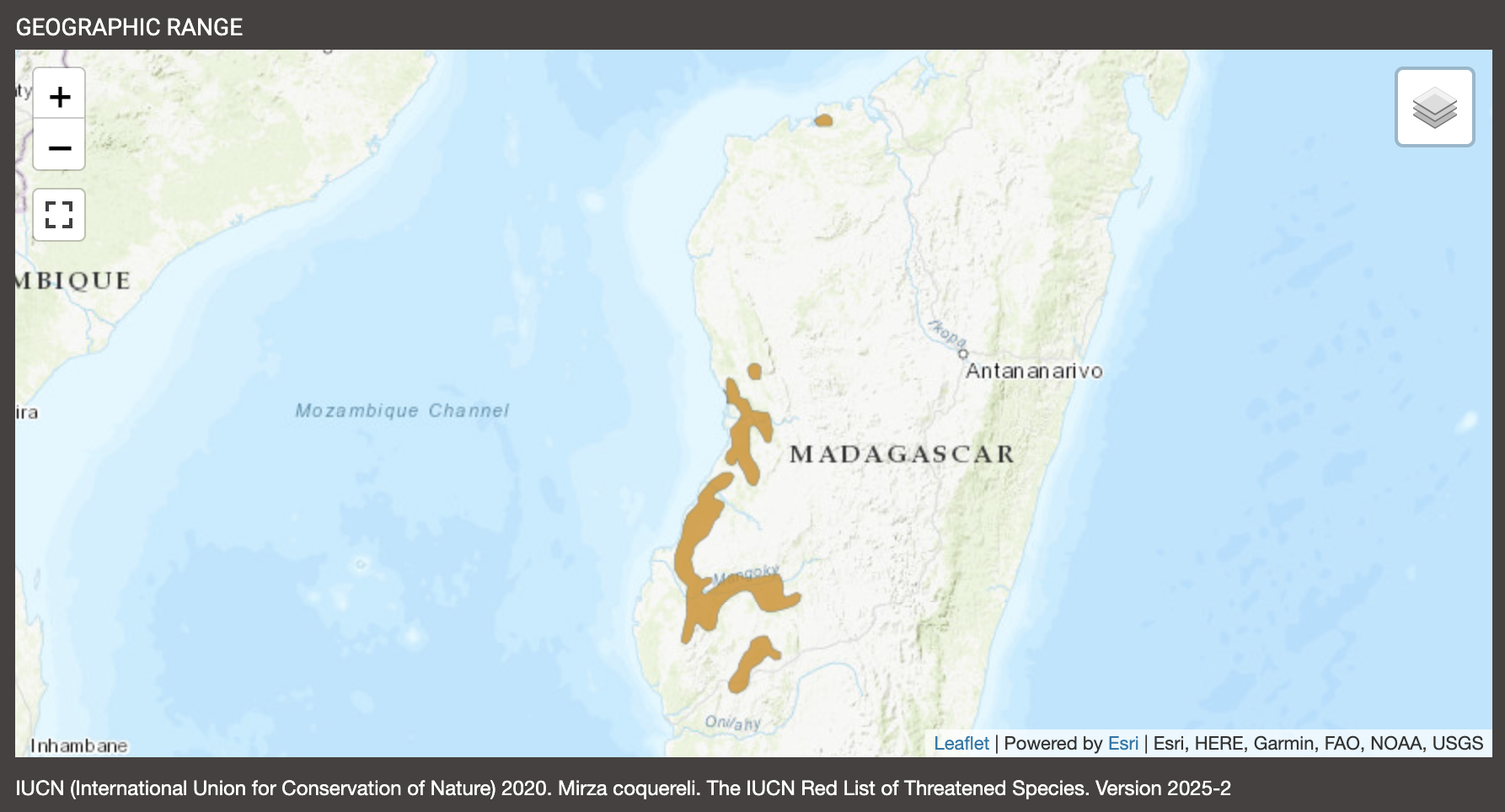
The Coquerel’s giant mouse lemur is small compared to all other lemur species, but gets its namesake for being several times larger than other mouse lemur species. The average body mass is 10.2-11.3 ounces (290–320 g). The species is sexually dimorphic, with males slightly larger than their female counterparts. Overall, their bodies measure an average of 9.8 inches (25cm) with tails measuring about 12.2 inches (31cm).
The lifespan of the Coquerel’s giant mouse lemur has not been reported, but a similar species, the northern giant mouse lemur (Mirza zaza), has been recorded to live until 17 years of age.
Appearance
To help the nocturnal Coquerel’s giant mouse lemur navigate its dark environment, they are equipped with large, reflective eyes, in addition to its delicate, large, and perceptive ears. Coquerel’s giant mouse lemurs are gray-brown in color with occasional orange undertones. They have a long, fluffy tail that can be a rusty-brown color, and which darkens at the tip. It is longer than their body. The tail helps them balance as they go from tree to tree and is actually quite thin, but long hairs give it the appearance of bushiness. Their bellies are generally a little lighter with more of a washed-out gray color, while their backs take on a more tan undertone. Both hands and feet have opposable thumbs to grasp trees and branches.
Diet
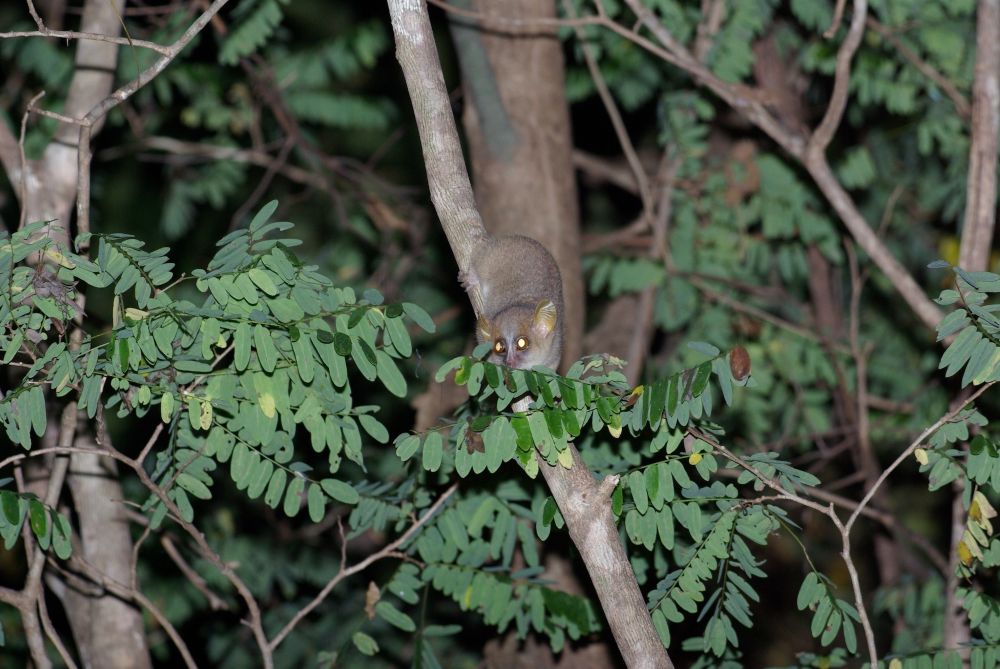
Coquerel’s giant mouse lemur is omnivorous, feeding on fruits, flowers, buds, gums, nectar, nuts, bird eggs, and a wide variety of animal matter, including insects, spiders, frogs, chameleons, small birds, and rodents. An important food source during the dry season of June to July is the excretions of insect larvae.
Behavior and Lifestyle
Coquerel’s giant mouse lemur is nocturnal (active at night) and spends the day resting in nests it constructs from interlaced vines, branches, leaves, and twigs chewed from nearby trees. Nests are spherical, measuring up to about 19.7 inches (50 cm) in diameter. They are typically built 6.6–32.8 feet (2–10 m) above the ground, positioned between branches or within dense woody vines. The nests are strategically placed to avoid predators, with 10-12 scattered across their home range, which they rotate through every couple of days.
During the day, Coquerel’s giant mouse lemurs forage and sometimes interact with neighbors. Their home areas range from 2.5-9.9 acres (1-4 ha) in size, which can overlap with the home ranges of up to eight neighbors. While much of their home range overlaps with that of other Coquerel’s giant mouse lemurs, they are not aggressive to individuals entering their territory. However, they do keep the inner circle of their domain extremely protected. For the innermost parts of their home, scent-marking, aggressive vocalizations, and the occasional tussle keep other individuals away.
Coquerel’s giant mouse lemurs’ tails are longer than their bodies!
Coquerel’s giant mouse lemur is called “giant” because it is several times larger than most other mouse lemur species.
Unlike some related lemurs, such as dwarf lemurs, who conserve energy by hibernating, Coquerel’s giant mouse lemur remains active throughout the year.
The Coquerel’s giant mouse lemur is largely solitary, and individuals generally do not share nests, except mothers with their offspring. These giant mouse lemurs maintain home ranges of 2.5-9.9 acres (1-4 ha) that border up to eight neighbors. They are not aggressive in defending their home ranges and may occasionally tolerate visitors, sometimes engaging in brief social interactions.
Coquerel’s giant mouse lemurs normally leave their nests around dusk to begin self-grooming or foraging for food. On colder nights, they leave their cozy nests later in the evening and return home to rest in the wee hours of the morning. To find food sources, the Coquerel’s giant mouse lemurs will travel through canopies 16.4-32.8 feet (5-10 m) tall, very occasionally descending to the forest floor. Later in the night, a couple of hours before they retire for the day, they may engage in social activities like grooming
While interactions are rarely observed, one study found that individuals are connected through hidden matrilines, or generations of related females. Genetic testing showed that females with neighboring home ranges shared the same mitochondrial DNA haplotype, indicating maternal relatedness. Although both sexes leave their natal nests once mature, females sometimes remain in the same area, a phenomenon known as female philopatry, which can result in related females living nearby.
While considered a solitary species, Coquerel’s giant mouse lemurs use many modes of communication to converse with neighbors.
Scent marking is especially prominent in this species, with individuals using urine, saliva, and other secretions to mark territory and communicate home range boundaries.
Another form of communication is vocalizations. Coquerel’s giant mouse lemurs use calls to “talk” with mates and interact with neighbors. During the mating season, males and females alike will call to one another across home ranges. Recordings of females making vocalizations that started with a “zek” or downward modulated pulse, followed by a succession of up and down modulations in frequency, have been dubbed with different names by scientists, such as the “advertisement call”, the “sexual call sequence”, and the “trill”.
Grooming is also considered a form of communication. Not only will they self-groom, but males groom females during the mating season when interactions are more common.
Females have also been known to hit males after grooming and copulation as a way to cease further advancements.
Although Coquerel’s giant mouse lemur is usually observed alone, males in some regions expand their home ranges during the October–November mating season, sometimes to four times their usual size, increasing access to neighbors and potential mates. That’s not the only thing that grows! Males’ testes can increase almost five times in size during the mating period. During these short few weeks, the females’ genitalia redden and swell, indicating fertility. Females and males alike call for mates during this period, and both sexes will have multiple partners. Males will also groom various females to get into their good graces.
Females experience a gestation of about 90 days and will typically give birth to two offspring. After three weeks, the infant can leave the nest. The mother and offspring form a strong bond and can live in the same nest for years, even after the offspring has matured. Throughout the offspring’s childhood, the mother is the primary caregiver, and the father is out of the picture, since he’s not sure if the babies are his. With babies with uncertain fathers, both males and females with multiple partners, increased home ranges, and a short mating window, their mating system is messy and chaotic.
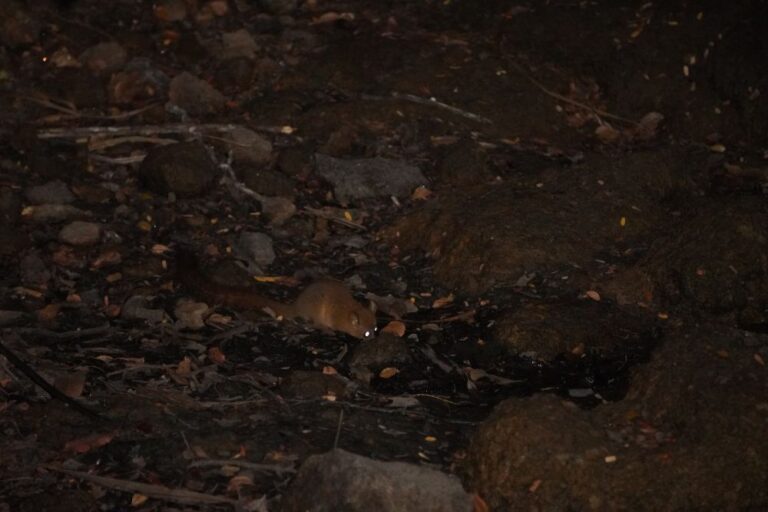
In Madagascar’s unique, biodiverse ecosystems, every organism plays an important ecological role, and the Coquerel’s giant mouse lemur is no exception. As fruit eaters, they pass seeds through their feces, helping to repopulate the forest floor. They keep the populations of the small animals they eat in check, maintaining the delicate balance in the ecosystem. Finally, as prey themselves, they nourish Malagasy carnivores, such as the fossa, owls, and other large birds of prey.


The Coquerel’s giant mouse lemur is classified as Endangered by the International Union for Conservation of Nature (IUCN, 2018), appearing on the IUCN Red List of Threatened Species.
The biggest threats to Coquerel’s giant mouse lemur are fragmented habitats. Slash-and-burn agriculture and charcoal production are problems throughout Madagascar, with the western dry forests being particularly vulnerable. Combined with hunting in parts of their range in western Madagascar, this species is threatened with extinction in the next century.
All lemur habitats have been on the decline for many years. From 1973 to 2014, 37% of Madagascar’s forests were lost, with an annual deforestation rate of 1.1% observed from 2010 to 2014. Madagascar’s forests and populations are suffering. More recent studies have claimed that Madagascar has lost more than 80% of its forests to human activities in the last century.
In light of the destruction of their home, Coquerel’s giant mouse lemur populations have significantly declined. The Coquerel’s giant mouse lemur population was cut in half in the last 15 years, and scientists predict that their population will halve again in the next 10 years.
Many of the occurrence reports indicating population sizes and their locations are dated from before the 21st century and need significant updating. As of 2024, sources report population densities of at most 1 individual per 2.5 acres (1 ha) in Tsingy de Bemaraha National Park, 1 or 2 individuals per 2.5 acres in Masoarivo, up to 2 individuals per 2.5 acres in Central Menabe Antimena, and possibly fewer than 1 individual per 2.5 acres in Zombitse-Vohibasia National Park. One study also reported high population densities in Kirindy forest, but since the original occurrence report, the population has mysteriously been declining.
In addition to the locations above, the Coquerel’s giant mouse lemur is present in three other protected areas, including Kirindy-Mitea National Park and the protected areas of Ambondrobe and Tsimembo-Manambolomaty.
The Coquerel’s giant mouse lemur is listed in Appendix I of the Convention on International Trade in Endangered Species (CITES), an international agreement between governments whose goal is to ensure that international trade in specimens of wild animals and plants does not threaten their survival.
While the human population of Madagascar continues to increase and forests are continually destroyed, Madagascar’s renowned biodiversity receives attention from conservationists and scientists alike. With this increased attention and a push towards public engagement, scientists hope to encourage local knowledge and inspire policymakers. One such example is the DLC-SAVA Conservation Project (the Duke Lemur Center and SAVA region Conservation Project), which works to preserve the natural biodiversity of Madagascar and conserve its lemurs by empowering local communities to be conservation leaders. Another organization working to protect the biodiversity of Madagascar is Wildlife Madagascar. Namely, their Namoroka field site works to protect 10 species of lemurs found in this region, including Coquerel’s giant lemur.
- Rowe, Amanda & Hending, Daniel & Schäffler, Livia & Markolf, Matthias. (2024). Coquerel’s Giant Mouse Lemur, Mirza coquereli (A. Grandidier, 1867).
- Markolf, M., Roos, C. & Kappeler, P. (2008). Genetic and Demographic Consequences of a Rapid Reduction in Population Size in a Solitary Lemur (Mirza coquereli). The Open Conservation Biology Journal, 2(1), 21-29. doi: https://doi.org/10.2174/1874839200802010021
- Peter M. Kappeler, Barbara Wimmer, Dietmar Zinner, Diethard Tautz; The hidden matrilineal structure of a solitary lemur: implications for primate social evolution. Proc Biol Sci 1 September 2002; 269 (1502): 1755–1763. https://doi.org/10.1098/rspb.2002.2066
- gbif.org: Mirza coquereli (A.Grandidier, 1867)
- Duke Lemur Center SAVA Conservation Project
- WWF Madagascar Forests
- Blanco, M.B. and Zehr, S.M. (2015), Longevity in hibernating lemur. J Zool, 296: 177-188. https://doi.org/10.1111/jzo.12230
- Stanger, K.F., Coffman, B.S. and Izard, M.K. (1995), Reproduction in Coquerel’s dwarf lemur (Mirza coquereli). Am. J. Primatol., 36: 223-237. https://doi.org/10.1002/ajp.1350360306
- The potential distribution of the giant mouse lemurs (Mirza coquereli, Mirza zaza) with implications for their conservation. Dominik Schüßler, Naina Ratsimba Rabemananjara, Jonah H. Ratsimbazafy
- Markolf, Matthias & Kappeler, Peter. (2019). Observations on the mating behavior of Mirza coquereli in Kirindy Forest, Western Madagascar. 22. 19-22.
- IUCN Redlist Coquerel’s Giant Mouse Lemur
- Namoroka Field Site Wildlife Madagascar
Written by Nami Kaneko, January 2026