
NORTHERN GIANT MOUSE LEMUR

Mirza zaza

Geographic Distribution and Habitat

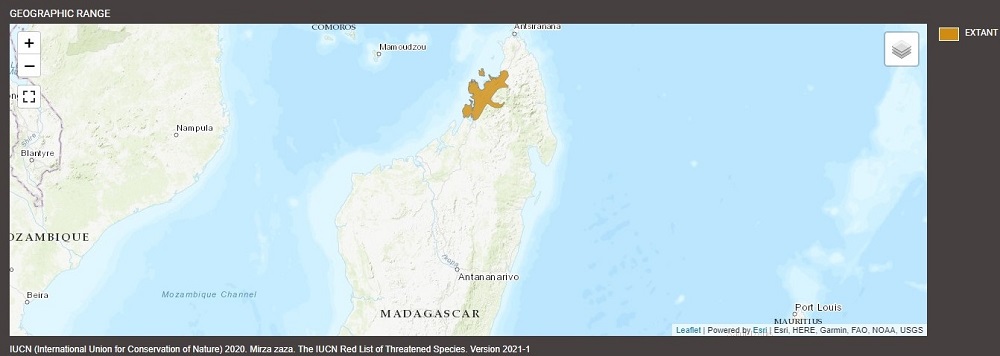
The northern giant mouse lemur, scientifically known as Mirza zaza, is endemic to Madagascar, like all lemurs. Its range lies in northwestern Madagascar in the Sambirano region. The species is bordered by two major rivers—the Maevarano River to the south and the Mahavavy River to the north—which form natural boundaries for the animals living in the region. A third river, the Sambirano River, runs through the middle of the region and may also influence the species’ distribution.

The region is primarily a dry forest biome characterized by a generally warm climate, long dry periods, and significant habitat decline over the past several decades. Northern giant mouse lemurs are also found in secondary forests, old banana plantations, gallery forests, and abandoned cashew orchards.

Part of the northern giant mouse lemur’s range overlaps with that of Coquerel’s giant mouse lemur (Mirza coquereli), which historically caused confusion between the two species. When first recorded in 1867, they were classified as the same species. However, genetic studies and detailed observations confirmed in 2005 that they are distinct species, improving our understanding of both.

Northern giant mouse lemurs live sympatrically with several other nocturnal lemur species, including the Sahamalaza sportive lemur (Lepilemur sahamalaza), Gray-backed sportive lemur (Lepilemur dorsalis), Mittermeier’s sportive lemur (Lepilemur mittermeieri), Claire’s mouse lemur (Microcebus mamiratra), Sambirano mouse lemur (Microcebus sambiranensis), Fat-tailed dwarf lemur (Cheirogaleus medius), and Pariente’s fork-marked lemur (Phaner parienti).

Northern giant mouse lemur range, IUCN 2025

Size, Weight, and Lifespan

The northern giant mouse lemur has a body length of about 10.6 inches (27 cm), with a tail measuring 10.6–11 inches (27–28 cm). Weighing about 10.6 ounces (300 g), it is smaller than Coquerel’s giant mouse lemur and is often described as a “squirrel-sized” primate.

The lifespan of the northern giant mouse lemur has not been directly observed. However, some sources suggest that giant mouse lemurs generally live about 5–6 years in the wild. In captivity, under well-managed professional care, they may live longer, possibly up to 17–25 years. A related species, Coquerel’s giant mouse lemur, has been recorded living up to 17 years.

Appearance

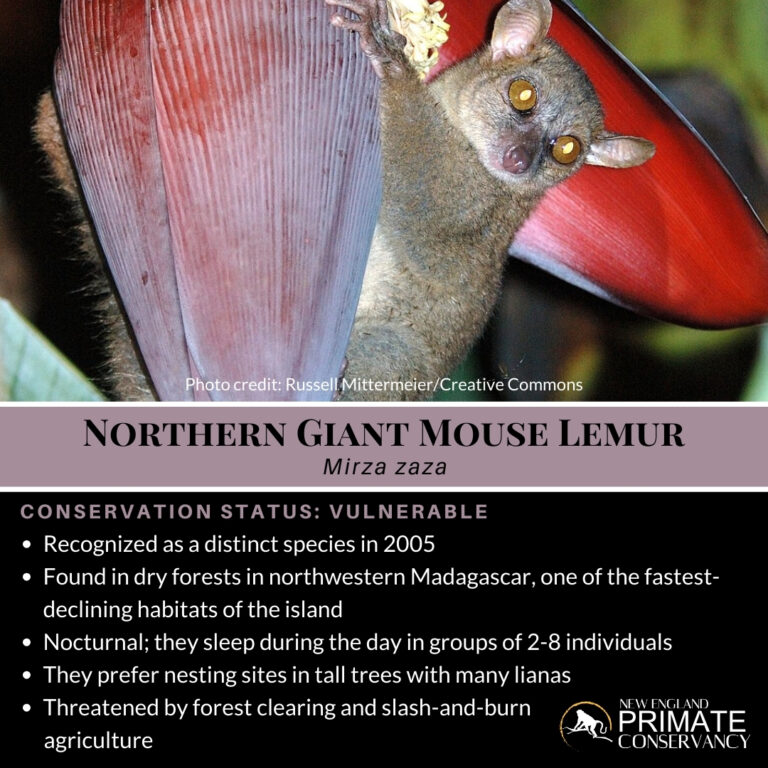
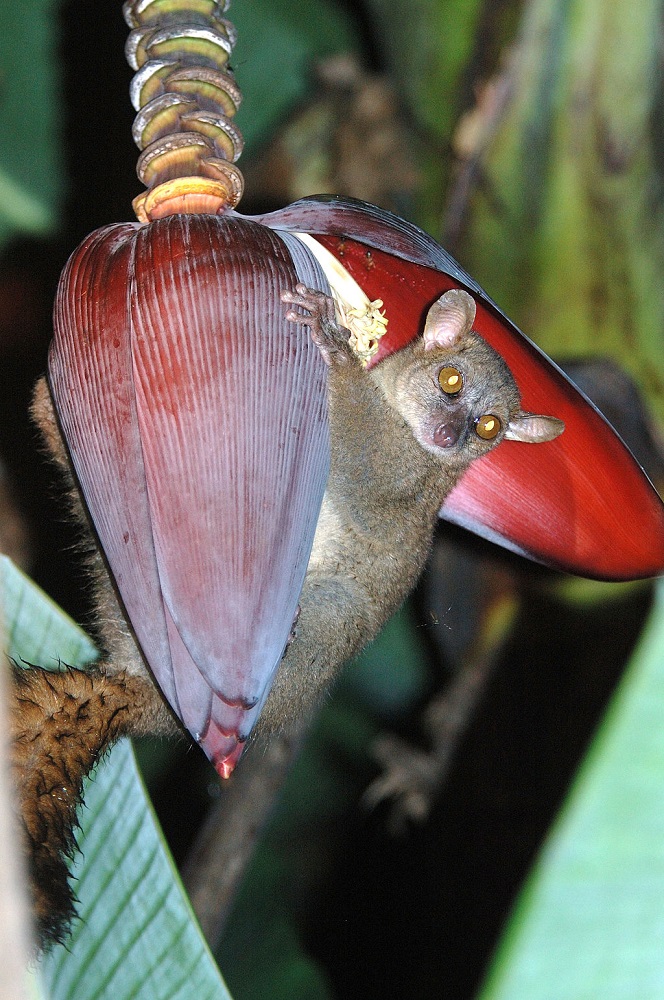
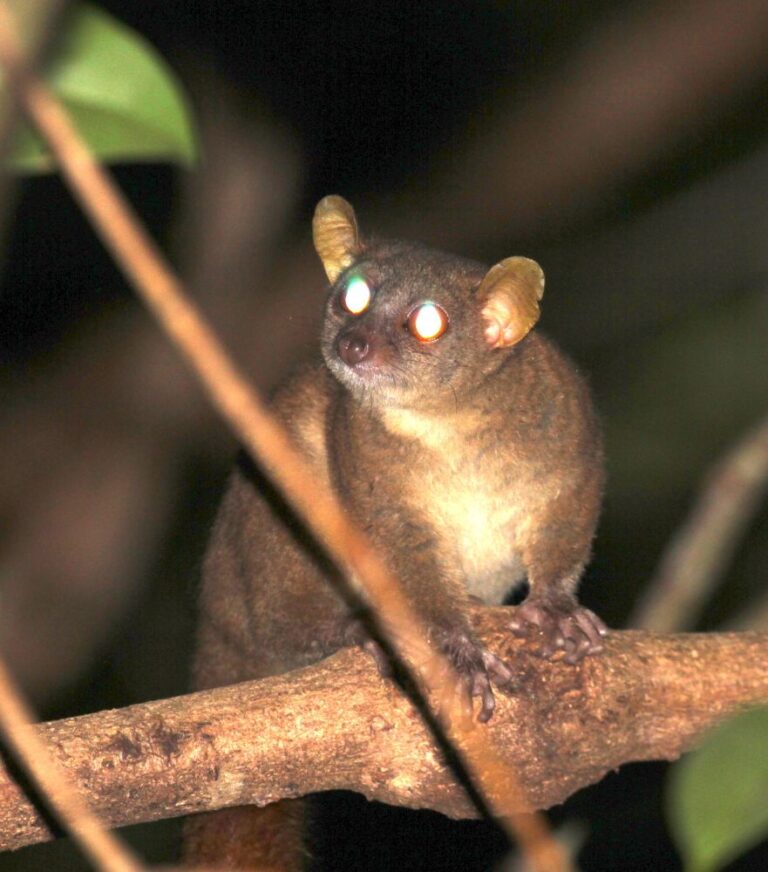
Because northern giant mouse lemurs are active at night, they have large eyes and prominent ears that help them navigate and detect danger in the dark forest. Their round, reflective eyes help them detect movement at night and range in color from brown to orange. Their large ears allow them to hear predators that may be approaching.

Their fur also helps them stay hidden from predators. Their bellies are light tan or cream, while their backs are dark brown with gray accents. This coloration provides camouflage: from below, their light bellies blend with the bright night sky, while from above, their darker backs blend with the forest floor.

Northern giant mouse lemurs also have fluffy, rust-colored tails about as long as their bodies. These tails help them maintain balance as they leap through the forest canopy.

One of the most notable physical features of the northern giant mouse lemur is the unusually large size of the males’ testes. Males have the largest relative testes size of any primate, an adaptation associated with their reproductive strategy.

Photo: Russell Mittermeier/Creative Commons
Diet

Northern giant mouse lemurs eat a wide variety of foods, including arthropods, small birds, mammals, amphibians, reptiles, eggs, fruit, flowers, buds, gums, and insect secretions. They have been observed licking the secretions of homopteran Flatidae (“planthopper”) larvae and are known to feed on the fruit of Gardenia rutenbergiana.

The largest known population of northern giant mouse lemurs also occurs in a region with many mango trees, suggesting that mangoes may be an important seasonal food source. One study also observed these lemurs feeding on gum from the talandoa tree (Polyscias bakeriana).

Studying their diet can be difficult because they move quickly through dense forest, making it challenging for researchers to observe exactly what they eat.

Behavior and Lifestyle

Northern giant mouse lemurs are nocturnal, meaning they are active at night and sleep during the day. Although most of their activity occurs at night, one study recorded individuals active during daylight hours, suggesting they may have a more flexible sleep–wake pattern than previously thought. This has raised the possibility that the species could be cathemeral (active during both day and night), though more research is needed to confirm this.

One study found that northern giant mouse lemurs spent about 65.3% of their waking time moving, 14.6% feeding and foraging, 13.4% resting or sleeping, 5.7% grooming, and about 1% engaged in social activities.

Northern giant mouse lemurs are arboreal, meaning they live in trees. When active, they typically remain less than 82 feet (25 m) above the ground, though on average they stay about 23 feet (7 m) above the forest floor.

A key difference between the northern giant mouse lemur and Coquerel’s giant mouse lemur is their sleeping behavior. Northern giant mouse lemurs sleep with both related and unrelated members of their species. During the day, they rest in spherical nests up to about 19.7 inches (50 cm) in diameter, constructed from twigs, lianas, branches, and leaves. At night, groups of two to four individuals—males and females of different ages—sleep together in these nests.

In a study of northern giant mouse lemurs in the Ankarafa Forest, nests were typically well covered by the forest canopy, even during the dry season (May–October). They were built in the tallest and largest trees in the forest, which often had more lianas (woody vines) than surrounding trees. Researchers suggest that these trees may be selected because they provide better protection from predators. The nests themselves were usually located close to the tree trunk, several meters below the top of the tree.

Fun Facts

Male northern giant mouse lemurs have the largest relative testes size, by volume, of any primate species.

They sleep in groups with other northern giant mouse lemurs of different ages, sexes, and social relationships.

The secretions of planthopper larvae are one of their favorite foods.

Northern giant mouse lemurs do not have a defined mating season.

Daily Life and Group Dynamics

Sleeping in mixed groups of related and unrelated individuals of different ages and sexes helps northern giant mouse lemurs strengthen their social bonds.

When active at night, their home ranges overlap, allowing opportunities for social interaction, though social behavior makes up only about 1% of their activity. Their home ranges can be as large as 3.7 acres (1.5 ha) and may overlap with those of 1 to 8 other individuals of different ages and sexes, both related and unrelated. Researchers believe that the individuals they share nests with during the day are often the same ones whose home ranges overlap at the edges.

Despite their social sleeping habits, northern giant mouse lemurs behave much like Coquerel’s giant mouse lemurs when active. During their main nighttime activities—especially foraging and hunting—they usually move and feed alone.

As the night progresses, their behavior changes slightly. After spending the early part of the night foraging, they tend to rest and socialize more during the latter half of the night.

Communication

Northern giant mouse lemurs use at least 10 different types of calls. In one study of captive individuals, most calls fell into several categories: advertisement, alarm, affiliative (friendly) behavior, agonistic (aggressive) behavior, and calls related to movement. Researchers also found that infants already used 9 of the 10 call types.

Differences also exist between the calls used by males and females. For example, trills are produced by both sexes but differ in sound. Advertisement calls are particularly notable: in one study, captive males used them to negotiate space, while females used them to advertise their fertility.

Another study found that groups differed in their loud whistle calls. Such group-level differences are expected because individuals live in close proximity and often sleep in the same nests. Spending significant time together may encourage the development of slightly different vocalizations within each group.

In addition to vocal communication, northern giant mouse lemurs rely heavily on their sense of smell. They use scent-marking to communicate information about home range boundaries and to convey details about who has been in a particular area and when.

Reproduction and Family

Northern giant mouse lemurs have a polygynandrous mating system, meaning that both males and females may have multiple partners. Their mating behavior also involves “scramble competition,” in which individuals compete for access to mates. When northern giant mouse lemurs are ready to mate, their home ranges expand and their activity increases as they search for potential partners. Unlike the closely related Coquerel’s giant mouse lemur, northern giant mouse lemurs do not have a clearly defined mating season and may breed at different times throughout the year.

One result of this highly competitive mating system is the unusually large testes of males. When males are ready to mate, their testes can increase to about five times their normal size and remain enlarged for an extended period. This adaptation increases their chances of reproductive success in a system where multiple males may mate with the same female. Females signal their fertility by producing estrous calls that attract potential mates.

Northern giant mouse lemurs typically reach sexual maturity at just under one year of age. Females give birth to a single offspring after a gestation period of about 90 days. Birth intervals average about seven months, with females giving birth at roughly 22 months of age.

Ecological Role

Northern giant mouse lemurs are an important part of the diverse ecosystems of northwestern Madagascar. By eating fruit, they help disperse seeds, which are later deposited on the forest floor and contribute to forest regeneration. As predators of small animals, they help regulate the populations of those species and support ecological balance. At the same time, they serve as prey for larger predators, including birds of prey such as hawks and owls, snakes, and fossas, helping sustain the local food web.

Conservation Status and Threats

The northern giant mouse lemur is classified as Vulnerable by the International Union for Conservation of Nature (IUCN, 2018) and is listed on the IUCN Red List of Threatened Species.

The dry deciduous forests where this species lives are among the fastest declining habitats in Madagascar. Forest cover in these regions decreased by about 40% between 1975 and 2000, largely due to slash-and-burn agriculture. Despite being one of the most heavily affected ecosystems, only about 5.79% of these forests were protected as of 2022.

Habitat loss makes survival increasingly difficult for northern giant mouse lemurs. Large, continuous populations have not been observed, and scientists believe the species exists in fragmented populations. As habitats become more fragmented, group sizes shrink and populations become more vulnerable. Increased inbreeding can also occur, making the species more susceptible to disease and other threats.

Some northern giant mouse lemurs live within protected areas such as Sahamalaza National Park, where 157 individuals were directly observed in 2015. Outside protected areas, particularly in the Ambato region, populations may total more than 1,000 individuals. Although these figures do not represent a complete population estimate, they provide a general picture of the species’ distribution. Much more research is needed to fully understand the size and range of northern giant mouse lemur populations.

Conservation Efforts

Northern giant mouse lemurs are listed in Appendix I of the Convention on International Trade in Endangered Species (CITES), an international agreement among governments that aims to ensure international trade in wild animals and plants does not threaten their survival.

Although only part of the northern giant mouse lemur population lives within protected areas, several organizations are working to conserve this species in northwestern Madagascar. The Lemur Conservation Association (AEECL) supports research efforts by providing opportunities for both local and international scientists to study and help protect the species. Madagascar National Parks also contributes to conservation through the management of protected lands that support this species and other wildlife endemic to the region. Additional organizations—including Planet Madagascar, the Nosy Be Island Program, Mikajy Natiora, the Bristol Zoo Project, and IMPACT Madagascar—work with local communities to combat deforestation, promote sustainable practices, and protect Madagascar’s biodiversity.

Researchers are continuing to study the species’ population distribution to better understand how forest fragmentation is affecting northern giant mouse lemurs. With improved knowledge of their distribution and population structure, scientists can develop more targeted and effective conservation strategies.

Conservationists are also calling for greater local education about the species, increased environmental awareness, and broader adoption of sustainable agricultural practices to help protect the forests where these lemurs live.

References:
  • Madagascar Dry Deciduous Forests | One Earth 
  • IUCN redlist: Northern giant mouse lemur
  • Hending, D., Seiler, M. & Stanger-Hall, K.F. The Vocal Repertoire of the Northern Giant Mouse Lemur (Mirza zaza) in Captivity. Int J Primatol 41, 732–763 (2020). https://doi.org/10.1007/s10764-020-00181-4 
  • “The Dwarf and Mouse Lemurs of Madagascar: Biology, Behavior and Conservation” (edited by Lehman, Radespiel, & Zimmermann, 2016): Morphology, behaviour, ranging patterns, and habitat use of the northern giant mouse lemur Mirza zaza in Sahamalaza, northwestern Madagascar
  • Johanna Rode, E., Anne-Isola Nekaris, K., Markolf, M., Schliehe-Diecks, S., Seiler, M., Radespiel, U., & Schwitzer, C. (2013). Social organisation of the northern giant mouse lemur Mirza zaza in Sahamalaza, north western Madagascar, inferred from nest group composition and genetic relatedness. Contributions to Zoology, 82(2), 71-83. https://doi.org/10.1163/18759866-08202001 
  • Rode EJ, Nekaris KAI, Kappeler PM, Schwitzer C (2015). The largest relative testes size among primates and aseasonal reproduction in a nocturnal lemur, Mirza zaza. American Journal of Physical Anthropology 158: 165–169. 
  • Seiler M, Hending D, Stanger-Hall KF. Spacing and Mate Attraction: Sex-Specific Function of Advertisement Calls in the Northern Giant Mouse Lemur (Mirza zaza). Folia Primatol (Basel). 2019;90(5):361-378. doi: 10.1159/000494884. Epub 2019 Aug 15. PMID: 31416068. 
  • Hending, D., Randrianarison, H., Cotton, S., Holderied, M., & McCabe, G. (2020). Observations of daytime activity in the nocturnal northern giant mouse lemur (Mirza zaza). Behaviour, 158(1), 69-76. https://doi.org/10.1163/1568539X-bja10054
  • The Lemur Conservation Association (AEECL)
  • Rabemananjara N., et al. (2018). A survival blueprint for the Northern giant mouse lemur, Mirza zaza.in Madagascar and an EDGE of Existence Fellowship, Zoological Society of London, London, UK.
  • gbif.org Mirza zaza
  • planetmadagascar.org 

Written by Nami Kaneko, March 2026