
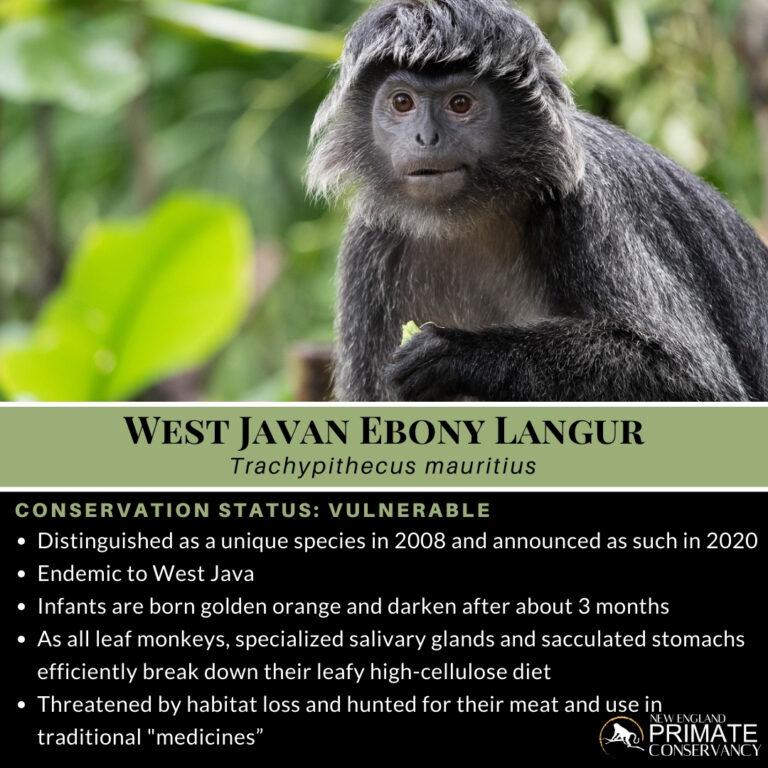
West Javan Ebony Langur, Trachypithecus mauritius
WEST JAVAN EBONY LANGUR
Trachypithecus mauritius
Geographic Distribution and Habitat
The West Javan ebony langur (Trachypithecus mauritius) is endemic to the westernmost forests of Java, the largest island in Indonesia. Its distribution is limited to the region west of the Cisalak River, south of Jakarta, along the southern coast near Pelabuhan Ratu, and east to Cikaso.
West Javan ebony langurs live in dry deciduous forests, swampy mangroves, and secondary forests (those that have regenerated after disturbances such as fire or logging). These langurs prefer the upper forest canopy at elevations between 3,280 and 5,085 feet (1,000 to 1,550 m) above sea level.
The West Javan ebony langur is also known as the West Javan lutung, western ebony langur, and West Javan ebony leaf monkey. In Sundanese, they are called “lutung”, and in Indonesian, “lutung hitam”.
It is important not to confuse the West Javan ebony langur with the Javan leaf monkey (Presbytis comata). Although the two species are sympatric (they occur in the same geographic area), they are distinct species.
The story of how scientists classified the West Javan ebony langur is an interesting example of how taxonomy changes as new evidence becomes available. Early taxonomists relied on specimens collected from the wild and sent to museums, where they compared physical features to identify and classify different primate species. Many of these specimens were shipped from their countries of origin to colonial museums and were sometimes mislabeled, damaged, or subject to clerical errors.
Leaf monkeys have a long and complicated taxonomic history because many species share similar characteristics, including long tails, slender bodies, dexterous fingers, and similar diets. The West Javan ebony langur was first described in 1821 as Simia mauritius because the museum specimen was mistakenly recorded as having been collected on Mauritius (an island nation off the east coast of Africa). Since Mauritius is home to introduced long-tailed macaques, assumptions were made based on the mislabeling, and the specimen’s true origin went unrecognized for many years.
In 1995, after careful comparisons with other museum specimens and historical records, researchers concluded that the original specimen most likely came from Jasinga in West Java. As a result, it was reclassified as a subspecies of the Javan ebony langur (Trachypithecus auratus mauritius), distinguished primarily by its restricted distribution in western Java.
In 2008, genetic studies demonstrated that the West Javan ebony langur is distinct enough to be recognized as its own species, Trachypithecus mauritius. Interestingly, the species retained the historical name “mauritius”, even though it is not found on Mauritius and is endemic to the island of Java.
Identifying and classifying species is important because wildlife research, conservation efforts, and legal protections depend on knowing exactly which species are being protected.

Size, Weight, and Lifespan
West Javan ebony langurs have a body length of 1.4 to 2.1 feet (44 to 65 cm). Their tail is almost twice as long, measuring 2.0 to 2.9 feet (61 to 87 cm). Adults weigh between 2.2 and 15.4 pounds (1 to 7 kg).
There are no reliable estimates for the lifespan of West Javan ebony langurs in the wild. However, one captive individual lived for 31 years. Captive animals in reputable facilities are protected from predators and receive consistent veterinary care and reliable food sources, allowing them to live longer than they typically would in the wild. Based on the longevity of other langur species, a reasonable estimate is that West Javan ebony langurs live for around 20 years in the wild.
Appearance
The West Javan ebony langur is an endearing-looking monkey with a shaggy hairstyle and curious expression. As their name suggests, they are covered in glossy slate-gray to black fur that stands up and curls forward around their head. Their ears, chest, and the lower portions of their legs may have whitish fur, while the skin on their face, hands, and feet is bluish-black. The species is sexually dimorphic, meaning females can be distinguished from males by a yellowish-white pubic patch.
They have a long tail that is not prehensile (it cannot grasp branches), but it acts as a counterbalance while climbing and leaping through the forest canopy.
West Javan ebony langurs also have powerful jaws and specialized molars with high, blade-like ridges that are adapted for cutting and grinding tough leaves before they are digested in their specialized stomach.

Diet
Langurs are known for their folivorous (leaf-eating) diet. West Javan ebony langurs prefer young leaves because they are higher in sugars and protein and are easier to digest than mature leaves, which contain more cellulose fiber. Their diet consists of approximately 42% young leaves, 30% shoots, and the remaining 28% is made up of other plant material, including fruits and seeds.
Leaves are an abundant food source in tropical forests, but they are also difficult to digest because they are high in fiber and often contain toxic plant compounds. West Javan ebony langurs have several adaptations that allow them to thrive on this challenging diet. Enlarged salivary glands produce proteins that help bind and neutralize some plant toxins before they reach the stomach.
Like other leaf monkeys, they also have a large, sacculated (multichambered) stomach that acts like a fermentation chamber. This specialized stomach allows them to consume large amounts of leaves and digest them slowly over time. Beneficial bacteria living in the stomach break down cellulose, releasing nutrients that the langurs would otherwise be unable to access. This partnership between the langurs and their gut microbes allows them to obtain energy from a food source that many other mammals cannot efficiently digest.
Behavior and Lifestyle
West Javan ebony langurs are diurnal (active during the day) and spend most of their time feeding or resting. They are highly arboreal and are well adapted to life in the upper forest canopy. Their long limbs allow them to leap between branches, while their long tail acts as a counterbalance as they climb and move through the trees. They thrive in forests with continuous canopy cover, but in fragmented habitats they may be forced to descend to the ground to travel between isolated patches of forest.
These primates display fascinating anti-predator behaviors. When they detect a predator, such as a python, the resident male and a few other troop members often emit loud alarm calls while vigorously shaking branches and jumping above the predator in an attempt to drive it away from the troop. This behavior, known as mobbing, alerts nearby troop members and often warns other animals in the forest of the potential danger.
Mobbing events can last for an extended period (up to 40 minutes in one documented observation). During these encounters, only a few individuals actively mob the predator while the rest of the troop gathers nearby, remaining quiet but alert for additional threats. After the predator leaves, troop members often stay close together and remain more vigilant, suggesting that mobbing strengthens group cohesion and increases awareness of potential danger.
Alarm calling and mobbing are risky behaviors because they draw attention to the individuals giving the calls. As a result, only a few troop members usually participate directly. The resident male, being the largest member of the troop and its primary defender, often takes the leading role during aggressive encounters with predators.
West Javan ebony langurs also appear to adjust their responses depending on the type of predator they encounter. Large predators, such as pythons, typically trigger prolonged alarm calling and mobbing. In contrast, smaller aerial predators, such as crested goshawks, are less likely to provoke a strong response unless they pose an immediate threat. Because adult langurs are generally too large for a goshawk to capture, the troop may conserve energy by avoiding unnecessary alarm calls and aggressive displays.
Because the West Javan ebony langur was only recognized as a distinct species in 2008, relatively few behavioral studies have focused on this species alone. Much of what we know comes from earlier studies of Javan ebony langurs that may have included multiple populations before they were recognized as separate species.
The West Javan ebony langur’s scientific name (Trachypithecus mauritius) still refers to Mauritius, even though the species is found only on the Indonesian island of Java. This unusual name is the result of a museum labeling mistake made over 200 years ago.
West Javan ebony langur infants are born with bright orange fur that gradually changes to the dark gray-black coloration of adults by about 3 months of age.
West Javan ebony langurs spend more than half of each day resting. Their leaf-rich diet takes a long time to digest, so resting helps conserve energy while the bacteria in their specialized stomach break down tough plant material.
When a predator such as a python is spotted, West Javan ebony langurs may surround the predator, shake branches, and give loud alarm calls to drive it away. This behavior, known as mobbing, can last for up to 40 minutes.
West Javan ebony langurs typically begin their day with a feeding bout, traveling to trees with preferred young leaves and eating as much as possible. Because leaves take a long time to digest, they spend more than half of the day resting after feeding. During this time, adults groom one another, sleep, or bask in the sun, which may help speed digestion. Younger langurs spend less time resting and instead devote more time to playing and interacting with one another. Their home range (the area in which they live and forage) typically covers 49 to 74 acres (20 to 30 ha).
They live in troops of 7 to 21 individuals. A troop usually consists of several related females and their offspring, along with one or two adult males. Because males compete for access to mates, groups rarely contain more than two adult males that live together peacefully. Subadult and adult males who are not part of a breeding troop sometimes form bachelor groups, where they forage together and may benefit from the added protection of living in larger groups.
Life within a troop is generally peaceful because leaves are abundant and competition for food is low. Much of their resting time is spent allogrooming, in which individuals carefully groom one another’s fur to remove dirt, parasites, and loose hair. Allogrooming also strengthens social bonds and helps maintain harmony within the group.
We know relatively little about the social hierarchy within West Javan ebony langur troops because most observations describe cooperative rather than competitive behavior. Females often help care for one another’s infants, aggression between resident males is uncommon, and even neighboring troops appear to tolerate one another. Like all social primates, West Javan ebony langurs almost certainly have a social hierarchy, but the relationships among troop members are subtle and remain poorly studied.
The West Javan ebony langur shares its habitat with several other primates, including the spangled ebony langur (Trachypithecus auratus) and the Javan surili (Presbytis comata). Although these species occupy the same forests, they differ slightly in their diets. The spangled ebony langur has a more varied diet that includes flowers, fruits, and occasionally insects, while the Javan surili is a more specialized folivore that relies heavily on young leaves. These dietary differences likely reduce competition between the species and allow them to coexist within the same habitat.
As social primates living in dense forests, West Javan ebony langurs rely heavily on vocalizations because thick vegetation often limits visual contact between group members. Their most commonly heard vocalizations are the loud “ghek-ghok-ghek-ghok” alarm calls, which are usually given when they detect people or other potential predators. These calls alert troop members to danger and prompt them to gather in a safer location. The alarm calls may also benefit other animals in the forest by warning them of nearby predators. This type of behavior is considered altruistic because it provides a benefit to others, even if they are members of a different species.
West Javan ebony langurs also communicate through touch by allogrooming. Carefully combing through one another’s fur removes dirt and parasites while strengthening social bonds. This behavior is similar to the way human family members show affection by hugging, brushing one another’s hair, or spending time caring for each other.
One of the most obvious visual signals used by West Javan ebony langurs is the brightly colored fur of infants, which gradually changes to black as they mature. Researchers believe this striking coloration helps adults quickly recognize infants and may trigger caregiving behaviors in mothers and other troop members. It may also signal that infants require extra protection and attention.
West Javan ebony langurs have a polygynous mating system, meaning that one male mates with multiple females within the troop. They breed year-round rather than during a specific mating season, so a troop may have infants of different ages at any given time. Because breeding troops usually contain only one or two adult males, there is little competition for mates within the group. The dominant male is thought to father most of the offspring in the troop.
Female West Javan ebony langurs reach sexual maturity at around 3 years of age. Like other langur species, they have a gestation period (the length of pregnancy) of approximately 6 to 7 months. Females give birth to a single infant with bright orange fur and pale facial skin. Infants cling tightly to their mother’s belly during the first weeks of life before gradually becoming more independent.
Although the mother is the primary caregiver, West Javan ebony langurs also practice allomothering (also called cooperative breeding). Other troop members, almost always females, help carry, protect, groom, and care for the infant. The infant’s bright orange coat is thought to make it easier for the mother and other group members to recognize and care for the young.
Over the next few months, the infant’s golden-orange fur gradually darkens until they resembles the dark gray to black coloration of adults by about 3 months of age. Young ebony langurs remain dependent on their mother and the troop for food, protection, and care until they are about 12 months old.

Folivores (leaf-eating animals) play an important role in maintaining healthy forests by limiting excessive leaf growth in the canopy. Dense, overgrown canopies reduce the amount of sunlight that reaches the forest floor, making it difficult for smaller plants, vines, and seedlings to grow. By consuming large quantities of leaves, West Javan ebony langurs reduce canopy density, allowing more sunlight to reach the vegetation below. This promotes photosynthesis and helps maintain a greater diversity of plant life.
West Javan ebony langurs feed on leaves from a wide variety of tree species and can switch between preferred food sources as seasons and food availability change. This flexible diet reduces pressure on any one tree species and helps the langurs adapt to changing environmental conditions.
West Javan ebony langurs are also an important prey species for forest predators. They have been observed being hunted by crested goshawks and are vulnerable to large pythons, which are well adapted to moving through trees and swampy habitats. As both herbivores and prey, ebony langurs play an important role in maintaining the balance of their forest ecosystem.


The International Union for Conservation of Nature lists West Javan ebony langur as Vulnerable (IUCN, 2015), appearing on the IUCN Red List of Threatened Species.
West Javan ebony langur populations are declining because of a combination of habitat loss and hunting.
Much of Java has experienced extensive deforestation due to logging, slash-and-burn agriculture, and human development. Although West Javan ebony langurs can adapt to secondary forests, their long-term survival depends on large, connected areas of forest. Deforestation has fragmented their habitat into smaller, isolated patches, making it more difficult for troops to find food, disperse, and maintain healthy populations.
West Javan ebony langurs are also hunted for bushmeat and use in traditional medicine. Their generation length is approximately 12 years, meaning it takes an average of 12 years for an individual to produce offspring that contribute to the next generation. This relatively slow rate of population turnover makes it difficult for the species to recover from hunting because the loss of breeding adults cannot be replaced quickly.
West Javan ebony langur is listed in Appendix II of the Convention on International Trade in Endangered Species (CITES), an international agreement between governments whose goal is to ensure that international trade in specimens of wild animals and plants does not threaten their survival.
The West Javan ebony langur is protected under both international and Indonesian law. Despite these legal protections, illegal hunting continues because there is still a local demand for these primates as a source of bushmeat and traditional medicine.
The largest and most stable populations are found within protected areas, including Ujung Kulon National Park, Cibanteng Nature Reserve, and Cikepuh Nature Reserve. Protecting these forests, enforcing anti-poaching laws, and reducing demand for bushmeat and traditional medicine are all important steps in ensuring the long-term survival of this endangered primate.
- Asri, S.W.Z. and Widayati, K.A., 2019. Age-sex differences in the daily activity and diet of West Javan langur (Trachypithecus mauritius) in the Pangandaran Nature Reserve, West Java, Indonesia: A preliminary report. Asian Primates Journal, 8(1).
- Bánki, O., Roskov, Y., Döring, M., Ower, G., Hernández Robles, D.R., Plata Corredor, C.A., Stjernegaard Jeppesen, T., Örn, A., Pape, T., Hobern, D., Garnett, S., Little, H., DeWalt, R.E., Miller, J., Orrell, T., Aalbu, R., Abbott, J., Abreu, C., Acero P, A. et al., 2026. Trachypithecus mauritius (Griffith, 1821). In: Catalogue of Life (2026-06-19 XR). Amsterdam, Netherlands: Catalogue of Life Foundation.
- Facts and Details, n.d. Javan langurs and silvered leaf monkeys. Facts and Details.
- Griffith, E., 1821. General and Particular Descriptions of the Vertebrated Animals, Arranged Conformably to the Modern Discoveries and Improvements in Zoology. Order Quadrumana. London: Baldwin, Cradock, and Joy.
- Manansang, J., Sinaga, W. and Mansjoer, S.S., 2023. Population and home range of the West Java black langur (Trachypithecus mauritius) in the forested area of Taman Safari Indonesia. Jurnal Penelitian Kehutanan Wallacea, 12(2), pp.63–70.
- Roos, C., Boonratana, R., Supriatna, J., Fellowes, J.R., Groves, C.P., Nash, S.D., Rylands, A.B. and Mittermeier, R.A., 2014. An updated taxonomy and conservation status review of Asian primates. Asian Primates Journal, 4(1).
- Roos, C., Nadler, T. and Walter, L., 2008. Mitochondrial phylogeny, taxonomy and biogeography of the silvered langur species group (Trachypithecus cristatus). Molecular Phylogenetics and Evolution, 47(2), pp.629–636.
- Setiawan, A., Traeholt, C., Nijman, V. and Supriatna, J., 2021. Trachypithecus mauritius (amended version of 2020 assessment). The IUCN Red List of Threatened Species, e.T39849A196325582.
- Tsuji, Y., Higuchi, H. and Suryobroto, B., 2014. A note on the response of juvenile Javan lutungs (Trachypithecus auratus mauritius) against attempted predation by crested goshawks (Accipiter trivirgatus). Humans and Nature, 25, pp.105–109.
- Tsuji, Y., Prayitno, B. and Suryobroto, B., 2016. Report on the observed response of Javan lutungs (Trachypithecus auratus mauritius) upon encountering a reticulated python (Python reticulatus). Primates, 57(2), pp.149–153.
- Weigl, R., 2005. Longevity of Mammals in Captivity: From the Living Collections of the World. Stuttgart: E. Schweizerbart Science Publishers.
Written by Acima Cherian, July 2026