
Sierra de Perijá White-fronted Capuchin, Cebus leucocephalus
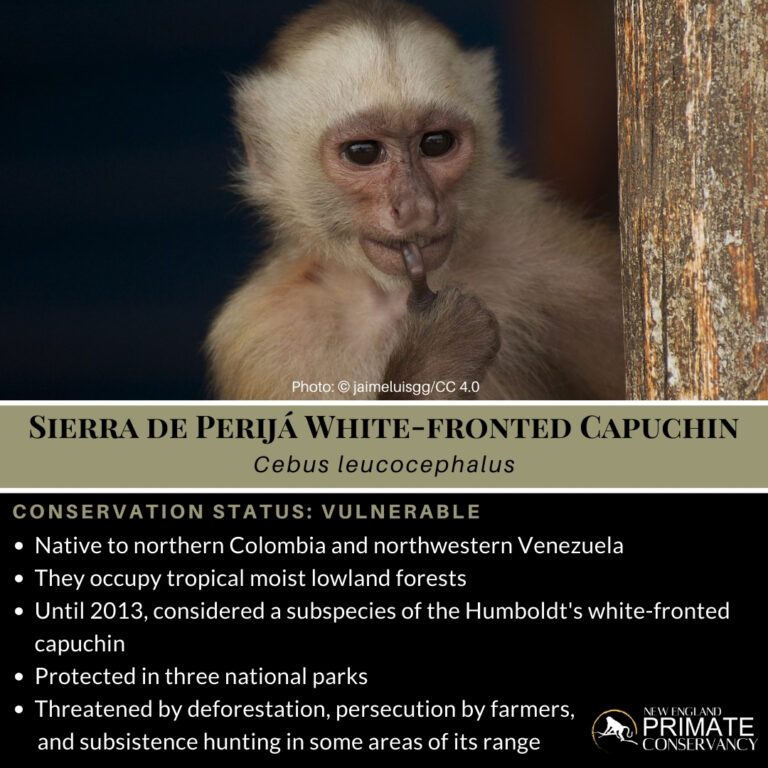
Sierra de Perijá White-fronted Capuchin
Cebus leucocephalus
Geographic Distribution and Habitat
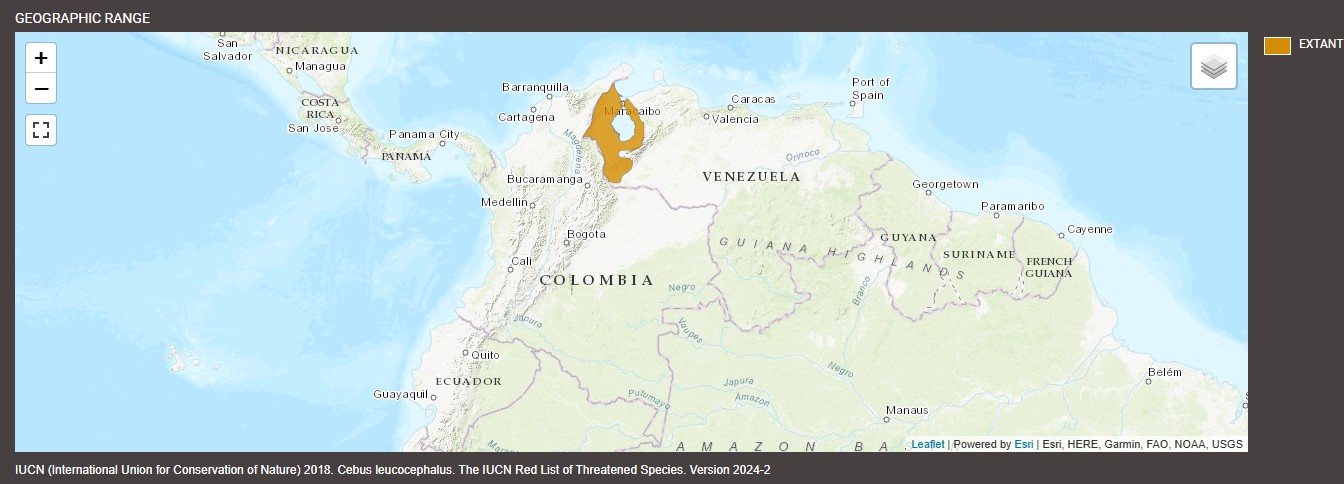
The Sierra de Perijá white-fronted capuchin is native to northwestern Venezuela and northern Colombia. With regard to the former country, this species of capuchin is found from the western slopes of the Cordillera Oriental, the widest and easternmost branch of the Andes Mountains, in the Santander Department, east through low passes to the Zulia River and Catatumbo River basins.
Within this range, this capuchin species is found in lowland moist forest, semi-deciduous forests, and mangroves.
The Sierra de Perijá white-fronted capuchin was once considered a subspecies of the Humboldt’s white-fronted capuchin, but was reclassified in 2013 as a separate species based on genetic studies.
All capuchin monkeys were once considered to be members of one genus, the gracile (slenderly-built) capuchins (genus Cebus). However, in 2012, capuchins were subdivided into two genera: the robust (or tufted) capuchins (genus Sapajus) and the gracile capuchins. The Sierra de Perijá white-fronted capuchins are proud members of the gracile capuchin monkey genus.
Size, Weight, and Lifespan
The Sierra de Perijá white-fronted capuchin is a very little studied species, and as you’ll see for the majority of the profile, much of the information has to be inferred from other closely-related capuchin species. The only measurements recorded are with regard to adult males, which have a head-body length ranging between 14.6-16 inches (37-40.7 cm), and a tail length between 15.4-19.6 inches (39.1-49.8 cm). No measurements of females have been recorded, but like other capuchin species, males and females likely exhibit sexual dimorphism, or noticeable differences between genders. Adult males are likely larger and develop larger canine teeth compared to females. The lifespan of the Sierra de Perijá white-fronted capuchin is unknown, but other capuchin species tend to live 15-25 years in the wild.
Appearance
The Sierra de Perijá white-fronted capuchin is the darkest colored among the white-fronted capuchins. The distinctive cap is cinnamon black to deep grayish brown. The back is cinnamon brown with a mix of tawny on the upper back and russet on the lower back. The flanks are paler in comparison, appearing snuff-brown, and the outer sides of the forearms are burnt sienna. The outer surface of the thighs is cinnamon brown, while the forelegs and front of the thighs are burnt sienna. The wrists, ankles, and upper surface of hands and feet are auburn. Hairs on the belly and the lower part of the chest are burnt sienna, changing to an orange-rufus on the upper chest and inner sides of the upper arms. The tail is cinnamon brown above, becoming paler toward the tip, and is a paler buff underneath. Their expressive faces are pink, with dark brown eyes and large nostrils above the mouth.
They are a slender species, with long limbs that enable them to travel around their tree-dominated habitat with remarkable agility and grace. The tail is semi-prehensile, allowing them to balance and grasp branches, navigating the habitat with ease, but it cannot support their body weight.

Diet
Like all capuchins, the Sierra de Perijá white-fronted capuchin is an omnivore, eating both plant and animal material. Their diet includes fruits, insects and larvae, flowers, buds, and small vertebrates.
Behavior and Lifestyle
The Sierra de Perijá white-fronted capuchin, like all capuchins, is generally diurnal (active during the day) and primarily arboreal (tree-dwelling). They are likely most commonly seen early in the morning when they can be found foraging for food in the middle canopy of the forest or on the forest floor.
Very few studies have been conducted specifically on the Sierra de Perijá white-fronted capuchin. This includes specifics regarding their behavior and lifestyle. If we look at other species of white-fronted capuchins, it can be presumed that much of the day is spent foraging for food in groups, while nights are spent sleeping upon the branches of the trees. Like other capuchins, the primary mode of locomotion is quadrupedalism, that is, moving on four limbs, though they may also be capable of standing and walking upright.
Besides humans, predators that target the Sierra de Perijá white-fronted capuchin have not been documented. Looking at other capuchin species, however, they face threats from jaguars, cougars, coyotes, tayras, snakes, crocodiles, and birds of prey. While studies of this capuchin species are again, lacking, it can be assumed that, like other capuchins, they utilize an array of defense techniques to avoid predation. These may include emitting alarm calls which may vary depending upon the type of predator, remaining vigilant while foraging by staying close together in groups, spending most of their time in the trees to avoid ground-based predators, using their natural agility to beat a hasty retreat, using their natural coloration to act as camouflage which allows them to blend in with their tree-based habitat, and selecting habitats that offer better protection from predators, such as dense forests, with plenty of cover and escape routes.
Capuchins are named for their “caps” of hair, which resemble a capuche, the cowl worn by a Capuchin friar, a type of Catholic monk.
The size of the home range of Sierra de Perijá white-fronted capuchins is unknown, but those of white-fronted capuchins as a whole can vary depending on the subspecies. Typically, they are fairly large, usually 0.48-0.56 square miles (1.2-1.5 square km).
Among white-fronted capuchins, adult males are notably tolerant of one another in the group, but they are very aggressive towards males belonging to other groups. The presence of adult males seems to lend psychological support to the adult females of a group. No doubt, having such protective males helps to keep the peace, especially when it comes to potential territorial disputes between neighboring groups.
Upon reaching sexual maturity, males will leave to form a group of their own, while females remain with their birth group for life.
As for interactions and associations with other primates, information is severely lacking and requires further research. White-fronted capuchins as a whole frequently travel with squirrel monkeys, and sometimes with black-capped capuchins (S. apella) and Colombian red howlers (Alouatta seniculus). It’s certainly not unreasonable to assume the Sierra de Perijá white-fronted capuchin travels alongside at least some of these primates.
Despite the lack of data on Sierra de Perijá white-fronted capuchins, it can be presumed that, like other capuchins, they are VERY smart! Communication among all white-fronted capuchin species is sophisticated, utilizing a repertoire of vocalizations and body gestures that relay information about food sources, potential threats, and social dynamics within a group. This ability to communicate effectively is a testament to their intelligence and social sophistication, allowing for cooperation and coordination in their daily activities. Sierra de Perijá white-fronted capuchins may even mimic the calls of predators to scare away potential competitors and secure food resources for themselves!
As is the case with all capuchins, grooming plays a large part in maintaining strong social bonds among the group. All members groom one another as a means of bonding and reaffirming their status within the group.
Like other capuchins, Sierra de Perijá white-fronted capuchins may mark their territory by spreading glandular secretions, saliva, or other pungent substances onto trees bordering their territory. They also likely exhibit self-anointing behavior, or rubbing themselves with secretions or objects found in nature, which is used for a wide variety of purposes, including communication. Objects of choice include mud, plants, and insects. As well as for communication, such actions may be used to kill fungi and their spores, act as a repellent, or as self-medication.
Once again, data on the Sierra de Perijá white-fronted capuchin must be inferred from other white-fronted capuchin species. Like other species of capuchins, the Sierra de Perijá white-fronted capuchin is likely polygamous, meaning males and females mate with multiple members of the opposite gender. Similar to the Trinidad white-fronted capuchin (C. trinitatis), they may not have a specific breeding season, but most births likely occur during the dry season.
The length of the gestation (pregnancy) period is not known for white-fronted capuchins, but it is probably around 160 days, like that of the black-capped capuchin. Like other capuchins, it can be presumed that females give birth to a single offspring, and become pregnant every one to two years.
As observed with white-fronted capuchins in western Colombia’s El Tupparo National Park, newborns ride positioned sideways over the mothers’ shoulders. However, during the first days, the baby holds on to any part of Mom, such as the base of the tail, the tail, the legs, and the arms, before discovering and learning that the position over the shoulders is best and most secure. After several weeks, the baby makes the change from the sideways position over the shoulders to riding on her back.
All group members take an interest in the newborn and take advantage of any opportunity to examine and look at the baby’s genitals if Mom allows it. It’s unheard of for us, but a common initial bonding mechanism for these capuchins. Over time, the baby will climb up other members of the group, including the adult males who are interested in protecting the little one. Playing behavior is principally with a companion, and all group members, from the alpha male, the mother, and all other young members, solicit play with the young one to create and strengthen bonds.
It can be presumed that, similar to other capuchin species, sexual maturity is reached at around four years of age. Upon reaching this milestone, females will stay with their natal group, while males will leave to form a group of their own or attempt to join another one.
As fruit-eaters, Sierra de Perijá white-fronted capuchins aid in the regeneration of their forest habitats by dispersing seeds through their feces as they move around the habitat. In addition, they may serve as pest controllers, since a portion of their diet is made up of insects and their larvae. Finally, as a prey species, they also play a role in feeding local predators within their range.


The International Union for Conservation of Nature lists the Sierra de Perijá white-fronted capuchin as Vulnerable (IUCN, 2015), appearing on the IUCN Red List of Threatened Species.
Although they are protected in three national parks, the Sierra de Perijá white-fronted capuchin is affected by deforestation, persecution by farmers, and subsistence hunting in some areas of their range.
The Sierra de Perijá white-fronted capuchin is listed in Appendix II of the Convention on International Trade in Endangered Species (CITES), an international agreement between governments whose goal is to ensure that international trade in specimens of wild animals and plants does not threaten their survival.
The Sierra de Perijá white-fronted capuchin is found in three protected national parks: Venezuela’s Ciénagas del Catatumbo National Park and Sierra de Perijá National Park, and Colombia’s Tamá National Natural Park.
Conservation actions needed in order to protect and preserve this little-studied capuchin species include properly enforced land, water, and site/area management, as well as educational outreach and properly-enforced laws to prevent further persecution by farmers. Along with these, further research on the life history and ecology, specifically of the Sierra de Perijá white-fronted capuchin, would be a helpful aid in gathering more information in order to prevent this species from continuing ever closer down the path to extinction.
- https://www.alltheworldsprimates.org/Members/Home/MasterPrimate.aspx?tid=1306
- https://www.bioexplorer.net/animals/mammals/monkeys/sierra-de-perija-white-fronted-capuchin/
- https://en.wikipedia.org/wiki/Sierra_de_Perij%C3%A1_white-fronted_capuchin
- https://www.gbif.org/species/7450444
- https://www.iucnredlist.org/species/70333164/191707856
- https://www.oneearth.org/ecoregions/cordillera-oriental-montane-forests/
Written by Sienna Weinstein, January 2026