
Peruvian Yellow-Tailed Woolly Monkey, Lagothrix flavicauda
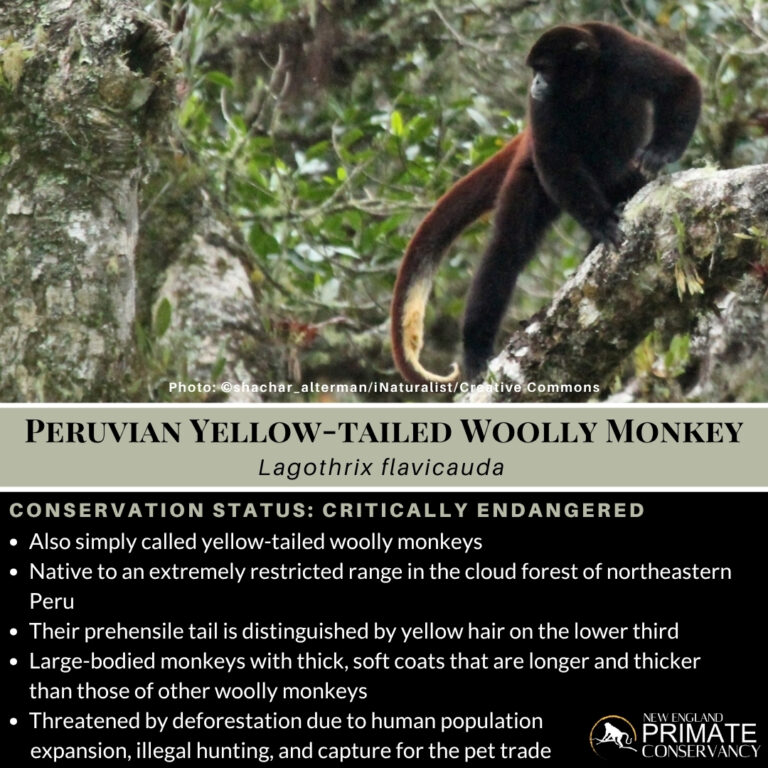
PERUVIAN YELLOW-TAILED WOOLLY MONKEY
Lagothrix flavicauda
Geographic Distribution and Habitat
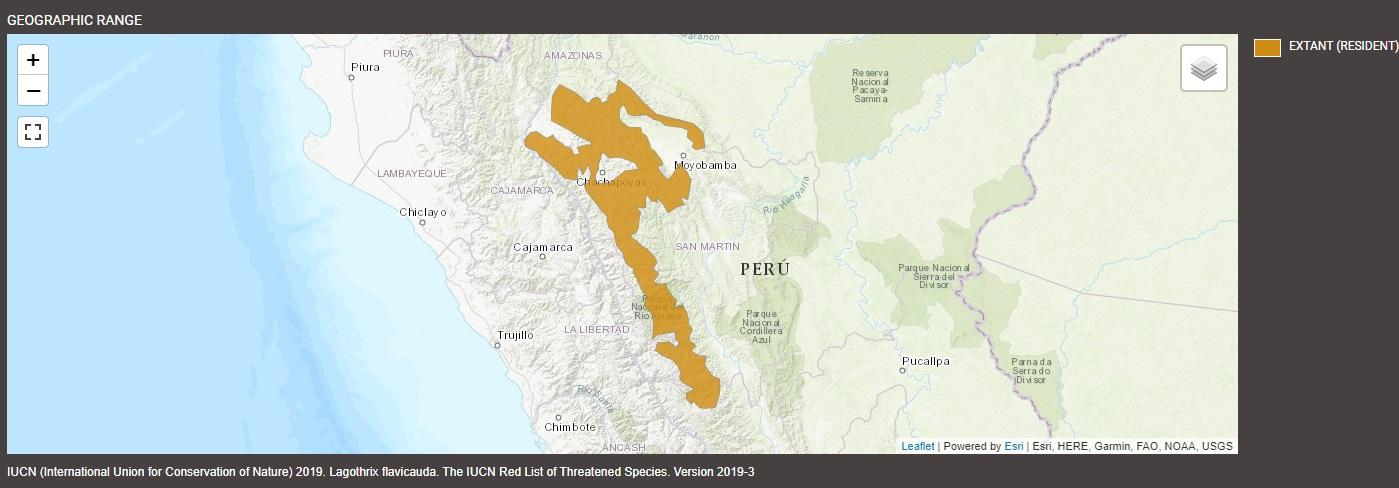
The Peruvian yellow-tailed woolly monkey (Lagothrix flavicauda), also referred to as the yellow-tailed woolly monkey, is the largest primate species endemic to the beautiful country of Peru. As an endemic species, they are exclusively found in this country. Located on the western coast of South America, Peru has a rich variety of landscapes, which include the Andes mountains, the Amazonian rainforest, and coastal deserts. Populations typically inhabit montane and cloud forest environments, although they have also been observed in white-sand forests, bamboo forests, and ridge-top forests. Their home ranges vary in size between 227.3 and 430 acres (92 and 174 hectares) and are defined by geographic boundaries such as the Pacific Ocean, Río Marañón, as well as the Santa Martha and Magdalena river valleys.
Peru experiences distinct wet and dry seasons. The wet season, which lasts from November to April, brings hot and humid conditions, temperatures ranging between 85 to 90 degrees Fahrenheit (30 to 32 degrees Celsius). Afternoon rain showers are common, but the heaviest rainfall occurs between December and March. The dry season spans from April to October, and the average daily low is around 68 degrees Fahrenheit (20 Celsius). During this period, days are generally sunny while the nights are cold.
They thrive at elevations ranging from 3,609 feet (1,100 m) to 8,858 feet (2,700 m). This wide elevation range leads to various atmospheric conditions, ultimately creating several microclimates. Microclimates are small areas with different atmospheric conditions, such as temperature, humidity, and light. These conditions directly affect animal and plant populations, allowing for greater species diversity within the country!
Woolly monkeys were once considered to be four distinct species: the gray (Lagothrix cana), Colombian (Lagothrix lagothricha lugens), silvery (Lagothrix lagothricha poeppigii), and Peruvian yellow-tailed (Lagothrix flavicauda) woolly monkeys. However, recent genetic studies suggest there are actually only two woolly monkey species: the Peruvian yellow-tailed and the common woolly monkey (Lagothrix lagothricha). The gray, Colombian, and silvery monkeys were reclassified as subspecies of the common woolly monkey.
Peruvian yellow-tailed woolly monkeys were first described by Alexander von Humboldt in 1812. Their descriptions were based on skins collected from Peruvian horseback riders in the Andes, who used them as saddle blankets. For more than 150 years after the species’ initial description, nothing was known about them. Taxonomic revisions of the woolly monkeys in 1963 clarified the yellow-tailed woolly monkey’s position as a distinct species.
Size, Weight, and Lifespan
Although the physical measurements for Peruvian yellow-tailed woolly monkeys are not well-documented, sources suggest the average monkey weighs up to 22 pounds (9.98 kg). They have an average head-to-body length of 20.3 to 21.1 inches (51.5 to 53.5 cm). Their tail is around the same length as their head-to-body length, if not greater.
The lifespan of this species is unknown, but other woolly monkey species live an average of 24 to 30 years in the wild.
Appearance
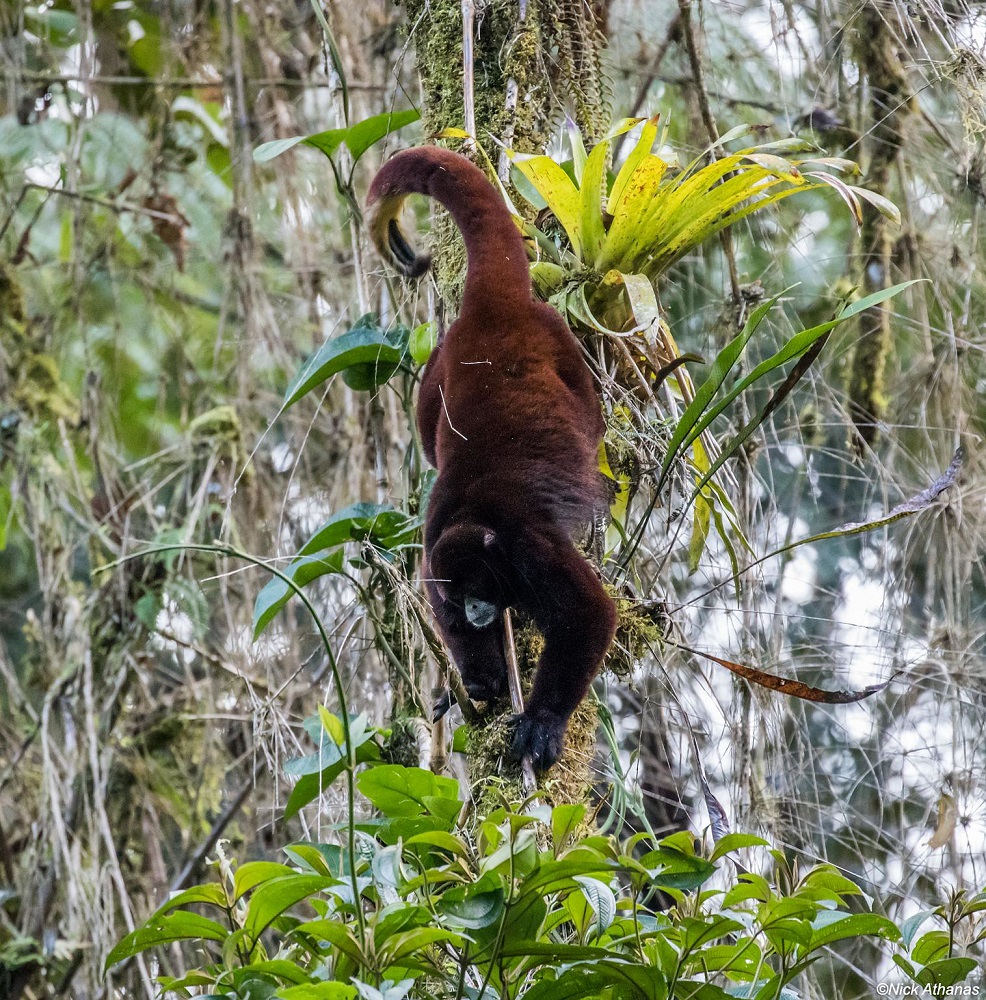
Peruvian yellow-tailed woolly monkeys are large, sturdy animals with strong muscles. Their fur is long, soft, thick, and mahogany-colored, accented by reddish-brown tones. As the fur transitions toward the upper parts of their bodies, it deepens into darker shades of brown and black. They also have dark faces with white hair around their mouths and noses, complemented by brown to hazel-brown eyes.
Yellow-tailed woolly monkeys are named after the distinctive patch of yellow hair located on the underside of the lower third of their tails. Their tails are prehensile, able to grasp and hold onto objects such as branches or food items. A thick pad of skin at the tail’s end also enhances their gripping ability. As they navigate the forest, individuals often rely on their tails for balance due to their size and strength. The tail acts as a counterweight to the upper body’s movements, allowing the animal to remain stable while maneuvering uneven surfaces. Because of its incredible strength, the tail is also capable of supporting the entire body weight of the monkey, which can be especially useful when preventing falls!
Woolly monkeys are sexually dimorphic, a term that refers to the differences in size, shape, color, and other traits between males and females of the same species. In color, males tend to be darker than females. Both sexes have yellowish tufts of pubic hair in their genital regions; however, the male’s is longer and more prominent. Additionally, females have a hypertrophic clitoris, meaning it is long and visible behind their vulva. Easy to spot in infants or juveniles, it can measure up to 1.5 to 2 inches (2.54 to 5.08 centimeters) and is bright pink in color.
Diet
Peruvian yellow-tailed woolly monkeys are a predominantly herbivorous species, so they eat a variety of plant products, such as leaves, fruits, flowers, mosses, lichens, roots, and bulbs. Recent studies estimate they spend about 28% of their time feeding and roughly 9% of their time foraging. Their most commonly consumed food sources include: chachafruto (Erythrina edulis); naranjillo (Styloceras laurifolium); olive-leaved yellow wood, or pino pasto (Podocarpus oleifolius); dragon’s blood, or sangre de drago (Croton lechleri); Venezuelan star apple (Chrysophyllum venezuelanense), and various ficus species. Occasionally, they consume small insect species, such as beetles or ants. They rarely have to descend to the ground; they drink water by licking or scooping from tree-holes, and also consume water-rich leaves and fruits.
Considering the seasonal atmospheric differences in Peru, their diet is influenced by resource availability. For instance, during the dry season, fruit consumption decreases. Furthermore, in areas affected by deforestation, ripe fruit is scarce and hard to find. Luckily, leaves and small insects are typically readily available.
Behavior and Lifestyle
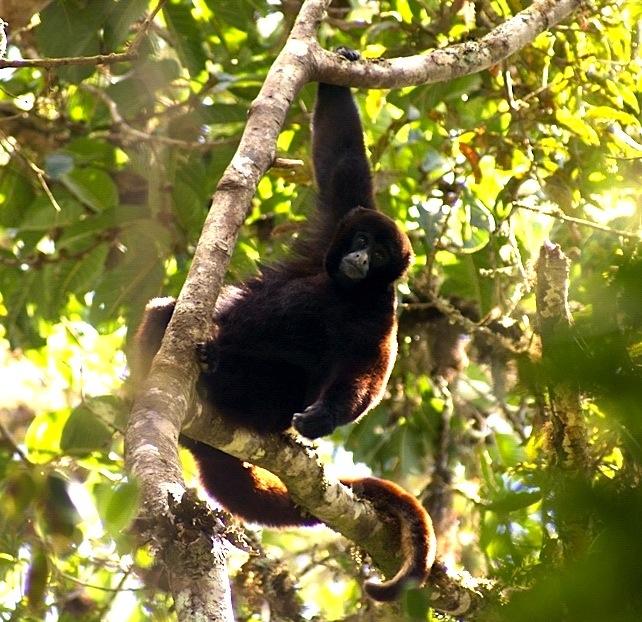
Whether they are foraging, traveling, resting, or socializing, yellow-tailed woolly monkeys spend nearly all of their time in the trees. Rarely do they descend to the forest floor. On average, they have a daily path length between 0.64 and 0.75 feet (1.03 and 1.2 kilometers), which is the total distance they travel in one day. Their movement is a combination of quadrupedal clambering using all four limbs plus their tail. They also exhibit suspensory movements, such as hanging or swinging arm-over-arm. On the rare occasion they find themselves on the ground, they typically move quadrupedally but have the ability to stand or walk bipedally, or on two limbs, for a short amount of time.
As a diurnal species, they are most active during daylight hours and find spots to rest at night. To stay safe from predators, they sleep in the tallest trees of the forest, which typically range in height between 82 feet and 114.8 feet (25 to 35 meters). Before dozing off, they carefully consider the strength of their night perch and strategically balance their body to prevent falling to the ground.
Their predators include pumas (Puma concolor), jaguars (Panthera onca), harpy eagles (Harpia harpyja), and crested eagles (Morphnus guianensis).
In addition to nighttime rest, Peruvian yellow-tailed woolly monkeys engage in a midday rest when the sun is at its highest point. Also referred to as a siesta, this behavior allows them to escape the heat, avoid thermoregulatory stress, and conserve energy. What a daytime luxury!
The average troop size of Peruvian yellow-tailed woolly monkeys can vary from 5 to 22 individuals. Each troop is multi-male and multi-female, and there are approximately 2 adult males, 4 adult females, 3 juveniles, and 2 infants.
On average, there are only 1 to 2 troops of Peruvian yellow-tailed woolly monkeys per 1 acre (0.405 hectares). They inhabit areas with low population densities, resulting in fewer individuals spread across a larger area. Since most individuals in these regions are usually troop members, they usually exhibit peaceful behaviors. Except during initial encounters, they show very few signs of aggressive behavior. Despite overlapping territories with neighboring troops, they rarely engage in fights over territory. Research indicates that this behavior stems from their tendency to consume scattered food sources across the forest. Because they do not consider boundaries when searching for food, they do not see fighting over strict territory as beneficial.
In lower-altitude habitats, yellow-tailed woolly monkeys were observed forming sympatric relationships with white-bellied spider monkeys (Ateles belzebuth) and white-fronted capuchins (Cebus albifrons). For primates, sympatry means multiple species share the same habitat or ecosystem, and must find ways to coexist and survive.
Communication practices for Peruvian yellow-tailed woolly monkeys include vocalizations, body gestures, and facial expressions. Vocalizations are the most identifiable. Calls are typically produced during social interactions, whether to convey aggression, excitement, cooperation, or danger. For example, woolly monkeys produce loud barks in response to predators to try to scare them away.
Social grooming practices are also a form of communication for this species. It is a complex behavior that serves as a communication tool. Grooming involves one primate cleaning the fur or skin of another. In addition to serving hygienic purposes, grooming strengthens bonds through physical touch, which elicits calming effects. It is a communication tool used to maintain friendships, reinforce social hierarchies, and resolve conflicts.
Playing can also have similar effects to grooming. Of the various age groups in a troop, juveniles tend to be the most social and are observed playing with one another throughout the day. Play is critical for primates because it helps them develop physical and social skills, in addition to enhancing their cognitive abilities.
After a gestation period, or pregnancy, of approximately 7 to 7.5 months, females give birth to a single infant that weighs roughly one pound (.45 kg). They are born with their eyes wide open. Females have a low reproductive rate, with almost three years between births.
Newly born infants cling to their mother’s belly in their first few weeks of life. A couple of weeks later, they relocate to their mother’s back, gripping her fur with their hands while their tails loop around their mother’s body for support. At about five months, infants start venturing away from their mother to explore, interact, and build social skills. As they gain confidence and independence, they still rely on nursing, which typically continues until around one year of age. Mothers perform all parental care for their offspring, and infants rely on them for comfort, nourishment, and food. Research shows that females typically invest more time in foraging than males, a behavior linked to the energetic demands of pregnancy, nursing, and caring for infants.
Between the ages of 6 and 8 years old, females reach sexual maturity. Once achieved, they leave their natal group in search of other troops. After trying out a few different groups and landing on the best match, she begins seeking opportunities to mate and have babies of her own. Males reach sexual maturity around 5 years of age, but do not leave their birth groups as often as females.
Frugivores, particularly those that consume large quantities of fruit, play an important role within their ecosystem as seed dispersers. As they move through the forest, they drop or excrete seeds from various plants. When this happens, they inadvertently disperse seeds from one location to another, moving them across long distances. By relocating seeds away from their parent plant, Peruvian yellow-tailed woolly monkeys help reduce competition for resources like space, sunlight, or water. This process ultimately increases the chances of seed germination and species survival, increasing the health and biodiversity of their ecosystem.


The International Union for Conservation of Nature (IUCN) assessed the Peruvian yellow-tailed woolly monkey as Critically Endangered (IUCN, 2019) on its Red List of Threatened Species.
The destruction of their natural habitat over 50 years, from 1980-2030, is suspected to cause their populations to decline by greater than 80%, leading to their critically endangered status. Deforestation is the most pressing threat and is caused by an increase in human activities like commercial development, farming, ranching, and mining. Due to their slow reproductive rates, they are particularly vulnerable to environmental changes and face challenges in recovering from threats. Their limited range further exaggerates their vulnerability, as nearly all remaining unprotected habitats within their range could be lost by 2030 due to deforestation.
Aside from habitat loss, Peruvian yellow-tailed woolly monkeys are heavily hunted by indigenous communities for their fur and meat. Tragically, mothers are often killed so their infants can be taken and sold as pets.
The Peruvian yellow-tailed woolly monkey is listed in Appendix I of the Convention on International Trade in Endangered Species (CITES), an international agreement between governments whose goal is to ensure that international trade in specimens of wild animals and plants does not threaten their survival.
The estimation of the current population size for this species is between 1,000 and 10,000 individuals, so more research is needed to better understand the population size and trend. They occur in many protected areas, including: Rio Abiseo National Park; Alto Huyabamba; Concessiones para Conservacion El Breo; Zona Reservada Rio Nieva; and Santuario Nacional Cordillera de Colán.
Although their situation has improved in some areas, there is still a need for increased protection and reinforcement within designated parks, reserves, and protected forests. The establishment of protected areas would further create biological corridors; control illegal logging; establish economic models for local communities living along buffer zones, preventing further migration into primary cloud forests; and increase the implementation of conservation education.
In 2007, the organization Neotropical Primate Conservation began a range-wide conservation project for this species focused on land protection. Organization members worked with local communities to carry out research and improve the habitat. They also assisted local people in the commercialization of sustainable products and increased public awareness of the primate’s plight. Other organizations like APOBRIC El Breo, Proyecto Mono Tocon, and Conservation International also work in different parts of the species’ range in land protection, education, and research.
- Heintz MR, Murray CM, Markham AC, Pusey AE, Lonsdorf EV. The relationship between social play and developmental milestones in wild chimpanzees (Pan troglodytes schweinfurthii). Am J Primatol. 2017 Dec;79(12):10.1002/ajp.22716. doi: 10.1002/ajp.22716. Epub 2017 Nov 23. PMID: 29168188; PMCID: PMC5728447.
- Shanee S. Yellow-tailed woolly monkey (Lagothrix flavicauda) proximal spacing and forest strata use in La Esperanza, Peru. Primates. 2014 Oct;55(4):515-23. doi: 10.1007/s10329-014-0430-6. Epub 2014 Jun 7. PMID: 24906420.
- https://www.researchgate.net/publication/397458802_Activity_budgets_and_the_effect_of_weather_over_a_10_year_period_in_Critically_Endangered_yellow-tailed_woolly_monkeys_Lagothrix_flavicauda_at_El_Toro_Peru?__cf_chl_tk=CmG1ygWYZrdZ4.0wmLpDLNC1pE8dU3.MtctXNy1o5YE-1764082507-1.0.1.1-SsNqWVI6EhVo8eRU1JU_II79BqjbcptKTkejXYpnJ4E
- https://onlinelibrary.wiley.com/doi/full/10.1002/ajp.23423#:~:text=Temperature%20and%20rainfall%20mask%20nocturnal,3.&text=4.,et%20al.%2C%202016).
- https://news.mongabay.com/2023/07/the-biologist-working-to-save-perus-yellow-tailed-monkey-qa-with-fanny-cornejo/
- https://www.nationalgeographic.com/animals/mammals/facts/woolly-monkeys?loggedin=true&rnd=1763748436086
- https://worldrainforests.com/kids/animal-profiles/woolly-monkey.html
- https://www.apenheul.com/primates-abc/woolly-monkey#:~:text=Reproduction,onto%20another%20group%20to%20reproduce.
- https://www.monkeysanctuary.org/wp-content/uploads/2010/08/What-is-a-Woolly-Monkey.pdf
- https://www.bbc.com/future/article/20131014-the-touching-moments-we-all-need
- https://researchmatters.in/article/researchers-study-how-monkeys-drink-water-tree-holes#:~:text=Monkeys%20and%20apes%20typically%20get%20their%20water,as%20leaves%2C%20to%20soak%20up%20the%20water**
- https://primate.wisc.edu/primate-info-net/pin-factsheets/pin-factsheet-yellow-tailed-woolly-monkey/
- https://www.cbc.ca/news/canada/edmonton/microclimates-canada-temperature-variations-explainer-alberta-1.6724798
- https://tempest.earth/resources/what-is-a-microclimate/
- https://www.scielo.br/j/zool/a/HdPWyfbBj68VqBzZBPsxB5v/?format=html&lang=en
Written by Brooklynne Mitchell-Arno, Nov 2025