
Mongoose Lemur, Eulemur mongoz
MONGOOSE LEMUR
Eulemur mongoz
Geographic Distribution and Habitat
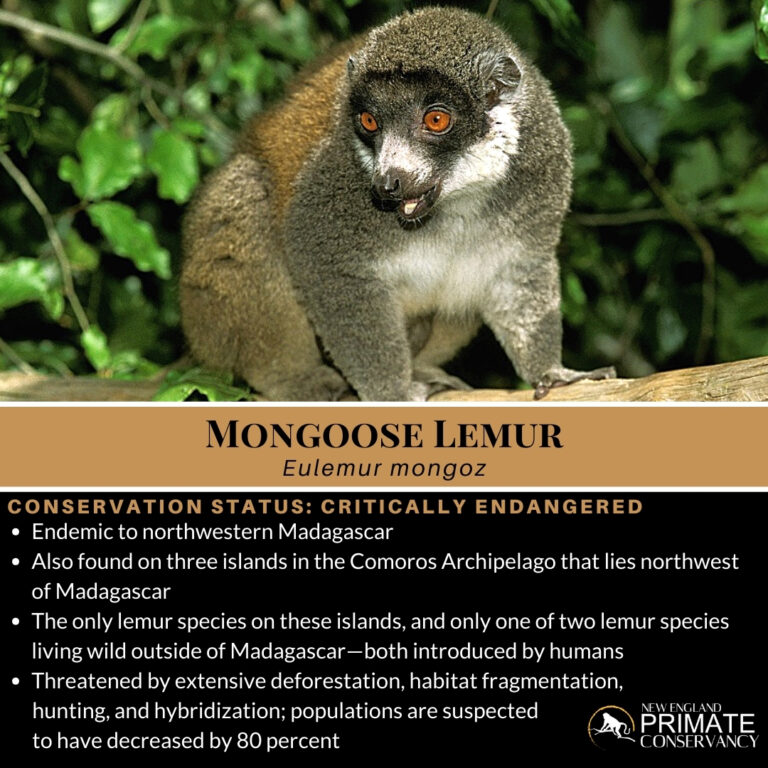
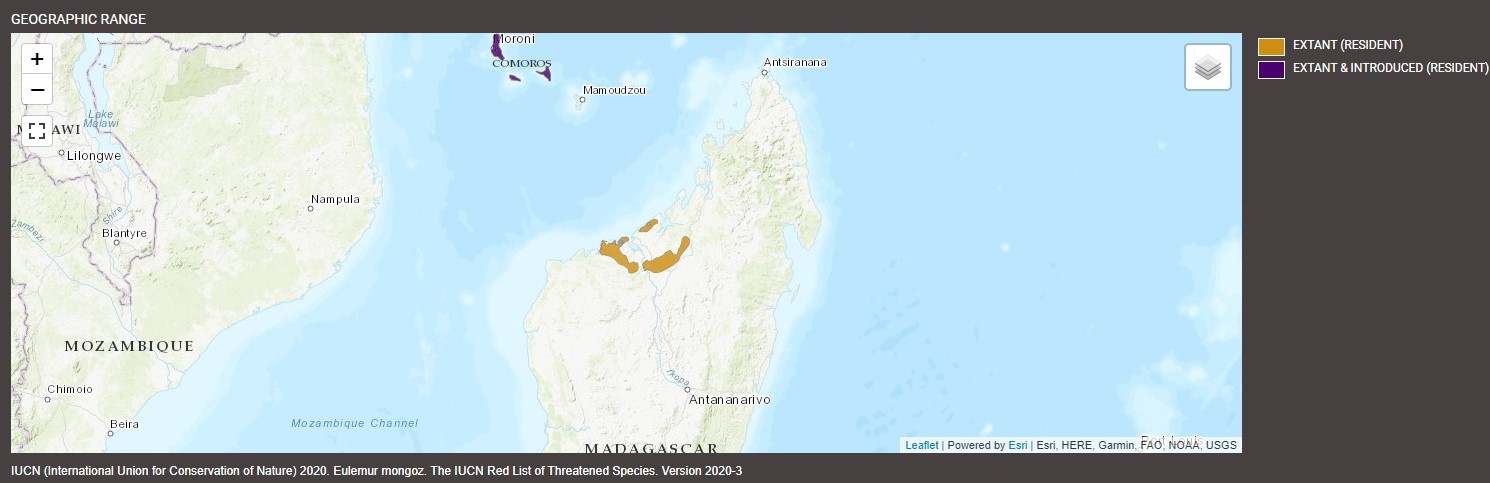
The mongoose lemur is native to northwestern Madagascar in the regions of Ambato-Boéni and Ankarafantsika, where they inhabit dry deciduous forests. They will sometimes wander into mangroves as well. Their northern limit reaches near Analalava on the Bay of Narindra and extends southwest of the Betsiboka River at Katspey and to the shores of Lac Kinkony. The highest density of mongoose lemurs is found in the Mahavavy-Kinkony wetland complex. The region experiences an annual rainfall of 46.85 inches (1.19 m), mostly occurring in the 5-month wet season between December and April. The dry season lasts from May to November.
Mongoose lemurs were likely introduced on the Comoros islands of Moheli, Anjouan, and Grande Comoro, where the population is believed to be larger than that in Madagascar. The forests in the Comoros islands tend to be more humid than those in which the mongoose lemur is found in Madagascar.
Thanks to their opportunistic diets, mongoose lemurs can withstand secondary forests that have undergone some human disturbance, but do not seem to move between fragments and remain within the largest available forest patch.
Size, Weight, and Lifespan
Mongoose lemurs typically weigh 3.30–4.40 pounds (1.5–2 kg). They have a head and body length of about 13.77 inches (35 cm) and a tail length of 18.89 inches (48 cm).
Under professional care, mongoose lemurs can live to about 25 years of age.
Appearance
Like other prosimian primates, mongoose lemurs retain many traits that were likely present in some of the earliest primates. They have extended snouts to help them sniff out food and scent marks left by other individuals. They also have a toothcomb, formed from elongated, forward-projecting lower front teeth, which helps keep their fur neatly groomed, as well as a grooming claw (a modified nail) on their second hind toe that extends into a point, unlike their other flat nails.
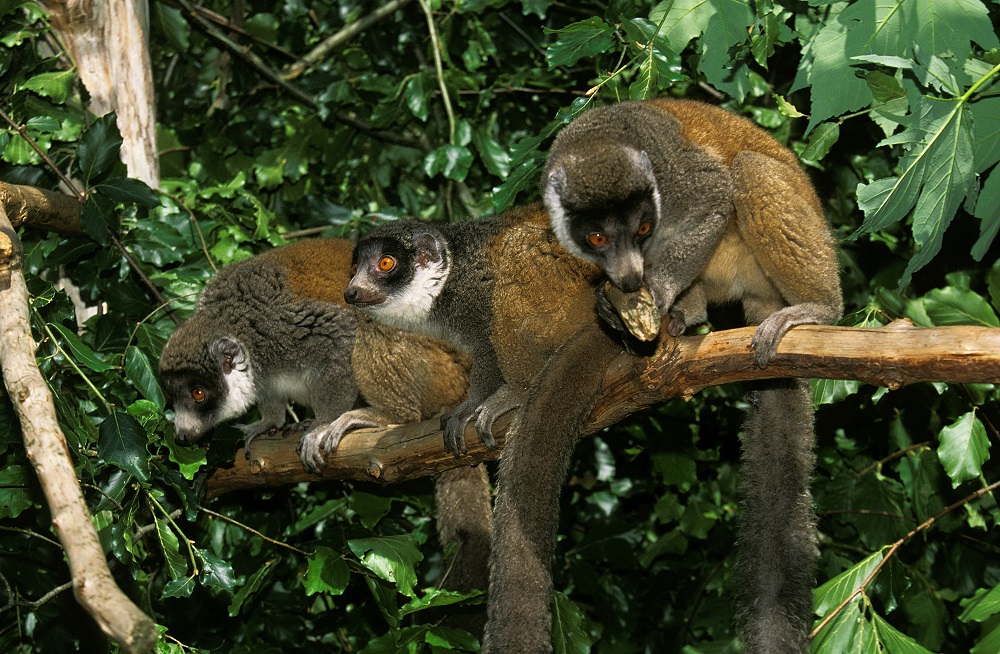
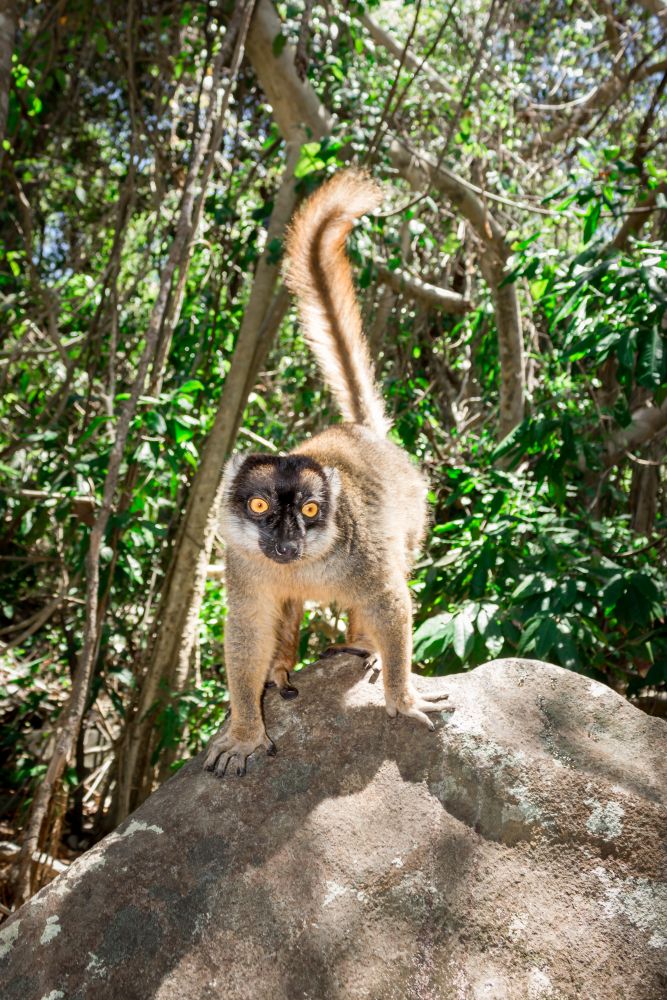
While not particularly sexually dimorphic in size (males and females are about the same size), mongoose lemurs are dichromatic. Their coloring differs based on gender. Females have a grayish face framed in black with a white chin and cheeks. The top of their head is also gray, spreading into the shoulders and forelimbs, then turning brown down their back and hindlimbs, contrasting the white or light brown color of their bellies. Males also have gray fur, although it tends to be more brownish than that of females. Their gray faces are framed with orange fur that wraps around their forehead and along their cheeks and chin. As they grow into adulthood, the red coloration begins to wrap around to the back of the neck. Some males will even become bald from rubbing the tops of their heads while scent marking.
Diet
Mongoose lemurs have a variable diet, but mostly eat fruit, nectar, and leaves. They particularly seem to enjoy feeding on flowers from the introduced kapok tree. The composition of their diet changes between the seasons, helping them make sure they maintain their necessary nutritional intake year-round. During the wet season, their diet mainly consists of mature fruits, nectar and seeds. In the dry season, some mature fruit is still available, as well as flowers and leaves. They will also sometimes eat ants and have even been recorded predating on fledgling birds during the dry season.
Behavior and Lifestyle
Mongoose lemurs are arboreal, spending most of their time in the trees. They travel mostly by walking and running quadrupedally along the branches with their long tails helping them balance. They are cathemeral, meaning they can switch between daytime and nighttime activities depending on seasonal needs. They are typically more active at night during the dry season, possibly to help them better thermoregulate during the cooler nights. Nights during the wet season also tend to be darker due to cloud cover, which also impacts the mongoose lemurs’ ability to be active.
Like many lemurs, mongoose lemurs must watch out for the fossa, which is their only mammalian predator (besides human hunters). Birds of prey may also seek out mongoose lemurs when making dinner plans.
Known as dredrika or gidro in Malagasy and as komba in Comorian.
Mongoose lemurs tend to keep a close social circle, living in small cohesive family units typically consisting of one adult breeding pair with up to four of their offspring. Larger groups sometimes occur in Mohéli in the Comoros, indicating that differences in environment may impact group structure. Groups typically have a home range of about 6.92 acres (2.8 ha). Like other lemurs, the female runs the group and has priority access to the best foods. While their active hours vary, when they are ready to tuck in to sleep, mongoose lemurs choose to sleep high in the canopy, typically nestled in between tree branches.
Mongoose lemurs overlap in range with the common brown lemur and the red brown lemur, and have even been known to hybridize with red brown lemurs.
Scent marking is an important method of communication amongst lemurs. Brown lemurs, like the mongoose lemur, have their scent glands situated on the heads and palms of the males, as well as under their tails. Their moist noses help them pick up the scents of others. Males will often scent mark on females to strengthen their bond by rubbing themselves against them.
Vocalizations are also important for communicating with other group members, especially for long-distance communication. Mongoose lemurs are known to have 15 distinct vocalizations, including a nasally long grunt (also described as creeeeeeeeee), as well as clicks and snorts, which are used to communicate movement to other group members or alert them to potential threats. The alarm long grunt, which is sometimes compared to a creaking door, is used to alert to the presence of terrestrial predators. Grunts are used for group cohesion, in aggressive encounters, and when defending territory. Chatters and, in particularly intense interactions, screams are also used in aggressive scenarios. Grunt hoots and hoots are used for alerts. Croui-croui calls are used for territorial defense. A closed-mouthed cak is used to alert the presence of aerial predators.
Mongoose lemurs typically have their birth season around mid-October, but may differ between populations based on differences in environment and resources in each area. After a gestation period of 126-128 days, females give birth to a single infant. Males take part in parental care and will help carry babies once they’re about two weeks old. Mongoose lemurs carry their babies “side-saddle,” where the infant is wrapped around the adult’s belly with their head resting on the adult’s back. Babies begin feeding and moving independently at about 9 weeks, and wean by about 6-7 months. Females will typically give birth once per year.
Mongoose lemurs are socially monogamous in their native Madagascar, although in the Comoros, they have been observed in multimale-multifemale groups. Both sexes disperse when mature. Females immigrate at 27-30 months of age and males at 31-42 months.
Like other fruit-eating primates, mongoose lemurs likely play an important role as seed dispersers for the fruiting trees they feed on. This role helps maintain the biodiversity of the forests they live in by dropping seeds farther than they could travel on their own, and by helping the seeds germinate by processing them.
While the role hasn’t been studied for mongoose lemurs, researchers have noted the potential for other closely related lemurs to act as pollinators. While licking nectar from the insides of flowers, pollen is likely transferred to the fur around the lemurs’ faces, which they then spread to the next flower as they continue to feed. Because mongoose lemurs also enjoy feeding on nectar from flowers, they likely also transfer pollen between them and help ensure the production of fruit for their own future meals.


The mongoose lemur is classified as Critically Endangered by the International Union for Conservation of Nature (IUCN, 2018), appearing on the IUCN Red List of Threatened Species. Their populations are expected to be decreasing. In 2000, surveys of the mongoose lemur population in Anjamena recorded 16 groups/0.39 square mile (1 square km) and 45 individuals/0.39 square mile (1 square km). A repeat of the survey in 2008 reported densities of 2.5 groups/0.39 square mile (1 square km) and 10 individuals/0.39 square mile (1 square km).
Mongoose lemurs are primarily threatened by deforestation and habitat degradation due to logging, slash-and-burn agriculture, and charcoal production. The Ambato Boeny area in Madagascar has already lost several of its remaining forest fragments, often resulting in the loss of local wildlife such as the mongoose lemur. Between 2010 and 2014, Madagascar experienced a deforestation rate of 1.1% of forest cover lost per year. They are also hunted for bushmeat and sold in the pet trade. Many locals in Madagascar justify hunting mongoose lemurs as they are seen as crop pests.
Social species, like primates, including the mongoose lemur, have been shown to be more sensitive to anthropogenic disturbances, which can cause disruption in the movement of individuals between groups, as well as the availability of food and space. These factors can result in changes in group size and composition.
Mongoose lemurs are listed in Appendix I of the Convention on International Trade in Endangered Species (CITES), an international agreement between governments whose goal is to ensure that international trade in specimens of wild animals and plants does not threaten their survival. They are protected by national law in Comoros. Community-based conservation plays an important role in protecting mongoose lemurs in the Ambato Boeny District of Madagascar.
On the Comoros Islands, some people, mainly Malagasy people who have moved to the islands, perceive mongoose lemurs as crop-raiding pests. Many locals in Comoros, however, recognize the inherent value of the mongoose lemurs as living beings and their potential to benefit the local economy as a tourist attraction. While not native to the Comoros, the islands may provide an important “reservoir” for the species, especially considering their protections there surpass those in their native Madagascar.
As of 2019, 110 mongoose lemurs were reported in zoological collections worldwide, many of which are participating in breeding programs to help maintain the species.
- Razafindramanana, J., Eppley, T.M.E., Rakotondrabe, R., Roullet, D., Irwin, M. & King, T. 2020. Eulemur mongoz. The IUCN Red List of Threatened Species 2020: e.T8202A115561431. https://dx.doi.org/10.2305/IUCN.UK.2020-2.RLTS.T8202A115561431.en. Accessed on 25 February 2026.
- Gould, L., Sauther, M., and Cameron, A. (2011). Lemuriformes. In Primates in Perspective (second, pp. 76–77). Oxford University.
- Curtis, D. J. (2004). Diet and nutrition in wild mongoose lemurs (Eulemur mongoz) and their implications for the evolution of female dominance and small group size in lemurs. American Journal of Physical Anthropology: The Official Publication of the American Association of Physical Anthropologists, 124(3), 234-247.
- Nadhurou, B., Gamba, M., Andriaholinirina, N. V., Ouledi, A., & Giacoma, C. (2016). The vocal communication of the mongoose lemur (Eulemur mongoz): phonation mechanisms, acoustic features and quantitative analysis. Ethology Ecology & Evolution, 28(3), 241-260.
- Mittermeier, R. A., Tattersall, I., Konstant, W. R., Meyers, D. M., & Mast, R. B. (1994). Lemurs of Madagascar. Conservation International.
- Matthew Richardson, Deborah Curtis. Eulemur, mongoz,. © All the World’s Primates. N Rowe, M Myers, eds. (alltheworldsprimates.org) Downloaded 3/21/2026
- Nadhurou, B., Righini, R., Gamba, M., Laiolo, P., Ouledi, A., & Giacoma, C. (2017). Effects of human disturbance on the mongoose lemur Eulemur mongoz in Comoros: implications and potential for the conservation of a Critically Endangered species. Oryx, 51(1), 60-67.
- Birkinshaw, C. R., & Colquhoun, I. (1998). Pollination of Ravenala madagascariensis and Parkia madagascariensis by Eulemur macaco in Madagascar. Folia Primatologica, 69(5), 252-259.
Written by Lina Rademacher, March 2026