
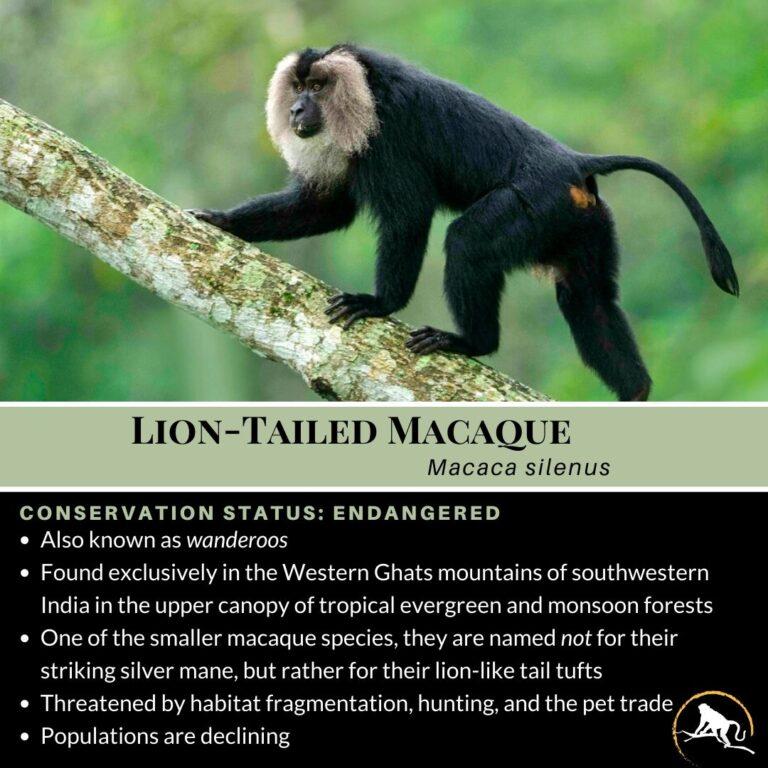
Lion-Tailed Macaque, Macaca silenus
LION-TAILED MACAQUE
Macaca silenus
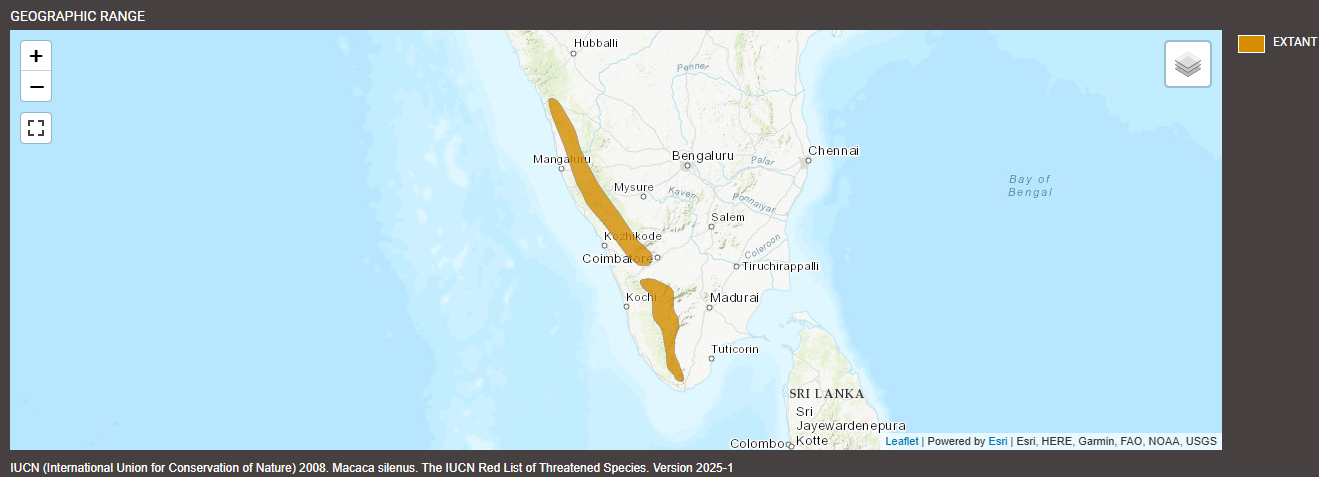
Geographic Distribution and Habitat
The lion-tailed macaque (Macaca silenus), also known as the wanderoo, is endemic to southwest India’s Western Ghats mountain range and occupies elevations ranging between 328 feet (100 m) and 4,265 feet (1,300 m). This species’ geographic distribution is bordered by the Kalakkad hills to the South and the Sirsi-Honnavara rainforests to the North. Their range is broken up by a low mountain pass called the Palghat gap.
As an arboreal species, lion-tailed macaques spend most of their time in trees, 98-164 feet (30-50 m) off the ground in the upper rainforest canopy. They prefer undisturbed, old-growth tropical evergreen forests, but will also live in forests that have been disrupted by human development. Occasionally, they may also occupy forest fragments where humans have planted fruit trees like jackfruit, guava, and passion fruit.
Despite habitat disturbance, the Western Ghats are still one of the eight ‘hottest hotspots’ of global biodiversity. Of these eight hotspots, the Western Ghats have the highest human population density.
Lion-tailed macaques north and south of the Palghat gap are genetically distinct—populations south of the gap have more genetic diversity than populations to the north. Scientists believe this genetic separation, which happened 2.11 million years ago, was likely caused by changes to the climate during the last ice age.
The amount of genetic variation between lion-tailed macaques north and south of the Palghat gap is higher than the difference between the rhesus and Japanese macaque subspecies. Scientists do not all agree on whether this genetic difference is enough, on its own, to warrant separating the northern and southern lion-tailed macaque populations into different subspecies. Since this species is endangered, however, scientists recommend evaluating the two populations differently for conservation purposes.
Size, Weight, and Lifespan
Lion-tailed macaques are one of the smaller macaque species. Adult females are roughly 33% smaller than adult males and weigh an average of 4.4-13.2 pounds (2-6 kg), compared to 11-22 pounds (5-10 kg) for males.
Males are also longer and measure 20-24 inches (51-61 cm) from the top of the head to the end of the body. Females, meanwhile, are 16.5-18 inches (42-46 cm) long. The tail, which this species is named for, is about 55-75% of the head-body length.
Individuals can live up to 38 years.
Appearance
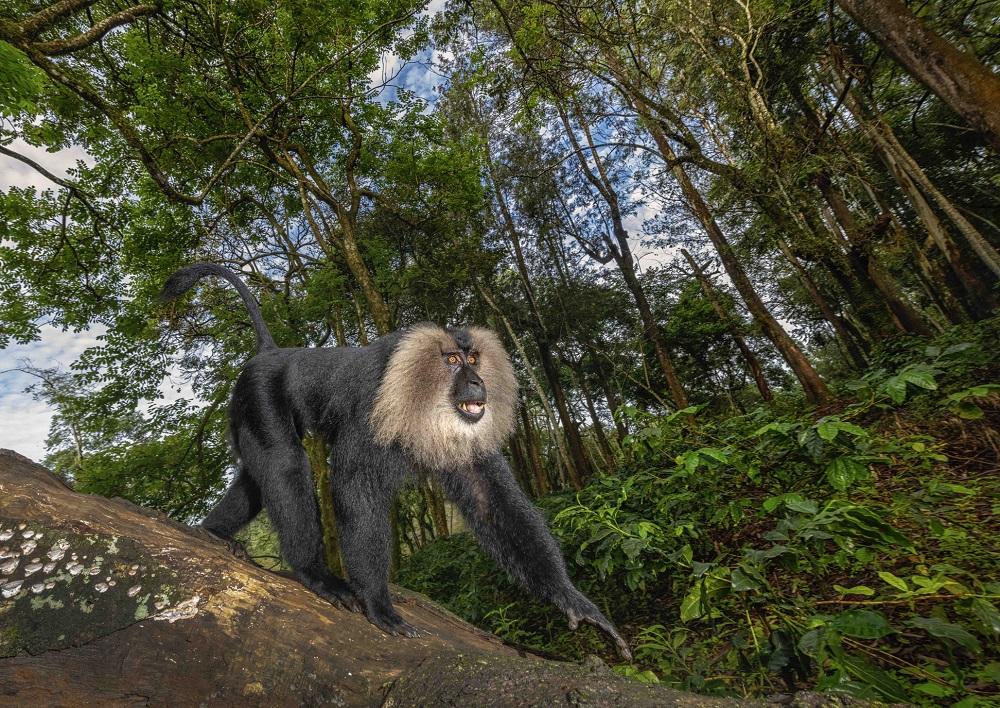
As you would expect from the species name, lion-tailed macaques share many features with the king of the jungle—on both ends of their bodies! Of course, there is the titular tail, which has a tuft on the end, just like that of a lion. Then, there is the striking grayish-tan mane that circles these monkeys’ faces. This ruff circles the chin, is widest around the cheeks, and ends between the eyes. Everywhere else on their body, the lion-tailed macaque has glossy black fur.
Their black face features thin but protruding brow bones and a broad, flat nose. Lion-tailed macaques have close-set hazel eyes and long, sharp canines.
Lion-tailed macaques have expandable cheek pouches that function as temporary storage compartments. While foraging, they can quickly gather fruits, seeds, leaves, or insects and tuck them into their pouches. This adaptation allows them to collect food efficiently without having to eat it immediately, which is especially useful in the dense rainforests where food may be patchily distributed and competition is high.
Diet
As frugivores, lion-tailed macaques mostly eat fruit. However, they are also very well-rounded eaters and supplement their diet with seeds, young leaves, berries, nuts, bark, nectar, gums, fungi, and lichen. Throughout the year, the most important foods for this species are fruits in the breadfruit and jackfruit genus (Artocarpus) and the fruit and flowers of wild durian (Cullenia exarillata). When they are close to villages where humans have cultivated fruits, lion-tailed macaques will also eat guava, passion fruit, coffee, and the fruits of the umbrella tree used to shade coffee plants.
Of the time that lion-tailed macaques spend eating, around 20% is spent consuming prey: both invertebrates and vertebrates. This increases up to 24% during the dry season from December to May, when fruit is scarce, and goes back down to 11% during the wet season between June and November, when fruit is more abundant. Most of their prey are invertebrates like leaf insects and stick insects plucked from the leaves, spiders picked off their webs, and dragonflies—eaten headfirst, with the wings and legs discarded. They will also eat moths, butterflies, cicadas, and caterpillars (taking care to rub them first to remove any stinging hairs or spines).
Lion-tailed macaques of any age will eat tree frogs, along with their secretions, from their nest and eggs. Only the adults, however, eat tree lizards and flying dragons. They don’t eat the skin and bones, though. Other vertebrate prey include birds, nestlings, and bats. The monkeys have also been observed attacking and chasing, but failing to catch, an Indian chevrotain fawn.
Behavior and Lifestyle
Out of all the macaque species, lion-tailed macaques spend the greatest share of their day in trees. They are active while the sun is up and spend more than half of the day looking for food and eating it. They spend another 27% of their time resting, 15% traveling, and around 5% socializing. When the weather cools or they are at higher elevations, lion-tailed macaques tend to spend less time resting and more time foraging for food.
In undisturbed forests, lion-tailed macaques spend most of the day in trees and are occasionally observed on the ground while eating mushrooms. This behavior changes in disturbed areas, however, where lion-tailed macaques spend time on the ground looking for food, picking up large fallen fruits, travelling, and even resting.
Because of the broken canopies in disturbed forests, lion-tailed macaques also fall out of trees more frequently, with 1-5 incidents per day.
While lion-tailed macaques have been named in English for their back end, the Germans call this species “bartaffe,” which translates to “beard ape.”
This species lives in groups of 4-30 individuals, but 10-20 is the most typical size. Usually, there are 1-3 males, of which one is the alpha. The ratio of adult males to adult females is typically 1:2, but can be as high as 1:9. Females typically stay close to home for their entire lives, while males may change groups and will enter by aggressively taking over another male. This is quite different from how the rhesus and Japanese macaques prefer to infiltrate groups, which is by discreetly entering the group hierarchy and working their way up.
Despite living in groups, males tend to keep to themselves, in contrast with bonnet macaques that spend more time socializing and huddling close together. The dominance hierarchy among males in a group of lion-tailed macaques is highly linear. There is always one alpha male, and the males are often in conflict with one another.
Since lion-tailed macaques primarily eat just a few widely dispersed foods, their home ranges can be quite large, at 500 hectares (5 km²) or more. Sometimes these bubbles overlap with other groups, but the central core area of around 300 hectares (3 km²) is usually exclusive to one group. In fragmented forests near plantations, where food sources are more concentrated, lion-tailed macaques tend to have smaller home ranges.
Predators include leopards, pythons, the Indian black eagle, the mountain hawk-eagle, and a species of wild dog known as a dhole. In human-altered landscapes, where lion-tailed macaques spend more time on the ground, domestic dogs are also a threat.
Many macaque species use their faces to signal aggression. The threat often begins by staring at the enemy with eyes wide open, and can ramp up in intensity by adding other features like opening their mouth without showing their teeth, raising their eyebrows, and flattening their ears. Macaque species may make threats while competing for food, competing for a mate, or even because someone got too close. Individuals in a group assert dominance by mounting those lower down in the hierarchy, whether they are the same or opposite sex.
Lion-tailed macaques signal their affiliation with another monkey by silently baring their teeth. In many other macaque species, this same display is known as the fear grin or grimace and is typically used to show submission.
The primary way that lion-tailed macaques signal submission is by turning around and showing their rear end. Most of the time, lion-tailed macaques let their tails hang casually, swinging like a pendulum. But sometimes, if they are frightened, are submitting to a dominant monkey, or are trying to impress a mate, lion-tailed macaques may carry their tails up or towards one side.
When a male lion-tailed macaque wants to mate, he will pucker his lips to indicate that he is approaching without aggressive intentions. The female, if she is interested, will also pucker in response.
Observations of lion-tailed macaques in captivity revealed 17 basic patterns of vocal communication. An analysis of the sound waves revealed that these calls were adapted specifically to be heard in the acoustic conditions of the tropical forest. The dense vegetation makes vocal communication incredibly important, since any visual signals would be only useful from a short distance.
This species is polygenous—males mate with several females, but each female only mates with one male. Males start breeding when they are 8 years old. Because the availability of food changes very little from season to season, male lion-tailed macaques are able to breed throughout the year. There are usually at least one to two females who are receptive to mating at any given time, indicated by swellings on their rear ends. Although mating happens year-round, births tend to peak in February and March.
Females reach sexual maturity when they are around four years old. They have a menstrual cycle of 40 days and usually give birth for the first time at 5-6 years of age. They typically have a gap of 34.3 months between births, a fairly long period that makes the species intrinsically rare in the wild.
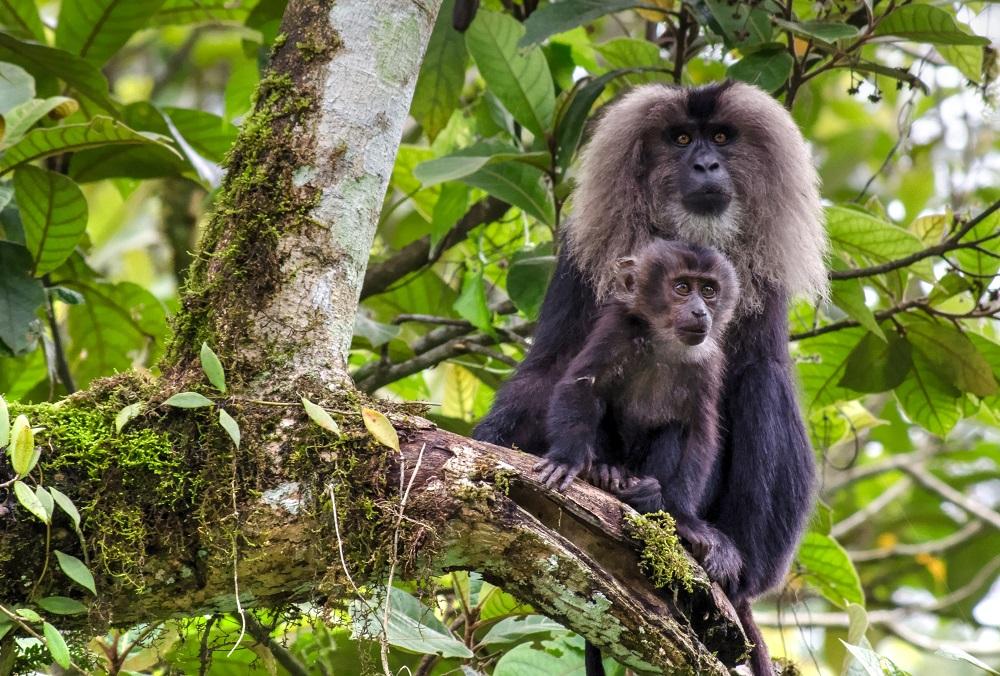
After a 162-186-day pregnancy, the lion-tailed macaque gives birth to a little baby with brown fur and pale, pink skin. At two months, the iconic mane starts growing in. In this species, the mother has no problem with picking a favorite child—she’ll spend twice as much time grooming a male infant as she will a female. After 12 months of nursing, she’ll wean the child off and punish him or her for any further attempts at breastfeeding.
Like so many other animals that eat fruit, lion-tailed macaques help disperse plant seeds through the forest. Their rather large home range means lion-tailed macaques can spread seeds quite far. Some coffee bushes growing in the forest understory have even been attributed to lion-tailed macaques who ate coffee seeds on a plantation and later went to the bathroom in the forest.


The International Union for Conservation of Nature lists the lion-tailed macaque as Endangered (IUCN, 2015), appearing on the IUCN Red List of Threatened Species. Scientists estimate there are 4,000 lion-tailed macaques left in the wild. Less than 2,500 of these individuals are mature and able to reproduce.
The most significant threat to lion-tailed macaques is habitat loss and fragmentation. In the late 19th and early 20th centuries, large swaths of the Western Ghats that this species calls home were cleared to build rice, tea, cardamom, coffee, eucalyptus, and teak plantations. Although these activities have left behind pockets of intact forest, such habitats are of lower quality and continue to be degraded by activities like timber harvesting, dam-building, mining and mineral exploration, road construction, and power lines.
The lion-tailed macaque’s wide geographic range is only sparsely populated. They live in a few dozen isolated subpopulations, isolated from one another in fragments of forest that have been left behind by deforestation. None of these subpopulation have more than 250 mature individuals. This disruption is especially pronounced in the highly fragmented Anamalai hills, which are filled with tea and coffee plantations. Lion-tailed macaques in this area, which form almost 20% of the entire wild population, have less genetic diversity than those living in more connected forests, like in Nelliyampathy.
Another threat to the species is hunting. This is especially prevalent in the Coorg District of Karnataka, where lion-tailed macaques have been hunted in the past for “medicinal” uses. They are also occasionally hunted for meat and captured to be traded as pets.
As hunting, road kills, and habitat loss continue, estimates suggest the population of lion-tailed macaques will likely continue to decline over 20% over the next approximately 25 years.
The lion-tailed macaque is listed in Appendix I of the Convention on International Trade in Endangered Species (CITES), an international agreement between governments whose goal is to ensure that international trade in specimens of wild animals and plants does not threaten their survival.
Under the Indian Wildlife (Protection) Act of 1972, the lion-tailed macaques are provided the highest level of protection as a Schedule I species—hunting them is illegal. These monkeys live in several protected areas, including Indira Gandhi Wildlife Sanctuary and National Park, Kalakkadu Wildlife Sanctuary, Kudremukh National Park, Periyar Wildlife Sanctuary, and Silent Valley National Park.
The number of road kills could be reduced by preventing tourists from feeding the monkeys and reducing roadside food waste. Efforts to reduce hunting, maintain what forests remain, and restore connections between forest fragments would also help ensure the long-term survival of lion-tailed macaques.
- https://www.iucnredlist.org/species/12559/17951402
- https://tb.plazi.org/GgServer/html/CE199B17FFC3FFC7FA356602F83AF421
- https://juniperpublishers.com/jojwb/JOJWB.MS.ID.555595.php
- https://link.springer.com/article/10.1007/s10329-024-01152-6
- https://journals.plos.org/plosone/article?id=10.1371/journal.pone.0142597
- https://www.sciencedirect.com/science/article/abs/pii/S0006320796000717
- https://www.gbif.org/species/2436617
- https://primate.uchicago.edu/1997EOC.pdf
- https://brill.com/view/journals/ijfp/45/3-4/article-p148_2.xml
Written by Jiayu Liang, Aug 2025