
Eastern Lesser Bamboo Lemur, Hapalemur griseus
EASTERN LESSER BAMBOO LEMUR
Hapalemur griseus
Geographic Distribution and Habitat
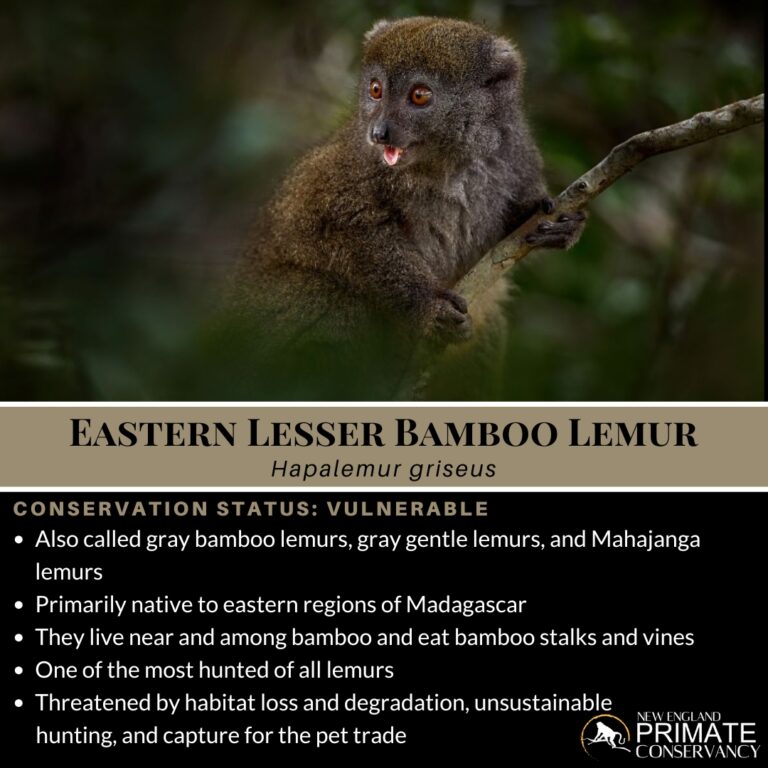
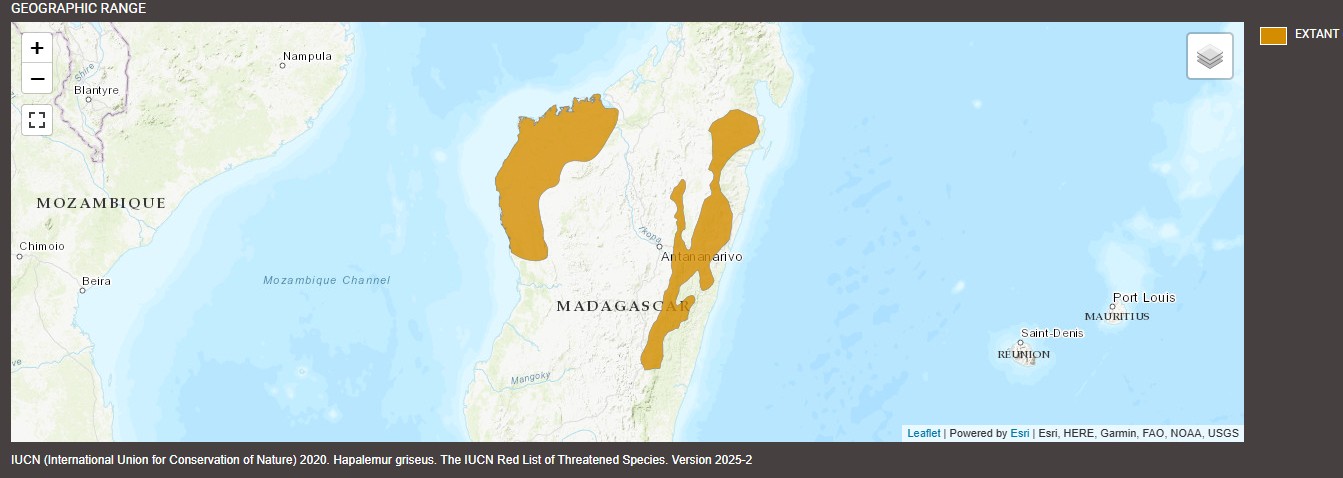
The eastern lesser bamboo lemur, also known as the gray bamboo lemur, the gray gentle lemur, the Mahajanga lemur, and varibolo in Malagasy, is native to the fourth largest island in the world: Madagascar. 90% of the plants and animals living on Madagascar cannot be found anywhere else in the world, including the eastern lesser bamboo lemur. They live in a variety of habitats, including lowland, primary, secondary, and mountain rainforests, as well as marshlands.
There are three recognized subspecies of the eastern lesser bamboo lemur, each found in a preferred forest type and region.
The nominate eastern lesser bamboo lemur subspecies (Hapalemur griseus griseus) has the widest distribution, living in forests along the east coast and isolated inland forests in the northeast, from the northern Onibe River to the southern Onive River.
The second subspecies, known as the Ranomafana bamboo lemur (H. g. ranomafanensis), is found in two populations, one in east-central Madagascar and the other in west-central Madagascar. The eastern population is found south of the Mangoro and Onive Rivers, into Ranomafana National Park; the western group inhabits the northern forests of Tsingy de Bemaraha to the Makay in the south. More research is needed to determine the exact extent of this subspecies.
The third subspecies, known as Gilbert’s bamboo lemur (H. g. gilberti), lives in east-central Madagascar, south of the Mangoro River. This subspecies was described by scientists from a forest called Beanamalao in the northwestern part of the island, north of the Nosivolo River. However, recent studies located this subspecies between the Mangoro and Onive Rivers in Ranomafana National Park, much further south. The IUCN lists this subspecies as Data Deficient. More research is needed to clarify their distribution.
Very adaptable creatures, eastern lesser bamboo lemurs can survive in fragmented, high-altitude forests up to 6,726 feet (2,050 m) with high humidity and temperatures ranging from 39.2º to 86ºF (4–30°C). There is one thing they cannot live without, though: bamboo. These primates rely heavily on this plant for survival: the largest populations all occur in or around primary and secondary forests with large bamboo stands. Research confirms that eastern lesser bamboo lemur populations would starve without access to bamboo.
Lemurs belong to the oldest and most primitive suborder of primates, known as strepsirrhines, or the ‘wet-nosed’ primates. Also known as prosimians, this group includes lemurs, lorises, pottos, and bushbabies.
Three subspecies of the eastern lesser bamboo lemur are recognized. Each exhibits subtle variations in coat color and occupies its own geographic range in Madagascar. Over the last two decades, however, scientists have debated the veracity of some of these subspecies, elevating two, the Lac Alaotra bamboo lemur (Hapalemur alaotrensis) and the western lesser bamboo lemur (Hapalemur occidentalis), to full species status in 2001.
Size, Weight, and Lifespan
Eastern lesser bamboo lemurs are the smallest of all bamboo lemurs. They have a head-body length of around 11 inches (28 cm), with a tail that measures 14 inches (35 cm), and an average weight of 2 pounds (.9 kg). Males are typically slightly smaller than females.
The lifespan of eastern lesser bamboo lemurs in the wild is unknown. Under rare, highly managed captive conditions—such as in well-resourced, professionally run institutions—some individuals have lived to 23 years of age. The average lifespan for eastern lesser bamboo lemurs living in these highly managed captive conditions is 17.1 years for females and 12.8 years for males.
Appearance
These little lemurs sport a gray-brown coat with rusty-cinnamon fur covering their backs and crowns, giving them the charming appearance of wearing tiny helmets. Their faces are small (adorably so!), with a slightly pointed, protruding snout and large, rounded copper-colored eyes that match the color of their backs and ‘helmets.’ Their fur is so thick that it covers their ears, giving their heads a round appearance.
Their fur is incredibly dense, an essential adaptation for staying dry in the tropical rainforest. The roundness doesn’t end there, as their compact bodies can sometimes look very plump and pear-shaped when they sit upright.
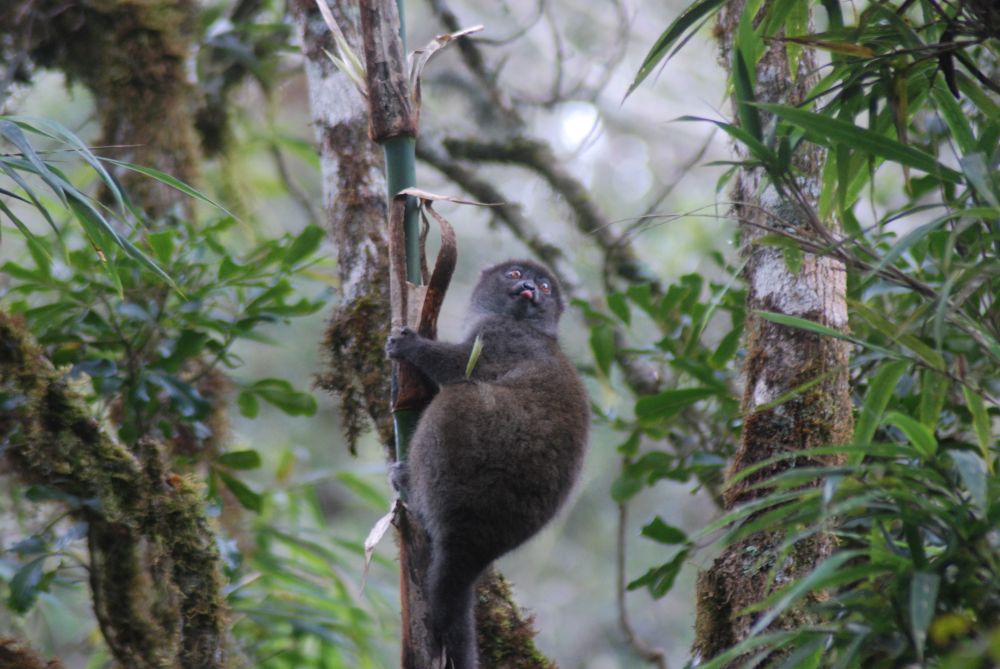
They have strong hindlimbs that are slightly longer than their forelimbs, a limb structure associated with vertical climbing. Their tails are not prehensile, meaning they can’t use them to climb or hang from branches.
Diet
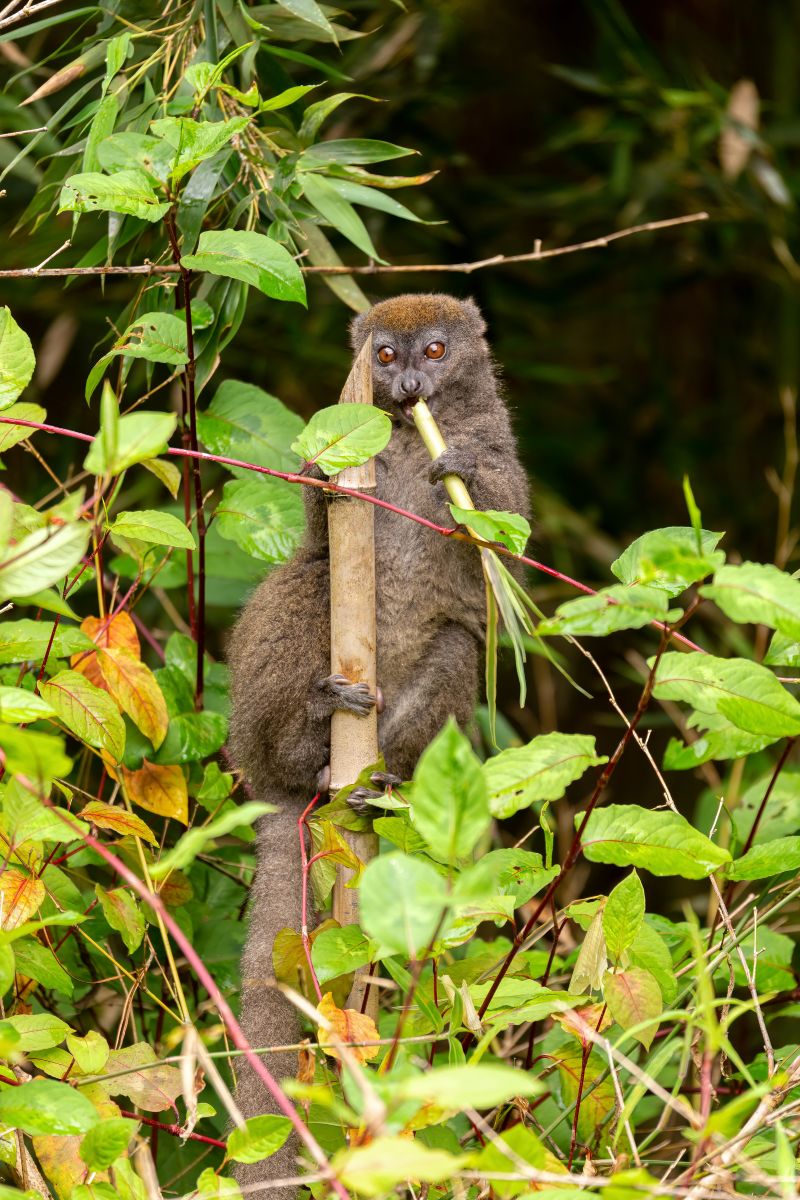
Eastern lesser bamboo lemurs are folivorous herbivores: animals with a plant-based diet that favor eating leaves. Scientists might more specifically classify eastern lesser bamboo lemurs as lignivores, or animals that mainly eat wood. As their name suggests, they specialize in eating woody bamboo plants, which can make up to 90% of their diet, depending on the time of year. Although more than 40 bamboo species grow across Madagascar, eastern lesser bamboo lemurs show a strong preference for giant and Tinwa bamboo. When available, they prefer to eat the base and inner tissues of young bamboo shoots. These are harder to find in the dry season, from May to October, so they must settle for mature leaves and hollow stems. Although they mainly eat bamboo, they also supplement their diet with other plant matter, including grass stems, young leaves of plants other than bamboo, berries, figs, guavas, and mushrooms. They sometimes even practice geophagy—the eating of soil to obtain its mineral nutrients.
The preferred food source of the eastern lesser bamboo lemur, young bamboo shoots, contains high concentrations of cyanide. This food source would be deadly for many other animals, and they avoid getting sick because of their specialized digestive system. They have a very large caecum and colon, containing microbes that slowly break down tough plant fibers. While bamboo passes quickly through the stomach and small intestine, the plant spends more time in the large intestine, allowing these microbes to extract the energy needed from the fibers. Another study expanded these findings by analyzing the excretions of three lemur species, including the eastern lesser bamboo lemur. Researchers detected cyanide in nearly all urine samples, but only rarely in fecal samples, suggesting that after cyanide is absorbed in the gastrointestinal tract, it is, at least partially, excreted by the kidneys.
Behavior and Lifestyle
Eastern lesser bamboo lemurs are cathemeral, meaning they are active at irregular intervals during the day and night, with predominantly daytime activity patterns. Throughout the year, they show some variation in activity patterns, as bamboo and nutrient availability change with the seasons. On a regular day, they might be active in the early morning and late afternoon, while resting in the middle of the day and at night. During these periods of inactivity, groups retreat to the trees, where they huddle for warmth. One member of the group will typically be on the outside of the huddle to watch for predators. These rest periods are essential, as they provide them time to manage the energy-intensive digestion of such a dense and fibrous food source.
Eastern lesser bamboo lemurs are primarily arboreal, traveling through the trees by vertically leaping and maintaining an upright posture as they cling to successive branches or bamboo stalks. When moving along horizontal branches or on the forest floor, they shift to quadrupedal locomotion, using all four limbs in a quick, cat-like gallop. Rather than actively searching for food, individuals often remain still and visually scan the surrounding vegetation for suitable bamboo shoots, then use precise hand-eye coordination to move directly to the selected food source.
Eastern lesser bamboo lemurs live alongside other bamboo specialists, such as golden bamboo lemur (Hapalemur aureus) and greater bamboo lemurs (Prolemur simus), with little territorial conflict, likely because each species favors different parts or types of bamboo. Predators include raptors, snakes, fossas, and even domestic dogs and cats. These lemurs use different calls depending on the type of predator they encounter to warn other group members. These vocalizations, known as intimidation calls, are high-pitched, shrill screams.
Lemurs within the genus Hapalemur have superior manual dexterity and hand-eye coordination when compared to most lemurs!
Bamboo lemurs ingest large quantities of cyanide every day, a toxic chemical that is lethal to most mammals.
Scientists speculate that massive trees—with vines, roots attached to soil, and little lemur ancestors living inside—were tossed into the ocean off the east coast of Africa multiple times over the course of millions of years, leading to the evolution of lemurs on Madagascar.
Eastern lesser bamboo lemurs generally live in close-knit family groups of three to six individuals, often including one or more breeding females, an adult male, and their offspring. As with many lemur species, their social hierarchy is typically female-dominant, with females having priority access to feeding sites. Males are primarily responsible for group defense, especially for protecting infants. Group members tend to remain close to one another, with females occupying more central positions and males occupying more peripheral positions.
Males commonly leave their natal group upon reaching sexual maturity, while females may either remain in their natal groups or disperse, depending on local ecological and social conditions.
Home ranges average between 19.8 and 37 acres (8–15 ha), which is relatively small compared to those of other bamboo lemurs. Although home ranges may overlap with those of neighboring groups or other kinds of lemurs, interactions are usually nonviolent and rely on scent marking, vocalizations, and charging displays rather than physical aggression.
Shared latrine behavior also plays a role in the social dynamics of the eastern lesser bamboo lemur, with individuals taking turns defecating in a single, communal location.
Eastern lesser bamboo lemurs rely on a combination of vocal, chemical, visual, and tactile signals to communicate, maintain group cohesion, mark territories, and respond to threats. They possess a rich array of vocal calls, including grunts, clicks, growls, purrs, screeches, howls, and high-pitched screams, with each call serving a specific function. Alarm calls vary in intensity depending on the level of danger and whether the threat comes from an aerial or terrestrial predator. Contact calls help group members monitor their locations and vary in volume based on the distance between individuals. Females produce a distinct vocalization when fertile, and group members respond with soft grunts and soothing behaviors.
Olfactory, or scent-based, communication is equally important. Like many lemurs, eastern lesser bamboo lemurs use specialized scent glands on their forearms and armpits to mark territory. These glands are also involved in “stink fights,” primarily performed by males, in which individuals rub their tails against the scent glands and wave them toward rivals. Territory ownership may also be signaled by trampling vegetation on the forest floor.
Tactile communication, particularly social grooming, maintains positive social bonds and overall group cohesion.
Like much of their lives, reproduction and family dynamics in the eastern lesser bamboo lemur are closely tied to seasonal changes in food availability. Females reach reproductive maturity at around two years old, at which point they become fertile once a year; males mature slightly later, at about three years old. With only a single opportunity to conceive each year, any disruption—such as habitat loss, food scarcity, or climate-driven shifts in seasonal cycles—can result in an entire year of lost reproduction. For a vulnerable species with slow maturation rates, even short-term environmental disturbances can have long-lasting consequences for population recovery. Because eastern lesser bamboo lemurs take a long time to mature and reproduce, safeguarding the forests they call home is especially critical.
Eastern lesser bamboo lemurs are predominantly monogamous, forming social bonds with others to create families. Breeding occurs during the dry season, followed by a 140-day pregnancy period. This timing ensures that births occur during the rainy season, generally between October and January, when bamboo is most plentiful. Females typically give birth to a single infant, with twins being rare, and births are spaced about one year apart.
Newborns are dependent on their mothers and are small enough to be carried in the mother’s mouth. Once strong enough, infants cling to their mother without support. Mothers leave their young on a secure branch within dense bamboo thickets while they forage, returning periodically to nurse and groom, a behavior scientists have called parking. Within a few weeks, infants are capable of independent movement and begin eating bamboo by six weeks of age. Despite this growing independence, they remain reliant on their mothers until weaning off milk at around 20 weeks. Mothers provide the majority of care, but fathers occasionally assist by carrying the infant or protecting it from threats, representing a higher level of paternal involvement than is typical for many lemur species.
Eastern lesser bamboo lemurs maintain ecological balance by feeding on bamboo that most other animals cannot consume. Additionally, they serve as prey for local predators like Malagasy tree boas, fossas, ring-tailed mongooses, owls, and Madagascar serpent eagles. Introduced predators, such as domestic dogs and cats, disrupt the precarious ecological balance in these unique forest environments.
The eastern lesser bamboo lemur is found nowhere else in the world. Bamboo lemurs are part of the island’s impressive primate diversity, which includes 21% of all primate genera and 36% of all primate families. Sadly, 90% of Madagascar’s lemur species are threatened with extinction, making primate conservation a top priority for global and local environmentalists.


The eastern lesser bamboo lemur is classified as “Vulnerable” by the International Union for Conservation of Nature (IUCN, 2018), appearing on the IUCN Red List of Threatened Species. Habitat loss from slash-and-burn agriculture, timber harvesting, and agricultural expansion has left their forest homes fragmented, isolating family groups and reducing the bamboo thickets essential for their survival. Climate change also poses a major threat, and it is projected that eastern lesser bamboo lemurs will experience a 71% reduction in their range between 2000 and 2080. They also fall victim to illegal capture for the pet trade, as well as unsustainable levels of hunting by poachers and domesticated animals.
These threats are especially severe for a species that reproduces slowly and becomes fertile only once per year. When habitat degradation, food shortages, or human pressures disrupt breeding opportunities, an entire reproductive cycle may be lost—delaying population recovery and compounding long-term decline. Protecting continuous, bamboo-rich forests is therefore critical not only for survival, but for sustaining future generations.
Eastern lesser bamboo lemurs are listed in Appendix I of the Convention on International Trade in Endangered Species (CITES), an international agreement between governments to ensure that international trade in specimens of wild animals and plants does not threaten their survival.
Only a handful of wild places in Madagascar protect the eastern lesser bamboo lemur, including Zahamena and Betampona Nature Reserves, Andasibe-Mantadia National Park, Tsingy de Bemaraha National Park, Ranomafana National Park, and Marolambo National Park. Nevertheless, many groups of bamboo lemurs reside in unprotected forest areas. Because eastern lesser bamboo lemurs have long generation times, safeguarding these vulnerable forest fragments is especially critical.
SOS Lemurs (Save Our Species–Lemurs) is a conservation group dedicated to protecting lemur populations and preserving their habitats. The organization had previously collaborated with the IUCN Species Survival Commission on a five-year lemur conservation strategy (2017–2021), funded by a Geneva-based private foundation. SOS Lemurs has also launched the Sustainable Lemur Conservation and Community-Based Action in the Ambositra-Vondrozo Forest Corridor project, which aims to reduce lemur poaching, increase local knowledge and appreciation of lemurs across 32,000 hectares, support lemur-friendly livelihoods for forest communities, strengthen nine Community Forest Management associations, and plant 45,000 endemic trees to benefit both lemurs and people.
The Association Européenne pour l’Étude et la Conservation des Lémuriens (AEECL) is another conservation organization that supports long-term lemur conservation efforts. While their primary focus is the critically endangered blue-eyed black lemur, their work has benefited all lemur species. They engage in activities such as sponsoring local students and teachers to encourage conservation education in the community, hosting annual lemur festivals, and collaborating with Malagasy authorities to develop national species action plans.
- https://www.iucnredlist.org/species/9673/115564580#geographic-range
- https://madagascar.co.uk/application/files/7517/2593/9730/LN24.pdf
- https://animalia.bio/eastern-lesser-bamboo-lemur/1000#habits
- https://www.bioexplorer.net/animals/mammals/prosimians/eastern-lesser-bamboo-lemur/
- https://www.proquest.com/openview/49315942ad86fb6d94d467648007f151/1?pq-origsite=gscholar&cbl=18750&diss=y
- http://lemur.duke.edu/eastern-lesser-bamboo-lemur/
- https://www.iucnredlist.org/species/9673/115564580#taxonomy
- https://onlinelibrary.wiley.com/doi/10.1002/ajpa.20423
- https://onlinelibrary.wiley.com/doi/abs/10.1002/(SICI)1098-2345(1997)43:3%3C211::AID-AJP2%3E3.0.CO;2-%23
- https://journals.co.za/doi/pdf/10.10520/EJC137240
- https://aeecl.org/wp-content/uploads/2020/03/lemurnews2018_21.pdf
- https://www.proquest.com/openview/779bc537b9c3aa360b8a084897da1c0f/1?pq-origsite=gscholar&cbl=18750
- https://www.iucnredlist.org/species/9673/115564580#threats
- https://www.iucnredlist.org/species/9673/115564580#conservation-actions
- https://aeecl.org/index.php/about/our-work/
Written by Hannah Broadland, January 2026