
Common Patas Monkey, Erythrocebus patas
COMMON PATAS MONKEY
Erythrocebus patas
Geographic Distribution and Habitat
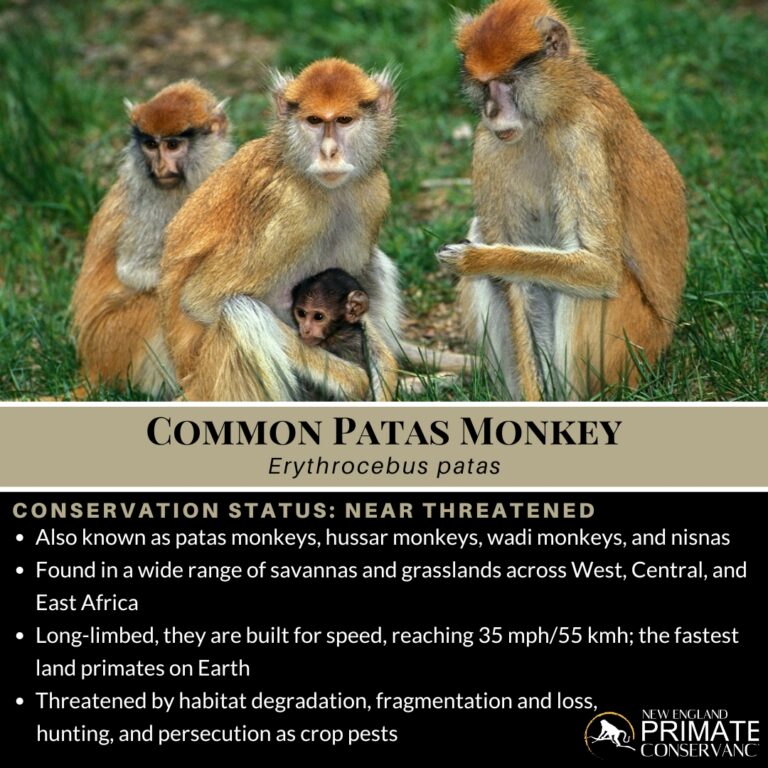
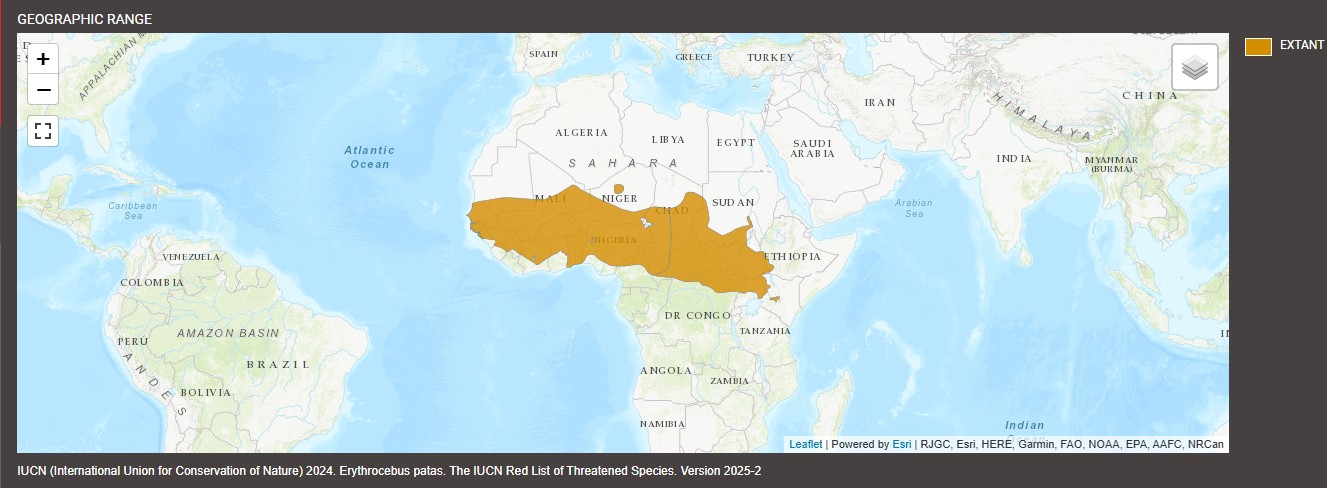
Common patas monkeys, also called hussar monkeys, wadi monkeys, and nisnas, are widely distributed across sub-Saharan Africa, ranging from Senegal and Mauritania in the west to parts of Ethiopia and Kenya in the east. Different populations occupy a broad band of dry habitats south of the Sahara Desert, including savannas, lightly wooded grasslands, thorn scrub, open acacia woodlands, and semi-arid steppes. They are especially well-adapted to environments with scattered trees and large open spaces where they can rely on speed and sharp eyesight to detect predators from a distance.
Unlike many primates that prefer dense forests, patas monkeys spend most of their lives on the ground. Open habitats allow them to travel efficiently in search of food, water, and sleeping sites. At night, groups typically retreat to trees or rocky outcrops where they can safely rest out of reach of many predators.
Temperatures in parts of their range regularly exceed 86°F (30°C), and some areas may receive less than 20 inches (50 cm) of rainfall annually, with a distinct wet and dry season. During the rainy season, grasses grow quickly, and food becomes more abundant. Fruits, seeds, insects, and young leaves and shoots are easier to find, allowing groups to spread out over larger areas. In the dry season, food and water become scarcer, and patas monkeys may travel greater distances each day while concentrating their activities near reliable water sources or patches of green vegetation.
Historically, there have been many debates surrounding the number of patas monkey species and subspecies. Taxonomists once considered all patas monkeys part of a single species with several subspecies. More recent genetic and anatomical research, however, suggests that some populations may represent distinct species. In 2025, the IUCN Red List published assessments for three species in the genus Erythrocebus: the common patas monkey (E. patas; Near Threatened), the southern patas monkey (E. baumstarki; Critically Endangered), and Heuglin’s patas monkey (E. poliophaeus; Data Deficient).
Size, Weight, and Lifespan
Common patas monkeys are sexually dimorphic, meaning males and females differ noticeably in size. Adult males are substantially larger and more heavily built than females, sometimes weighing nearly twice as much. Males typically weigh between 15 and 29 pounds (7-13 kg) and measure about 23-35 inches (58-87 cm) in body length, not including the tail. Females are smaller and more slender, usually weighing between 9 and 15 pounds (4-7 kg) and measuring approximately 19-26 inches (49-65 cm) long.
Both sexes possess exceptionally long tails that help provide balance while running and maneuvering through trees. The tail may measure even longer than the body itself, often reaching 28-35 inches (70-90 cm) in length.
In the wild, patas monkeys generally live around 15-20 years, though survival depends heavily on predator pressure, habitat quality, and access to food and water. Under rare, highly managed captive conditions—such as in well-resourced, professionally run institutions—some individuals have lived into their mid-20s.
Appearance
Common patas monkeys have a striking appearance that makes them easily recognizable. Their short fur is usually reddish-brown or chestnut across the back, giving rise to the nickname “red monkey” in some parts of Africa. The underside is lighter in color, often pale gray or white.
Their faces are especially distinctive. Patas monkeys have dark faces framed by white fur, along with a white mustache-like marking around the mouth and nose. Above the eyes, a darker brow gives them an expressive, almost serious look. Males often develop brighter coloration and more strongly defined facial features as they mature.
Their bodies are slim and athletic, with unusually long arms and legs adapted for life on the ground. Long lower legs help increase stride length while running, allowing patas monkeys to reach speeds of up to 34 miles per hour (55 kph) when escaping predators. Their fingers are relatively short and straight compared to those of more arboreal (tree-dwelling) monkeys, reflecting their more terrestrial (ground-dwelling) lifestyle.
Patas monkeys also have cheek pouches, which allow them to quickly gather food and store it temporarily while continuing to forage. This adaptation allows them to feed efficiently in open habitats where stopping too long in one place could leave them vulnerable to predators such as leopards, hyenas, and large birds of prey.

Diet
Common patas monkeys are primarily omnivores, meaning they consume both plants and animal matter, but their diet leans heavily towards plants. In the dry savannas and grasslands they inhabit, they often rely on whatever food is available seasonally, which means their menu can shift considerably throughout the year. Much of their diet consists of grasses, seeds, young shoots, fruits, and tree gums, particularly gums from Acacia trees. During wetter periods, when new plant growth is abundant, patas monkeys tend to consume more fresh vegetation and fruit. In drier months, when these foods are harder to find, they may depend more heavily on tough, fibrous resources such as seeds and underground plant parts. They also supplement their diet with insects such as ants, termites, and grasshoppers, which provide an important source of protein.
Their teeth and jaws are well-suited for this flexible feeding strategy. Patas monkeys have strong molars designed for grinding fibrous plant material, along with relatively sharp incisors that help them bite into tougher foods. This combination allows them to process a wide variety of textures, from soft fruit to coarse grasses. Their cheek pouches allow them to gather food quickly while watching for predators, then chew it later in a safer spot. Opportunistic feeding and dietary flexibility are critical adaptations allowing patas monkeys to survive in environments where food availability can change dramatically with the seasons.
Behavior and Lifestyle
Among the fastest of all terrestrial primates, common patas monkeys are highly adapted for life on the ground in open savanna habitats. Their long limbs and lean bodies allow them to travel efficiently across large distances while searching for food, and they rely heavily on speed to escape predators. Patas monkeys are primarily terrestrial (ground-dwelling), spending much of their day moving through grasslands and scattered woodland areas in search of insects, seeds, fruits, and other available resources.
Because food sources in their environment are often widely dispersed, patas monkeys maintain large home ranges. Typical groups range across approximately 8.9-20 square miles (23-52 square km), while bachelor males may travel through areas as large as 38.6 square miles (100 square km). Their daily activity budget reflects the demands of this lifestyle, with about 36.9% of their time spent foraging, 10.1% traveling, 39.5% resting, and 13.5% engaged in social behaviors.
Patas monkeys usually live in social groups consisting of one adult male, several females, and their offspring, although group composition can vary. These groups are highly mobile and often choose new sleeping sites each night. Living in open habitats also means remaining constantly alert to predators such as large cats, hyenas, and birds of prey. Group members frequently pause to scan their surroundings, and individuals often coordinate vigilance while others feed.
During the hottest parts of the day, patas monkeys spend time resting in shaded areas beneath trees or dense vegetation. Social grooming commonly occurs during these quieter periods and helps strengthen social bonds within the group. Overall, the patas monkey’s behavior reflects a balance of movement, vigilance, and cooperation that allows it to survive in wide, open landscapes where both resources and dangers are spread across great distances.
Patas monkeys are among the fastest primates on the ground, capable of reaching bursts of speed that help them escape predators in open savanna habitats.
Unlike many monkeys that rely heavily on dense forest cover for safety, patas monkeys often use their speed and vigilance in open landscapes, shaping much of their behavior and social structure.
Despite being terrestrial monkeys, meaning they spend most of their time on the ground versus in trees, patas monkeys have very long tails. Terrestrial monkeys often have short tails, but because they are so fast, their long tails act as rudders, allowing them to make sharp, quick turns.
Common patas monkeys live in social groups centered around related females and their offspring, usually with a single adult male accompanying the group. Group size can vary considerably, and single-male groups can range anywhere from 13 to 56 individuals. Females typically remain in their natal groups throughout life, forming stable matrilineal relationships that help maintain group cohesion. Males, on the other hand, usually disperse upon maturity and may live alone or move between groups.
Daily life depends heavily on coordination and cooperation. Patas monkeys travel together across large home ranges, and synchronized movement helps maintain safety in open savanna habitats where predators are common. Group members often engage in shared vigilance, with some individuals scanning for danger while others forage. Communication through vocalizations, posture, and movement allows the group to remain cohesive even while spread across open terrain.
Female social relationships are especially important within patas monkey societies. Grooming reinforces social bonds and helps reduce tension between individuals, and similarly, allomothering, in which females help care for infants that are not their own, also occurs. This cooperative infant care strengthens social connections among females and improves infant survival. Although female relationships are generally peaceful, dominance hierarchies guide social decisions, and conflicts among adult females can arise when competition over resources or social rank intensifies.
Adult males play a more variable role in group dynamics. Resident males are responsible for helping protect the group and maintaining access to breeding opportunities, but competition between males can be intense. During the breeding season, multimale influxes may occur when males from outside groups temporarily join or challenge established groups. Male turnover can create instability, aggression, and even infanticide. In some cases, newly arrived males kill infants that they did not sire. This increases the likelihood that females will reproduce again sooner, allowing the new male an opportunity to pass on his own genes.
Although patas monkeys are most often observed within their own social groups, they have occasionally been documented associating with other primate species, including green monkeys (Chlorocebus sabaeus) and Temminck’s red colobus (Piliocolobus badius temminckii). These rare interspecific associations may involve traveling, foraging, or play behavior and could provide additional protection from predators through increased group awareness. Overall, the social organization of patas monkeys reflects a balance of cooperation, competition, and flexibility that supports survival in challenging open-country environments.
Like many primates, patas monkeys rely on a combination of vocalizations, body language, facial expressions, and scent cues to remain connected across their expansive ranges and large groups. Because they often travel through open savanna habitats, clear and timely communication is especially important for keeping the group coordinated and alerting others to predators or rival patas monkey groups.
Vocal communication includes sharp alarm calls that are quickly produced when predators are detected. These calls are not one-size-fits-all, and can vary depending on the type of threat, helping group members respond appropriately. For example, different alarm calls may be used for aerial predators versus ground-based threats, triggering different responses such as running into dense vegetation or freezing in place.
Outside of alarm situations, patas monkeys also use softer contact calls to keep track of one another while traveling. Some of these calls are even quiet enough that they are difficult for humans to hear. These quieter vocalizations help maintain group cohesion when individuals are spread out while foraging.
Body language plays an equally important role. Raised eyebrows, stiff postures, and sudden changes in movement can signal alertness or tension, while relaxed postures and close physical proximity often indicate safety and social comfort. Grooming is another key communication tool, reinforcing social bonds and easing group tensions without the need for vocal signals.
Scent marking, while being less obvious to us, is also a critical component of patas monkey communication. It can help convey information about identity, reproductive status, and group boundaries, particularly in areas where home ranges of different groups overlap. Patas monkeys can scent mark through urination or through rubbing parts of their bodies on their surroundings.
Together, these communication methods form a flexible system that helps patas monkeys coordinate movement, avoid predators, and maintain social structure across large and often exposed landscapes.
Common patas monkeys typically breed seasonally, with births timed to coincide with periods of greater food availability. In many parts of their range, infants are born shortly before or during the rainy season, when fresh vegetation, fruits, and insects are more abundant, and conditions are better for raising young.
Patas monkey societies are usually centered around groups of females and their offspring. Adult males often live alone, in groups of bachelor males, or move between groups outside of the breeding season. During the mating season, however, a single adult male may temporarily join and travel with a group of females, defending access to mates from rival males. These males rely on their impressive speed, displays, and vocalizations to compete with one another, though serious physical conflicts are relatively uncommon.
After a gestation period, or pregnancy, of about five and a half months, females typically give birth to a single infant. Newborn patas monkeys are highly dependent on their mothers and spend their first weeks clinging tightly to their mother’s belly as she travels across the savanna. As they grow stronger and more curious, infants begin riding on their mother’s back and gradually start exploring nearby branches and play opportunities with other young monkeys.
Females are the primary caregivers, but infants are raised within a highly social environment. Young patas monkeys learn important survival skills by observing older group members, including how to recognize predators, locate food, and navigate complex social interactions. Play is a critical part of development, allowing juveniles to practice and hone climbing, chasing, and communication skills they will rely on as adults.
As they mature, females remain in their natal groups for life, strengthening long-term family bonds between related females. Males, on the other hand, usually leave their birth groups upon reaching maturity and may spend years living solitarily before gaining opportunities to reproduce.

Common patas monkeys play an important role in maintaining the health and balance of the savanna ecosystems they inhabit. As omnivores with a varied diet, they influence both plant and insect populations across their range. Because they spend much of their time on the ground and move through large home ranges, patas monkeys connect different parts of the ecosystem, carrying nutrients, seeds, and energy across the savanna as they travel.
One of their most important ecological roles is seed dispersal. After feeding on fruits and seeds, patas monkeys transport and deposit those seeds in new locations through their droppings, helping many plant species spread across the landscape. Because patas monkeys travel long distances each day, often much farther than many other African monkeys, they can disperse seeds over especially wide areas. Their feeding habits also help control insect populations. Patas monkeys consume large numbers of ants, termites, grasshoppers, beetles, and other invertebrates, which may help limit outbreaks of certain insect species in grassland and woodland habitats.
At the same time, patas monkeys are an important food source for predators such as leopards, lions, hyenas, jackals, martial eagles, and large snakes. Their presence helps support the broader food web of the African savanna. Their remarkable speed, sharp eyesight, and alarm-call systems have evolved in part because of the many predators that share their habitat.
Patas monkeys may also indirectly benefit other animals through their vigilance. Sometimes they are seen alongside antelope or birds, and the monkeys’ loud alarm calls can alert these nearby animals to danger as well as warn members of their own group.


The International Union for Conservation of Nature lists common patas monkeys as Near Threatened (IUCN, 2024), appearing on the IUCN Red List of Threatened Species.
Although they remain widespread across parts of sub-Saharan Africa, populations are declining in many areas due to ongoing habitat loss and fragmentation. The habitats common patas monkeys inhabit are disappearing as human populations expand. Large areas of natural savanna have been converted into farmland, grazing land for livestock, roads, settlements, and industrial developments. In some regions, trees are also cut for charcoal production and firewood, reducing the scattered woodland patches that patas monkeys rely on for shade, sleeping sites, and protection from predators.
Because patas monkeys spend much of their time on the ground, they are especially vulnerable to changes in the landscape. Expanding agriculture and fencing can disrupt their movement patterns and isolate groups from each other. In some areas, patas monkeys are also hunted for bushmeat or killed after raiding crops. This species also needs to drink water every day, so water shortages can be highly detrimental to their survival.
Climate change may pose an additional long-term threat. Increasing droughts and changing rainfall patterns across the Sahel and East Africa are altering the dry grassland habitats on which patas monkeys depend.
Common patas monkeys are listed in Appendix II of the Convention on International Trade in Endangered Species (CITES), an international agreement between governments whose goal is to ensure that international trade in specimens of wild animals and plants does not threaten their survival.
Common patas monkeys occur in several protected sites across Africa, including national parks, wildlife reserves, and community-managed conservation areas. These protected habitats help preserve the open savannas, grasslands, and woodland edges they depend on for food, shelter, and travel routes.
Conservation groups and local governments are also working to reduce habitat loss by promoting more sustainable farming and grazing practices. In some regions, community education programs help people learn about the importance of native wildlife and ecosystems, encouraging coexistence between humans and patas monkeys.
Researchers continue to study patas monkey populations throughout their range to improve our understanding of how habitat fragmentation, climate change, and human activity affect them. Because patas monkeys cover large distances and spend the majority of their time on the ground, tracking their movements can help scientists identify important wildlife corridors and areas in need of protection.
In parts of West and East Africa, patas monkeys benefit from broader conservation efforts aimed at protecting savanna ecosystems as a whole. Safeguarding these habitats not only supports patas monkeys but also many other species that share the same dry grassland environments.
- International Union for Conservation of Nature (IUCN). Erythrocebus patas. The IUCN Red List of Threatened Species. https://www.iucnredlist.org/species/174391079/205893855
- The Living Desert Zoo. For the first time ever… https://www.livingdesert.org/zoo-news/animal-care/for-the-first-time-ever/
- Kingdon, J. The Kingdon Field Guide to African Mammals (2020).
- Enstam, K. L., & Isbell, L. A. “Patas Monkey (Erythrocebus patas)” in Primates in Perspective (2013).
- Hall, K. R. L. (2009). “Behaviour and ecology of the wild Patas monkey, Erythrocebus patas, in Uganda”. Journal of Zoology.
- Rowe, N., & Myers, M. All the World’s Primates (2016).
- San Diego Zoo Wildlife Alliance Library. Patas monkey. https://ielc.libguides.com/sdzg/factsheets/patasmonkey/behavior-ecology
- Primate Info Net. (n.d.). Erythrocebus patas. University of Wisconsin–Madison. https://primate.wisc.edu/primate-info-net/pin-factsheets/pin-factsheet-patas-monkey/
- Encyclopaedia Britannica. Patas monkey. https://www.britannica.com/animal/patas-monkey
Written by Chloe Becker, May 2026