
Chacoan Titi, Plecturocebus pallescens
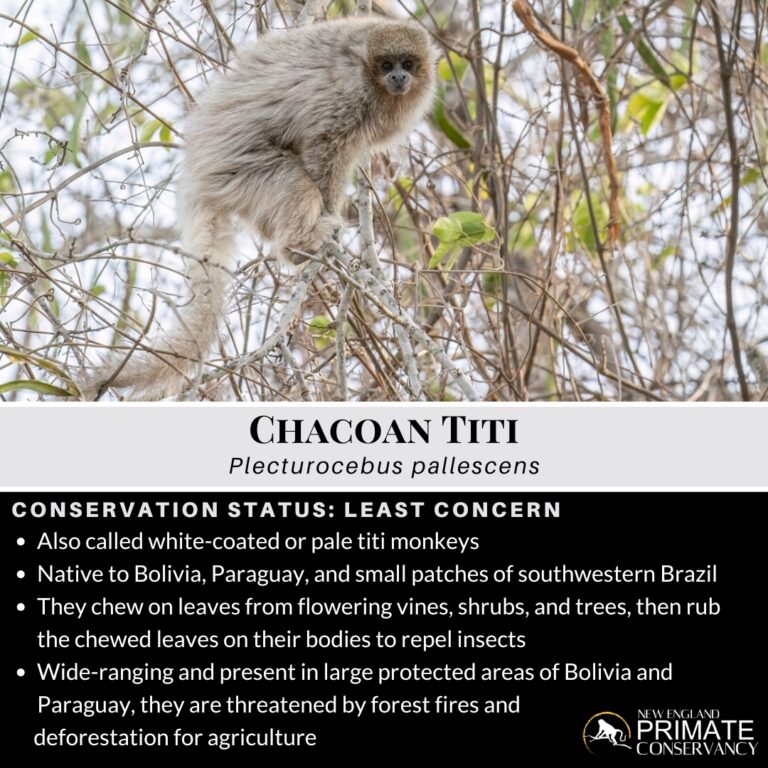
CHACOAN TITI
Plecturocebus pallescens
Geographic Distribution and Habitat
Chacoan titi monkeys, also known as white-coated or pale titi monkeys, are adorable little primates native to Latin America. They can be found south of the Amazon Rainforest across several countries.
These primates inhabit the dry forests of the Southern Santa Cruz Department in Bolivia, the Chaco region in Paraguay, as well as some forested areas in the Mato Grosso do Sul in Brazil. They thrive in the presence of tall trees, tree holes for shelter, and water-rich foods like succulent leaves and fruit. It is estimated that the species spreads across a territory of around 202,000 square miles (325,000 km²). This represents a decrease of 60,000 square miles (96,560 km²) from a previous evaluation and corresponds to an adjustment made for the Mato Grosso do Sul. Indeed, the populations that inhabited the Pantanal flooded forests are now confined to patches of the high ground forests at the Brazilian and Bolivian border.
In the 1990s, Chacoan titi monkeys were classified as a subspecies of the Bolivian gray titi monkey (Plecturocebus donacophilus). They were recognized as a distinct species in 2002. Molecular analyses conducted on titi monkeys and published in 2016 confirmed the latter classification.

Size, Weight, and Lifespan
Both male and female Chacoan titi monkeys are rather small, with an average weight of 28 to 45 ounces (800-1,300 g) and a head-to-body length of approximately 13 inches (33 cm). The tail is typically longer than their body.
They generally have a lifespan of 20 years in the wild and can live over 25 years in expert captive care.
Appearance
Not only are male and female Chacoan titi monkeys about the same size, but they also share the same coloration. With a body covered in a thick cream color pelage. The fur is especially thick and bushy around the shoulders and the center of the body. The hair on their heads perfectly frames their little faces. Their big, round, brown eyes face forward, an indication that they have three-dimensional depth perception, which is very useful when traveling between branches.
Their nose is flat with nostrils facing sideways—a characteristic of South American monkeys. The term for a flat nose with this type of nostrils is “platyrrhine”. The area around their mouth and nose is hairless and a darker color than the rest of the body. These little monkeys have 36 teeth, and the canines of both females and males are similar in size.
Their long tail is not prehensile (meaning they can’t grasp objects with it), but helps them keep their balance while traveling and standing on branches. It is entirely covered in fur, the same color as the rest of the body, whereas the fur on their feet and hands appears greyish.
Diet
The diet of the Chacoan titi monkeys consists primarily of fruit and leaves, but they also consume seeds, flowers, and insects. How much of each of the food items they ingest greatly depends on where they live and seasonal conditions.
Leaves of the Chilean mesquite, Chilean algarrobo, and cupesí trees, as well as those of the old fustic, dyer’s mulberry, taiúva trees, and the Durat’s Air Plant, provide food all year-round. Note that titi monkey species are known to rub their entire bodies with chewed leaves, which scientists think is a way of warding off insects. This applies to the Chacoan titi monkeys as well.
When foraging for fruit, titi monkeys spend more time traveling than when they eat leaves, which are readily available. Like all fruit-eating primates, their brains have evolved to give them the capacity to map out the forest and remember where and when to find fruit. One of their favorites is the small mistol fruit, which is yellow when unripe, purple when ripe, and tastes a bit like sugarcane. Another favorite is the brown ebony tree fruit, which has high nutritional value and anti-inflammatory properties.
In times of scarcity, they may supplement their diet with the occasional insect as well as the large, colorful flowers of silk floss trees and the white flowers of trumpet vines.
Behavior and Lifestyle
Chacoan titi monkeys are diurnal (most active during the day) and arboreal. They are quadrupedal, which means they travel using all four limbs to make their way through the canopy.
They live in small family groups composed of a bonded pair and their offspring. Because these monkeys are monogamous, in 2017, the California National Primate Research Center (CNPRC) used them as subjects when they conducted studies to understand the neurobiology of social bonding. By separating bonded pairs, scientists were able to show that titi monkey behavior betrayed emotions similar to “jealousy” in humans. Hormonal changes in both males and females indicated that stress levels correlated with the amount of time they spent apart from each other. Heightened activity in an area of the brain associated with aggressive behavior indicated that titi monkeys are intent on preserving their relationships. This explains why the bonded pair claim their territory by joining in a duet every morning between 6 and 9 AM to let outsiders know who they are and where they are. The duet also reinforces the bonds between both partners.
The Chacoan titi monkey is named after the Chaco region in South America.
Chacoan titi monkey fathers are fully engaged in the rearing of their offspring.
Chacoan titi monkeys spend the early morning hours foraging for food and travel approximately 0.3–1 mi (0.5–1.5 km) every day. Their home ranges between 4 and 74 acres (1.5-30 ha). They take several breaks throughout the day to rest and play. Grooming is a social activity that helps keep the fur of these monkeys clean and parasite-free, but it is also the glue that ties all family members together.
Titi monkeys are one of the rare species in which both parents take care of the young.
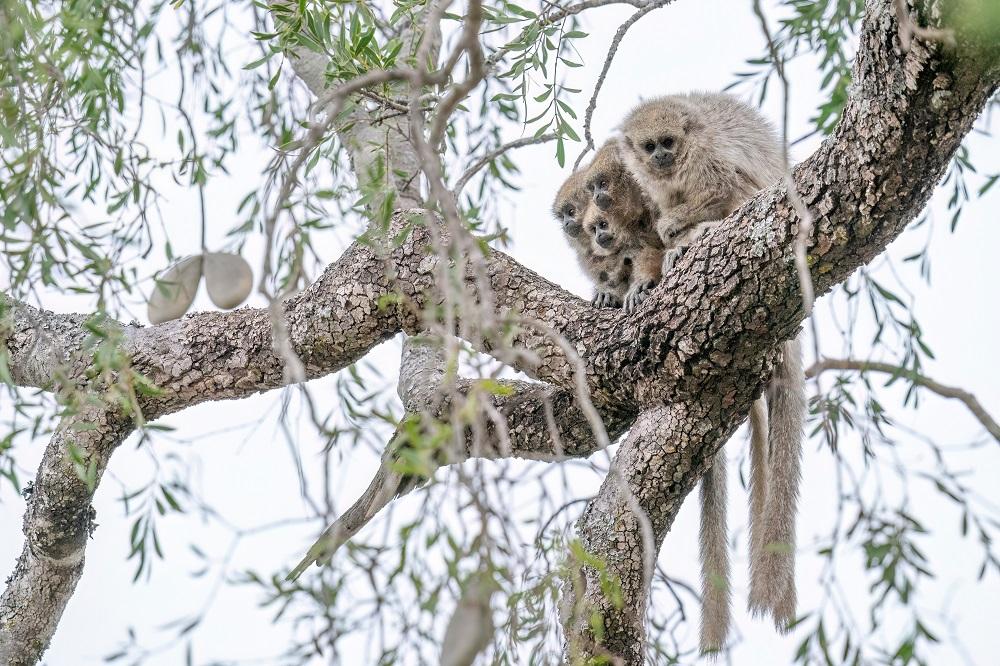
Around 5:30 PM, the family travels back to their sleeping site. They settle in trees with dense foliage to hide from predators. They sleep side by side, and it is not unusual to see two monkeys with their tails entwined—the equivalent of hugging or holding hands in humans.
Although territorial, titi monkeys are not considered aggressive. When challenged, they typically resolve conflicts through vocalizations and displays, and rarely resort to physical force.
Chacoan titi monkeys communicate primarily through vocalizations. The air sac in their larynx allows them to produce loud, long-range advertising calls in the form of solos, duets and choruses. These generally occur when atmospheric conditions are optimal for sound transmission (like early morning). Choruses are heard when several neighboring bonded pairs participate in the singing.
Duets are like a dialogue; one partner starts, and the other joins in. The patterns are not random. For Chacoan titi monkeys, the male initiates, and it all starts with a few high-pitched syllables, occasionally with moans. The sequences are short (~5 seconds) and the male calls are more numerous. Males and females each contribute a sequence of pants, hoots, bellows and arches, and they synchronize their calls. Duets may last five minutes or more without interruption. However, sometimes they end abruptly before resuming a few seconds later. The duet is over when one of the mates stops responding. Recent studies on titi monkey vocalizations revealed that the median frequency of duets for Chacoan titi monkeys was measured at 947.5 Hz.
Low-pitched vocalizations are used to communicate with family members. High-pitched calls are emitted while foraging, if the monkeys are agitated, or if they find themselves in danger.
Like all primates, vocalizations serve different purposes depending on circumstances—such as affiliation, distress, play, or intimidation to deter intruders. Predator alarm calls are specific to the type of predators detected and vary in both duration and frequency.
Chacoan titi monkeys live in small monogamous groups. The adult male and female are tightly bonded and depend on each other to raise a family. However, each plays a very specific role. Females start reproducing around the age of 4. They give birth once a year to one altricial (i.e., helpless) baby after a gestation period of 160 to 170 days. The births typically occur at the end of the dry season and at the beginning of the wet season when food is most abundant. Newborns are grey and exhibit the same color as their parents by the time they reach their first birthday.
Titi monkey fathers are great caregivers. One week after birth, mothers stop carrying their infants on their backs. Fathers take over this duty for 6 months, until the babies are able to move independently. They do it so moms can forage and eat sufficiently to produce nutritious milk. Baby titi monkeys are ravenous indeed and need constant feeding. Besides nursing for 8 months until the young are weaned, mothers provide little parental care. Fathers do all the work. They keep their babies warm, clean them, socialize them, and teach them the ways of titi monkeys while protecting them from predators. Actually, recent studies revealed that young titi monkeys experience more stress when they are separated from their fathers than when they are separated from their mothers.
Once they reach sexual maturity at 2-3 1/2 years old, both males and females leave their family groups to form their own.
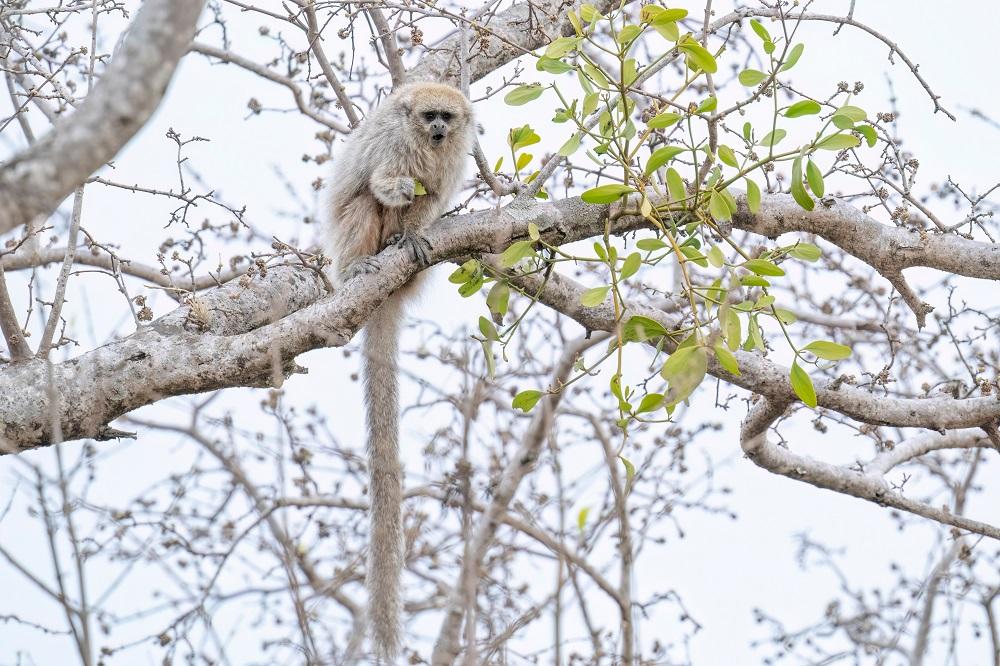
Chacoan titi monkeys contribute to the health of the forests in which they live by spreading seeds through their feces, thereby promoting new plant growth in various areas. By eating leaves and insects, they also help with tree pruning and insect population control.
As prey, they provide food to raptors, snakes, big cats, and other carnivorous mammals.


The International Union for Conservation of Nature lists the Chacoan titi monkey as Least Concern (IUCN, 2021), appearing on the IUCN Red List of Threatened Species.
To date, scientists consider the species is not in immediate danger because it is present in large protected areas. However, its status may need to be revised to Near Threatened in the future if the rate of deforestation for agriculture and cattle ranching in the Chaco region of Paraguay and Bolivia progresses more rapidly than anticipated.
Other threats to the species include the illegal pet trade and hunting. Chacoan titi monkeys may be captured in Paraguay to be sold as pets, and they are occasionally hunted by the Izoceno indigenous people in Kaa-Iya del Gran Chaco National Park.
Their natural predators include raptors, snakes, big cats and other carnivorous mammals.
The Chacoan titi monkey is listed in Appendix II of the Convention on International Trade in Endangered Species (CITES), an international agreement between governments whose goal is to ensure that international trade in specimens of wild animals and plants does not threaten their survival.
Chacoan titi monkeys living in national parks are protected. They are present in three: the Rio Negro, Chovoreca, and Defensores del Chaco—as well as the Fortin Patria Private Reserve, the Paraguayan Pantanal Reserve, and the protected areas of Kaa-Iya, San Matías, and Otuquis.
However, those living in the Humid Chaco—an area of tropical grasslands, savannas, and shrublands—are not. The Humid Chaco, located on the eastern part of the Gran Chaco, borders the Paraguay River and stretches across eastern Paraguay, northeastern Argentina, and a small portion of southeastern Brazil. It is characterized by a subtropical climate with high annual rainfalls and warm temperatures that favor a more diverse and dense vegetation than the Dry Chaco, but it is facing many environmental challenges, especially deforestation and habitat fragmentation due to hydroelectricity projects, agriculture, and cattle ranching. The construction of dams negatively impacts natural flooding patterns, and the monoculture of exotic crops like soybeans reduces biodiversity.
Conservation efforts are paramount not only for wildlife but also for human populations in the region. Paraguay has one of the highest rates of deforestation in Latin America, and there aren’t any local primatology research resources. Universidad Nacional de Asunción is the only one to offer a degree in biology. Postgraduate students have no option but to finish their studies abroad and rarely return home because of a lack of career opportunities in the field. The only Paraguayan organization that focuses on primate conservation is the NGO Fundación Para La Tierra (PLT), which focuses on capuchin and howler monkeys. Because the existing data on Paraguayan primates is obsolete, in 2018, National Geographic funded the training of forest guards across the country to spot and report the GPS location of primates they encounter. Fortunately, projects aimed at solving the climate crisis can play an important role in primate conservation. One such project is the Chaco Viv, which is six times larger than any previous REDD+ (Reducing Emissions from Deforestation and Forest Degradation) initiatives in the country. Designed a couple of years ago, it addresses all of the United Nations Sustainable Development Goals and operates under the philosophy of “people first”. The program focuses on the sustainable management of forests, the improvement of ecosystems, and the protection of endangered and endemic species.
As for Brazil, in 2023, the governor of Mato Grosso do Sul sanctioned the Pantanal Law, which promotes the conservation, protection, restoration, and sustainable exploitation of the biome in the state. It also outlines specific rules for agriculture, indicating that a great portion of rural areas must preserve forests and forbids crops of soybeans and sugar cane for commercial purposes.
Surely such initiatives, if successful, can only benefit the Chacon titi monkeys and other species sharing the same living environment.
- IUCN Redlist (2021)
- Distribution, Habitat and Status of the white-coated titi monkey (Callicebus pallescens) in the Chaco – Chiquitano Forests of Santa Cruz, Boliva – Damián I. Rumiz
- An Animal Model for Mammalian Attachment: Infant Titi Monkey (Plecturocebus cupreus) Attachment Behavior Is Associated With Their Social Behavior as Adults – Logan E Savidge, Karen L Bales
- Duetting Patterns of Titi Monkeys (Primates, Pitheciidae: Callicebinae) and Relationships with Phylogeny – Patrice Adret, Kimberly A. Dingess, Christini B. Caselli, Jan Vermeer, Jesus Martínez, Jossy C. Luna Amancio, Silvy M. van Kuijk, Lucero M. Hernani Lineros, Robert B. Wallace, Eduardo Fernandez-Duque and Anthony Di Fiore
- Field Notes: My Time with Titis – David B. Wood, edited by Cassidy Cooper
- The Challenges of Primate Research and Conservation in Paraguay – Rebecca L. Smith, Jorge Damián Ayala Santacruz, and Paul Smith
- Paraguay’s First Primatology and Environmental Education Training Course for Forest Guards – Rebecca L. Smith and Jorge Damián Ayala Santacruz
- Which monkey is less aggressive? – James Murray
- Mapping Monogamy, Jealousy in the Monkey Mind – Uncovering the Neurobiology of Social Bonding in a Monogamous Primate – Carlos Villatoro
- Mamíferos Medianos y Grandes de Bolivia – Capitulo 12 – Pitheciidae – Jesús Martínez y Robert B. Wallace
- https://nationalzoo.si.edu/animals/titi-monkey
- https://lacgeo.com/humid-chaco-ecoregion
- https://chacovivo.com – New REDD+ Paraguayan project underway in the Gran Chaco is the largest in Paraguay thus far – Chaco Vivo
- New state law protects pantanal biome in Mato Grosso do Sul | Agência Brasil – Luciano Nascimento
Written by Sylvie Abrams, Dec 2025