
Brumback’s Night Monkey, Aotus brumbacki
BRUMBACK'S NIGHT MONKEY
Aotus brumbacki
Geographic Distribution and Habitat
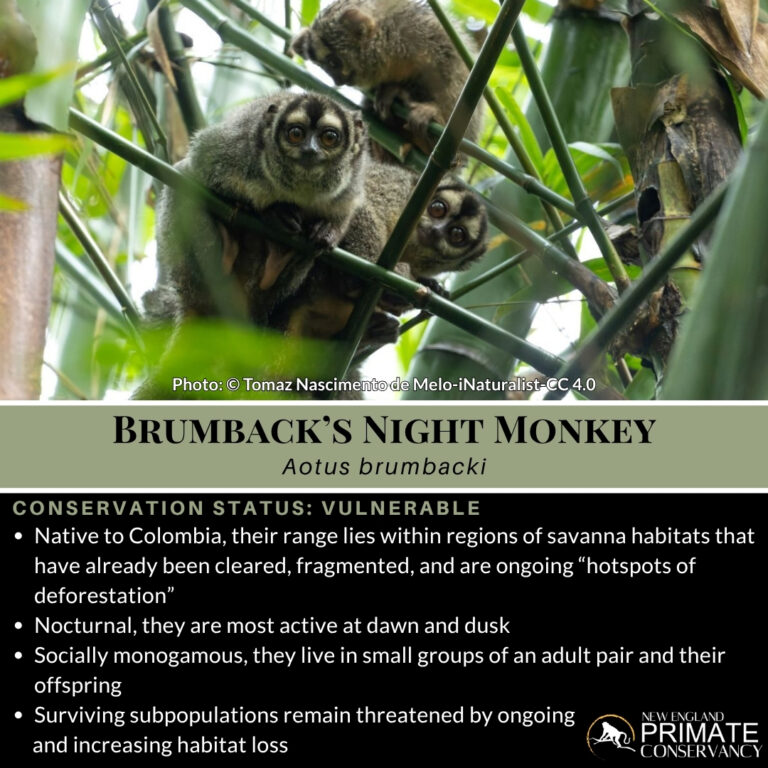
The Brumback’s night monkey, also referred to as owl monkey or douroucouli, is only found in Colombia. Their range is not well defined, as only a handful of Brumback’s night monkey populations have been recorded. From what we can tell, their range falls between the Arauca and Guaviare Rivers, and possibly even into east central Colombia to the north of the Guaviare River. They are mostly found in a range of lowland habitats, including savannas, gallery forests that grow between savanna and water sources, rainforests, and moriche palm swamps. Many of the forests the Brumback’s night monkey is found in have been fragmented due to ongoing deforestation, meaning many populations may be separated from each other.
When researchers first began studying night monkeys, they described nine species between two groups: the gray-necked group (which includes the Brumback’s night monkey), all of which resided north of the Amazon River, and the red-necked group, south of the Amazon River. The groups were considered distinct based on neck coloration and some genetic factors, including susceptibility to malaria. Further investigations on night monkey taxonomy focused on skull measurements and fur color, resulting in Brumback’s night monkey being lumped in with the visually similar Spix’s night monkey, along with the Colombian night monkey, which Brumback’s night monkey was later considered a subspecies of. As researchers continued to try to figure out where one night monkey species began and the other ended, they turned back to genetics, which revealed that there were possibly up to eleven different species of night monkey, including Brumback’s night monkey as a distinct species.

Size, Weight, and Lifespan
We only have recorded weights for two Brumback’s night monkey individuals. One individual of undetermined sex weighed in at 1.93 pounds (0.88 kg), and the other, a female, weighed 1 pound (0.455 kg)—although the researchers weighing her did not believe she was fully grown.
Brumback’s night monkey likely falls in the same size range as the closely related Colombian night monkey and Spix’s night monkey, so we can expect they’ll have a head to body length of 12.05–13.39 inches (30.6–45.0 cm), a tail length of about 12.20–18.50 inches (31.0–47.0 cm), and weigh around 1.54–2.03 pounds (0.7 – 0.92 kg).
The lifespan of Brumback’s night monkey is not currently known.
Appearance
Like the owls they are sometimes compared to, night monkeys have big, dark brown eyes that help them pick up even the smallest bit of light. Above their eyes are two thick white markings similar to eyebrows. Their faces are framed by two black lines starting from their mouth and wrapping up to the back of their head, giving them a clown-like appearance. The fur on their necks, back, and on top of their arms and legs is light gray. This color extends into their tail and becomes darker towards the end. The fur on their bellies is a pale yellow or orange-ish color.

Diet
Night monkeys are primarily frugivores, meaning they mostly like to eat fruit. They seem to especially enjoy palm fruits as well as fruits in the mulberry family. Night monkeys are known to sneak into plantations and eat crops. Leaves and flowers also make up a part of the night monkey’s diet, although these likely act as the understudies for fruit in between fruiting seasons. In total, scientists have observed the Brumback’s night monkey feeding on 41 different plant species.
While insects are a popular snack for night monkeys, scientists have not been able to determine exactly how reliant night monkeys are on insects to maintain their balanced diet. Night monkeys have been observed eating moths, beetles, spiders, and even a cicada or two.
Behavior and Lifestyle
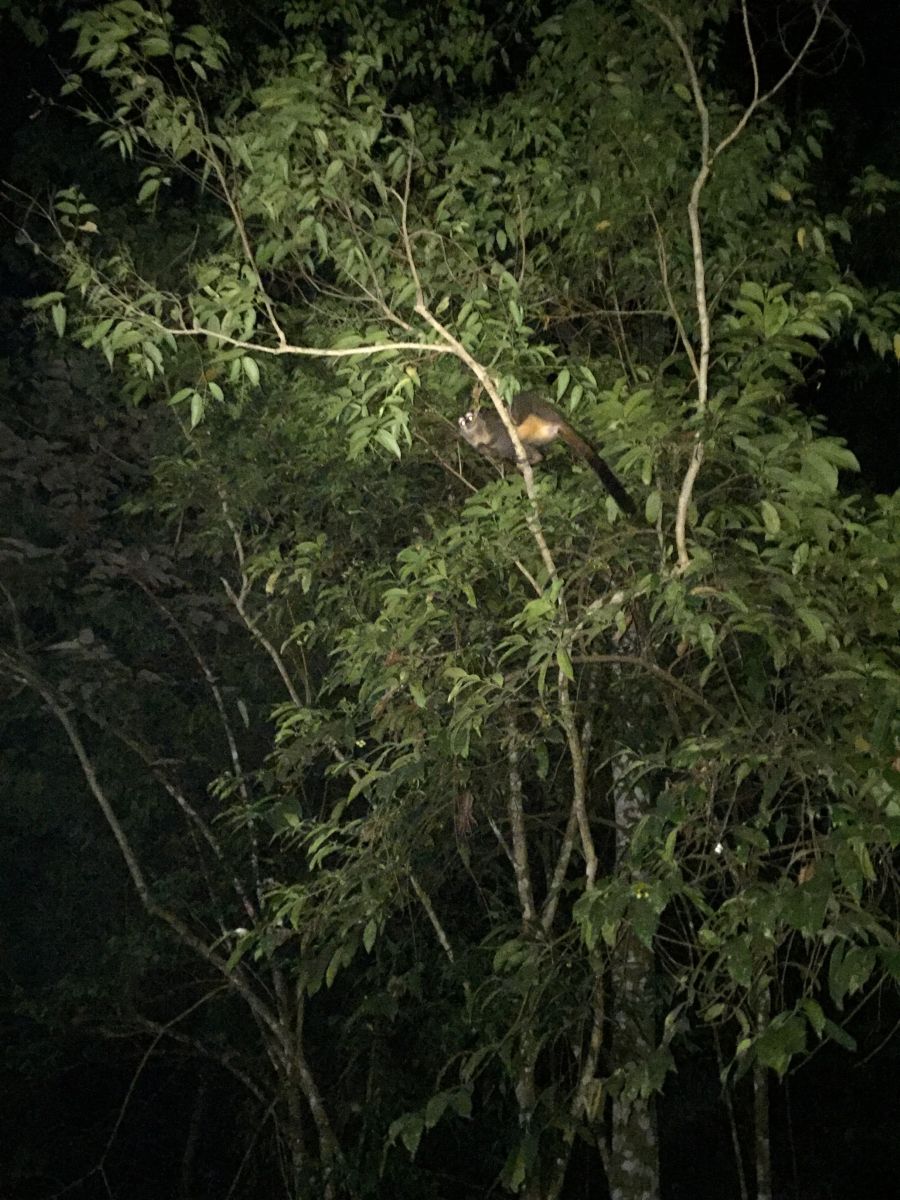
As indicated by their name, night monkeys are nocturnal. They are active throughout the night but mostly during dawn, right before going to bed, and at dusk, just after they wake up. They are arboreal and spend most of their time during the night climbing, running, and leaping through the forest canopy.
Groups are territorial and will defend their home ranges from intruding night monkeys looking to steal a snack or even a mate. When groups encounter each other at territory edges, they will vocalize warnings and even chase outside group members.
The genus name for night monkeys, Aotus—derived from the Ancient Greek words for “earless”—refers to their seeming lack of ears, which in actuality are hidden under their dense fur.
Night monkeys typically live in small groups of two to six members, including one mated pair (meaning one breeding male and one breeding female), and their infant or subadult kids. Both males and females will stay with their parents until they reach maturity and leave to establish a family of their own. Researchers have also observed individual night monkeys roaming on their own and believe that they were likely in-between groups.
Brumback’s night monkey has an estimated home range size of 43.24 acres (17.5 ha), of which they’ll typically roam 0.207 acres (0.084 ha) in a night. In other night monkey species, scientists have found that the amount of moonlight influences how far night monkeys will travel in a night. During the full moon, night monkeys travel farther, whereas during the new moon, when there is no moonlight, they’ll typically stay closer to their sleeping site.
When the sun starts to rise, night monkeys will tuck in for the day in the hollows of dead or living trees, as well as in tangled vines.
Vocalizations are one of the main ways night monkeys communicate with each other. During territorial encounters, rival groups will give resonating whoops to tell each other to back off. Hoots are used to communicate between individuals who are far away from each other. All night monkeys in earshot of a hoot will respond, even if they’re from different species.
Like many nocturnal primates, olfactory communication (i.e. smell) is an important tactic for getting information across under the dark of night. Night monkeys will scent mark either by peeing or rubbing special scent glands on a surface or their mate’s fur. Scientists think that olfactory signals can communicate the identity of the individual that left them, including their sex and even what family they came from.
Similar to other night monkeys, Brumback’s night monkeys are socially monogamous. While considered monogamous in that they will have one mate at a time, night monkeys aren’t necessarily the commitment type when it comes to relationships. An outside member of either sex may kick out the corresponding member of the resident pair and replace them. It’s not yet clear exactly how often this happens, but from night monkey species that have had more long-term studies, pairs seem to replace a mate every few years or so.
From what we know about other night monkeys, they typically reach sexual maturity at 2–4 years in males, and between 3-4 years in females, depending on the species and environmental factors, so we can guess that Brumback’s night monkey likely also follows this pattern.
Generally, female night monkeys have a reproductive cycle that lasts 13-25 days, and gestation (pregnancy) lasts 117–119 days. Females typically have one baby at a time. During the first two weeks of life, baby night monkeys will stay clinging to their mother. After this time, dad takes over as the primary caretaker, not only carrying the infant most of the time but also playing with, grooming, and sharing food with the youngster. Night monkeys might just hold the title of “best dad” in the world of primates. Even as subadults, night monkeys will spend more time hanging out with dad while still in their birth group than with mom.
While the exact ecological role the Brumback’s night monkey plays has yet to be studied, we can guess how they help out in their ecosystem with the information we do have. Because they mostly eat fruit, night monkeys likely act as seed dispersers by either spitting out or passing the seeds from the fruit they eat, helping the seeds to spread farther than they could just dropping from the tree. This helps maintain the plant diversity of the forest, and helps the night monkeys make sure they’ll have food for generations to come without even realizing it.


The Brumback’s night monkey is classified as Vulnerable by the International Union for Conservation of Nature (IUCN, 2020), appearing on the IUCN Red List of Threatened Species. It is suspected that, as of 2020, the population had decreased by 30% in the previous 24 years. This decline is expected to continue. Between the years 2000 and 2006, more than 70% of the Brumback’s night monkey’s habitat had been lost to deforestation.
Brumback’s night monkey is threatened primarily by deforestation—in fact, the area they are found in is recognized as a “hotspot” for deforestation, mainly due to oil palm plantations, cattle pasture, extraction of oil, and mining.
Colombia’s history of armed conflict has also driven habitat destruction across the region. During times of instability, illegal harvesting of natural resources, such as farming coca, mining, logging, and even wildlife trafficking, becomes a staple sources of income. While conflict in Colombia has settled in more recent years, there is still a chance that the exploitation of natural resources, both legally and illegally, will continue in the wake of conflict if not handled appropriately.
Brumback’s night monkeys are listed in Appendix II of the Convention on International Trade in Endangered Species (CITES), an international agreement between governments whose goal is to ensure that international trade in specimens of wild animals and plants does not threaten their survival.
Most known subpopulations of Brumback’s night monkey are present in protected areas, including Sierraní de la Macarena National Park, Tiniqua National Park, El Tuparro Natural National Park, and El Cocuy National Park.
While there are currently no specific efforts to protect the Brumback’s night monkey, scientists call for continued research on the species to help us better understand their conservation needs. Education of local communities on practices that protect the forest, policies, and programs that ensure locals have stable income without depleting natural resources are also key to protecting Brumback’s night monkey and the other animals they share the forest with.
- Carretero, X., Guzman-Caro, D. & Stevenson, P.R. 2020. Aotus brumbacki. The IUCN Red List of Threatened Species 2020: e.T39915A17923405. Accessed on 26 October 2025.
- Vargas-Gomez, M., Gomez-Castañeda, F. S., Niño-Moreno, M., & Carretero, X. (2023). Fruit consumption by the endemic Brumback Night Monkey (Aotus brumbacki, Primates, Aotidae) in forest fragments of Colombian Llanos. Mammalogy Notes, 9(2), 394-394.
- Carretero, X., & Ortiz-Moreno, M. L. (2024). Nest sites of Brumback night monkey (Aotus brumbacki, Primates, Aotidae) in fragmented landscapes of Colombian Llanos. Mammalogy Notes, 10(2), 465-465.
- Morales, L. (2017). Peace and environmental protection in Colombia. Proposals for sustainable rural development. Inter-American Dialogue, 5.
- Defler, T. R., & Bueno, M. L. (2007). Aotus diversity and the species problem. Primate Conservation, 22(1), 55-70.
- Fernandez-Duque, E. (2011). Callitrichines Aotinae Social Monogamy in the Only Nocturnal Anthropoid. In Primates in Perspective (second, pp. 140-154). Oxford University.
- Eduardo Fernandez-Duque, Anthony Di Fiore. Aotus, vociferans,. © All the World’s Primates. N Rowe, M Myers, eds. (alltheworldsprimates.org) Downloaded 11/21/2025
- Eduardo Fernandez-Duque. Aotus, lemurinus, . © All the World’s Primates. N Rowe, M Myers, eds. (alltheworldsprimates.org) Downloaded 11/21/2025
- Eduardo Fernandez-Duque. Aotus, brumbacki,. © All the World’s Primates. N Rowe, M Myers, eds. (alltheworldsprimates.org) Downloaded 11/21/2025
Written by Lina Rademacher, Nov 2025