
Bicolored Banded Langur, Presbytis bicolor
BICOLORED BANDED LANGUR
Presbytis bicolor
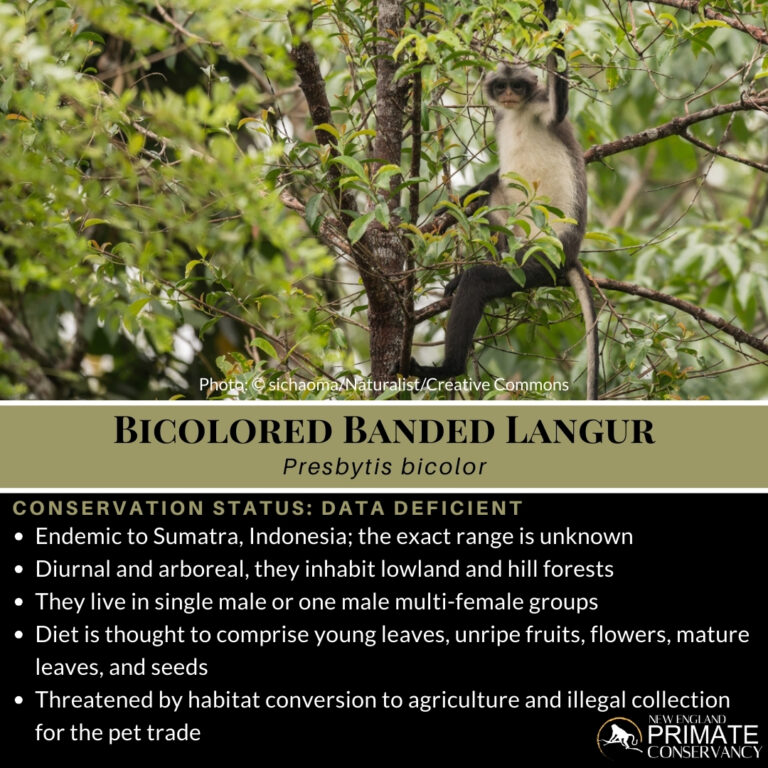
Geographic Distribution and Habitat
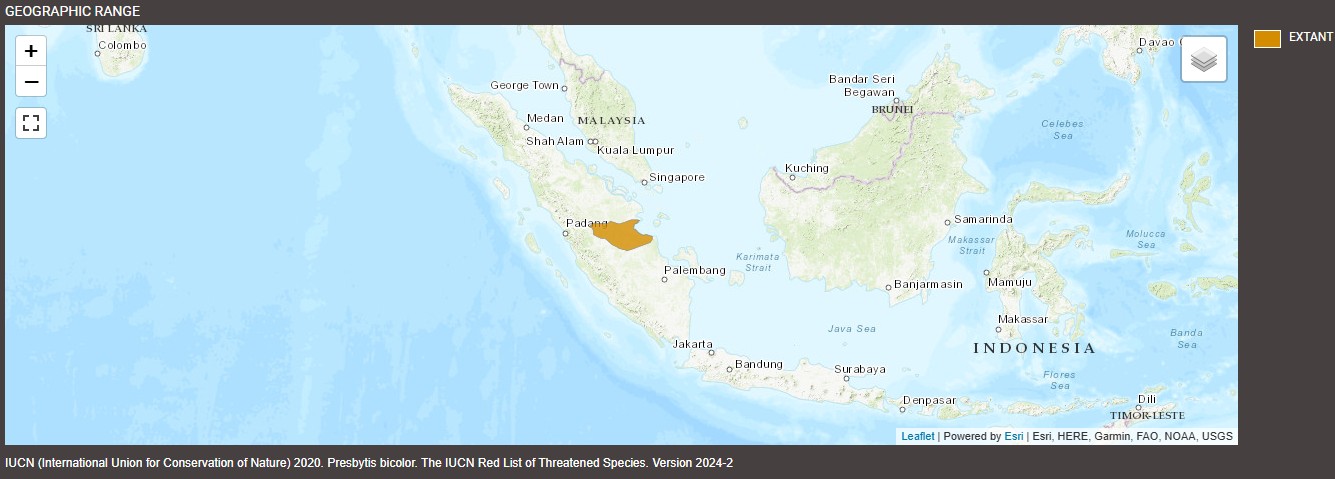
The known populations of bicolored banded langurs have been observed in eastern and central Sumatra between the Indragiri River in the north and the Batang Hari River in the south.
Sumatra is the largest of the Sunda islands in Indonesia, and the sixth-largest island in the world. It has lost almost half (30 million acres/12 million hectares) of its rainforest since the 1990s, and unfortunately, the forest habitat is especially degraded in the eastern portion of the island.
The Indragiri River flows in the region of Riau and empties into the Strait of Malacca. The annual average temperature in the eastern portion of the island is 73°F (23°C), with February being the warmest month at 75°F (24°C) and August the coldest at 72°F (22°C). The average annual rainfall is 108.5 inches (2757 mm), with November being the wettest month.
The Batang Hari River is the longest in Sumatra. It originates in the Minangkabau Highlands in West Sumatra Province and flows through Jambi Province on the east coast of Sumatra. The river is used by local human inhabitants for fishing, transportation, mining, and personal hygiene. The annual average temperature in the area is 73°F (23°C), with April being the warmest month at 75°F (24°C) and January the coldest at 72°F (22°C). The average annual rainfall is 94-125 inches (238.3–318.3 cm), with December being the wettest month.
Bicolored banded langurs belong in the Presbytis genus, one of the most diverse genera of Asia’s monkeys. The classification relies on behavioral, anatomical characteristics, and coat coloration. To date, only one molecular genetic study has been conducted, and all attempts at reconstructing the evolutionary history of the genus have yielded contradictory results. Scientists are therefore unclear on the origins of the bicolored banded langurs, but they assume that the species is referable to the Raffles’ banded langur.
Size, Weight, and Lifespan
Although no specific information is available, the body length of the bicolored banded langurs is probably anywhere between 17 and 24 inches (43 to 61 cm), and their weight is between 11 and 18 pounds (6 and 8 kg). Their tail is as long as their body.
Their lifespan can be estimated between 15 and 18 years in the wild.
Appearance
Bicolored banded langurs are gangly-looking with long limbs. Their legs are strong with muscular thighs and are a perfect adaptation for leaping from branch to branch in the canopy. Their hands and feet have long, skinny digits that they use to hold onto branches. They have abbreviated thumbs that facilitate travel in the canopy. Unlike their African colobine (leaf-eating monkey) counterparts, who do not have thumbs, langurs’ thumbs are useful for grabbing the foods available in their ecosystems while being short enough not to interfere with their nimble, arboreal maneuvers.
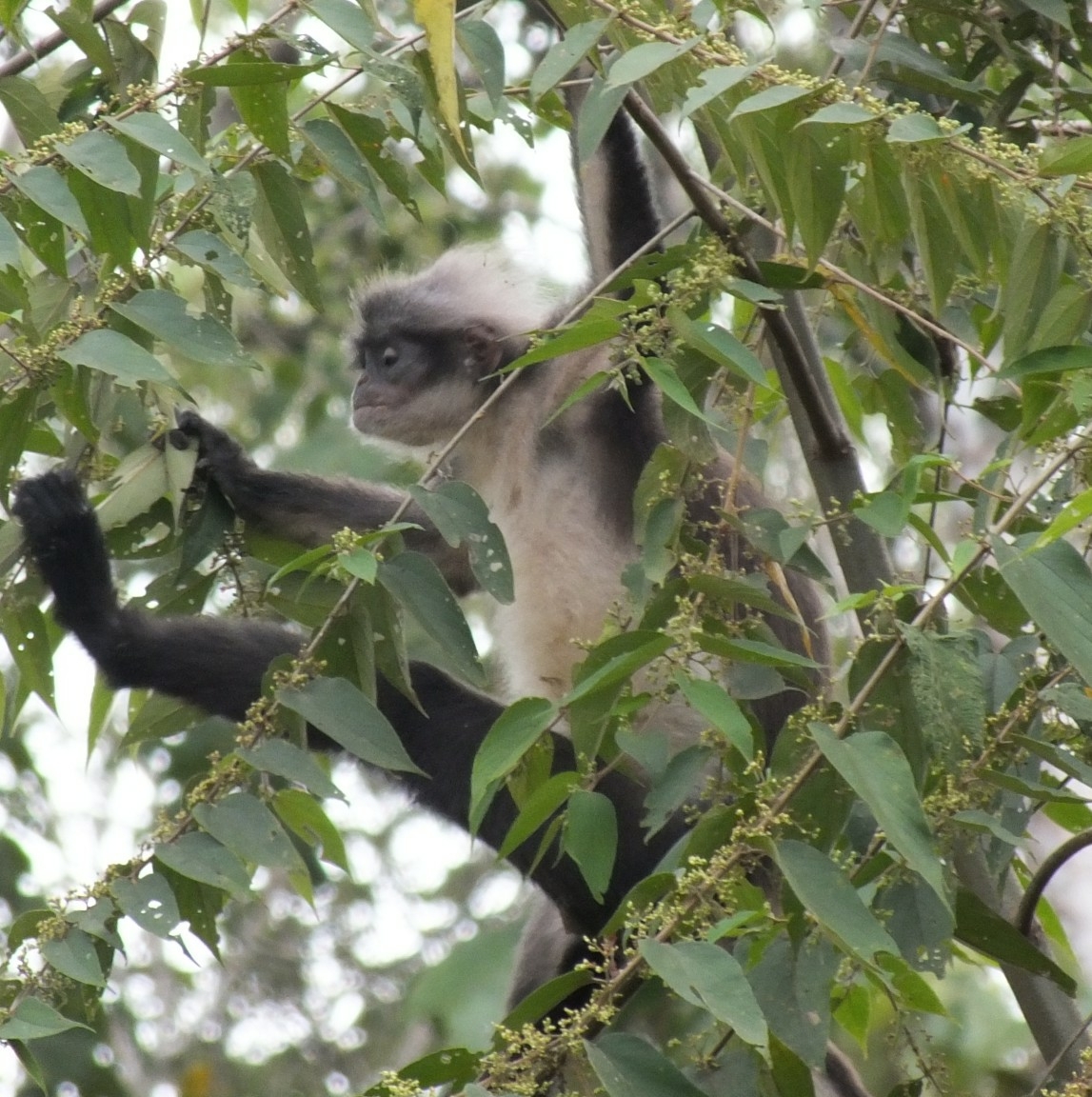
As their name indicates, their fur is of two colors—sandy dust grey for the back, head, and limbs, and off white for the belly. The light color fur also forms like a band on the chest and inner thighs—hence the use of the term “banded”.
Their triangular face looks as if framed by soft fur. The dark grey top portion of their face resembles a mask behind which beautiful, almond-shaped eyes look at the world. Their nose and mouth appear as if delicately drawn in charcoal on a light pink triangle. Their tail is very long and covered in fur; they can use it to keep their balance while jumping from tree to tree.
Like all langurs, they have ischial callosities—pads with no nerve endings on the rear ends. These pads are an adaptation that helps them sit comfortably on thin branches for long periods of time without falling.
Diet
Based on the information available on similar langur species, it is safe to infer that the bicolored banded langurs eat a diet composed of young leaves, unripe fruit, flowers, mature leaves, and seeds.
Leaves constitute the majority of their diet; they are rich in protein but difficult to digest. As usual, nature provided these primates with the perfect physiological adaptations: high-cusped teeth with long shearing blades to efficiently chew foliage, and a sacculated stomach (divided into chambers) to ferment and break down cellulose so all the nutrients can be absorbed efficiently.
Because the forests in which these animals live are exploited by humans, it would be interesting to know if (like Raffles’ banded langurs in the Riau region) bicolored-banded langurs are able to adapt and eat foliage and fruit from non-native rubber trees. Such information is not currently available, but it would be valuable to understand the species’ survival odds in the face of deforestation and habitat degradation.
Behavior and Lifestyle
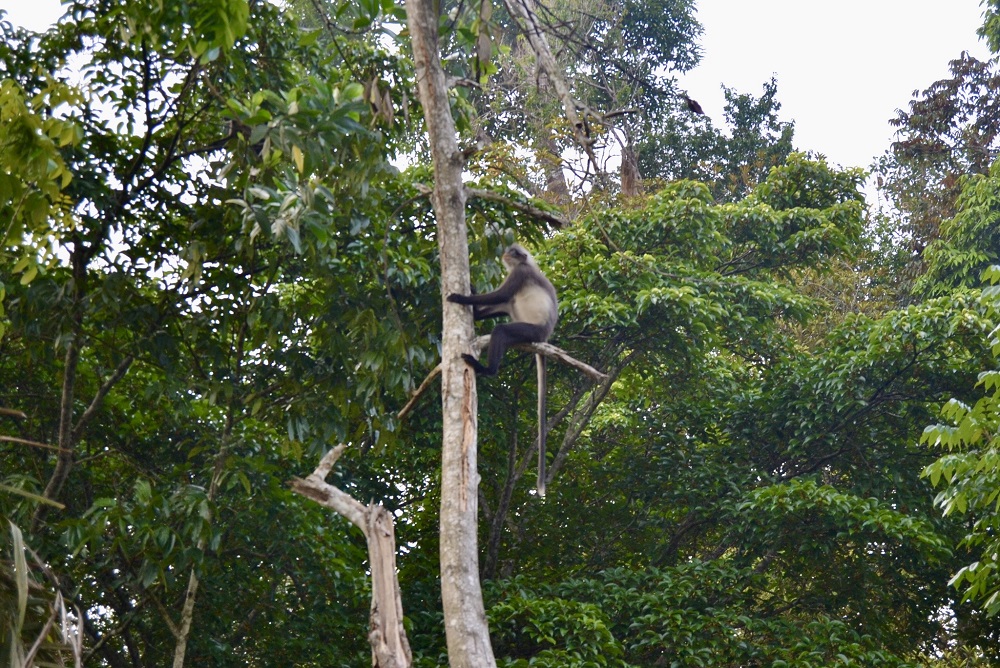
Bicolored banded langurs are diurnal (most active during daytime) and they are arboreal (tree-dwelling). They rarely descend to the ground. Their main locomotion methods are walking on all fours and leaping.
The size of their home range may be similar to that of the Raffles banded langur, between 22 and 52 acres (9 and 21 hectares) approximately.
Langurs split their waking hours between foraging, traveling, and resting. They are most active early in the morning and late in the afternoon. The dominant male patrols the borders of the territory to defend it against intrusion. As in several other langur species, bachelors probably attack troops to kidnap females in order to form their own family. Such intrusions lead to aggressive encounters that can result in serious injuries.
The scientific name of the genus the species belongs to is Presbytis, which comes from ancient Greek and means “elder”. This name was chosen by naturalist Johann Friedrich von Eschscholtz in 1821. He most likely thought of it because the facial traits of the langurs reminded him of those of an old man.
Langurs are territorial. They live in troops composed of one male and multiple females with juveniles and infants. Females remain with their natal group, but males leave when they reach maturity. Unattached adult and sub-adult males then form smaller troops of 4 to 5 “bachelors” until they, in turn, find their mates.
Living as a group is a clever adaptation against predators. There is strength in numbers. One member can stand guard while others forage or rest, and alert everyone if a predator is near.
Communication is an essential survival tool. Langurs use many vocalizations, each with a specific purpose. Calls are used to maintain social bonds, alert the troop to danger, and maintain troop cohesion.
When living in small forests, langurs use high-pitched sounds that travel short distances and are efficient at reaching members of the troop without all the neighbors knowing about it.
Alarm calls can be divided into two categories: those that identify aerial predators and those that identify terrestrial predators. These identify the type of predators, such as birds of prey or snakes, so the troop knows what to do. The troop members’ initial response to an alarm call is to freeze, look in the direction of the threat, then flee to a safe location or stay vigilant. The urgency of the threat is conveyed by the repetition of the call. In family troops, it is not unusual for the dominant male to position himself between the threat and the infants or females to defend them.
Contact calls are used during foraging. These have two functions: to reassure the members of the troop that others are near and to coordinate travel.
Male mating calls tell females how fit their potential partner is, whereas female estrus calls tell males that their consort is fertile.
Barks, growls, and screams can be heard during confrontations. They also clearly communicate the pecking order in the troop.
Infants utter distress calls when they need rescuing, and juveniles emit play calls when interacting with one another.
Scientists think bicolored banded langurs are related to Raffles’ banded langurs; it is therefore reasonable to think both langurs’ family structure and reproduction model are comparable.
Based on such an assumption, we can infer that after a gestation period of approximately 6 months, females give birth to one infant.
Predators are always looking for easy prey, and babies are most vulnerable, but langur mothers are very protective of their progeny and carry them around everywhere on their bellies or backs for the first year. Even so, babies are at risk of fatal falls when their mothers leap from branch to branch. Once babies become mobile and more independent, all females in the group take turns caring for them. This is known as “allomothering”. This model gives young females an opportunity to learn how to care for their future offspring and provide round-the-clock protection while giving the mother some respite. The dominant male’s role is to protect his family.
Once they reach puberty at age 4 or 5, males leave their natal group and may join other bachelor males; whereas females remain with their family of origin unless they are snatched by or meet a young, attractive male and start their own family.
Since these langurs consume fruit, they contribute to the biodiversity of the forests by spreading seeds through their feces.
As leaf eaters, they also contribute to the clearing of the forest by cutting branches.
As prey, they provide food for other species, like raptors.


The International Union for Conservation of Nature lists the bicolored banded langur as Data Deficient (IUCN, 2021), appearing on the IUCN Red List of Threatened Species.
The reason the IUCN assessment is estimated to be Data Deficient is due to the fact that more field studies are needed. Indeed, there isn’t enough information about the species and where it persists; it is therefore impossible at this time to know how many bicolored banded langurs exist in the wild. If the majority of the population persists in the eastern portion of its range, then it could be considered as Endangered; if not, then it could be considered as either Vulnerable or Near Threatened.
The biggest threat to primates in Sumatra is deforestation. The forests of eastern Sumatra are extremely degraded. Deforestation on the entire island is so severe that it has created a seasonal haze. In 2013, the seasonal haze even impacted neighboring countries and created tension with Malaysia and Singapore. The island was densely forested until the early 1950s, when land clearing began. The most fertile and favorable areas for human settlements were targeted first for agricultural purposes. In the 1970s and 1980s, deforestation accelerated in favor of industrial plantations as well as legal and illegal logging. Today, there are only small scattered remnants of undisturbed forest outside of protected areas. Unfortunately, the governmental authorities and private landowners have not acted responsibly to curb or stop deforestation. Indonesian law allows selective logging and a 35-year period for the forest to be regenerated. However, industrial logging companies do not abide by it and deliberately over-log. They then send an application to get the area declared “degraded”, at which point, the land is reclassified, and a sister company steps in and applies to convert it for plantation of acacia or palm for pulp wood. Roads are also built to transport the logs and cut through the forest, thereby limiting access of wildlife to disconnected forest patches.
To compound the problem, since 1999, district governments have been allowed to allocate 247 acres (100 ha) concessions to be logged by small-holders and communities, without the necessary planning or the forest ecology knowledge needed to make sound decisions.
To top it off, the latest announcement in February 2025 by the Indonesian government to use another 5.7 million acres (2.3 million ha) of protected forest for food and biofuel does not bode well for wildlife. This represents an area equivalent to 30 times the size of New York City. The decision goes against the primary role of protected forests, which is to ensure the conservation of biodiversity. The Indonesian government justified its decision by claiming these areas are already degraded and their conversion for agriculture does not constitute deforestation. The fact that many of these forest patches are unsuitable for agriculture due to heavy rain and the structure of the terrain does not seem to be a deterrent, and more protected forest areas could be included in the plan at a later date.
Furthermore, forest fires from natural causes or due to human activities are another threat to the langurs and other species living in Sumatra.
Finally, as with other primates, it is probable that the bicolored banded langurs are targeted by hunters and the illegal pet trade. Skulls of Indonesian primates, including those of langurs, often make their way to the tourist markets in Bali.
The bicolored banded langur is listed in Appendix II of the Convention on International Trade in Endangered Species (CITES), an international agreement between governments whose goal is to ensure that international trade in specimens of wild animals and plants does not threaten their survival.
In May 2025, the United Nations Environmental Program announced the launch of the “Growing Resilience through Emissions Reductions, Community Empowerment, and Ecosystem Restoration for a Nurturing Future” (GREEN for Riau) initiative. This is a conservation and sustainability program in the Riau region of Sumatra that is funded by the United Kingdom. Its goal is to reduce deforestation and greenhouse gas emissions while at the same time ensuring local populations can earn a living.
It is the number and the success of initiatives like this one, in association with field studies aimed at understanding where populations of bicolored banded langurs live and what their actual conservation needs are, that will determine their fate in the long run.
- IUCN Redlist (2021)
- https://wwf.panda.org/discover/knowledge_hub/where_we_work/sumatra/
- Mitochondrial phylogeny of leaf monkeys (genus Presbytis, Eschscholtz, 1821) with implications for taxonomy and conservation – Dirk Meyera, Ir. Dones Rinaldi, Hatta Ramlee, Dyah Perwitasari-Farajallahe, J. Keith Hodgesa, Christian Roos
- The Open Sale of Primate Skulls on Bali Reveal Complex Indonesia-wide Wildlife Trade Networks – Jessica Chavez and Vincent Nijman
- Deforestation of Primate Habitat on Sumatra and Adjacent Islands, Indonesia – Jatna Supriatna, Asri A. Dwiyahreni, Nurul Winarni, Sri Mariati and Chris Margules
- Mongobay – Indonesia targets 2.3m hectares of protected forests for food & biofuel crop production – Hans Nicholas Jong
- Asian Primates Journal – Preliminary study on the distribution and conservation status of the East Sumatran banded langur in Riau Province, Sumatra, Indonesia – Rizaldi, Kurnia Ilham, Irvan Prasetio, Zan Hui Lee, Sabrina Jabbar, Andie Ang
- https://realitypathing.com/tips-for-observing-langurs-in-their-natural-habitat/
- https://realitypathing.com/types-of-langur-vocal-calls-and-their-purposes/
- https://www.unep.org/events/un-day/launch-green-riau-advancing-forest-and-peatlands-conservation-and-climate-ambitions
Written by Sylvie Abrams, Nov 2025