
Allen’s Swamp Monkey, Allenopithecus nigroviridis
ALLEN'S SWAMP MONKEY
Allenopithecus nigroviridis
Geographic Distribution and Habitat
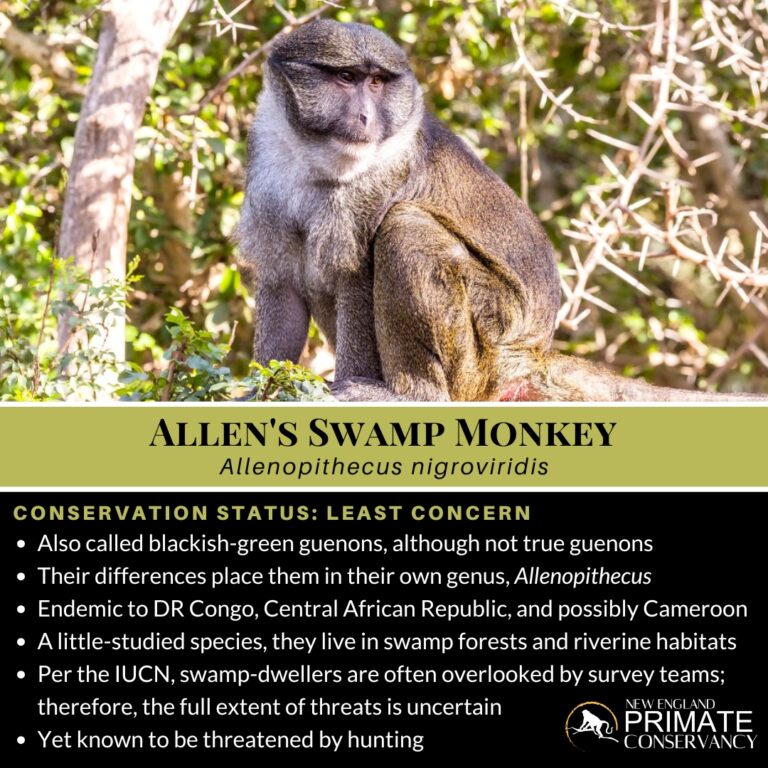
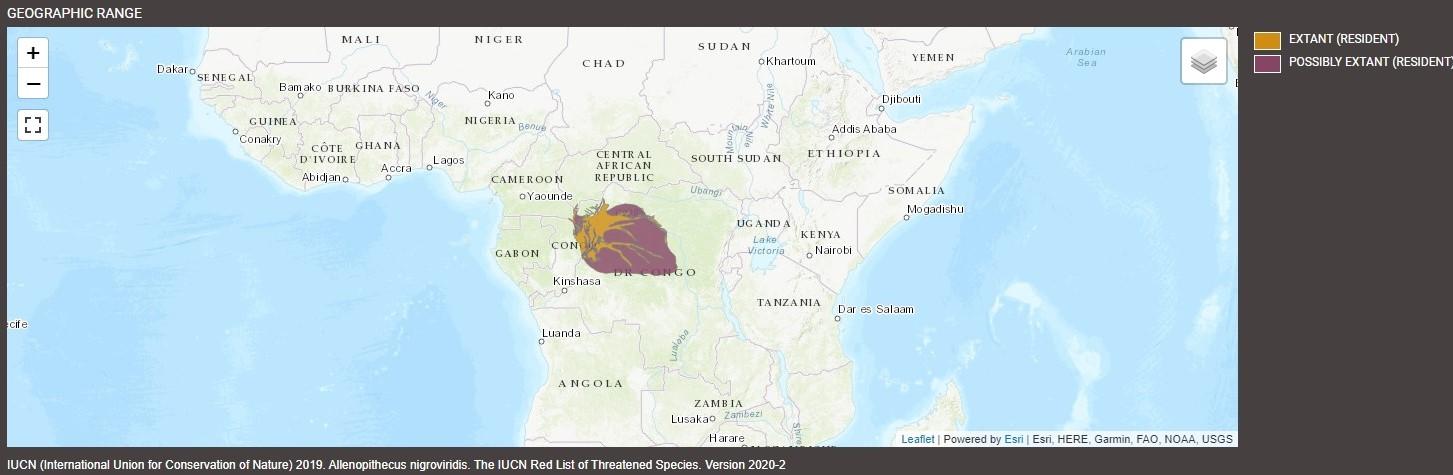
Allen’s swamp monkeys (Allenopithecus nigroviridis) live in the central Congo Basin of Central Africa, primarily in the Democratic Republic of the Congo and the Republic of the Congo. Smaller populations have also been recorded in parts of Cameroon and the Central African Republic. Scientists believe this species may occur in additional areas, but some regions have not been studied thoroughly enough to confirm their presence. These monkeys are also sometimes referred to as blackish-green guenons, though they are not true guenons.
Although Allen’s swamp monkeys occupy a large geographic range, they are very particular about where they live. They are closely associated with water and are most often found in swamp forests, seasonally flooded forests, and riverside woodlands. Because they depend on these wet habitats, only a portion of their overall range provides suitable living conditions. Much of their habitat is found along the Congo River and its many tributaries, including the Oubangui, Likouala-aux-Herbes, and Sangha Rivers. These waterways are lined with extensive swamps and forested floodplains that provide food, shelter, and protection from predators.
One particularly unusual population has been observed on small islands in the Sangha River near Nouabalé-Ndoki National Park in the Republic of the Congo. These islands are separated from the mainland and are not connected by land bridges or overhanging trees. Researchers believe the monkeys reached the islands by swimming. This is a remarkable feat for a primate and evidence of this species’ comfort around water. Allen’s swamp monkeys are known to be strong swimmers and may even dive into the water to escape danger.
Allen’s swamp monkeys have a somewhat unusual place in the monkey family tree. They have so many similar traits to guenons that Allen’s swamp monkeys were once placed in the same genus as guenons, Cercopithecus. Sometimes they may still appear under the older name Cercopithecus nigroviridis in some references. Today, however, they are placed in their own genus, Allenopithecus, and are the only living species in that group.
Size, Weight, and Lifespan
Allen’s swamp monkeys have a sturdy, compact build. Adults measure about 18 inches (45 cm) from head to body, with a tail that can about an additional 20 inches (50 cm) in length. Like many monkeys that spend most of their time in trees, they have longer hind legs than front legs, which helps them climb and move through branches efficiently.
Male and female Allen’s swamp monkeys differ noticeably in size. This physical difference between the sexes of the same species is known as sexual dimorphism. Adult males typically weigh around 13 pounds (6 kg), while females usually weigh about 8 pounds (3.7 kg). Newborn infants are tiny by comparison, weighing only about half a pound (220 g) at birth.
Very little is known about how long Allen’s swamp monkeys live in the wild because they are difficult to study in their remote swamp habitats. However, individuals living under managed care in accredited facilities have been known to live for more than 23 years. Some estimates suggest they may reach nearly 28 years of age under human care.
Appearance
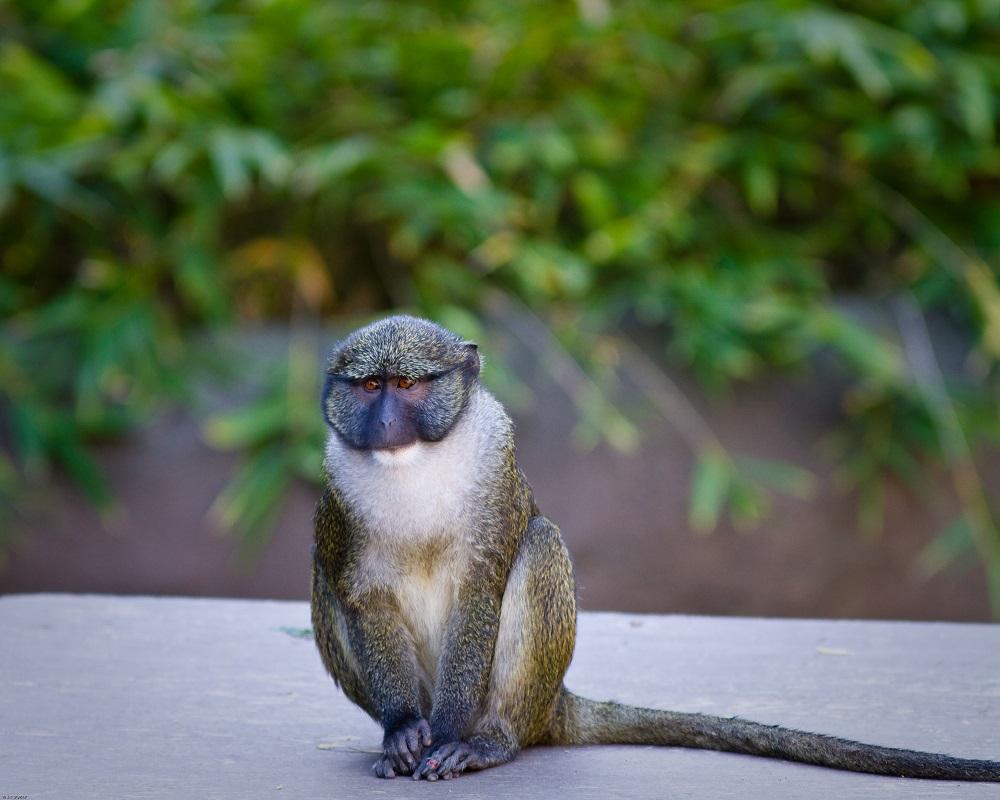
Allen’s swamp monkeys males and females are covered in dark olive-brown to grayish fur, with lighter fur on their undersides. Their faces are framed by long gray cheek hair that gives them a distinctive, almost bearded appearance. They have short limbs and tails that are slightly longer than their bodies.
Both males and females have a patch of reddish-orange skin beneath the tail. Females develop noticeable swellings around the reproductive area, called estrus swelling, when they are ready to breed, which is a relatively uncommon characteristic among similar monkeys. Males are generally larger than females and have pale blue skin on the scrotum.
Infants look quite different from adults when they are born. Their fur is a lighter yellowish-brown color, and they have soft white facial hair. As they grow, this juvenile coat is gradually replaced by the darker coloration seen in adults.
These primates have broad hands and feet, rounded leaf-shaped ears, and large molar teeth adapted for processing a variety of foods. Males also have larger canine teeth than females, a common feature in many monkey species where males compete for mates.
Allen’s swamp monkeys have thickened, hairless patches of skin beneath their buttocks called ischial callosities. These firm pads provide support while resting on branches and other surfaces. They are especially well developed in adult males.
Perhaps the most remarkable feature of Allen’s swamp monkeys is the partial webbing between their fingers and toes. This adaptation helps them move efficiently through swampy habitats. Allen’s swamp monkeys are capable swimmers and may even enter the water to escape predators.
Diet
Being opportunistic feeders, Allen’s swamp monkeys have a highly varied omnivorous diet. They spend time foraging both in the trees and on the ground, allowing them to take advantage of many different food sources. Fruits make up a large portion of their diet, but they also eat seeds, nuts, leaves, flowers, nectar, and other plant material.
Allen’s swamp monkeys regularly consume animal prey as well. They hunt insects such as caterpillars, beetles, grasshoppers, spiders, and flying insects, and may also eat snails, freshwater shrimp, fish, and other small aquatic animals found in their swampy habitat. This flexibility allows them to take advantage of whatever foods are seasonally available.
Allen’s swamp monkeys have expandable cheek pouches inside their mouths that function much like built-in grocery bags. These pouches allow them to quickly collect food and store it temporarily before moving to a safer location to eat. This adaptation helps reduce the amount of time they spend exposed to predators and may also help them compete for food when resources are limited.
Researchers have found that food also appears to remain in their digestive system longer than it does in many other monkeys of similar size. Scientists believe this may allow beneficial bacteria in the intestines more time to break down tough plant material and extract nutrients. As a result, Allen’s swamp monkeys can make use of a wider variety of foods than many other forest-dwelling monkeys.
Behavior and Lifestyle
Allen’s swamp monkeys are active during the day and spend much of their time moving through the dense vegetation of Central Africa’s swamp forests. Unlike many monkeys that remain high in the forest canopy, they frequently travel on the ground, navigating tangled roots, fallen branches, and muddy riverbanks on all fours.
Life in a wetland environment has shaped many of their behaviors. Allen’s swamp monkeys are comfortable around water and readily wade through shallow areas when traveling or searching for food. They are also capable swimmers and have been observed diving into the water to escape predators. This willingness to enter the water is unusual among monkeys and is one of the species’ most distinctive traits.
Although they spend a great deal of time on the ground, Allen’s swamp monkeys also climb into trees to feed, rest, and sleep. Fruits are an important part of their diet, and individuals often move into the lower levels of the forest canopy to forage when food is available. They may also search for insects and other prey among leaf litter, fallen vegetation, and along the edges of waterways. On occasion, researchers have observed them catching fish and other aquatic animals in shallow water.
Allen’s swamp monkeys are one of the only monkeys that are adapted for swimming. They are strong swimmers and may enter rivers or swamps to escape predators or move through their habitat.
Their fingers and toes are partially webbed, an unusual trait among monkeys. This helps them move more efficiently through muddy, flooded forest areas and shallow water.
Unlike many forest monkeys, they regularly eat animal prey in addition to plants. Their diet can include insects, shrimp, snails, and even small fish when available.
Allen’s swamp monkeys live in dense swamp forests of Central Africa, often in remote and waterlogged areas, which makes long-term scientific study challenging and means there is still a lot to learn about them.
Studying the social behavior of this species in the wild is challenging. Allen’s swamp monkeys live in dense swamp forests and flooded habitats that are difficult for researchers to access, and they are not always encountered along established field trails. As a result, many observations come from brief encounters rather than long-term continuous monitoring, making it harder to fully understand their social structure.
Although information on the social structure of Allen’s swamp monkeys is relatively limited, research shows they live in social groups whose size and structure can vary widely depending on location and habitat conditions. At some study sites, such as Salonga National Park, researchers have recorded relatively large groups of more than 50 individuals. In other areas, such as Lomako, much smaller groups of only a few individuals have been observed. This variation suggests that group size may be flexible and influenced by local environmental conditions such as food availability and habitat density. Despite this, Allen’s swamp monkeys are generally believed to live in multi-male, multi-female groups. In many observed groups, adult females outnumber adult males, although the exact balance can differ between populations.
During the day, groups may split into smaller foraging parties that search for food independently. As evening approaches, these smaller groups often reunite and settle into trees near rivers or swamps for the night. Sleeping above the ground and near water may help reduce the risk of predation from some terrestrial predators while providing easy access to feeding areas the following day.
Even with these limitations, researchers have identified some important patterns. Like many other African monkeys, Allen’s swamp monkeys likely maintain social bonds through grooming and vocal communication. Calls may play an especially important role in helping group members stay in contact in thick vegetation where visibility is low. Groups may also shift in composition as individuals move through the forest to forage, suggesting a flexible social system adapted to life in a complex swamp environment.
Allen’s swamp monkeys use a wide range of vocalizations to communicate within their groups. These include soft contact grunts used to keep group members together while moving through thick vegetation, sharp chirps that may signal alarm or alertness, and louder calls produced mainly by adult males. Younger individuals may produce isolation calls when separated from the group, while both males and females can produce intense screams in high-excitement situations.
Adult males of this species have specialized physical features that support communication through both scent and sound. Males possess scent glands on the chest that produce odors used to mark branches and tree trunks. They also have enlarged throat structures that amplify their vocalizations, allowing them to produce loud calls that carry over long distances through dense swamp forests. The exact role of scent marking performed specifically by males is not fully understood, but it appears to be an important part of social and territorial communication. In managed care settings, males have been observed scent-marking new objects placed in their environment, whereas females typically do not scent-mark but may investigate these marked areas by sniffing them.
Females have also been observed producing a distinctive vocalization during mating. When predators are detected, individuals may emit alarm calls that alert nearby group members to danger, helping the group respond quickly even when visibility is limited in dense forest.
Much of the reproductive behavior of wild Allen’s swamp monkeys remains largely undocumented. Detailed observations of courtship, mating, and parent–infant interactions in natural swamp forest conditions are limited due to the difficulty of long-term study in their swampy habitat. What is known from field data and broader primate research is that breeding tends to follow seasonal patterns, with births often occurring during times of increased food availability. Gestation lasts approximately 5.5 to 6 months, and females typically give birth to a single infant at a time.
Infants are highly dependent on their mothers after birth, clinging closely and relying on them for nourishment and protection. As they grow, they gradually begin to spend more time away from their mothers and engage in increasing amounts of independent play and exploration. Weaning is a gradual process that occurs over several months, rather than at a fixed age.
Observations of Allen’s swamp monkeys under human care provide additional insight into early development. In managed care settings, newborns are initially completely dependent on maternal care. Around three months of age, infants show increased independence, including more time exploring their environment, interacting with objects, and engaging in playful behaviors such as climbing, tumbling, and brief social interactions. During this stage, young monkeys also begin to regulate their own distance from their mothers more frequently, while still returning for nursing and reassurance. Studies of groups in accredited facilities have reported that these interactions are generally non-aggressive, with adult individuals tolerating and responding to infant behavior in a largely gentle manner.

Very little detailed research has been conducted on the full ecological role of Allen’s swamp monkeys, largely because they live in dense swamp forests that are difficult for scientists to study over long periods. As a result, many aspects of their impact on the ecosystem are still inferred rather than directly measured.
Based on what is known about their diet and movement patterns, Allen’s swamp monkeys likely play a role in seed dispersal. Seed dispersal is the process of carrying seeds away from the parent plant after eating fruit, often by moving through the forest and later passing the seeds in their waste. This helps plants spread and grow in new areas of the forest.
Because Allen’s swamp monkeys consume a wide variety of fruits and travel between ground-level and forested habitats, they are well positioned to move seeds through different parts of the swamp forest. While the exact importance of this role has not yet been fully studied, they are likely one of many animal species that help support plant diversity and forest regeneration in their ecosystem.
Allen’s swamp monkeys are also likely an important part of the food web as prey for larger predators in the Congo Basin. Although direct observations are limited, they are believed to be vulnerable to animals such as leopards, large birds of prey, crocodiles, and large snakes.


The International Union for Conservation of Nature lists Allen’s swamp monkeys as Least Concern (IUCN, 2018), appearing on the IUCN Red List of Threatened Species. However, available data suggest that some local populations are declining. This means that while the species is not considered globally threatened with extinction, it still faces significant pressures in parts of its range.
The primary threat to Allen’s swamp monkeys is hunting for bushmeat. Because they live in swamp forests and often travel along riverbanks and waterways, they may be vulnerable to hunters who use boats to move through their habitat. These hunting practices can make even remote forest areas more accessible to humans. In some regions near human settlements, Allen’s swamp monkeys may also be exposed to additional risks when they forage near cultivated areas or food sources associated with people. In these situations, they can become more likely to encounter traps and other forms of human-wildlife conflict.
Although their preference for swampy and flooded forests may offer some protection from large-scale logging compared to other forest-dwelling primates, habitat change and fragmentation can still affect local populations. Overall, the species is relatively widespread, but its dependence on specific wetland habitats and exposure to hunting pressure mean that some populations may be more vulnerable than the global conservation status suggests.
Allen’s swamp monkey is listed in Appendix II of the Convention on International Trade in Endangered Species (CITES), an international agreement between governments whose goal is to ensure that international trade in specimens of wild animals and plants does not threaten their survival. This means that while the species is not currently considered threatened with extinction, international trade must be monitored and regulated to ensure it does not become a conservation risk.
The species occurs in several protected areas across Central Africa, including Salonga National Park and the Lac Tumba-Ledima region in the Democratic Republic of the Congo, the Dzanga-Sangha Protected Area Complex in the Central African Republic, and the Lac Télé Community Reserve in the Republic of the Congo. These protected areas play an important role in maintaining habitat and reducing hunting pressure.
Conservation outcomes for Allen’s swamp monkeys vary widely depending on local human activity. In areas where hunting pressure is low or where regulations are enforced, populations can remain relatively stable. For example, parts of the upper Sangha River basin have been identified as areas where the species is not a primary target of the bushmeat trade. In contrast, in regions such as sections of the Likouala and Congo River systems, hunting pressure can be significantly higher, and monkeys may be taken as part of the bushmeat trade. Conservation efforts in some regions, including community-based management initiatives in and around Nouabalé-Ndoki, have involved agreements with local communities to allow subsistence hunting while discouraging commercial or large-scale trade outside local areas.
Despite these efforts, enforcement and protection vary widely across the species’ range, and long-term population trends remain poorly understood. More research on population density, hunting impacts, and habitat use is needed to fully assess how conservation measures affect Allen’s swamp monkeys across regions.
- International Union for Conservation of Nature (IUCN). (2019). Allenopithecus nigroviridis (Allen’s swamp monkey) – The IUCN Red List of Threatened Species. https://www.iucnredlist.org
- Kingdon, J. (2015). The Kingdon Field Guide to African Mammals (2nd ed.)
- Blaine, K. P., & Lambert, J. E. (2012). Digestive retention times for Allen’s swamp monkey and L’Hoest’s monkey: Implications for cercopithecine digestive strategies. https://doi.org/10.1111/j.1749-4877.2012.00283.x
- Smithsonian’s National Zoo & Conservation Biology Institute. Allen’s swamp monkey (Allenopithecus nigroviridis). https://nationalzoo.si.edu/animals/allens-swamp-monkey
- Groves, C.P. (2005). “Order Primates” Mammal species of the World: A Taxonomic And Geographic Reference.
- iNaturalist. Swamp monkeys. https://www.inaturalist.org/taxa/43463-Allenopithecus
- Fleagle, John G. Primate Adaptation and Evolution. Academic Press, 2013.
- Fiona Maisels, et al. “A Note on the Distribution of Allen’s Swamp Monkey, Allenopithecus Nigroviridis, in Northwestern Congo.” Primate Conservation, vol. 21.
Written by Chloe Becker, June 2026