
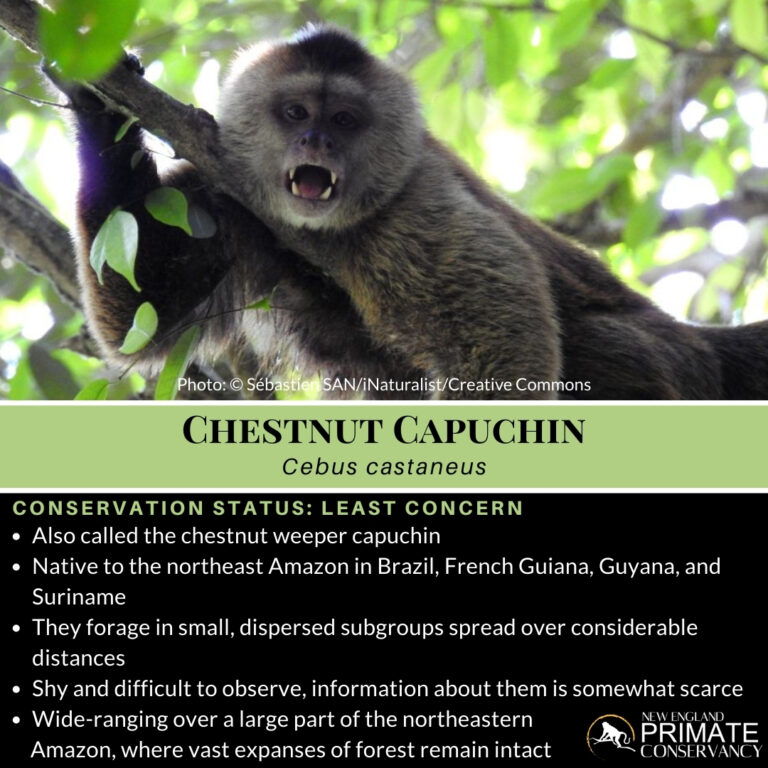
Chestnut Capuchin, Cebus castaneus
CHESTNUT CAPUCHIN
Cebus castaneus
Geographic Distribution and Habitat
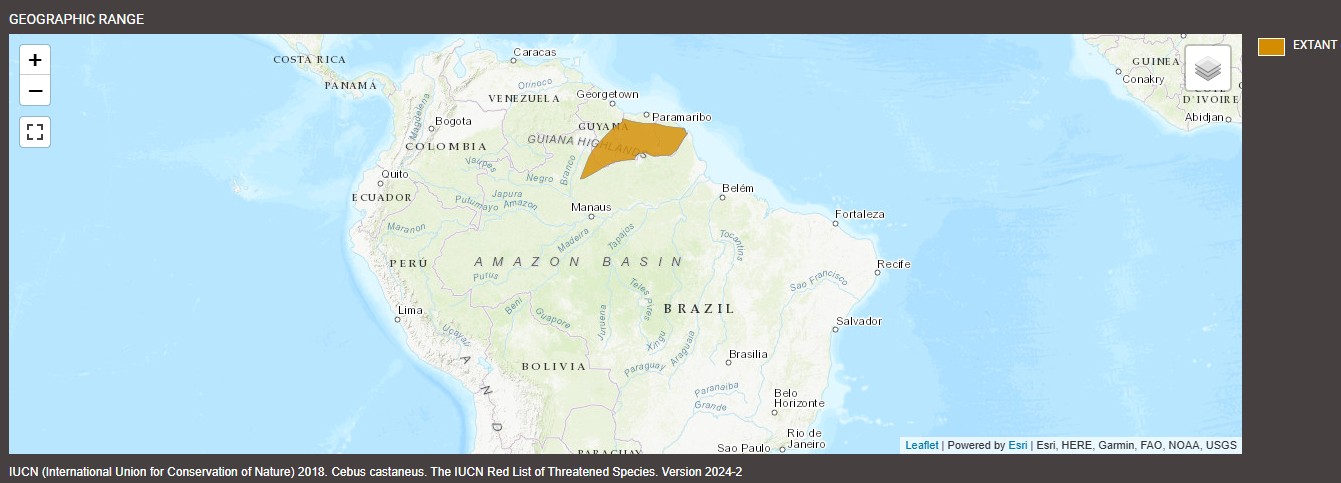
The chestnut capuchin, also known as the chestnut weeper capuchin, is native to the northeast Amazon, including a small portion of northeastern Brazil, much of southern Guyana, and the majority of Suriname and French Guiana, save for the northern portion of the latter two countries. They inhabit the uplands of the Guiana Shield, a 1.7 billion-year-old formation containing both lowland and submontane (sub-moutanous) forests, and high flat-topped peak mountains called “tepuis”. The Shield covers just over 667 million acres (270 million ha), and includes the countries of French Guiana, Suriname, Guyana, Venezuela, and parts of Colombia and Brazil, totaling 40% of the total area of the Amazon biome!
Within the uplands of the Guiana Shield, this capuchin is found north of the famed Amazon River, east of the Black River, limited on both sides by the Branco River, and from there, ranges north, east of the Orinoco and Ventuari rivers, to Guyana. Within this range, they are found in rainforests, tropical forests, gallery forests, which are narrow and corridor-like forests along rivers, streams, or wetlands in areas that are otherwise sparsely treed or treeless altogether, and finally, evergreen or deciduous dry forests. Evergreen forests keep their leaves year-round, while deciduous forests lose their leaves during the colder months and regrow them in spring. Any of these forests can be primary—those that have not been disturbed by humans, or secondary—those that have recovered after a period of human-caused disturbance. Despite ALL of this information, the chestnut capuchin’s range remains poorly known, as is further information regarding this shy, reclusive primate. Be prepared for inferences based on other closely related capuchin species!
The chestnut capuchin was described in 1851 as a subspecies of the Guianan weeper capuchin (C. olivaceus). A 2012 study found justification for at least tentatively recognizing the chestnut capuchin as a separate, distinct species. This wobbly tightrope walk of classification regarding the chestnut capuchin also implies that much of the information available regarding this species may very well overlap with the Guinean weeper capuchin. Science is fun, but of course, there have never been claims that it’s easy!
All capuchin monkeys were once considered to be members of one genus, the gracile (slenderly built) capuchins (genus Cebus). However, in 2012, capuchins were subdivided into two genera: the robust (or tufted) capuchins (genus Sapajus) and the gracile capuchins. The chestnut capuchins are proud members of the gracile capuchin monkey genus.
Size, Weight, and Lifespan
There is even limited information on the size and weight of these elusive monkeys! The following is known to be true for the Guianan weeper capuchin, but at this point in time, it is merely a scientific guess for the chestnut capuchin.
Head-body length ranges between approximately 13-22 inches (33-56 cm), with the tail adding another 5.9 inches (14.9 cm) for females, and 7.3 inches (18.5 cm) for males. With regard to weight, both genders generally weigh between 5.5-6.2 pounds (2.5-2.8 kg), but males can weigh up to 8.8 pounds (4.0 kg). These differences in size and weight are examples of sexual dimorphism, or noticeable physical differences between genders.
The lifespan of the chestnut capuchin is unknown, but other capuchin species tend to live 15-25 years in the wild.
Appearance
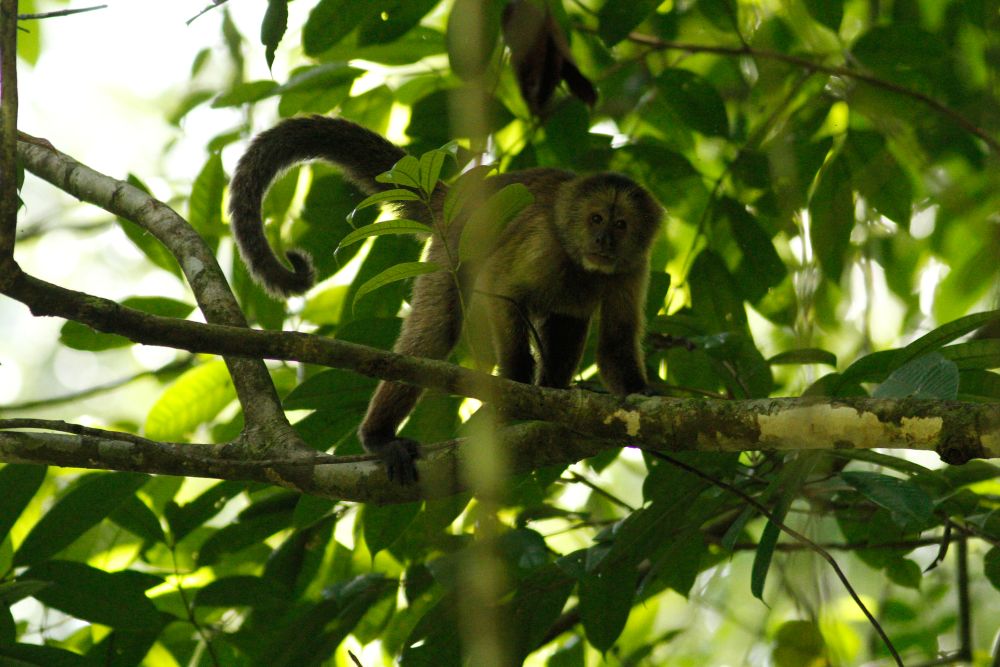
The chestnut capuchin has a yellowish white head with a narrow black triangle crowning the head. The areas above the ears and the nape of the neck are a reddish chestnut, as are the back sides of the body and limbs. The shoulders and fronts of the arms above the elbows are pale yellow. The hands and feet are blackish, and the tail is blackish brown, with gray tips on its backside.
They are a slender species, with long limbs that enable them to travel around their tree-dominated habitat with remarkable agility and grace. The tail is semi-prehensile, allowing them to balance and grasp branches, navigating the habitat with ease, but it is unable to support their body weight.
Diet
Like all capuchins, the chestnut capuchin is an omnivore, eating both plant and animal material. Their diet includes fruit, insects and their larvae, flowers, buds, and small vertebrates.
Behavior and Lifestyle
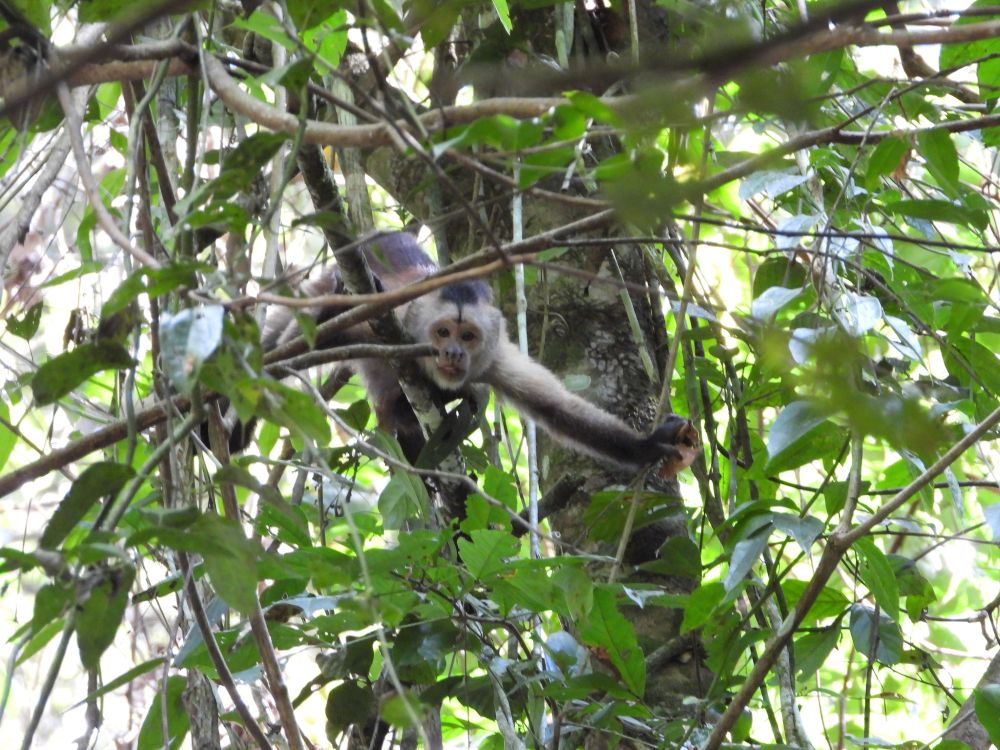
The chestnut capuchin, like all capuchins, is generally diurnal (active during the day) and primarily arboreal (tree-dwelling). They also have been found to disperse into small subgroups within their home range and travel a considerable distance in their daily foraging trips.
No studies are known to have been conducted specifically on the chestnut capuchin. This includes studies regarding their behavior and lifestyle. If we look at the Guinean weeper capuchin (which will be done numerous times throughout this article), it may be presumed that much of the day is spent foraging for food in groups, while nights are spent sleeping upon the branches of trees.
Like other capuchins, the primary mode of locomotion is quadrupedalism, that is, moving on four limbs, though they may also be capable of standing and walking upright.
While not documented among chestnut capuchins since their tentative speciation split from the Guianan weeper capuchin, it should be noted that one Guianan weeper capuchin behavior that isn’t entirely understood is the practice of rubbing millipedes against the fur, known as “self-anointing.” The capuchins also sometimes share the millipedes among group members, and have also been observed placing the millipedes in their mouths before continuing to rub them against their fur. Scientists theorize that the millipedes may release particular chemicals when stressed (such as being handled by these capuchins), which may act as a mosquito repellent. This theory is further strengthened by the fact that the behavior is more common during the rainy season, when mosquito numbers are at their highest. It’s reasonable to assume chestnut capuchins engage in these millipede stress-inducing behaviors, but this needs further research specific to this species.
Predators that target the chestnut capuchin have not been documented. Other capuchin species, however, face threats from jaguars, cougars, coyotes, tayras, snakes, caimans, and birds of prey. While studies of this capuchin species are again lacking, it may be assumed that, like other capuchins, they utilize an array of defense techniques to avoid predation. These may include: emitting alarm calls which may vary depending upon the type of predator, remaining vigilant while foraging by staying close together in groups, spending most of their time in trees to avoid ground-based predators, using their natural agility to beat a hasty retreat, using their natural coloration to act as camouflage which allows them to blend in with their tree-based habitat, and selecting habitats that offer better protection from predators, such as dense forests, with plenty of cover and escape routes.
Capuchins are named for their “caps” of hair, which resemble a capuche, the cowl worn by a Capuchin friar, a type of Catholic monk.
Very little is known about the daily life and group dynamics of the chestnut capuchin, and must be inferred from closely related species. What is known for certain is that chestnut capuchin groups are made up of about 10-33 individuals of both genders, and upon reaching sexual maturity, females leave their natal group to join another unrelated group. While social dynamics are more relaxed with regard to breeding within the group, the same cannot be said when it comes to competing for food and water resources between other groups of chestnut capuchins, or even other capuchin species! It’s every group for itself in the battle for food and water, and resources are not shared between groups or other primates, as far as the chestnut capuchin is concerned.
If we look at the Guianan weeper capuchin, grooming behavior is an important practice for establishing group dynamics. Grooming behaviors among chestnut capuchins can be seen as complex and convoluted. Juveniles of both genders will seek out opportunities to groom adults with the purpose of integrating themselves into the adult social structure of the group. This is particularly important for young females, as they can lose access to crucial resources if they fail to establish relationships with the elder females of the group. Due to this focus on elder females, young females rarely groom one another. Adult females, on the other hand, tend to rely on two strategies for grooming. In the first of these, a subordinate adult female may attempt to initiate grooming when approached by a higher-ranking female in the hope of avoiding an aggressive confrontation, which often results when a high-ranking female approaches a subordinate. By lying down and submitting to grooming, the confrontation may be calmed. The second grooming strategy is affiliative, or intended to form social bonds and alliances. This type of grooming typically takes place among females with less inequality in rank, and can offer social and material advantages to both participants.
Again, very little is known regarding the communication practices of the chestnut capuchin, and until further research is done, it must be inferred from information known about other closely related species.
The Guianan weeper capuchin uses many unique sounds and facial expressions to communicate. For example, high-pitched screams are used to alert the troop of predators. They may bare their teeth and scream at intruders of the same species as a sign of aggression and dominance. Lip-smacking and swaying are associated with positive interactions, such as grooming or sexual intercourse.
Yet again, very little is known regarding the reproductive habits and family/maturation processes of the chestnut capuchin, and must be inferred from those of other capuchin species. What is likely certain is that the chestnut capuchin is polygamous, meaning a female or male mates with multiple members of the opposite gender. There is likely one dominant male among the group who has the most likelihood of mating with receptive females, but females mating with subordinate males is not entirely out of the question.
If we look once again at the Guianan weeper capuchin, infants are nursed for an average of two to four months before they are weaned from their mother’s milk. During this time, the infant will be cared for almost exclusively by Mom. Males are not involved with infant care, but females within the group alloparent, a practice in which an infant is cared for by someone other than the parents. Siblings are more likely to babysit than unrelated group members. Additionally, juveniles and young adult females are more prone to allomaternal behavior than older females, a trait that is common in other primate groups, and suggests that younger females gain valuable experience by helping to raise infants.
Like other species of capuchin, female chestnut capuchins likely reach sexual maturity at three to five years of age, whereas males reach this milestone at around six to eight years of age. Upon reaching sexual maturity, males remain in their birth group, while females leave to join an unrelated group.
As fruit-eaters, chestnut capuchins aid in the regeneration of their forest habitats by dispersing seeds through their feces as they move around the habitat. In addition, they may serve as pest controllers, since a portion of their diet is made up of insects and their larvae. Finally, as a prey species, they also play a role in feeding local predators within their range.

The International Union for Conservation of Nature lists the chestnut capuchin as Least Concern (IUCN, 2018), appearing on the IUCN Red List of Threatened Species.
Overall, the species is widespread with little forest disturbance. However, capuchins, as a whole, are threatened by capture for the exotic pet trade. Capuchins are popular exotic pets, and go through a great deal of suffering, as they are typically bought by individuals who have no knowledge of the complex physical, psychological, and social needs of primates. There is the threat of inflicting serious injuries and even diseases onto their owners due to mistreatment and stress. As an individual, you can make the choice to not promote the exotic pet trade by stopping yourself from sharing cute videos of pet primates on social media. Educate those around you to do the same, and you can help save capuchins of all kinds!
Besides being potential targets of the pet trade, capuchins also suffer greatly from habitat loss, as they lose their home and all of the necessary resources due to deforestation.

The chestnut capuchin is listed in Appendix II of the Convention on International Trade in Endangered Species (CITES), an international agreement between governments whose goal is to ensure that international trade in specimens of wild animals and plants does not threaten their survival.
Despite their incredibly secretive nature, chestnut capuchins are found in multiple protected areas across their range, including (but not limited to): the Central Suriname Nature Reserve (which itself contains multiple nature reserves), Sipaliwini Savanna Nature Reserve, Iwokrama Forest Reserve, Nouragues Natural Reserve, and the Montanhas de Tumucumaque National Park.
Keeping an eye on potential areas of habitat loss around the chestnut capuchin’s range is a smart idea, as it is well known that many parts of the Amazon are under threat from human activities such as logging. Otherwise, A LOT of research specifically on the chestnut capuchin is needed so that our knowledge of this species can grow over the decades to come.
- https://www.alltheworldsprimates.org/Members/Home/MasterPrimate.aspx?tid=1386
- https://amazonteam.org/maps/guiana-shield/
- https://www.bioexplorer.net/animals/mammals/monkeys/weeping-capuchin/
- https://cites.org/sites/default/files/eng/com/ac/28/E-AC28-21-01-Annex9.pdf
- https://en.wikipedia.org/wiki/Chestnut_capuchin
- https://en.wikipedia.org/wiki/Gallery_forest
- https://en.wikipedia.org/wiki/Guiana_Shield
- https://en.wikipedia.org/wiki/Wedge-capped_capuchin
- https://www.iucnredlist.org/species/43941/191707135
Written by Sienna Weinstein, Oct 2025