
Golden-White Bare-Eared Marmoset, Mico leucippe
GOLDEN-WHITE BARE-EARED MARMOSET
Mico leucippee

Geographic Distribution and Habitat
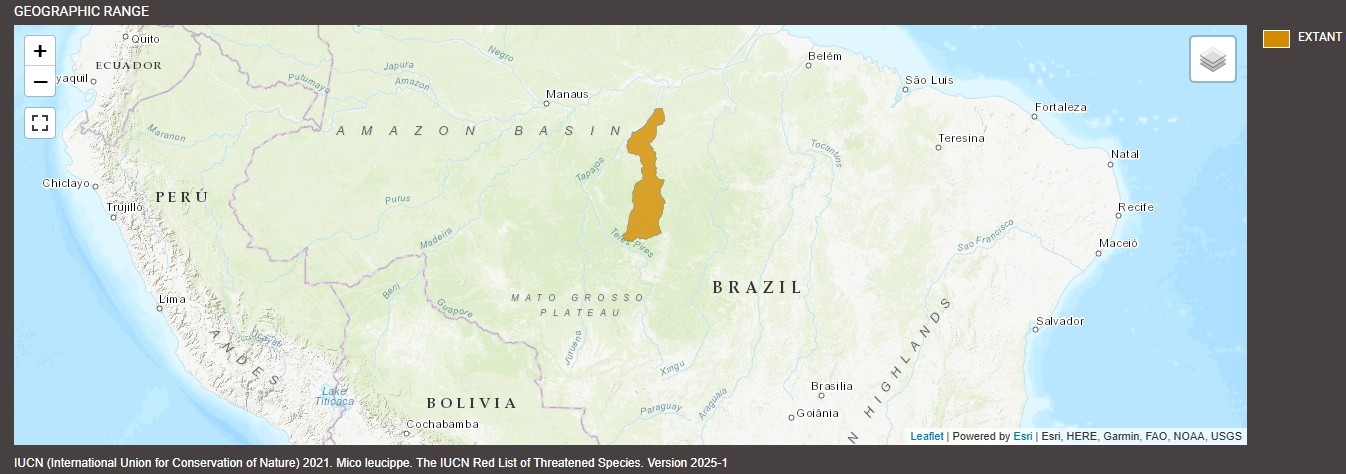
Golden-white bare-eared marmosets are native to Brazil, in the southwest of the State of Pará, where they live in humid tropical rainforests, and show a preference for secondary growth and edge habitat. Their territory is rather large, and groups have been observed from the right bank of the Rio Tapajós, extending south to Rio São Benedito, Rio Jamanxim, and as far east as Rio Curuá.
They live in the Sustainable Forest District, which includes the Itaituba II National Forest, Trairão National Forest, Tapajós National Forest, and the localities of Novo Progresso, Castelo dos Sonhos, Rio Cupari, and Rio Jamanxim.
Local temperatures are stable all year round and average 77°-84°F (25°-29°C). The region is characterized by high humidity (40-70%) and there are significant rainfalls throughout the year; however the wettest months are January through May with approximately 17 inches (43 cm) of rain. The rain usually falls in the afternoon. The driest months are June through August.
Although human activities are contributing to rapid deforestation in the region and the population of golden-white bare-eared marmosets is declining, the species seems to adapt rather well for the time being.
All Brazilian marmosets, including the golden-white bare-eared marmoset, were originally classified as belonging to the genus Callithrix. However, in the early 2000s, scientists reclassified them into the Mico genus based on their geographic distribution.
The scientific name of the species Mico leucippe describes their appearance. “Mico” comes from the Tupi language and means “monkey”. The roots of the word “leucippe” come from ancient Greek – “leukos” which means “white” in reference to their fur.
Size, Weight, and Lifespan
The body and head of golden-white bare-eared marmosets measure 8 to 9 inches (20.5 to 23.5 cm). Their tail is longer and measures 10.5 to 14.5 inches (26.5 to 37 cm). These primates are pretty light and weigh 15 ounces (435 g) on average.
Marmosets have a life expectancy of 12 to 18 years in the wild. We can therefore guess that such is the case for the golden-white bare-eared marmosets.
Appearance
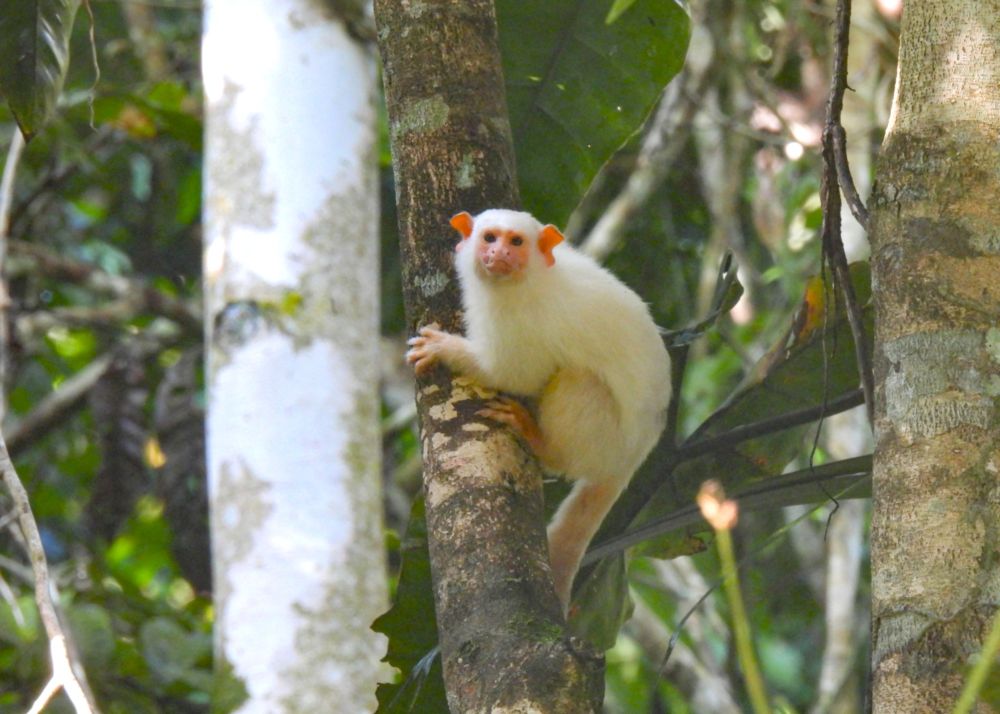
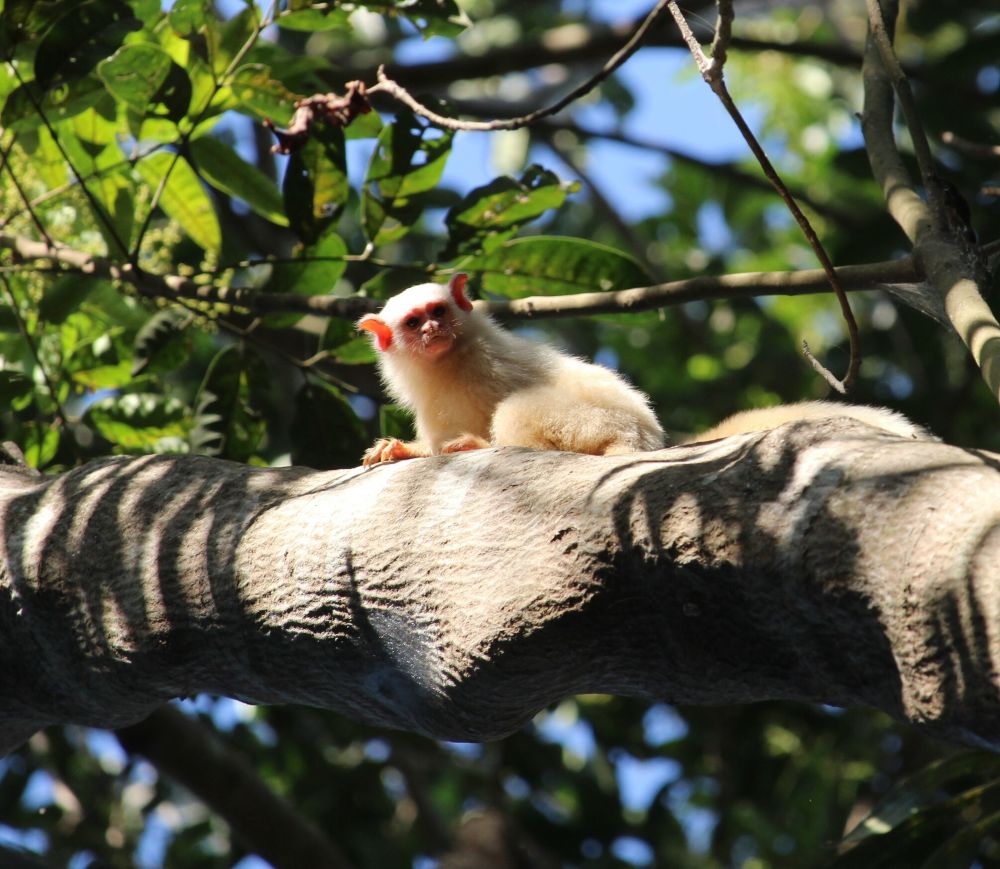
Golden-white bare-eared marmosets are small. Males and females are approximately the same size and look very much alike. Their fur is white with a honey golden hue. Their cute little face and their big leaf-shaped ears are bare and pink. Their eyes are big, dark, and expressive.
They have a long, non-prehensile tail, which means they cannot use it to grab things, but it helps them keep their balance while traveling from branch to branch. This can be observed when they bend their tail upon landing unsteadily on a branch and immediately regain their footing.
They have claws (called “tegulae”) instead of nails on their digits, except on their big toe. These claws enable them to effortlessly cling to tree branches and bark. Their hands are relatively short—a characteristic of primates that glean insects and other food items from trees. They have fingerprints and lines on their hands, much like us. This is referred to as “dermatoglyph”. These patterns help primates get a good grip on branches, and they enhance tactile sensitivity. Their long fingers also help marmosets move securely when walking on thin branches.
Diet
These marmosets feed on fruit, flowers, nectar, plant exudates such as gums, saps, latex, and small prey like frogs, snails, lizards, insects, and the occasional spider. Saps are composed of water, sugars, and minerals; gums are rich in fiber, and prey provide protein.
Their teeth are perfectly adapted to such culinary preferences with two molars on each side of the jaw, large lower incisors that are bent and lack enamel on the inside surface, and short canines. When they sink their upper incisors into the tree bark, their lower incisors gouge into it until a cavity is opened. They spend approximately 50% of their feeding time gouging trees, branches, and vines with their teeth in order to extract sap and gums. Using their claws, they can simultaneously capture insects and small animals living in the trees they bite. Their digestive system is perfectly adapted to the absorption of gums, which are difficult to assimilate. Their intestines have a large cecum and an elongated colon that allow the fermentation and breakdown of the ingested cellulose.
Behavior and Lifestyle
Golden-white bare-eared marmosets are social creatures living in family groups of four to fifteen individuals. They are diurnal (i.e., active during the day), arboreal, quadrupedal (which means they use all four limbs to navigate the canopy), and can be described as clingers and leapers.
The groups’ home range (i.e., the area in which they live) covers between 25 and 90 acres (10 to 40 ha), depending on food availability and the condition of the forest.
Their mode of locomotion consists mainly of walking, running, and jumping in trees with an extended tail to keep their balance. When they settle to eat, they cling to the branch on which they stand by wrapping their tail around it, while using their hands and mouth to feed. When they run, their tail is arched, a way of moving often referred to as an “arched-tail gallop”. When they rest, their tail is often wrapped around their body or is in contact with the body of a friend next to them.
Marmosets engage with members of their group regularly and display a wide range of behaviors. For instance, they may invite another marmoset to groom by flopping on their side or back, all stretched out. Several marmosets may engage in grooming sessions together to clean their fur from parasites, but also to strengthen their bonds. They can also indicate their intention to interact by stalking another marmoset, staring, hiding, approaching, and then retreating away. Friendly gestures include hugs and a light touch with both hands extended.
Occasionally, conflicts occur and marmoset fights can be vicious with bites resulting in bleeding injuries, but most of the time, a challenged marmoset will stand on their hind legs with arms extended in a submissive behavior to avoid a clash.
Levels of a variant form of oxytocin (also called the love hormone) have been found in marmosets, and it is thought to be responsible for male parental and alloparental care of marmoset babies.
Golden-white bare-eared marmoset family groups are relatively stable. The groups, which are organized around a breeding pair, typically include some related parents or siblings of the breeding pair, as well as unrelated adult females and males, subadults, juveniles, and infants. The breeding pair is dominant, and the hierarchy for the rest of the group is usually based on age.
All members of the group get up around sunrise to go foraging and retire at sundown to rest—making their nest in vine growth or tree forks where thick vegetation can hide them from predators.
The breeding male and female are extremely bonded to each other. They groom, huddle, share food, do everything together, and protect each other against any threats to their relationship.
When they become adults, the offspring do not disperse, as is the case in some other primate species. They remain with their natal group for as long as they want and do not engage in reproductive behavior by seemingly voluntarily abstaining from engaging in romantic relationships or because their hormones are naturally suppressed. Subordinate females at the age of reproducing (18 months or older) may leave if they find a suitable male outside of their family group.
Marmosets use facial expressions, body posture, scent-marking, piloerection, and vocalizations to communicate with one another.
Like humans and other non-human primates, marmosets have a network of face patches in their visual cerebral cortex. This makes marmosets extremely skilled at interpreting facial expressions and gathering a lot of social cues and information. Not only are they able to interpret the intentions of another individual, but they are also able to follow their gaze and decide to investigate later on what their fellow marmoset was looking at. When they observe another animal, prey, or even a piece of food, marmosets tend to stare with their head tilted to the side. If their mouth is slightly open, it may mean that they are not sure about what or who they’re looking at and are a bit guarded. If they bare their teeth and retract their lips, they are being aggressive. This is usually accompanied by a vocalization like a scream. However, when engaging in play fights, they may bare their teeth, but the lips are not retracted.
Body postures also convey information; for instance, the flattening of the ears signals submission.
Piloerection (i.e., when the fur of the body and/or tail is raised) is observed in combination with various body postures associated with fearful or aggressive behavior, such as display when encountering an external group of marmosets.
Scent-marking by rubbing the anal glands on tree branches is used to mark territory. Scents provide data about the status of an animal, its health condition, as well as its age and gender. Licking and nuzzling are often associated with scent-marking. Group members may nuzzle to greet or to investigate what a friend is eating. Licking is a way to greet a friend. All members of a group express affection by licking young infants—usually in the anal region, which also serves a cleaning function.
Finally, like so many other primates, marmosets do vocalize, and they do so a lot. The vocabulary they use is different depending on the social context and includes predator alarm calls, mobbing calls, and food calls. Twitters are short modulated sounds used when two different groups encounter, while trills are used when group members are foraging to keep in touch with each other. The “phee” call is used to maintain social contact while defending their turf against intruders. This call contains information about the identity and gender of the caller. Although not confirmed for the golden-white bare-eared marmosets, field studies revealed that the “phee” calls can vary slightly depending on the group a marmoset belongs to—the equivalent of a dialect as humans understand it.
Golden-white bare-eared marmosets are monogamous. During courtship, the male and female lip-smack. The gestation period is approximately 145 days. Interestingly, the heartbeat is only detected 45 days after the embryo is formed (much later than the 23 days in humans). Scientists think it may be an adaptation due to the fact that marmosets live in trees and weigh very little. Although there is no field study indicating that golden-white bare-eared marmoset females do have multiple successive pregnancies after giving birth to their twins, scientific literature indicates that marmoset females can get pregnant again only two to four weeks after delivery. This is also thought of as an adaptation because these small animals are so vulnerable to predators. Another factor may be that mothers get a lot of help from everyone in the group, including the father, while rearing their offspring—a system referred to as “cooperative breeding”. During the first two weeks after delivery, the mother exclusively takes care of her offspring, but from the third to eighth weeks after delivery, the father and all members of the group alternatively serve as babysitters and carry the offspring on their backs.
Young and juvenile marmosets engage in play activities by wrestling with both hands and feet, biting one another, pouncing on each other, biting and grabbing each other’s faces, necks, and tails. This is training for the skills they will need to capture prey when they get older. They also learn from observing the adults capturing prey. In fact, adults teach the young all the time, and if they observe unruly behavior, they may scold the offenders by scratching and baring teeth at them, and occasionally by delivering a sharp bite to the neck.
Golden-white bare-eared marmosets play an important role in the health of the forests they live in. They spread the seeds of the fruit they eat through their feces and transfer the pollen attached to their fur after consuming flowers, thereby contributing to the maintenance of plant diversity. They also help the entire forest ecosystem through their consumption of small prey and insects, and they, themselves, are food to other species such as snakes and birds of prey.


The International Union for Conservation of Nature lists the golden-white bare-eared marmoset as Least Concern (IUCN, 2021), appearing on the IUCN Red List of Threatened Species.
Habitat degradation due to human exploitation of the Brazilian forests is one of the biggest threats to golden-white bare-eared marmosets, even if, for the time being, these animals seem to adapt. Indeed, in the last forty years, the region has been significantly impacted by large projects, such as the 2,486 miles (4,000 km) Transamazon (BR-230) highway built in 1973, which runs through the Amazon forest and the Brazilian states of Paraíba, Ceará, Piauí, Maranhão, Tocantins, Pará, and Amazonas. Three years later, the 2,224 miles (3579 km) Cuiabá-Santarem highway (BR-163) was built to link several Brazilian states from north to south. Surrounding these highways are also many roads built illegally by gold miners, loggers, and unauthorized land settlements. These result in further fragmentation of forest habitat.
Most recently, entire forest patches have been converted in favor of soy plantations. A recent report from Brazil’s National Institute of Space Research indicates that the soy planted on virgin land has tripled between 2018 and 2023, and 16% is planted on land that has been cleared since 2008. This is in spite of the rules imposed by the Amazon soy moratorium that was signed in 2006 by world grain traders who agreed they wouldn’t buy soy grown on land deforested after 2008. Furthermore, farming groups have launched lawsuits in an attempt to weaken the rules imposed by the Soy moratorium.
Since the 1960s, the Brazilian government has invested massively in the construction of hydroelectric dams. Usually, the technology is presented as ecologically sound. However, the impact on ecosystems is major. These dams increase deforestation, encourage urbanization of the rainforest, release greenhouse gases such as CO2 and methane into the atmosphere, and displace indigenous people by disrupting their food sources.
Although not the main targets, golden-white bare-eared marmosets occasionally get captured for the illegal pet trade.
Should threats increase in the near future, the species’ status will need to be re-evaluated.
The golden-white bare-eared marmoset is listed in Appendix II of the Convention on International Trade in Endangered Species (CITES), an international agreement between governments whose goal is to ensure that international trade in specimens of wild animals and plants does not threaten their survival.
Brazil’s official deforestation data indicates that the state of Pará lost 17.7 million acres (7.2 million hectares) of forest cover between 2000 and 2019, which represents 6% of its mature forest. Despite previous conservation efforts by the Brazilian government, enforcement of environmental laws weakened, and deforestation increased again in 2020.
The state of Pará is equivalent in size to France, the United Kingdom, Portugal, and Spain combined; it is also the most populous in the country. Its economy is driven by agribusiness and mining, which makes preserving forest habitat and the rich biodiversity of the region a complex challenge.
However, in 2019, Pará committed to transitioning to a low-carbon economy and becoming carbon neutral in terms of land use and forest emissions by 2036. Preliminary results of the jurisdictional REDD+ (Reducing Emissions from Deforestation and Forest Degradation) initiative are positive (21% emission reductions for the years 2021/22 and 2022/23). This success is due to the active participation of all concerned, from private businesses and small farmers to non-governmental organizations.
The state of Pará was also the first in Brazil to launch a Bioeconomy Plan to encourage the sustainable use of the land. The Green Seal initiative also encourages food distributors, investors, and commodity markets to evaluate meat and soy suppliers and ensure they only buy products from those who fulfill their legal obligations.
Any effort to protect the forest is beneficial to the well-being and survival of endemic species, including the golden-white bare-eared marmosets.
- IUCN Redlist assessment 2021
- Marmoset Vocal Communication: Behavior and Neurobiology – Steven J. Eliades, Cory T. Miller
- Current Biology Magazine – Quick Guide: Marmosets – Fazal Wahab, Charis Drummer, and Rüdiger Behr
- Family Life in Marmosets: Causes and Consequences of Variations in Caregiving – Jeffrey A. French, Jeffery E. Fite, Corinna N. Ross
- https://anthropology.iresearchnet.com/marmosets/ Marmosets
- news.mongabay.com/2022/09/road-network-spreads-arteries-of-destruction-across-41-of-brazilian-amazon/
- www.reuters.com/sustainability/climate-energy/corporate-deal-that-protected-amazon-soy-farming-starts-show-cracks-2025-06-20
- https://www.thecanary.co/global/world-analysis/2025/04/10/brazil-hydropower
- https://forestsnews.cifor.org/70481/how-one-brazilian-state-is-tackling-deforestation-within-its-borders?fnl=en
- https://resources.leafcoalition.org/wp-content/uploads/2024/03/Para-brochure-EN-compress.pdf
Written by Sylvie Abrams, Oct 2025