
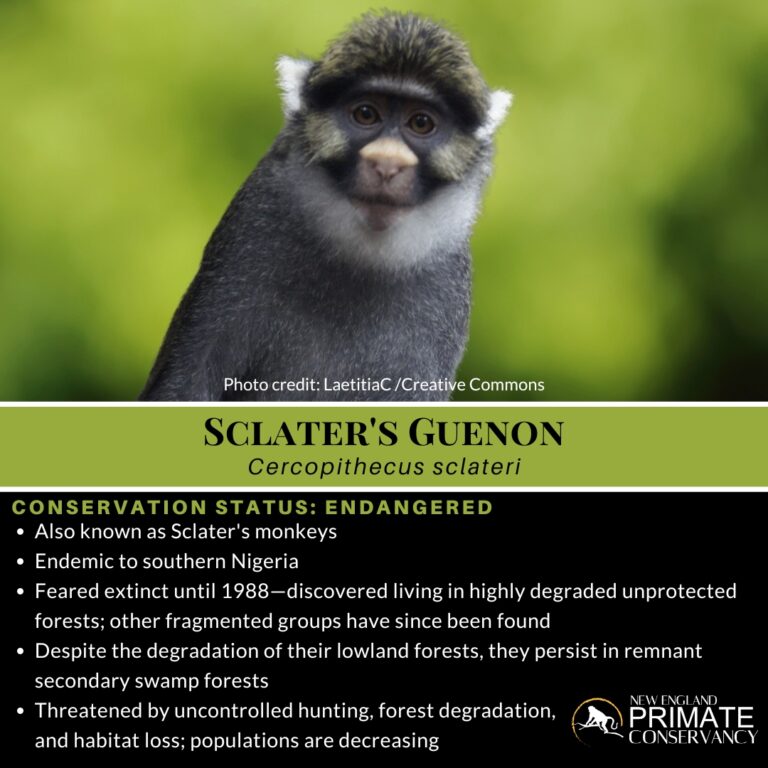
Sclater’s Guenon, Cercopithecus sclateri
SCLATER'S GUENON
Cercopithecus sclateri
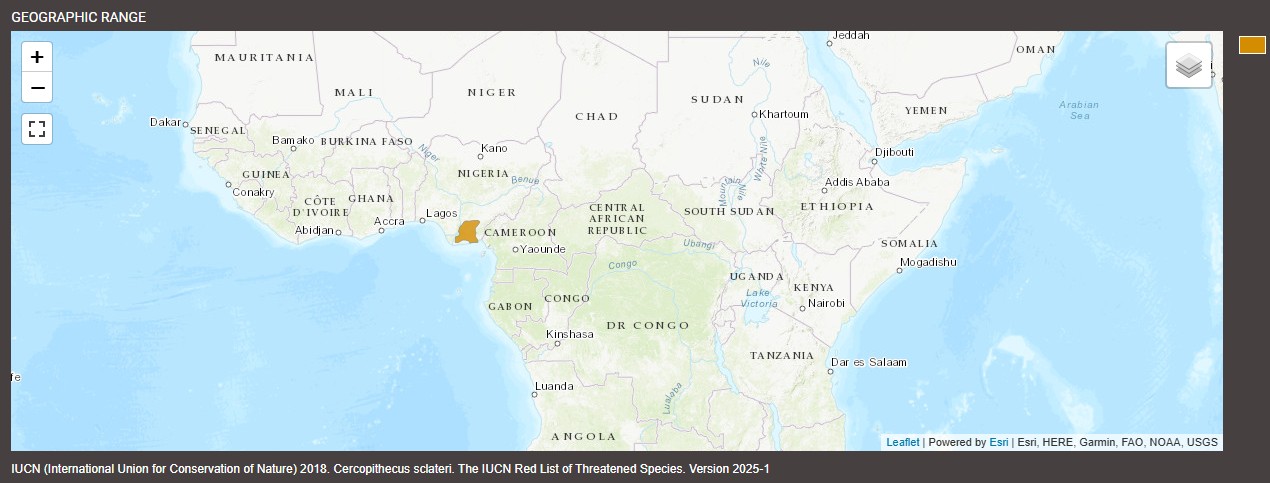
Geographic Distribution and Habitat
Sclater’s guenon, the only monkey endemic to Nigeria, is also called Sclater’s monkey, white-throated guenon, the Nigerian monkey, and scientifically as Cercopithecus sclateri. Sclater’s guenons live in fragmented and degraded forests in regions of Southern Nigeria’s Eastern Niger Delta to the Cross River up to the Enugu and Ebonyi states in the north. The monkeys are primarily restricted to an area of about 11,004 square miles (28,500 km2) in a densely human-populated and oil-producing region of southern Nigeria.
The monkeys’ original habitat was in moist tropical lowland forests, but since the degradation of their habitat, the monkeys have moved to remnant secondary forests, gallery forests, and freshwater swamp forests. Importantly, their habitats also include bodies of water, since many of their sleeping sites tend towards swamps and lakes. Sclater’s guenons can also be found in marginal forests and areas surrounding farmland in communities where monkeys are regarded as sacred and protected. In two communities, the Lagwa and Akpugoeze, the Sclater’s guenon is tied to folklore and religious beliefs, effectively protecting the monkeys.
In these varying habitats, Sclater’s guenons never live higher than 426.5 feet above sea level (130 m). The understanding of the wide variety in habitat is owed to a study in 2008 that found many more groups of Sclater’s guenons than previously thought. The researchers found that the monkeys were living in 27 previously unknown sites across Southern Nigeria.
The Sclater’s guenon was first described by Reginald Innes Pocock in 1904 when one monkey was brought to London from Benin City, Nigeria.
At first, the monkey was lumped together with a similar-looking guenon, the red-eared guenon (Cercopithecus erythrotis). Sclater’s guenon and the red-eared guenon were considered subspecies of the moustached guenon (Cercopithecus cephus). Scientists later separated the moustached guenon and the red-eared guenon, but retained Sclater’s guenon as a subspecies of the red-eared guenon. After more research, the Sclater’s guenon was elevated to a distinct species.
Shortly after the discovery, the Sclater’s guenon was considered extinct until it was sighted in 1988. This was primarily due to the confusion surrounding their natural habitat. Since the original monkey came from Benin City, Nigeria, a large trade and commerce city, the origin of the monkey was unknown. Only after two scientists, Oates and Anadu, in 1987 heard rumors of a monkey that matched the description of the Scalter’s guenon, did they return the following year and identify them in the wild.
Size, Weight, and Lifespan
Direct measurements of Sclater’s guenon have yet to be made, but generally, the monkey is sexually dimorphic, with males larger than females. Sclater’s guenon is a relatively smaller guenon species, and weight ranges can be made by observing other closely related guenons.
The closely related moustached guenon has an average adult male weight of about 8.8 pounds (4 kg) and an average adult female weight of 7.9 pounds (3.6 kg). Adult males measure roughly 23 inches (58 cm) in head-to-body length, while adult females average 19.3 inches (49 cm). The tail adds another 31 inches (78 cm) to the male’s total length and 27.4 inches (69.5 cm) to the female’s.
Two captive Sclater’s guenons were recorded at 11.6 pounds (5.3 kg) for the adult male and 8.6 pounds (3.9 kg) for the female. Keep in mind that captive individuals often weigh more than their wild counterparts due to consistent access to food. Although their head-to-body lengths were not documented, their tails measured 32.3 inches (82.25 cm) for the male and 26.5 inches (67.53 cm) for the female. Their tails can be as long as or longer than their head-to-body lengths.
Their lifespans have yet to be directly recorded, but the median age of guenons overall is 16.4 years of age. Some species can even live up to 36 years of age. More research is required to understand exactly where Sclater’s guenons fit into this spectrum.
Appearance
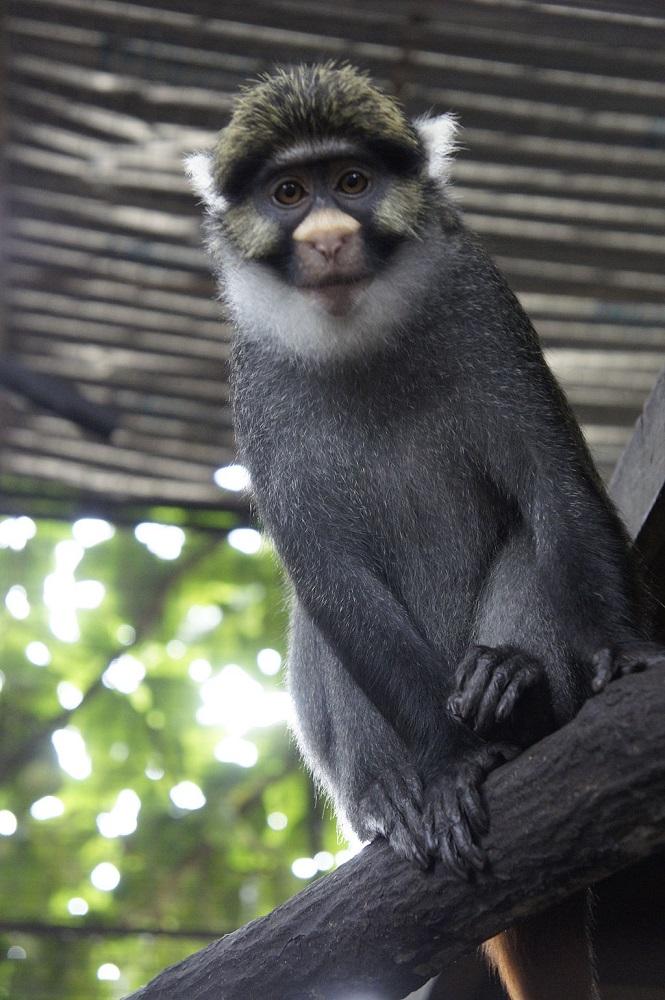
One of the key characteristics of Sclater’s guenon is its tail: colored light grey with reddish brown and an orange base. In fact, this was how the scientists who rediscovered Sclater’s guenon were able to locate the monkey in 1987. Only after hearing Igbo-speaking locals (Igbo is the local language of southeastern Nigeria) mention a monkey with a reddish brown and orange tail were they able to track down the monkey for the first time since its discovery.
Guenons are known for their vibrant coloration and striking facial patterns. The Sclater’s guenon face is framed by bright white fur along the ears, and the nose is tan with a subtle pink tint. The eyes are closely set and deep brown, surrounded by gray-green tufts of hair that encircle the face. The facial fur itself is primarily black with a lighter brow ridge, blending into a gray neck. Their bodies are cloaked in olive-toned pelage along the back, with a contrasting gray underside.
Guenon species have cheek pouches—expandable pockets inside their cheeks that can hold nearly as much food as their stomachs. This adaptation helps reduce competition for resources by allowing individuals to gather food quickly, store it temporarily, and then retreat to a safer location to eat at their leisure.
Diet
Sclater’s guenons mainly feed on fruits, along with leaves, seeds, and sometimes insects. In areas where they are considered sacred, the monkeys partake in agricultural crops and steal food from houses. In the short dry season of August, the monkeys have been recorded to feed on more fruits than leaves and seeds. Conversely, in the wet season from March to November, seeds tend to be the food of choice. The rest of the year in Nigeria is characterized by rains not as heavy as the wet season but with a marked difference from the dry season. During this time, the Sclater’s guenon may partake in whatever food is most available, most likely a combination of wet and dry season diets. Some specific food sources include the Gold Coast bombax tree (Bombax buonopozense), African Oil Palm (Elaeis guineensis), and the West African Wine Palm (Raphia hookeri).
Behavior and Lifestyle
Sclater’s guenons are arboreal, meaning they live in trees, very similar to other guenon species. They are also active during the day, or diurnal. During the day, Sclater’s guenons will interact with group mates, forage for food, and feed. Time spent feeding is thought to change with the seasons. One study speculates that since many other nonhuman primate species tend to increase time spent feeding during the rainy season compared to the dry season, Sclater’s guenon may as well.
Sclater’s guenons occupy all levels of the forest canopy. To explore their arboreal habitat, the monkeys use their tails to balance and are quadrupedal, meaning they use all four limbs to travel. In areas where the monkey is hunted, they spend most of their time in thick, low growth. At night, they rest in trees close to bodies of water.
The Sclater’s guenon is Nigeria’s only endemic primate species.
The monkey was named in honor of zoologist Philip Lutley Sclater in 1904.
The Sclater’s guenon was considered extinct until the monkey was sighted in 1988.
In Igbo, the local language of southeastern Nigeria, the monkey is called amina.
In Akwa Ibom state, Nigeria, the Sclater’s guenon is called Adiaha awah-Itam, the daughter of the Itam deity.
Since not much Sclater guenon behavior has been directly observed, scientists use closely related guenon species to fill in the gaps about their behavior and other information about the species. While perhaps not 100% accurate, it can provide valuable insights into what they might be like.
Limited direct evidence of Sclater’s guenons reveals that there may be only one singular dominant male in a given group, as only one individual was making any alarm calls. Dominant males typically have priority of access not only over females of the group but also over resources. However, Sclater’s guenons may also have a more relaxed social structure with multi-male and multi-female groups and may not always have one dominant male.
Juvenile males will leave the group once they become sexually active in search of new homes. Some lone males will join bachelor groups that go around to new groups in an attempt to find their new home.
The group size of Sclater’s guenon is most likely 3-30 monkeys. Similar to other guenon species, these groups are further separated into subgroups of two to six and work together to forage for food and feed together.
Sclater’s guenons are sympatric, meaning they live in the same forests as the West African potto (Perodicticus potto), Calabar angwantibo (Arctocebus calabarensis), red-capped mangabey (Cercocebus torquatus), mona monkey (Cercopithecus mona), and the putty-nosed monkey (Cercopithecus nictitans).
Three instances of vocalization have been recorded. A loud snorting call occurring consecutively one after the other was used by an adult male to signal a disturbance to the group. A rapidly repeating extremely high-pitched squeak was used as an alarm signal. Lastly, a small grunt was recorded when two monkeys made contact with each other. Outside of this, no other Sclater’s guenon vocalizations have been recorded. That said, other guenon species have 22 unique vocalizations or 22 ways they talk with each other. Vocalizations are typically signals from the dominant male about a possible threat approaching the group. Some other vocalizations that are used by guenons are chirps, croaks, growls, and “boom calls”. With distinct meanings, many of these vocalizations fall under the category of alarm calls, but can also be used to signal social status or promote group cohesion.
Other guenon species employ a myriad of head and facial muscle movements, such as teeth baring and eye closing, to communicate with their group mates. Tail movement can also be used to signal mood. In one study, males swung their heads back and forth to attract females.
Guenons are also groomers. To help solidify groups and create closer bonds, guenons groom each other or pick through each other’s fur. This keeps everyone’s fur clean and ensures happy monkeys all around.
Sclater’s guenons are most likely polygynous, like many other guenon species. Polygynous means that one male has multiple female partners in a given group.
Males and females reach sexual maturation, or the age they are biologically able to have offspring, at different times. While exact ages have not been directly observed for Sclater’s guenon, many other guenon species reach maturity somewhere between 3 to 6 years of age for females and between 4.5 to 7 years old for males. Guenons typically give birth to one offspring and occasionally twins, depending on the species. No record of Sclater’s guenon twins has been observed.
Pregnancy lasts about 24 weeks, with nursing up to 9 months. After birth, which occurs in December or February, the mother takes charge of caring for her offspring, with the occasional help of other females.
Guenon males are philopatric, meaning they leave their home, or natal, groups once sexually mature.

Since Sclater’s guenons eat fruits, the seeds that go through their digestive tract can help support the ecosystem in which they live. Once seeds are consumed, they are deposited onto the forest floor through defecation, promoting biodiversity. While not directly observed, other guenons that find home in Nigeria contribute to the ecosystem by being prey to snakes and eagles.


The International Union for Conservation of Nature lists the Sclater’s guenon as Endangered (IUCN, 2019), appearing on the IUCN Red List of Threatened Species.
In 2019, it was estimated that the Sclater’s Monkeys had experienced a population decline exceeding 50% over the previous three generations (about 27 years). This is most likely as a result of the decline in the area of their habitat and habitat quality, caused by high levels of human exploitation. Habitat degradation is the number one cause leading to the population decline of these monkeys. Logging and agricultural expansions are especially harmful to their habitats and have contributed significantly to their endangered status.
However, in 2013, one study found that Sclater’s monkey population experienced a 5-10% increase in groups that were close to the Lagwa and Akpugoeze communities. These communities consider Sclater’s guenon as sacred and believe they are owned by deities. Their folklore forbids harming or killing them, effectively protecting these monkeys in the absence of government support.
For the Lagwa, two stories call for the protection of Sclater’s guenon. The first is the connection and ownership by the deity Arukwu-Lagwa. However, as the Lagwa community modernizes, the locals feel less of a religious connection to the animals and rather a general respect.
The second story also provides an origin of the long-standing respect for the Sclater’s guenon:
“Before any person lived in Lagwa, there were monkeys. One day, a man called Agwa arrived and brought his pregnant wife. Each morning, Agwa left his home to tend his farms and hunt animals. One day, he was delayed in the bush, and his wife became weak from hunger. While she was waiting for her husband, monkeys came to their compound and began picking fruits from trees. The monkeys dropped these fruits for the woman, who was then able to eat and nourish herself and the baby growing inside her. When Agwa returned, his wife told him what had happened. He was so grateful to the monkeys that he proclaimed from that day forward, any animal capable of such behavior should not be killed or harmed by anyone in his family or village.”
For the Akpugoeze, only two of the seven villages protect the Sclater’s guenon. This was the story summarized by a traditional elder.
“There are two major clans in Akpugoeze: Ihite and Ezi. Long ago, during the time of the forefathers, the Ezi clan said that the gods declared monkeys should never again be harmed or eaten, as monkeys belonged to the gods. However, one man did not agree, and he was supported by the entire Ihite clan and one Ezi village. The remaining two Ezi villages declared monkeys as the property of two shrines, located in Umuokpasialum and Amagu villages. Over time, monkeys learned that they were safe within the borders of these villages and took refuge there. Residents of other villages in Akpugoeze did not kill monkeys in Umuokpasialum or Amagu out of respect for their kindred.”
The Lagwa and Akpugoeze provide an interesting insight into human-monkey relationships that are not based on conflict. While this population growth is encouraging, it is not known whether it has been sustained in these specific regions, with increasing worry that population growth exacerbates human-monkey conflicts. Additionally, many of the residents are converting to Christianity, with many of the old folklore and cultural practices becoming more difficult to pass down. Regardless, across Nigeria, habitat destruction is causing a significant decrease in the population of Sclater’s guenon overall.
Scientists are surprised by the resiliency of Sclater’s monkey populations, considering the rapid destruction of their habitat, coupled with the increasing human population in Nigeria. This can be owed to the cultural taboos against harming them, in addition to their small size, making them less of a target for poachers.
Sclater’s guenon is listed in Appendix II of the Convention on International Trade in Endangered Species (CITES), an international agreement between governments whose goal is to ensure that international trade in specimens of wild animals and plants does not threaten their survival. They are also listed as Class B under the African Convention, which allows for the hunting, killing, capture, or collection of these monkeys only under special authorization granted by a competent authority.
Sclater’s guenon has no known protections aside from cultural and religious taboos against harming and killing them. Like the protections offered by the Lagwa and Akpugoze, there are sacred groves and forests scattered around Southern Nigeria. For instance, all villages in the Itu Local Government Area in Akwa Ibom State, Nigeria, have sacred land around their communities, offering respite from the Sclater’s guenon’s fragmented and degraded habitats. These regions are preserved by communal laws that prohibit the extraction of forest resources, including Sclater’s guenon. Unfortunately, in recent years, pressures of modernization have put immense strain on the communal laws that uphold these sacred spaces. Urbanization and population growth pose a serious threat to the existence of these groves and forests.
More research and protection efforts are needed to actively conserve this species. Scientists are calling for more formal and organized protections as well as widespread education initiatives to help stave off poaching and human-animal conflicts.
- Baker, L.R. and Olubode, O.S. (2008), Correlates with the distribution and abundance of endangered Sclater’s monkeys (Cercopithecus sclateri) in southern Nigeria. African Journal of Ecology, 46: 365-373. https://doi.org/10.1111/j.1365-2028.2007.00849.x
- Baker, Lynne. (2013). Links between local folklore and the conservation of Sclater’s monkey (Cercopithecus sclateri) in Nigeria. African Primates. 8. 17-24.
- John F. Oates, Pius A. Anadu; A Field Observation of Sclater’s Guenon (Cercopithecus sclateri Pocock, 1904). Folia Primatol 31 December 1989; 52 (1-2): 93–96. https://doi.org/10.1159/000156386
- San Diego Zoo: Guenons
- Jacob, Daniel. (2015). A Survey of Sclater‘s Guenon in Ikot Uso Akpan Community Forest, Itu, Nigeria. International Journal of Molecular Ecology and Conservation. 10.5376/ijmec.2015.05.0002.
- Cercopithecus sclateri Pocock, 1904 in GBIF Secretariat (2023). GBIF Backbone Taxonomy. Checklist dataset https://doi.org/10.15468/39omei accessed via GBIF.org on 2025-11-09.
- Ovat, Ovat & Tyowua, B. & Orsar, T. & Po, Egwumah. (2022). Assessment of Conflict between Humans and the Sclater’s Guenon (Cercopithecus sclateri Pocock 1904) in relation to Plant Species Utilization in Aboh-Mbaise Communal Forest, Imo State, Nigeria. Asian Journal of Research in Agriculture and Forestry. 32-42. 10.9734/ajraf/2022/v8i330157.
- Baker, L., Oates, J.F., Ikemeh, R. & Gadsby, E.L. 2019. Cercopithecus sclateri. The IUCN Red List of Threatened Species2019: e.T4229A17945814. https://dx.doi.org/10.2305/IUCN.UK.2019-1.RLTS.T4229A17945814.en. Accessed on 11 November 2025.
- African Convention on the Conservation of Nature and Natural Resources — Organization of African Unity
- Jacob, D.E., Eniang, E.A. (2023). Threats and Conservation Status of Cercopithecus sclateriin Akwa Ibom State, Nigeria. In: Izah, S.C., Ogwu, M.C. (eds) Sustainable Utilization and Conservation of Africa’s Biological Resources and Environment. Sustainable Development and Biodiversity, vol 32. Springer, Singapore. https://doi.org/10.1007/978-981-19-6974-4_5
- alltheworldsprimates.org
Written by Nami Kaneko, Nov 2025