
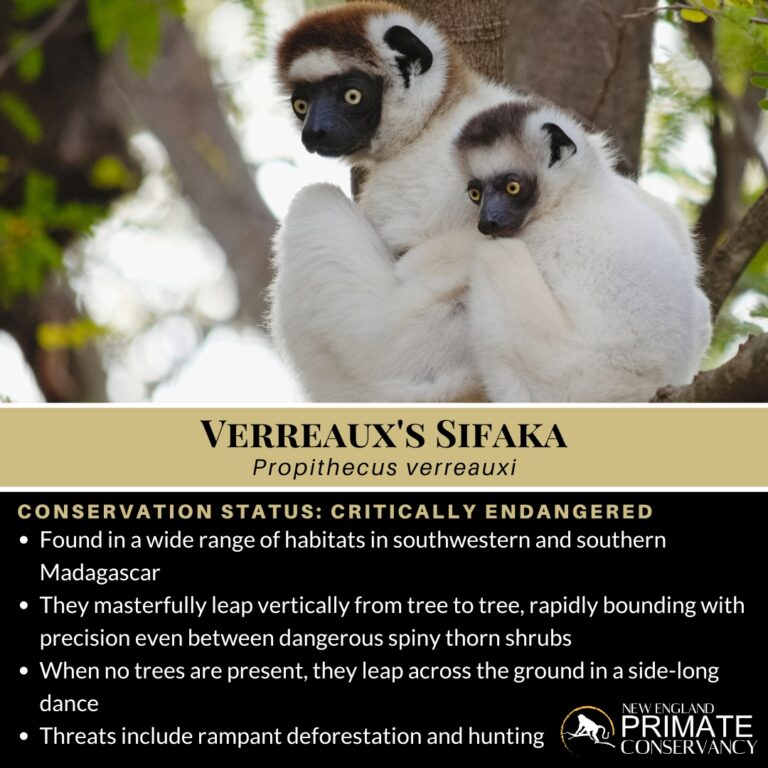
Verreaux’s Sifaka, Propithecus verreauxi
VERREAUX'S SIFAKA
Propithecus verreauxi
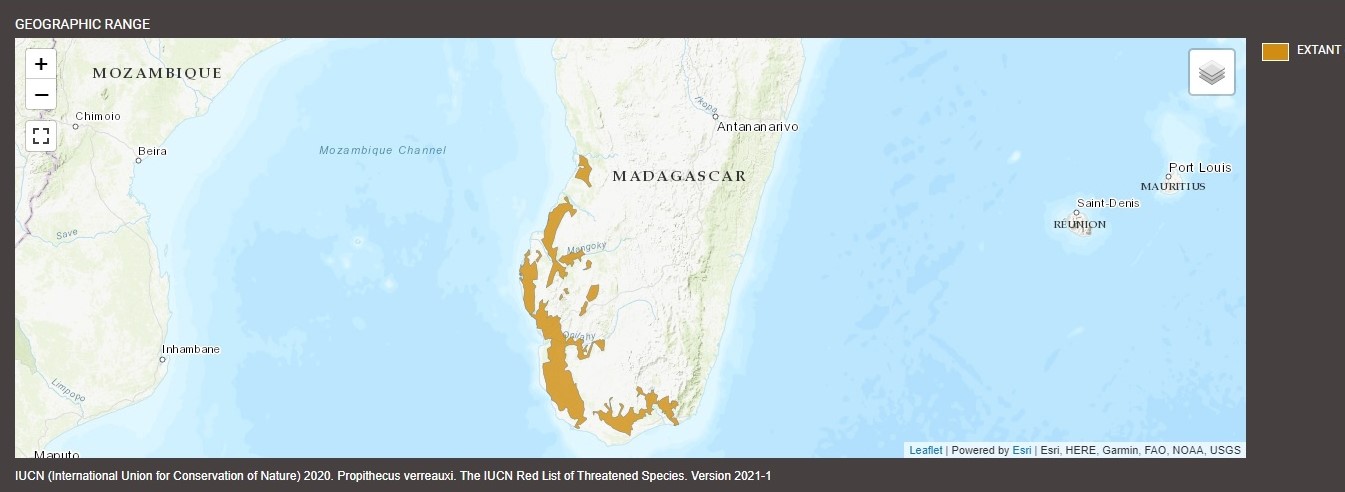
Geographic Distribution and Habitat
The Verreaux’s sifaka, also known as the white sifaka, is a primarily arboreal lemur native to southwestern Madagascar. While most abundant in tropical dry lowland and montane forests, it also inhabits spiny bush, brush and scrub thickets, riparian forests, and even wetter habitats.
Their northern limit is considered to be the Tsiribihina River. Their southeastern limit is shaped by the western slope of the Anosy Mountain range, a boundary formed by Andohahela National Park. East of Andohahela National Park lies Nahampoana, a private reserve that houses a small population of Verreaux’s sifakas. Considering this reserve is not a part of the historical geographical range of this species, this population was likely introduced.
Size, Weight, and Lifespan
The Verreaux’s sifaka is a medium-sized primate. Adults have a head and body length of roughly 16.7–17.7 inches (42.5–45 cm), with a tail that is even longer, measuring 22–24 inches (56–60 cm). Adult females weigh about 7.5 pounds (3.4 kg), and adult males about 7.9 pounds (3.6 kg). In the wild, they typically live 18–23 years, though individuals in captivity can reach up to around 31 years..
Appearance
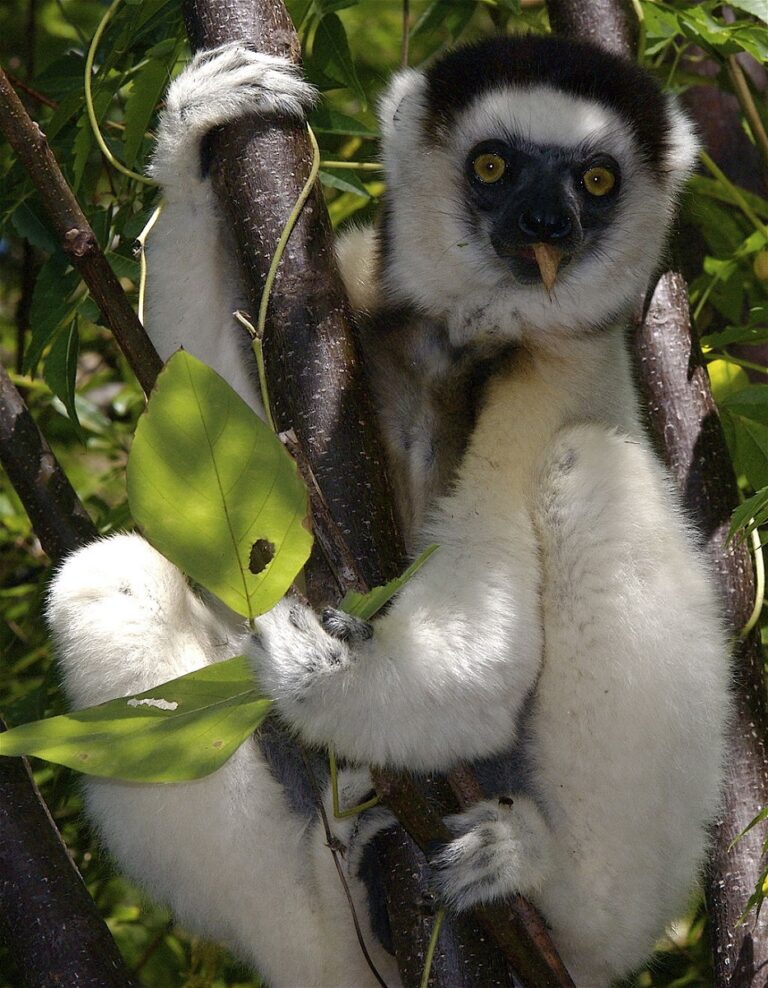
With white fur with a light yellow hue and a hairless, black face, the Verreaux’s sifaka has a very distinct coloration. Their dark face contrasts with their golden-brown eyes. On the back and top of their heads, they have a patch of reddish-brown fur. Fur is thicker dorsally (on their backs), with thinner fur around the chest, belly, underarms, and inner-thighs. They have relatively hairless hands, with hair on the tops of their feet, but not underfoot.
Sifakas belong to the Indriidae family of strepsirrhine primates, which means they are “wet-nosed”. Having a wet rhinarium—the damp surface of their nose—which makes their sense of smell stronger (dogs have this too!). This means that their sense of smell is extremely important!
Additionally, they have a dental comb, or toothcomb, a specialized dental structure made up of their lower front teeth—their incisors and canines—that works like a grooming comb. They use this for fur maintenance and grooming tasks. They also have a specific grooming claw, often called a ‘toilet claw’. This claw is found on the second toe of their foot, which they use for personal grooming, like scratching or parting their fur.
Since they are arboreal (tree-dwelling), they are nimble when making quick and long vertical leaps through the trees; their long tails are used for balancing when leaping from tree to tree. They have pseudo-opposable thumbs, which help to provide a good grip on tree trunks.
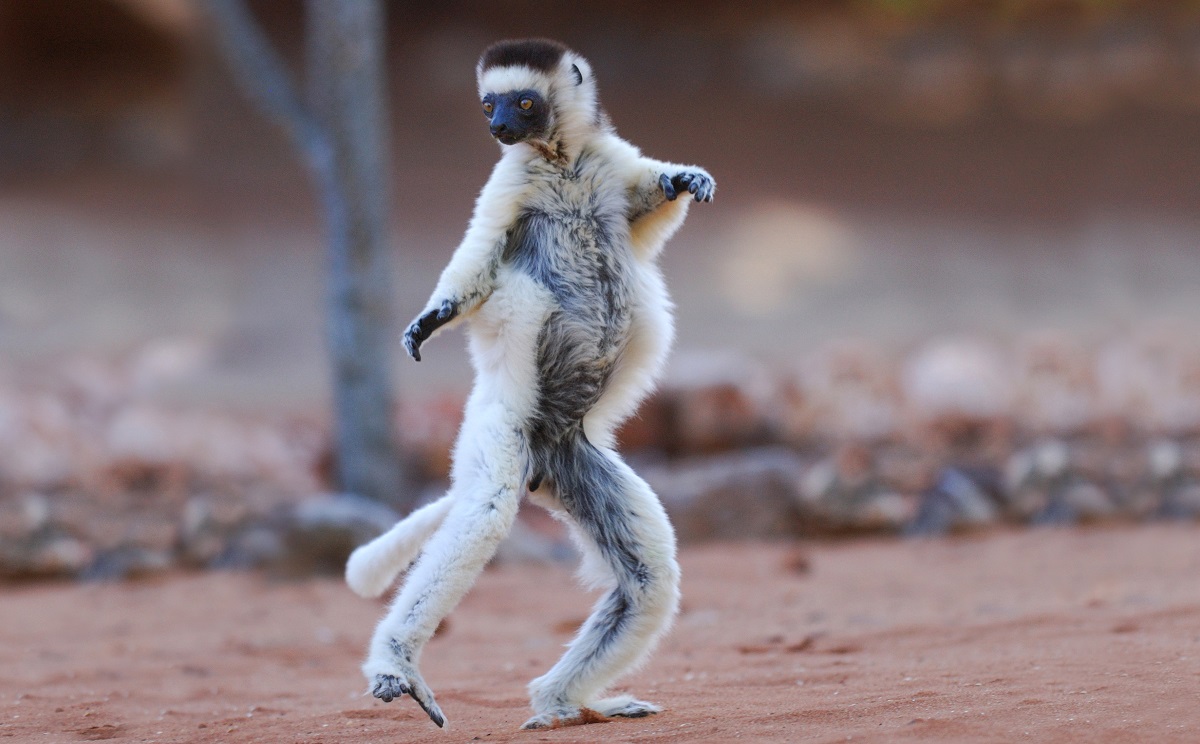
Sifaka have an upright, bipedal posture, holding their arms up while they hop sideways across the ground. This bipedal leaping locomotion technique helps sifaka as they traverse through very different habitat types, whether that be through tropical forests or spiny bush and brush-and-scrub thicket that has little tree cover. Sifakas’ arms are shorter than their legs, which is why they hop—they are built for vertical clinging and leaping.
They are not sexually dimorphic—males and females look very similar, with adult males being slightly heavier on average. Male-male competition has produced slight variations in appearance between males (this is called bimorphism). Some sifaka males are “clean-chested”, while others are “stain-chested” due to a sternal scent gland. Those who scent mark with this gland more frequently develop a browish stain on their chests. Clean-chested males tend to be subordinate or younger, with less marking activity and fewer mating opportunities.
Diet
The Verreaux’s sifaka is primarily herbivorous, feeding mostly on leaves, fruits, and seeds, though it may occasionally consume insects or other minor items. Its diet varies seasonally: young and mature leaves are eaten year-round, while fruit and seeds are consumed when abundant, and flowers and leaves make up a larger proportion in leaner seasons. One study found that their diet consisted of roughly 53% leaves and 38% fruits and seeds. This dietary flexibility allows sifakas to cope with fluctuations in temperature, rainfall, and food availability, making them well-adapted to the variable environments of southwestern Madagascar.
Behavior and Lifestyle
The Verreaux’s sifaka is diurnal, which means they are active during the day. During times of plenty, they travel widely through their home range in search of food. Their activity levels change with the dry and wet seasons. During dry months, when food is scarce, they spend more time resting to conserve energy, but even then, they are alert and mobile, especially when foraging opportunities arise. They eat, groom, sleep in the trees, or sunbathe, warming their bellies in the shining sun. Daily activities are influenced by the southwestern Madagascar’s seasonal environmental changes.
Sifakas use a form of locomotion called vertical clinging and leaping. This allows them to navigate efficiently through arboreal habitats. Using powerful leaps of up to 10 meters (over 30 feet), they move gracefully through the forest by clinging vertically to trunks and launching from tree to tree. On the ground, they employ an unusual bipedal sideways “hopping” gait, which is both distinctive and energy‐conserving.
Sifakas display a wide range of complex social behaviors. Group cohesion is maintained through social grooming, which helps strengthen bonds and reduce tension among members. They also engage in coalition formation, where individuals support one another during conflicts; redirected aggression, when frustration or stress is displaced onto another group member; and formalized dominance interactions that help define social hierarchies.
Shaped by both social dynamics and ecological pressures, sifakas balance cooperation and competition within their groups. When two groups encounter each other, they rely on loud vocalizations and scent marking to assert territory and communicate ownership, often avoiding direct physical confrontation. This strategy allows them to defend their resources while minimizing the risk of injury.
The common name sifaka, pronounced shi-FAH-kah or shi-FAHK, is an onomatopoeia of their distinctive “shi-fak” alarm call.
Despite being Critically Endangered, they are still the most widespread species within the Propithecus genus.
A group of lemurs is called a troop or a conspiracy!
Sifakas live in matriarchal (female-led), cohesive social groups of 2-14 individuals. Groups often include multiple adult females and one or more adult males. The sex ratio may vary across groups and over time.
Groups generally move together, having home ranges of roughly 5.4 acres (2.2 hectares) to 12.4 acres (5.0 hectares), though this varies depending on habitat and available resources. Daily travel distances fluctuate seasonally: during the rainy season, sifaka travel further per day (approximately 0.7 miles or 1,100 m), while in the dry season they travel less (0.47 miles or 750 m), likely due to resource availability. Recent research using satellite vegetation indices has shown that sifakas maintain consistent home ranges and core area sizes year‐round. This means that even under environmental stress, groups try to stay in the same areas and keep their social bonds strong.
Males generally leave the group they were born into, also known as their natal group, at around three years old, prior to becoming fully fledged adults. These males may join a neighboring social group, or they may travel longer distances. Sometimes these males do not leave alone, but with another male, like a brother.
For the most part, females do not leave their natal groups. Additionally, Verreaux’s sifakas exhibit female dominance (this means females have more social power than males).
Sifakas engage in a moderate level of intergroup aggression. Although territorial in defending key feeding areas, their home ranges often overlap. They do not maintain strict or sharply defined territorial boundaries. Instead, neighboring groups may share parts of the same forest, using them at different times. When they encounter one another, they typically rely on vocal displays or scent marking to assert presence rather than engage in physical conflict.
Intergroup encounters occur, often involving vocalizations, scent‐marking, chasing, or, in rare cases, physical aggression—males will frequently chase each other, but very rarely get into fights involving physical contact. One study found that female sifakas participated less often in intergroup encounters when they had dependent infants, likely to reduce the risk of infanticide. Male participation was influenced by social status; that is, dominant males participated in most encounters, whereas males with fewer opportunities to reproduce participated less often. This means that male participation is influenced by the incentive of maintaining access to females. Participation from the home group increases when more individuals from the opposing group get involved.
Sifakas decide to join a given encounter opportunistically, most likely based on a combination of individual incentives and the actual circumstances of each encounter. This individual choice shows that intergroup relationships are very complex!
Like us, sifakas rely on multiple forms of communication. Verreaux’s sifakas use a variety of signals to interact with their environment, fellow group members, and neighboring sifaka groups. These include vocal, chemical (scent-based), visual, and tactile forms of communication.
Their vocalizations serve different purposes, from alarms and territorial calls to intergroup interactions and social “chatter.” Loud, far-carrying barks—sometimes transcribed as “sifaka” or “tchi-fak”—are often produced by the group leader or other high-ranking individuals, particularly in the presence of intruders or during encounters with other groups. These calls help coordinate group defense and maintain social cohesion.
“Chatter” vocalizations are a submissive or subordination signal. A recent study of sifakas found that the “chatter” signal is emitted mostly in peaceful contexts (approximately 63% of usages in such contexts) and helps reduce conflict, increase grooming, and more!
Submissive vocalizations like chatter help reduce uncertainty in social interactions and help minimize conflict. Same-sex pairs, also known as intrasexual dyads, tend to show more peaceful chatters, which are associated with more grooming, less aggression, and stronger social bonds.
Both sexes use scent marking: the anogenital glands, and in males also throat glands, secrete substances used for marking territory, advertising estrus—when a female is sexually receptive—and signaling dominance or sexual advertisement. Stain-chested males rub secretions from their sternal gland onto their chest, signaling dominance and using both visual and chemical cues.
Tactile signals include grooming. Grooming is important socially—to reinforce bonds, reduce tension, and facilitate cooperation. It also plays a role in maintaining hygienic health.
Visual signals, such as chest staining in males, upright postures, facial expressions, and body movements, provide clear cues about status, dominance, and social intent within and between sifaka groups.
Reproduction and reproductive behaviors in sifakas are strongly influenced by environmental conditions and stress. Female reproductive success, measured by births and weaning, is closely linked to body condition during the mating season. This affects both when females breed and the length of time between pregnancies, known as the interbirth interval. Compared with other mammals of similar size, sifaka females give birth later, live longer, and continue reproducing for a longer period than expected. This extended reproductive lifespan may be a form of bet-hedging, an evolutionary strategy that helps them cope with the unpredictable climate and environmental fluctuations of southwestern Madagascar. In other words, sifakas balance the energy they invest in reproduction with the need to survive as adults in a challenging environment.
Group size does not strongly affect how often a female reproduces, but when more females live in the same group, competition for resources can reduce the survival of each female’s offspring. Larger groups may also experience higher stress and infant mortality, though adult survival depends on food availability and environmental conditions.
In contrast, male sifakas become reproductively active earlier than females and generally have shorter lifespans. Verreaux’s sifaka males typically reach sexual maturity around 2.5–3 years old, and many disperse from their natal groups at this time.
Adult males show two distinct forms, or morphs: they are either “clean-chested” or “stain-chested.” Research shows that stain-chested males tend to be more dominant and have higher testosterone levels, while clean-chested males are usually subordinate. This bimorphism acts as a visual and chemical signal of dominance, communicating competitive status to other males and social rank within the group.
Within a social group, stain-chested males are usually dominant or the only adult male. These males also scent-mark more frequently than subordinate males. Clean-chested males are often less central to group activities and spend more time on the edges of the social group. Female interactions with males are influenced by dominance signals, including chest status: females are generally more tolerant of clean-chested males but prefer to mate with dominant, stain-chested males. As a result, dominant males tend to mate more, achieve higher reproductive success, and often guard receptive females to maintain paternity.
Female Verreaux’s sifakas begin reproducing relatively late, around 5.5 years of age. They may continue reproducing for a long span, with the average age at last reproduction around 11–12 years. Females have a relatively short estrus period and may mate with one or multiple males in a breeding season, including both resident and non-resident males. Gestation lasts about 5.5 months, with births usually occurring between June and August. Reproductive success and timing are strongly influenced by environmental conditions, such as food availability and body condition, and females in better condition are more likely to give birth and successfully wean their offspring.
Once a baby sifaka is born, the mother is the primary caregiver. Infants will cling to the mother initially and then gradually begin feeding on solid food as they grow.
One important role of Verreaux’s sifakas is as seed dispersers. When they eat fruits, they carry seeds away from the parent tree and deposit them either by dropping them or through their excrement. This helps seeds germinate in new areas, contributing to the regeneration and maintenance of Madagascar’s biodiverse forests. Because of this ecological role, Verreaux’s sifaka helps sustain the health and diversity of its forest habitat.
Recently, this species has been promoted as a ‘flagship species’ — a charismatic ambassador used to raise support for biodiversity conservation. Such recognition could help secure more resources for protecting the forests of southwestern Madagascar.


The International Union for Conservation of Nature lists the Verreaux’s sifaka as Critically Endangered (IUCN, 2018), appearing on the IUCN Red List of Threatened Species.
It is suspected that over the past 30 years (about 3 generations), the population of this species has been reduced 80%. This, and further, population decline of the Verreaux’s sifaka is due to a decline in available habitat and a decrease in the quality of available habitat. Slash-and-burn agriculture, logging of riparian and gallery forest, charcoal and fuel wood production, the setting of fires—whether deliberate or accidental—to create open savannah for cattle grazing, selective logging, and exploitation as a result of unsustainable hunting practices. Because of these aforementioned causes, it is expected that the effect will be a continuous population reduction toward 90% over the next 30 years. This species is listed as Critically Endangered because of this inferred continued population reduction.
Malagasy primates live in highly fragmented forest habitats. For this reason, it is important to understand how edge effects affect lemur populations and dynamics. A study on Verreaux’s sifaka in Kirindy found that while these lemurs survive and reproduce in forest edge habitat, they appear to have a negative forest edge response; that is, they are sensitive to changes in the microhabitat conditions at the forest edge.
The Verreaux’s sifaka is listed in Appendix I of the Convention on International Trade in Endangered Species (CITES), an international agreement between governments whose goal is to ensure that international trade in specimens of wild animals and plants does not threaten their survival.
Of the roughly 107 lemur species endemic to Madagascar, it is estimated that the Verreaux’s sifaka is one of 103 are threatened by extinction! Because of this, there are great conservation efforts to help protect this species and their habitat. NGO leaders, scientists, and governmental organizations are forming a dry forest alliance in order to streamline conservation efforts for this valuable biome. One of the first actions this alliance pushed was promoting the Verreaux’s sifaka as a “flagship” species. In conservation biology, a flagship species is a species chosen to raise support for biodiversity conservation in a given place or social context. They hope this will bring attention to these primates on a global scale.
At the International Primatological Society (IPS) congress, which was held from the 2nd-9th August 2025, primatologist Rebecca Lewis and the organization she founded, Ankoatsifaka Initiative for Dry Forests (AID Forests), advocated for the inclusion of the Verreaux’s sifaka in the Primates in Peril, The World’s 25 Most Endangered Primates.
Research is being done to better understand this lemur, and how drive conservation for their continued survival. One such research project is the Sifaka Research Project that works in conjunction with the Ankoatsifaka Research Station to conduct research in the Kirindy Mitea National Park (KMNP). This research is conducted under the supervision of Rebecca Lewis of the University of Texas’s Department of Anthropology.
Because poverty, food insecurity, and malnutrition are common pressures for Malagasy people, there must be a conservation approach that includes infrastructure beneficial to the local peoples and the environment. KMNP is employing a strong community-based participatory approach that includes local communities in the research process. The focus is to utilize (and value) local experience, perspectives, and connection to the land, for the conservation of both the people and the wildlife.
World Wildlife Fund (WWF) trains and works with community patrollers, called polisin’ala, in Madagascar, to monitor the Amoron’i Onilahy Protected Area. The polosin’ala record population numbers, lemur behavior, forest health, and report illegal activity in the area.
- https://nc.iucnredlist.org/redlist/content/attachment_files/summary_sheet_en_web.pdf
- http://animalia.bio/verreauxs-sifaka
- https://www.worldwildlife.org/magazine/issues/winter-2024/articles/in-madagascar-community-members-help-protect-a-rare-lemur
- https://animalia.bio/verreauxs-sifaka
- https://dukespace.lib.duke.edu/server/api/core/bitstreams/3a4d5e5a-1de4-4119-b243-073aa1435e3f/content
- Amoron’i Onilahy Protected Area. (n.d.). WWF. https://www.wwf.mg/?18050941/Amoroni-Onilahy-Protected-Area
- A gaggle, a confusion and a conspiracy – bizarre animal collective group names. (2019, June 6). BBC Newsround. https://www.bbc.co.uk/newsround/48539466
- ANAge: the animal aging and longevity database: https://genomics.senescence.info/species/entry.php?species=Propithecus_verreauxi
- Ankel-Simons, F. (2007). Primate anatomy: An Introduction. Elsevier. 3rd Ed. Chapter 7, p.223-281.
- Ankoatsifaka Research Station – Just another Labs Sites site. (n.d.). https://labs.la.utexas.edu/ankoatsifaka/
- Axel, A. C., Harshbarger, B. M., Lewis, R. J., & Tecot, S. R. (2024). Consistency in Verreaux’s sifaka home range and core area size despite seasonal variation in resource availability as assessed by Enhanced Vegetation Index (EVI). American Journal of Primatology, 86(6). https://doi.org/10.1002/ajp.23617
- Benadi, G., Fichtel, C., & Kappeler, P. (2008). Intergroup relations and home range use in Verreaux’s sifaka (Propithecus verreauxi). American Journal of Primatology, 70(10), 956–965. https://doi.org/10.1002/ajp.20588
- Brockman, D.K., & Whitten, P.L. (1996). Reproduction in free-ranging Propithecus verreauxi: Estrus and the relationship between multiple partner matings and fertilization. American Journal of Physical Anthropology, 100(1), p. 57-69. https://doi.org/10.1002/(SICI)1096-8644(199605)100:1%3C57::AID-AJPA6%3E3.0.CO;2-A
- CONVENTION ON INTERNATIONAL TRADE IN ENDANGERED SPECIES OF WILD FAUNA AND FLORA. (2023). CONVENTION ON INTERNATIONAL TRADE IN ENDANGERED SPECIES OF WILD FAUNA AND FLORA. In Appendices I, II and III (pp. 1–4). https://cites.org/sites/default/files/eng/app/2023/E-Appendices-2023-05-21.pdf
- Dall’Olio, S. & Antonacci, D. & Norscia, Ivan & Palagi, Elisabetta. (2011). Brown or White? Sexual Bimorphism in Sifaka Males’ Chests May Reflect Females’ Mating Choice. Folia Primatologica. 82. 274-274.
- Dall’Olio S, Norscia I, Antonacci D, Palagi E (2012) Sexual Signalling in Propithecus verreauxi: Male “Chest Badge” and Female Mate Choice. PLOS ONE 7(5): e37332. https://doi.org/10.1371/journal.pone.0037332
- Dinter, K., Heistermann, M., Kappeler, P. M., and Fichtel, C.: Life on the edge: behavioural and physiological responses of Verreaux’s sifakas (Propithecus verreauxi) to forest edges, Primate Biol., 8, 1–13, https://doi.org/10.5194/pb-8-1-2021, 2021.
- Greene, L.K., Blanco, M.B., Farmer, C. et al. Dietary and Nutritional Selections by Ecologically Diverse Lemurs in Nonnative Forests. Int J Primatol 45, 947–950 (2024). https://doi.org/10.1007/s10764-024-00428-4
- Guevara, E. E., Webster, T. H., Lawler, R. R., Bradley, B. J., Greene, L. K., Ranaivonasy, J., Ratsirarson, J., Harris, R. A., Liu, Y., Murali, S., Raveendran, M., Hughes, D. S. T., Muzny, D. M., Yoder, A. D., Worley, K. C., & Rogers, J. (2021). Comparative genomic analysis of sifakas ( Propithecus ) reveals selection for folivory and high heterozygosity despite endangered status. Science Advances, 7(17). https://doi.org/10.1126/sciadv.abd2274
- Irwin, Mitchell & Rahalinarivo, Vololonirina & Ramorasata, Bruno & Raharison, Jean‐Luc & Ranaivoarisoa, Jean‐Freddy & Gherardi, Chloé & Rothman, Jessica. (2025). More Choosy for Minor Foods: Diet, Seasonality and Food Selection in Sympatric Frugivorous and Folivorous Lemurs. Ecology and Evolution. 15. 10.1002/ece3.71069.
- Junge, R. E., Williams, C. V., & Campbell, J. (2009). Nutrition and behavior of lemurs. Veterinary Clinics of North America Exotic Animal Practice, 12(2), 339–348. https://doi.org/10.1016/j.cvex.2009.01.011
- Kappeler, P. M. (1990). Female dominance in lemurs: A case for social role reversal. Behavioral Ecology and Sociobiology, 27(6), 361–372.
- Kappeler, P. M., & Fichtel, C. (2024). Independent fitness consequences of group size variation in Verreaux’s sifakas. Communications Biology, 7(1). https://doi.org/10.1038/s42003-024-06484-z
- Kappeler, P. M., Pethig, L., Prox, L., & Fichtel, C. (2022). Reproductive senescence in two lemur lineages. Frontiers in Ecology and Evolution, 10. https://doi.org/10.3389/fevo.2022.894344
- Kappeler, P. M., & Schäffler, L. (2008). Dispersal patterns of Propithecus verreauxi verreauxi in Kirindy Forest, Madagascar. International Journal of Primatology, 29(2), 521–539.
- Koch, U., Ganzhorn, J. U., & Rothman, J. M. (2005). Changes in feeding ecology and activity patterns of Verreaux’s sifaka (Propithecus verreauxi) in the dry season. International Journal of Primatology, 26(5), 1131–1146.
- Koch, F., Signer, J., Kappeler, P. M., & Fichtel, C. (2016). Intergroup encounters in Verreaux’s sifakas (Propithecus verreauxi): who fights and why? Behavioral Ecology and Sociobiology, 70(5), 797–808. https://doi.org/10.1007/s00265-016-2105-3
- Lawler, R. R. (2006). Fitness and extra‐group reproduction in male Verreaux’s sifaka: An analysis of reproductive success from 1989–1999. American Journal of Physical Anthropology, 132(2), 267–277. https://doi.org/10.1002/ajpa.20507
- Leimberger, K. G., & Lewis, R. J. (2015). Patterns of male dispersal in Verreaux’s sifaka (Propithecus verreauxi) at Kirindy Mitea National Park. American Journal of Primatology, 79(7), e22455. https://doi.org/10.1002/ajp.22455
- Lewis, R. J. (2008). Social Influences on Group Membership in Propithecus verreauxi verreauxi. International Journal of Primatology, 29(5), 1249–1270. https://doi.org/10.1007/s10764-008-9304-3
- Lewis, R. J. (2009). Chest staining variation as a signal of testosterone levels in male Verreaux’s Sifaka. Physiology & Behavior, 96(4–5), 586–592. https://doi.org/10.1016/j.physbeh.2008.12.020
- Lewis RJ. Subordination signals improve the quality of social relationships in Verreaux’s Sifaka: Implications for the evolution of power structures and social complexity. Am J Phys Anthropol. 2019 Aug;169(4):599-607. doi: 10.1002/ajpa.23876. Epub 2019 Jun 18. PMID: 31211415.
- Lewis, R. J., Bueno, G. L., & Di Fiore, A. (2022). Variation in female leverage: The influence of kinship and market effects on the extent of female power over males in Verreaux’s Sifaka. Frontiers in Ecology and Evolution, 10. https://doi.org/10.3389/fevo.2022.851880
- Lewis RJ, Kappeler PM. Seasonality, body condition, and timing of reproduction in Propithecus verreauxi verreauxi in the Kirindy Forest. Am J Primatol. 2005 Nov;67(3):347-64. doi: 10.1002/ajp.20187. PMID: 16287105.
- Lewis, R.J., van Schaik, C.P. Bimorphism in Male Verreaux’s Sifaka in the Kirindy Forest of Madagascar. Int J Primatol 28, 159–182 (2007). https://doi.org/10.1007/s10764-006-9107-3
- Mass, V., Heistermann, M., & Kappeler, P. M. (2009). Mate-Guarding as a Male Reproductive Tactic in Propithecus verreauxi. International Journal of Primatology, 30(3), 389–409. https://doi.org/10.1007/s10764-009-9345-2
- Mayor, M. I., Sommer, J. A., Houck, M. L., Zaonarivelo, J. R., Wright, P. C., Ingram, C., Engel, S. R., & Louis, E. E., Jr. (2004). Specific Status of Propithecus spp. International Journal of Primatology, 25(4), 875–900. https://doi.org/10.1023/b:ijop.0000029127.31190.e9
- Mittermeier RA, Louis EE, Richardson M, Schwitzer C, Langrand O, Rylands AB, Hawkins F, Rajaobelina S, Ratsimbazafy J, Rasoloarison R, Roos C, Kappeler PM, Mackinnon. 2010. Lemurs of Madagascar, 3rd ed. Washington, DC: Conservation International.
New England Primate Conservancy. (2025, March 13). Lemurs—Prosimians of Madagascar [Video]. YouTube. https://www.youtube.com/watch?v=2i3SHCDex5A
Norscia, Ivan; Palagi, Elisabetta (2016). The Missing Lemur Link: An Ancestral Step in the Evolution of Human Behaviour. United Kingdom: Cambridge University Press. p. 39. ISBN 978-1-107-01608-8
- Omaha et al., 2018). IUCN Red List of Threatened Species: Propithecus verreauxi. IUCN Red List of Threatened Species. https://www.iucnredlist.org/species/18354/115572044
- Palagi, E., Antonacci, D., & Norscia, I. (2008). Peacemaking on treetops: First evidence of reconciliation from a wild prosimian (Propithecus verreauxi). Animal Behaviour, 76(3), 737–747.
- Perofsky, A. C., Lewis, R. J., Abondano, L. A., Di Fiore, A., & Meyers, L. A. (2017). Hierarchical social networks shape gut microbial composition in wild Verreaux’s sifaka. Proceedings of the Royal Society B Biological Sciences, 284(1868), 20172274. https://doi.org/10.1098/rspb.2017.2274
- Primate taxonomy. (2006). Encyclopedia of Anthropology. https://doi.org/10.4135/9781412952453.n736
- Propithecus verreauxi (Verreaux’s sifaka). (n.d.). Animal Diversity Web. https://animaldiversity.org/accounts/Propithecus_verreauxi/
- Propithecus verreauxi Verreaux’s Sifaka — Coke Smith Wildlife. (n.d.-b). Coke Smith Wildlife. https://www.cokesmithwildlife.com/propithecus-verreauxi-verreauxs-sifaka
- Rakotovao, M. & Gyuse, T. (2025, September 15). Madagascar’s dry forests need attention, and Verreaux’s sifakas could help. Mongabay Environmental News. https://news.mongabay.com/2025/09/madagascars-dry-forests-need-attention-and-verreauxs-sifakas-could-help/
- Richard, A. F., Dewar, R. E., Schwartz, M., & Ratsirarson, J. (2000). Mass change, environmental variability and female fertility in wild Verreaux’s sifaka. Proceedings of the National Academy of Sciences, 97(6), 319–324.
- Richard, A. F., Dewar, R. E., Schwartz, M., & Ratsirarson, J. (2002). Life in the slow lane? Demography and life histories of male and female sifaka (Propithecus verreauxi verreauxi). Journal of Zoology, 256(4), 421-436.
- Richard, A. F., Rakotomanga, P., & Schwartz, M. (1991). Demography of Propithecus verreauxi at Beza Mahafaly, Madagascar. American Journal of Physical Anthropology, 84(4), 307–322.
- Richard, A. F., Rakotomanga, P., & Schwartz, M. (1993). Demography of Propithecus verreauxi at Beza Mahafaly, Madagascar: Sex ratio, survival, and fertility. American Journal of Physical Anthropology, 92(3), 307–321.
- Romanello, D. M. (2024). Protected area effectiveness: wildlife conservation and human well-being in Kirindy Mitea National Park, Madagascar. Texas ScholarWorks. (Doctoral dissertation). doi:10.26153/tsw/54298
Romanello, D., Thompson, K. E., Borgerson, C., Randriamanetsy, J. M., Andriamavosoloarisoa, N. N., Andrianantenaina, M. Y., … Lewis, R. J. (2023). A nuanced examination of primate capture and consumption and human socio-economic well-being in Kirindy Mitea National Park, Madagascar. Animals, 13(18), 2914. doi:10.3390/ani13182914
- Saneda, T. M. (2022, December 31). The Strepsirrhini. Biological Anthropology: A Brief Introduction. https://openwa.pressbooks.pub/anth205bioanth/chapter/strepsirrhini/
- Schröder, J. M., Rodríguez, L. P. Á., & Günter, S. (2021). Research trends: Tropical dry forests: The neglected research agenda? Forest Policy and Economics, 122, 102333. doi:10.1016/j.forpol.2020.102333
- The teeth of mammalian vertebrates. (2018). In Elsevier eBooks. https://doi.org/10.1016/c2014-0-02212-5
Written by Gabriella Giannone, Sep 2025