
Wied’s Marmoset, Callithrix kuhlii
WIED'S MARMOSET
Callithrix kuhlii
Geographic Distribution and Habitat
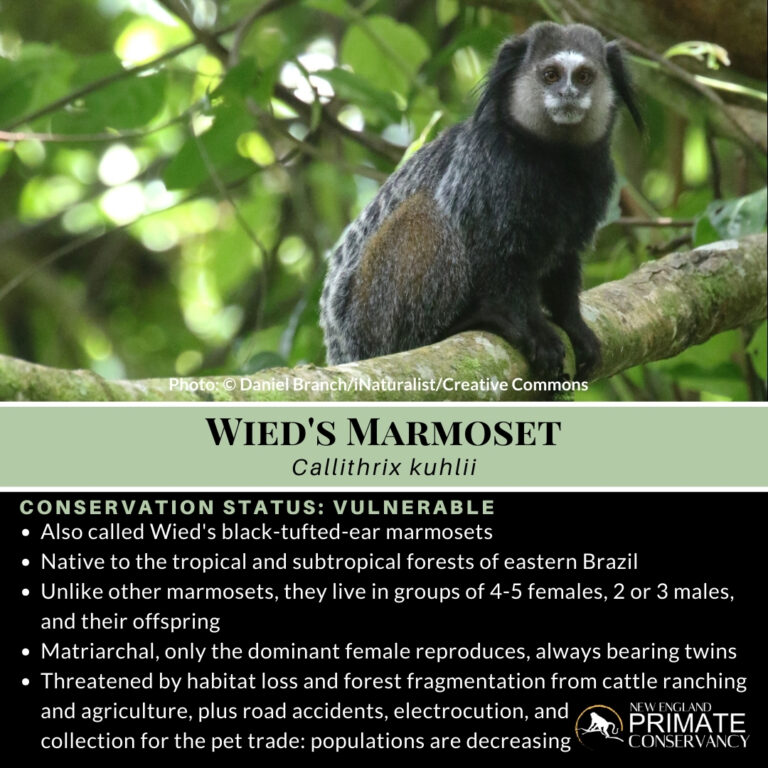
The Wied’s marmoset, also known as Wied’s black-tufted ear marmoset and scientifically as Callithrix kuhlii, is native to Brazil. They can be found between the municipalities of Rio de Contas and Rio Jequitinhonha in southern Bahia, a state on the eastern side of the country. The lowest elevation for their homes lies at about 13 feet (4m) and as high as 2,917 feet (889m). With their habitat entering just the north-easternmost tip of the state of Minas Gerais, the monkeys live within the range of the Atlantic coastal forest. Within this forest system, they occur in lowland and sub-montane humid forests, in seasonal (also known as mesophytic) rain forests, and in resting and white sand piaçava forests (which are known for the piaçava palm tree). Wied’s marmosets are very adaptable and have even been found in cabruca (cacao) plantations that have some remnants of their original native flora. They have also been found in secondary growth forest in abandoned rubber plantations. Due to their adaptability, Wied’s marmosets are able to live in a variety of environments with very different climates and weather patterns. With some areas of their habitat completely lacking a dry season, to some that have a dry season, to areas that have rainfall as low as 39.4 inches (1,000 mm) per year.
The range of the Wied’s marmoset overlaps with that of the golden-headed lion tamarin (Leontopithecus chrysomelas), with these two species considered “sympatric” or overlapping in habitat boundaries.

Size, Weight, and Lifespan
Wied’s marmosets are relatively small monkeys; their body measures 8 to 8.5 in (20.2 to 21.6 cm), and their tail measures 11 to 12 in (27.9 to 30.5 cm). They weigh just under one pound, between 0.66 and 0.88 lb (10.6 and 14 oz).
The average lifespan of the Wied’s marmoset in captivity differs by sex, with males averaging 8.7 years of age and their female counterparts at 7.4 years. While their average age in captivity is just below the age of 10, males have been observed to live up to 14 years and females up to 16 years. In the wild, they can live up to 10 years of age.
Appearance
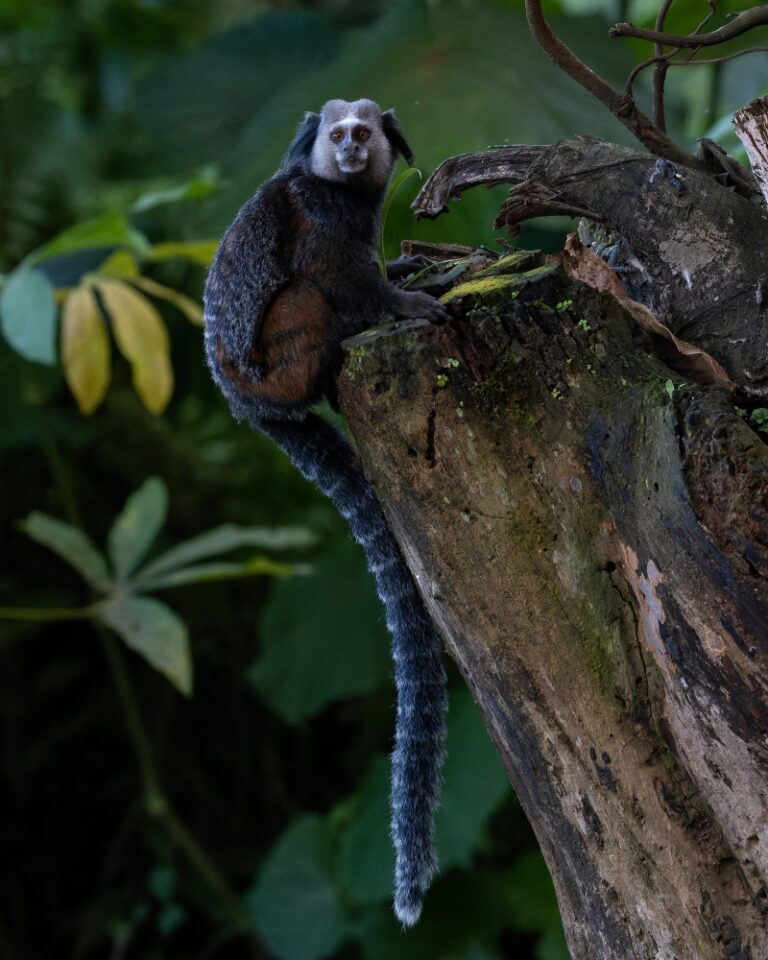
Wied’s marmosets are black and gray fluffy monkeys. The fur on their bodies is darker than the fur on their heads. On their cheeks and forehead are white lines that distinguish them from other marmosets. Black tufts by their ears earn their names “Wied’s black-tufted ear marmoset”. Their backs are covered in lighter stripes that become more intense towards their tails. Their striped tails are non-prehensile, meaning they are used for balance and not grasping. Their nails are more like claws, and since they use their teeth to extract food, they have less of a need for opposable thumbs. Even without it, their hands help them grasp tree branches as they jump from tree to tree.
Wied’s marmosets’ teeth are very important for their survival. Canines on their upper jaw are like short tusks and function like chisels to get through thick tree bark. On their lower jaw are the specialized incisors that scrape up as the canines chisel down. Their jaws are wide to accommodate this unique motion.
Diet
Wied’s marmosets dine on fruits, nectars, exudates (gums, saps, and latexes), and some animal prey such as insects, frogs, snails, lizards, and spiders. Out of the different marmoset groups, they eat the most variety of fruits and will consume more fruits and flowers during the wet season, but will save the exudates for the dry season. As for insects and other animals, Wied’s marmosets hunt by slowly scanning their environment and pouncing on unsuspecting prey.
Exudates, which are gum, saps, and latexes that come out of trees when injured, are what is called a “fallback food” for the Wied’s marmoset. These are foods that animals can rely on when there’s a dry spell or when things get tough. To ensure that they can always access exudates, Wied’s marmosets have very specially adapted teeth which allow them to gouge into trees and extract their meal. Unlike many other exudate feeders, Wied’s marmosets extract the exudates themselves, instead of eating already excreted gums, saps, or latexes left by insects. By using their teeth, Wied’s marmosets gouge the bark of the tree, which eventually starts to leak. Once a hole has been gouged, the marmosets eat what they can and then scent-mark the hole to claim their food resource.
Behavior and Lifestyle
Wied’s marmosets find home in ranges that are on the larger end for Callithrix. These home ranges, approximately 25 acres (10 ha) and can reach up to about 99 acres (40 ha), are centered on a principal exudate tree. Since exudates are one of their most important sources of food, they build their lives around at least one principal tree to ensure food security.
Wied’s marmosets are matriarchal, and the dominant female is the only reproductive female in the group. Wied’s marmosets are sometimes called “socially monogamous,” meaning they may appear to mate for life. On the contrary, Wied’s marmosets are actually polyandrous, meaning females have multiple mates.
Every mating season, there is a breeding pair who becomes co-dominant in the group, getting dibs on all the best food. In many cases, all the mates of the dominant female pull their weight and care for the offspring without knowing whether or not the offspring is theirs. In other words, Wied’s marmosets are cooperative breeders. Not only do the males participate by carrying the babies and tending to them, but the females of the group will help raise the offspring, too. In fact, less dominant females can become anovulatory, meaning they cannot bear offspring while the infants need care.
The Wied’s marmoset is named after German naturalist, explorer, and ethnologist Prinz Maximilian zu Wied-Neuwied, who first discovered the species during his travels to Brazil in 1815–1816.
Wied’s marmosets only have twins.
They do not have prehensile tails.
Wied’s marmosets gouge out holes in trees to sip sap, gum, or nectar. They do this using their specialized canine and incisor teeth.
Wied’s marmosets live in small extended family groups of 4 to 15 individuals, with an average group sitting of 4 to 7 monkeys. Each of these groups is very tightly knit, and each Wied’s marmoset family group contains typically 1 reproductive female, 1 to 2 adult males, 0 to 1 nonreproductive adult females, and 0 to 3 subadults, juveniles, or infants.
Within their home ranges, Wied’s marmosets travel or stay stationary for most of the day. When travelling across forests, they use all fours to grasp onto trees and use their tails for balance. Much like a squirrel jumping from tree to tree. Less than ten percent of their day is spent searching for exudates, fruits, and nectars, and they will spend a slightly smaller amount of time hunting for insect, amphibian, or snail prey.
Each night, different bromeliads and vine tangles are their choice of a comfy, cozy bed. Weid’s marmosets cuddle up together in a new place every night with the understanding that the more monkeys, the better the protection from hawks, snakes, jaguars, and ocelots.
Wied’s marmosets are social creatures. To reinforce their friendships and keep their family groups close, marmosets will groom one another. Since their group is small and well connected, groups are known to be territorial, using their chest or genital/anal glands to mark territory. Wied’s marmosets have been observed to become angry and start fights that can last hours when encountering neighboring groups.
While afraid of their larger predators, Wied’s marmosets are feisty and will mob or attack them on occasion. One recorded incident details a collaboration with a group of golden-headed lion tamarins (Leontopithecus chrysomelas) where they mobbed a cat together, vocalizing loudly above the animal.
Wied’s marmosets use vocalizations, body language, and olfactory (scent) cues to communicate.
For vocalizations, marmosets are known for using phee calls, multisyllabic long-distance calls used for territorial encounters, social isolation, and mate attraction. Since the phee call is so versatile, the identity of the individual making the phee call is very important, and among Wied’s marmosets, this specific call has sex differences. When phee calls are emitted by males, marmosets react with higher vigilance behaviors than if a female emitted the call, indicating that males may be tasked with guarding the group.
Other types of vocalizations include tsiks, twitters, trills, seeps, and infant cries. While not directly documented in Wied’s marmosets, these vocalizations are used by other closely related marmoset species. The use of each of these calls varies by age and is used in different scenarios. In more aggressive group interactions, phee calls, loud tsiks, and twitters can be heard.
Body and facial language are also forms of communication. In aggressive encounters, Wied’s marmosets will posture, which means making themselves look bigger, and will make eye contact with their opponent.
For communication through olfaction or scent, Wied’s marmosets have designated scent glands to mark territory, signal social status, or attract mates. These glands are in their chest and genital/anal areas. On the flip side, they also have an organ in their nose that allows them to be more sensitive to scents, called the vomeronasal organ. This organ is sensitive to the chemistry of smell and helps the marmosets understand why the scent is there and who left it.
Weid’s marmoset offspring, similar to other marmosets, are always born in pairs. Due to the unique structure of their reproduction, pairs can be biologically identical or fraternal twins, or they can be genetic step-siblings. The step-siblings could be from two different fathers. Scientists believe this genetic confusion, of not knowing who the father is, makes it so that cooperative breeding exists in this species. If the father does not know who their child is, but there’s a high chance that one baby of the pair is his, to make sure his child survives, he should care for all the offspring birthed by his mate. Males are very important in raising the offspring, taking the baby on their back while the mom goes to find food.
Comprising 25% of the mother’s body weight, a pair of twins is born twice per year. The cycle repeats on the half-year mark, with gestation lasting 4 and a half months and a period of infertility following 5-12 days after birth. After those few days, the previously pregnant dominant female or a newly dominant female will mate and become pregnant, beginning the cycle again. After the twins are born, in 4 to 6 months, they are weaned, meaning they are no longer solely relying on their mother or other parental figures. They are fully independent at one year, and a little over a year old marks sexual maturity. Once they become adults, both male and female Wied’s marmosets have been observed to leave their natal, or home, groups in search of a mate.

Wied’s marmosets contribute to their environment like all other animals, preying on animals and being preyed upon by other animals. Their presence helps keep the precarious balance of an ecosystem. As exudate consumers, Wied’s marmosets also leave holes in trees for other animals to eat leftover gums, saps, or latex. Since they also eat a large amount of fruit, the seeds they process through their digestive system to be eventually defecated out, provide a means for fruit trees to bloom in new places. As flower eaters, they also participate in the important job of pollinating the environment they live in.


The International Union for Conservation of Nature lists the Wied’s marmoset as Vulnerable (IUCN, 2015), appearing on the IUCN Red List of Threatened Species.
The population of the Wied’s marmoset is decreasing. Sitting at about 10,000 individuals currently, more than 30% of the population has diminished within the last 18 years. The main causes for the decrease in their population are disappearing forest habitats, the ongoing pet trade, and the hybridization (joining) of this species with other marmoset species.
The main threat to the Wied’s marmoset is habitat destruction and forest fragmentation. In the Western part of their range, the increase in cattle ranches and agriculture in the area has severely fragmented habitable forest areas.
The pet trade and accidents caused by human infrastructure also contribute to the declining population. Wied’s marmosets are very cute creatures and have been sold as pets. Keeping monkeys as pets is not only strenuous on the animal itself but can cause social issues to the group left behind when they are taken from their tight-knit family units. Due to the increase of these monkeys in more urban spaces, traffic accidents and electrocutions have led to a non-insignificant loss of life.
Lastly, hybridization, or mixing, with other marmoset species erases the Wied’s marmoset on a genetic level. The culprits are the invasive species of the common marmoset (Callithrix jacchus) and the black-tufted marmoset (Callithrix penicillata).
The Wied’s marmoset is listed in Appendix II of the Convention on International Trade in Endangered Species (CITES), an international agreement between governments whose goal is to ensure that international trade in specimens of wild animals and plants does not threaten their survival.
Many populations of Wied’s marmosets exist in strictly protected lands. Namely, Una Biological Reserve, Serra do Conduru State Park, Serra das Lontras National Park, and Una Wildlife Refuge. They are also loosely protected in areas that are well-maintained and managed. Lemos Maia Experimental Station, Canavieiras Experimental Station, and Djalma Bahia Experimental Station are some areas where Wied’s marmosets are considered safe.
Brazilian organization AMAP, or the Almada Mata Atlântica Project, works to protect biodiversity in the Atlantic Forest. While mainly focusing on golden-headed lion tamarin, they have pioneered projects of reforestation and supported local communities that work to promote biodiversity, which helps all the animals, including the Wied’s marmoset.
For Wied’s marmosets caught up in the pet trade, no direct species-specific protection exists. However, there are numerous initiatives across Brazil calling for the end of the marmoset pet trade. A national non-governmental organization, Rede Nacional de Combate ao Tráfico de Animais Silvestres, or RENCTAS, works to inform people and eventually put an end to all pet trading coming out of Brazil.
To further increase the positive effects of organizations such as AMAP and RENCTAS, scientists recommend local education initiatives, alternative livelihoods from wildlife trafficking, establishing new protected areas, providing increased funding for forest rangers, and lastly, stronger legislation to protect the biodiversity of Brazil and, in turn, the Wied’s marmoset.
- IUCN redlist Wied’s marmoset
- Raboy, B.E., Canale, G.R. & Dietz, J.M. Ecology of Callithrix kuhlii and a Review of Eastern Brazilian Marmosets. Int J Primatol 29, 449–467 (2008). https://doi.org/10.1007/s10764-008-9249-6
- Rylands, Anthony. (1984). Exudate-eating and tree-gouging by marmosets (Callitrichidae, Primates).
- Smith AS, Birnie AK, Lane KR, French JA. Production and perception of sex differences in vocalizations of Wied’s black-tufted-ear marmosets (Callithrix kuhlii). Am J Primatol. 2009 Apr;71(4):324-32. doi: 10.1002/ajp.20656. PMID: 19090554; PMCID: PMC2981084.
- Wisconsin National Primate Research Center: Common Marmoset
- Rylands, Anthony. (1989). Sympatric Brazilian callitrichids: The Black Tufted-Ear Marmoset, Callithrix kuhli, and the Golden-headed Lion Tamarin, Leontopithecus chrysomelas.
- AMAP Brazil
- Wikipedia: Wied’s Marmoset
- Wikipedia: Callithrix
- Adelmar F. Coimbra-Filho, Russell A. Mittermeier, Anthony B. Rylands, Sérgio L. Mendes, M. Cecília M. Kierulff, Luiz Paulo de S. Pinto “The Taxonomic Status of Wied’s Black-tufted-ear Marmoset, Callithrix kuhlii (Callitrichidae, Primates),” Primate Conservation, 2006(21), 1-24, (1 August 2006)
Written by Nami Kaneko, Sep 2025