
Bolivian Gray Titi, Plecturocebus donacophilus
BOLIVIAN GRAY TITI
Plecturocebus donacophilus
Geographic Distribution and Habitat
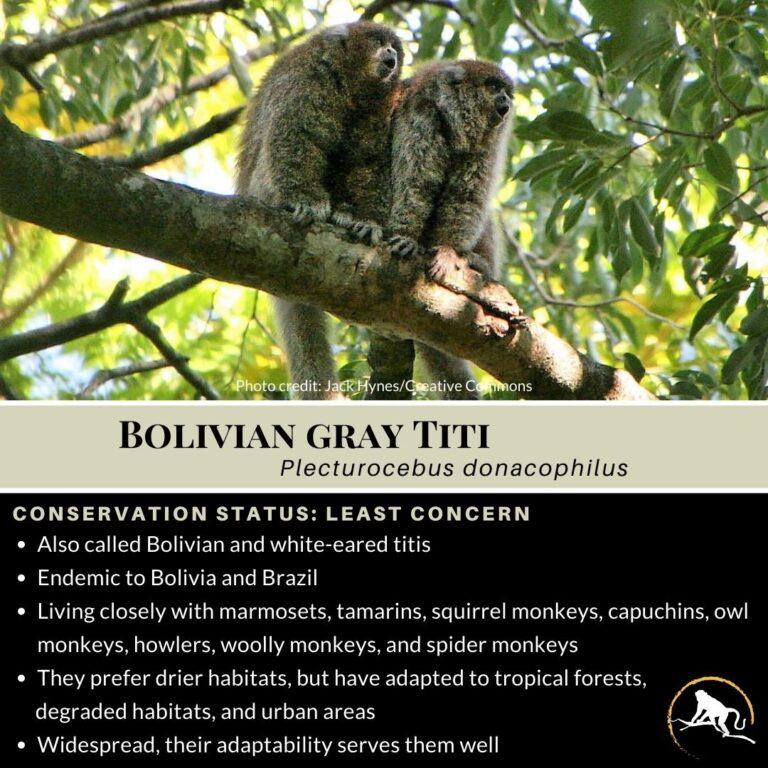
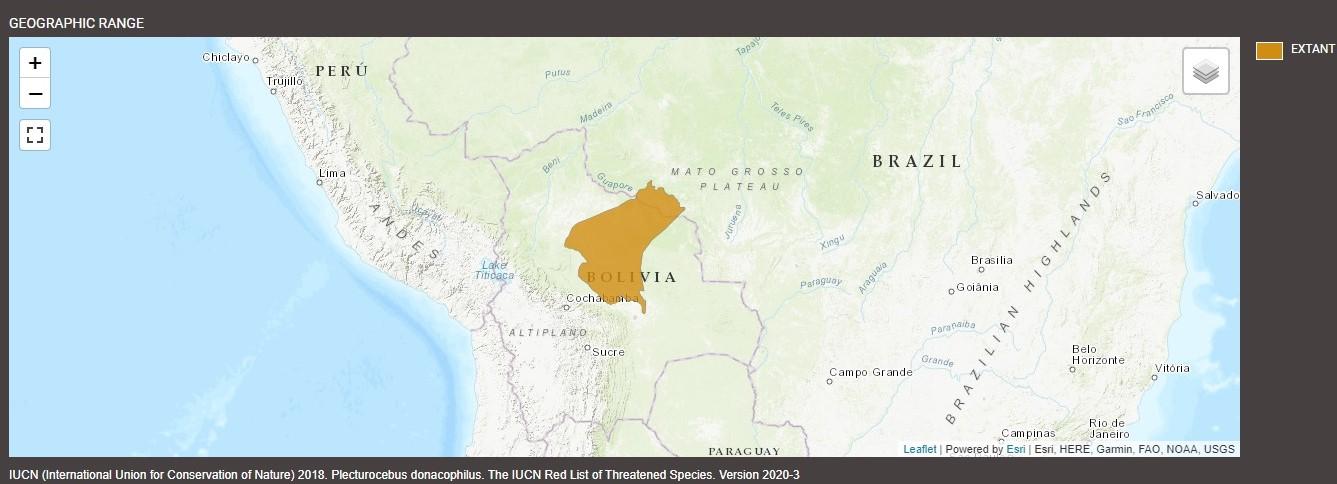
The Bolivian gray titi (Plecturocebus donacophilus), also known as the white-eared titi, is endemic to northeast Bolivia and western Brazil. This species’ geographic distribution is bordered by the Maniqui River to the west and the forests around the city of Santa Cruz to the south. The Bolivian gray titi’s range may extend as far north as the Pacaás Novos mountain range in the State of Rondônia, Brazil, where scientists have spotted monkeys of the appropriate size, shape, and color.
Their habitat includes subtropical forests and drier tropical forests, like those of the southern Amazon. The Bolivian gray titi tolerates humid lowlands, but stays away from the more humid forests in northeastern Bolivia. They like gallery forests, or corridors of trees, near swampy and non-swampy grasslands.
The Bolivian gray titi was formerly known by the scientific name Callicebus donacophilus. It belongs to the titi monkey subfamily, which initially classified all species in the genus Callicebus.
There was previously little molecular data showing how titi monkeys were related, and when new species diverged in their evolutionary history. In 2016, however, new DNA studies allowed scientists to divide titi monkeys into three genera: Cheracebus, Plecturocebus, and Callicebus.
Size, Weight, and Lifespan
In comparison to other species in the titi monkey family, Bolivian gray titis are rather small. They weigh on average 1.8 to 2.6 pounds (0.8–1.18 kg), with females generally on the lighter side. Males are an average of 12.1 inches (31 cm) in length, measured from the top of the head to the end of the body, while females average 13.4 inches (34 cm) in length. A long, fluffy, nonprehensile tail adds another 19–20 in (48–51 cm) to a compact body. Aside from these slight variations in size, Bolivian gray titis are not sexually dimorphic. In other words, you wouldn’t be able to tell whether you’re looking at a male or female just from his or her appearance.
There is little information on how long this species lives in the wild, but Bolivian gray titis have lived more than 25 years in captivity.
Appearance
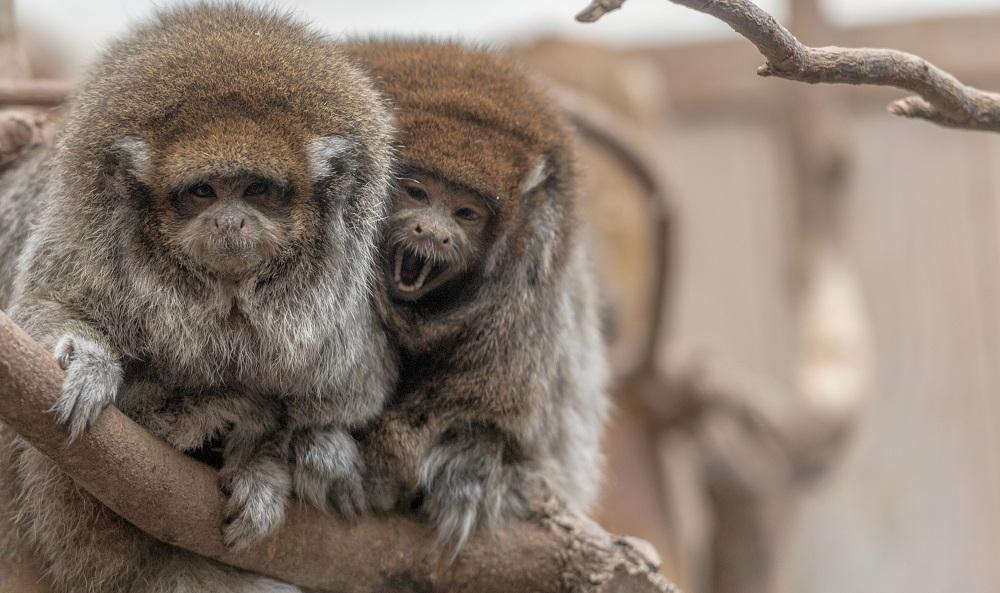
With their thick fur, fluffy tails, and cute little ear tufts, Bolivian gray titis look like small faces peeking out of pompoms. The hairs on their bodies are flecked with both gray and orange, a coloring known as agouti. You’ll find similar-looking coats elsewhere in nature, on animals like wolves, rabbits, and rats. The alternating bands of color on agouti coats help the animals camouflage by breaking up their silhouettes.
Diet
As frugivores, the Bolivian gray titi mostly eats fruit pulp, supplemented with leaves, insects, and seeds. Although fruit usually makes up the bulk of their diet, Bolivian gray titis do eat more leaves and vines during the dry season. Females also eat a greater proportion of insects when they’re nursing their young, likely to up their protein intake.
Members of this species take a “work smarter, not harder” approach to eating, seeking out smaller fruit trees so they don’t have to move around so much to get food. And they’re not picky, so it’s no problem if the fruit isn’t quite ripe yet. Bolivian gray titis also eat small insects like moths, spiders, and ants, if they happen to stroll by—no chasing after prey for this monkey!
Behavior and Lifestyle
Like other titis, Bolivian gray titis are diurnal; they are active during the day, waking up shortly after sunrise and staying awake until around when the sun sets. Depending on the time of year, this schedule can shift slightly. During the warmer months, when fruit is more plentiful, titis will rise before the sun is even up so they can maximize their time at the all-you-can-eat buffet. On the flip side, they may sleep an additional four hours after sunrise during the colder months, when there isn’t as much fruit.
At night, they sleep in vine tangles on small branches at least 49 feet (15 m) off the ground. Members of the same social group sleep close to one another, typically within 3.2 feet (1 m).
Although Bolivian gray titis are classified as quadrupedal (using four legs to get around), the full story of how they locomote is a bit more complicated. These monkeys primarily walk, clamber, and leap around their environment, with a little bit of bounding and climbing thrown in. They spend most of their time in the lower levels of the forest, which includes the understory and brush layer. This part of the forest is discontinuous, which means animals frequently need to jump small distances of a few body lengths to get around. In the rare instances that they’re on the ground, Bolivian gray titis bound at a lively pace.
Their agouti coats help them camouflage and hide from raptors, their primary predator. Species of many different sizes, including the Guianan crested eagle and the Ornate hawk-eagle, can attack the relatively small primate. Other occasional predators include big cats and tree-dwelling snakes, but these primarily eat other animals besides titi monkeys and aren’t a significant threat.
The genus that Bolivian gray titis belong to, Plecturocebus, is named for the monkeys’ tendency to intertwine their tails when sitting side by side. The name is derived from the Greek words “plektos,” which means twisted, “oura,” which means tail, and “kebos,” which means “a long-tailed monkey.”
Bolivian gray titis are territorial and keep to small groups of two to seven individuals, usually comprised of two pair-bonded mates and their offspring—some groups may have several males. The children usually leave the group when they’re two to four years old, with females leaving earlier than males. The adults don’t follow any hierarchy, and also don’t put pressure on offspring to move out.
Prefer to stay close to home? So does the Bolivian gray titi. On any given day, individuals typically roam between .3 miles (.5 km) and .9 miles (1.5 km) away from their home range, which is also quite small: between .002 mi² (.005 km²) and .05 mi² (.14 km²).
This species has about two meals a day: one in the morning and one in the evening, with a midday nap in the middle. They are active for around 11.5 hours a day and spend an average of 2.7 hours eating.
Maybe because they stick to such small groups in such a small home range, Bolivian gray titis are very cautious in new situations. They can tolerate other primates like marmosets, tamarins, squirrel monkeys, saki monkeys, capuchins, owl monkeys, howler monkeys, woolly monkeys, and spider monkeys in their habitat, but still prefer to stick with their own kind. This is likely related to the fact that larger species sometimes chase the smaller titis away from fruit trees.
An essential part of the Bolivian gray titi’s morning routine is moving to the edge of their home range, right after waking up, and yelling out to reinforce their boundaries to other titi groups. If Bolivian gray titis encounter other titis from a different group, they continue calling out, lash their tail, and may even chase the other titis away. Chasing is rare, though, and more often the competing groups break away after the initial confrontation and spend the rest of the day away from the edges of their territory.
Bolivian gray titis have a large repertoire of vocalizations at their disposal, generally falling into two categories: high-pitched quiet calls and low-pitched loud calls. By repeating these different calls, they can form a complex variety of sequences to communicate different needs or emotional states. The calls are sexually dimorphic, meaning they sound different coming from a male versus a female.
The high-pitched calls, which are often used to indicate distress, include squeaks, whistles, trills, chirps, grunts, and sneezes. Bolivian gray titis often chirp while looking for food. Whistles, squeaks, sneezes, and trills are emitted when they are fighting or confronting other titis within or outside their group. Whistles are also emitted when someone is lost, a female is resisting an unwelcome mate, or some titis are enjoying some vigorous play-wrestling or social grooming.
For long-range signaling, Bolivian gray titis use louder calls like chirrups, moans, pants, honks, bellows, pumps, and screams. While fighting, young males often scream. Chirrups are emitted in both hostile and non-hostile situations and seem to communicate the caller’s age and sex. This can be useful for locating and identifying group members as well as fostering group cohesion. Moans are used in both hostile and non-hostile contexts, such as during mating or when a competitor passes through the territory. In many of the same situations, Bolivian gray titis may also gnash their teeth.
Babies in this species will purr to show discomfort, such as when they’re being carried by a monkey that isn’t either parent. They also buzz and chirp to signal distress, such as when they are rejected or separated.
When Bolivian gray titis call out in the morning to define their territories and make sure other groups don’t get too close, males start the sequence with moans. Then, the calls shift to male bellows at the boundary of the home range. If a nearby group approaches, males and females on both sides will almost duet with each other, calling back and forth with combinations of bellows-and-pumping as well as pants-and-pumping. They alternate between male-dominated sections and female-dominated sections, switching every 2.5 seconds on average. These duets quickly ramp up in intensity and can last more than five minutes. After the confrontation, the monkeys will let out gobbles and pumps, which other groups within earshot may echo back.
The Bolivian gray titi also communicates using some visual signals, although these are mostly used in hostile circumstances. These include swaying, looking down, protruding lips, baring their teeth, raising or lashing their tail, and standing their fur on end to appear bigger.
This species’ love language is definitely physical touch. Bolivian gray titis in the same group will groom each other, hold hands, and huddle with their tails intertwined. They also show their connection by nuzzling, grasping each other, and sitting pressed together.
These lovebirds are monogamous, meaning they only have one mate. Bolivian gray titis take their relationships very seriously. When two are bonded, they coordinate their activities throughout the day and stick close together. If they are separated, they become agitated and distressed.
A female can give birth once she’s two years of age, but she won’t do so if she’s still staying with her parents and siblings. Although there’s no obvious, observable breeding season, births tend to spike just before the rainy season, which begins around December. Female Bolivian gray titis are pregnant for around four months in captivity, and typically go about one year between births both in the wild and in captivity. She nearly always gives birth to just a single baby. Scientists have observed twins in the wild, but very infrequently.
When a baby Bolivian gray titi is first born, he or she is covered in short, dense, fine hair and weighs between .17 pounds (.075 kg) and .22 pounds (.1 kg). The baby’s siblings and any others in the group will come to inspect, nuzzle, and groom the newborn on the first day, but soon stop interacting with the baby until he or she is three months old.
In the first week after birth, the mother carries the baby 20% of the time. She also nurses and grooms her baby, but otherwise leaves caring for the young to the father. He is the one who primarily carries and protects the baby; within several weeks after birth, the father becomes the only one who carries the baby. If the baby falls out of the branches, though, fear not—either parent will jump down to the rescue.
When it’s time for the baby to drink the mother’s milk, the father goes to sit by her so the baby can self-transfer between parents, climbing off the father’s shoulders and onto the mother. The more experienced a mother is, the less she interacts with the baby; breastfeeding makes up over half of their time spent together. As you may expect, infants are more attached to their fathers than they are to their mothers. Meanwhile, the two parents are more attached to each other than they are to their babies.
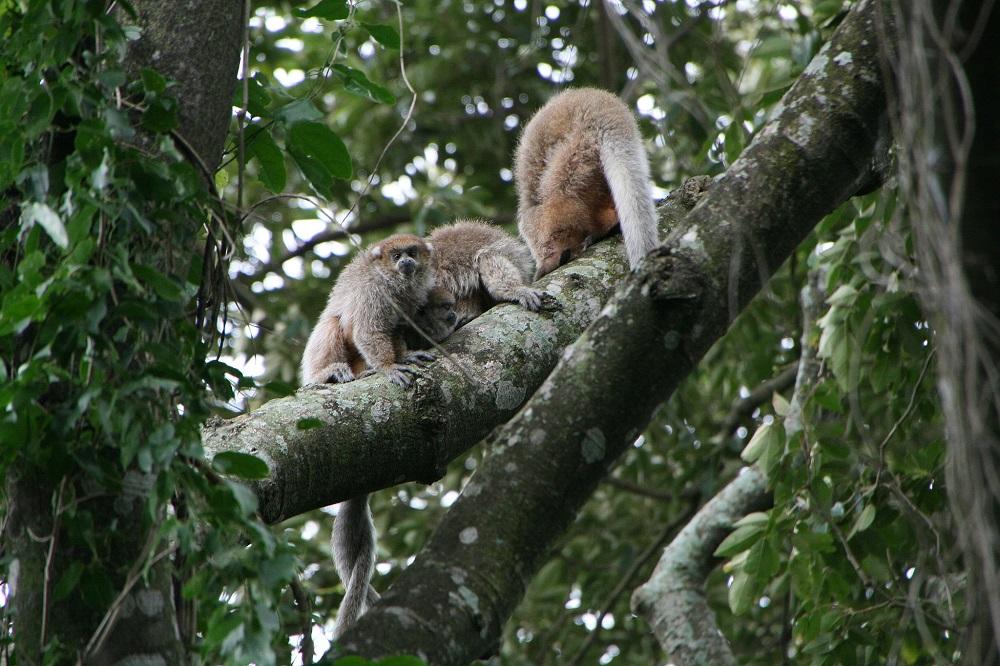
Like other frugivores, Bolivian gray titis help regenerate their forest habitats by eating fruits and later dispersing the seeds when they poop. Although these monkeys don’t travel very far, they still help distribute seeds farther than they might otherwise go if they simply fell to the ground without being eaten.


Despite declining adult populations, Bolivian gray titis are classified as Least Concern by the International Union for Conservation of Nature (IUCN, 2015), appearing on the IUCN Red List of Threatened Species.
Like many other Latin American primate species, Bolivian gray titis face the threat of deforestation and habitat loss. They have lost much of the forest they call home to agricultural activities, especially near urban areas. Highway construction, logging, and forest fires across Bolivia and Brazil also contribute to breaking up the species’ habitat. Although these development projects sometimes leave pockets of forest behind for the Bolivian gray titi, they also encourage people to move closer into this species’ habitat.
The Bolivian gray titi is listed in Appendix II of the Convention on International Trade in Endangered Species (CITES), an international agreement between governments whose goal is to ensure that international trade in specimens of wild animals and plants does not threaten their survival.
Fortunately, Bolivian gray titis can tolerate some disturbance. They live on in forest fragments that are left behind and can even survive in the city. Some conservationists propose building corridors to connect these forest fragments, since continuing development will likely continue to eat away at these pockets of habitat. Other solutions include protecting the populations in the forest fragments, as well as promoting overall forest conservation.
- https://www.iucnredlist.org/species/41548/17972581
- https://primate.wisc.edu/primate-info-net/pin-factsheets/pin-factsheet-dusty-titi-monkey/
- https://frontiersinzoology.biomedcentral.com/articles/10.1186/s12983-016-0142-4
- https://www.gbif.org/species/2436399/
- https://www.biodiversitylibrary.org/bibliography/2843
- Weigl, R. (2005). Longevity of mammals in captivity; from the living collections of the world. Stuttgart: E. Schweizerbartsche. p. 54. ISBN 9783510613793.
- https://www.researchgate.net/publication/242073663
- http://basicgenetics.ansci.cornell.edu/agoutihair.php?
- https://www.researchgate.net/publication/259739625
- https://www.britannica.com/place/Bolivia/Climate
- https://www.mdpi.com/2076-2615/8/10/178
Written by Jiayu Liang, Jul 2025