
Collared Titi, Cheracebus torquatus
COLLARED TITI MONKEY
Cheracebus torquatus

Geographic Distribution and Habitat
Collared titi monkeys, also called the yellow-handed titi and the widow monkey, are native to the State of Amazonas in Brazil. They live in a geographic area bordered by the Rio Solimões and between the Rio Purús and the Rio Juruá. They thrive in rainforests where many species of flowering plants and trees grow, but also in seasonally flooded forests (locally known as blackwater flooded forests or “igapó”). The term “igapó” comes from the Tupi language and means “forest of roots”. They are inundated by fresh water for up to six months every year, and the trees they harbor can survive while submerged and are able to grow up to 118 feet (36 m) high. These forests also contain many plant species that have the ability to fix nitrogen—a natural nutrient that helps with photosynthesis and the growth of plants.
Temperatures in the region average 75-88°F (24-31°C) during the wettest months (December through May) and 77-93°F (25-34°C) the rest of the year.
Collared titi monkey population density varies from 0.8 to 2.9 individuals per square mile, with the highest density in flooded forests.
It is possible the species extends south as far as Rio Tapauá or even Rio Pauiní, but it has not been confirmed yet.
The taxonomy of titi monkeys has been revisited several times over the years. Most recently, scientists have focused their classification efforts on morphology and genetics instead of lumping species together based on geographic distribution alone to simplify the process, as was done in the twentieth century.
Before 2016, collared titis, like all titis, were considered part of the Callicebus genus. However, the molecular data collected at the time revealed major differences between titi monkeys, thus resulting in the breakdown of the genus into three new genera: Cheracebus, Plecturocebus, and Callicebus. It turns out the Cheracebus genus is the most ancient of the titi genera, with this branch diverting from other titis approximately 11–13 million years ago.
How many species comprise the Cheracebus genus is an ongoing debate. Most commonly cited are the following six species: Lucifer titi (C. lucifer), black titi (C. lugens), Colombian black-handed titi (C. medemi), Rio Purus titi (C. purinus), red-headed titi (C. regulus), and, of course, the collared titi.
In 2020, a study based on the careful examination of museum specimens’ pelts suggested that Rio Purus titis are, in fact, collared titis. It redefined the distinction between black titis and collared titis based on geography. Yet, another study from the same year proposed that black titis are the closest living relatives of collared titis, while Rio Purus titis are not as closely related.
So the mystery remains, and ongoing research is needed to clarify the relationships within the Cheracebus genus.

Size, Weight, and Lifespan
Collared titi monkeys weigh between 7.5 and 12 pounds (3.5-5.5 kg) and are between 11.5 and 13.5 inches (about 295-348 mm) in length. Their tail is long and measures between 16 and 20 inches (405-510 mm).
Their lifespan in the wild is approximately 20 years. Under rare, highly managed captive conditions—such as in well-resourced, professionally run institutions—some individuals may live up to 25 years.
Appearance
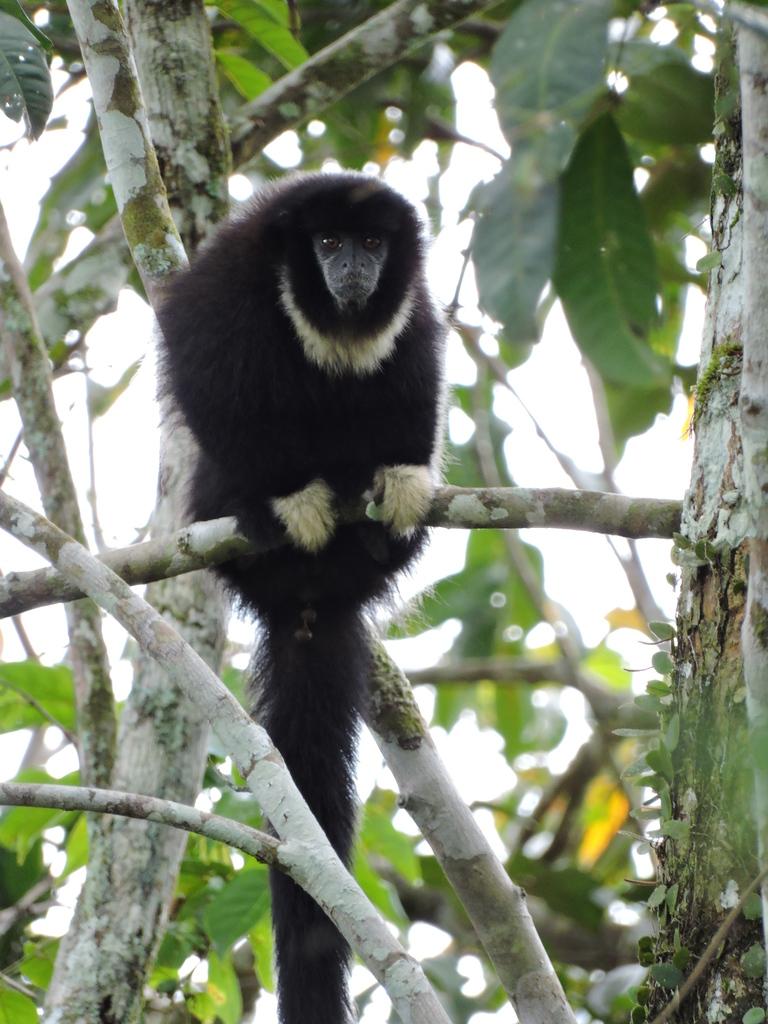
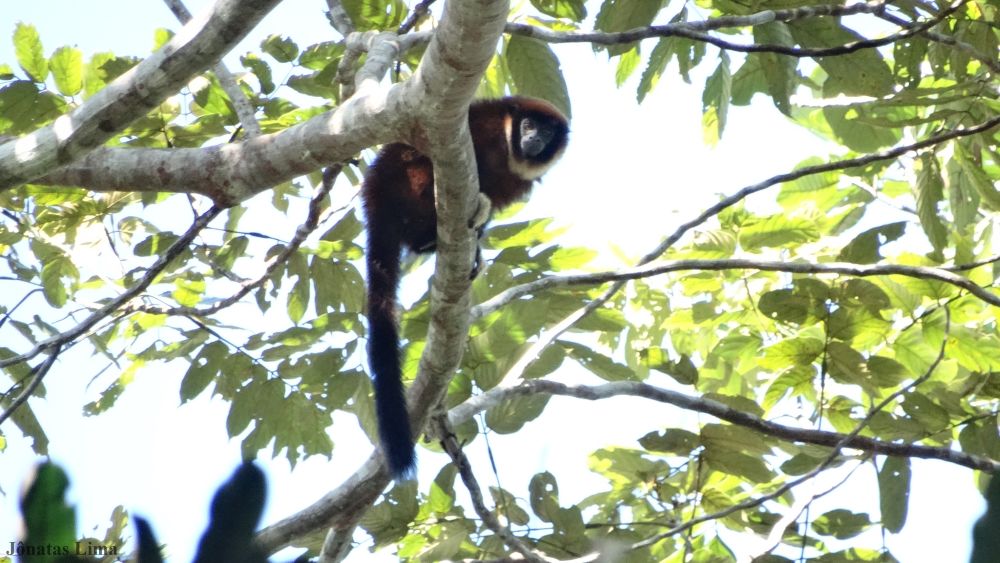
With their beautiful, glossy reddish/blackish brown coat, adorned with white fur on the neck and hands reminiscent of a scarf and gloves, the petite collared titi monkeys look like they might be dressed up for a night in town. Although their nickname “widow monkey” indicates they could also give the appearance of being dressed as a traditional local widow in mourning. In some parts of their range, rare individuals have reduced melanin pigment, giving them a cream-colored pelage instead of the usual black-brown.
Their expressive grey face is elongated, hairless for the most part, except for a delicate string of light hair that accentuates the shape of the muzzle and eye sockets. Their big brown eyes are round and forward-facing—an indication they have good depth vision. Their thick, long tail is furry and not prehensile (unable to grasp objects). There is no apparent sexual dimorphism among collared titis; males and females look very much alike.
Diet
Like all other titis, collared titi monkeys consume mostly fleshy fruit like figs (preferably ripe), some berries, and other tropical fruits. They spend about 75% of their time foraging for food throughout the day in small groups, starting in the wee hours of the morning, with a break to rest around noon.
Fruits provide sugar and energy, vitamins, potassium, and fiber, and they are easy to digest. In times of scarcity and because their nutritional needs vary according to the season, their age, and condition, they also consume some leaves, seeds, and small invertebrates. Leaves are rich in fibers, vitamins, and minerals, but take longer to process. Fortunately, these primates’ digestive system is able to break down cellulose and extract the maximum nutrients. These monkeys add a larger proportion of leaves to their menu in the dry season. Insects provide more protein than fruit and leaves. This explains why females who need more protein while lactating add invertebrates to their diet. They do not actively hunt but are opportunistic eaters—i.e., they eat whichever creature (spider, ant, moth) they come in contact with.
There is no information related to how many or which plant species collared titis consume, but it is probably comparable to that of their close relative and neighbor, the black titis who can theoretically ingest 51 species of plants but were only observed feeding on just five, including bamboo, wild honeytree (a bushy evergreen tree), and wetland nightshade (a vine that survives through multiple growing seasons).
Behavior and Lifestyle
Collared titi monkeys live in family groups. They are territorial, diurnal (most active during daytime), and arboreal (tree-dwelling). Their main mode of locomotion is quadrupedal. This means that they move through the canopy by either walking or climbing up trees using all four limbs, and they leap from branch to branch, using their tail for balance. They spend most of their time looking for food and eating, but grooming is also an important part of their social life, and usually takes place when they rest in the middle of the day. Grooming reinforces the bonds between individuals, provides comfort, and is much needed to keep their fur clean and free of parasites. It would seem that females groom more often than males.
At night, they retire to their sleeping site—usually a vine-encrusted tree about 49 feet (15 m) above the ground. They return to the same tree night after night until they move to a different area. These monkeys sleep side by side on small branches, huddling with tails entwined. Tail twining is most often observed between the male and female adults in a group whenever they sit together, day or night.
The scientific name of the collared titi monkey relates to its appearance. Cheracebus can be translated as “widow” and “long-tailed”, and torquatus as “twisted neck or collar” in reference to this monkey’s dark coloring, long tail, and neck markings. The word “torquatus” was associated with the names of several notables in Ancient Rome (such as some senators and generals).
Collared titi monkeys are monogamous. The family group is composed of an adult male, an adult female (also referred to as a bonded pair), and their offspring —newborns, infants, and juveniles.
The adult male decides where the group should forage and leads his family members to the site of his choice. They usually travel up to one mile (1.5 km) per day, but the group’s home range typically extends from 4 to 74 acres (1.5- 30 ha).
Family groups rarely engage in fights and defend their turf through vocalizations, as explained more thoroughly in the Communication section below.
Specific information on how collared titi monkeys communicate is not readily available, however they likely have similar strategies as other titi monkeys and communicate in many ways. In titi monkey society, scent is important. Individuals sniff each other to get to know one another, and some practice chest-rubbing (i.e., two monkeys rubbing their chests together) as a way to reinforce social bonds. Titi monkeys also rub their chest and wrist glands on tree branches to mark their territory. However, titi monkeys are better known for their vocalizations—the synchronized duets they sing to let everyone know where they live and who they’re with.
Studies conducted on another species, the Lucifer titi, outlined the different types of calls emitted during duetting sessions. The males’ loud, low-frequency coordinated calls are composed of three distinct phrases of paired pant and inhaled syllables, whereas the females’ calls consist of two phrases. It is possible that the songs of collared titi monkeys follow a similar pattern.
Duets are like a dialogue between an adult male and an adult female, an adult male and his daughter, or an adult female and her son. The singing advertises their relationship and reinforces their bonds.
Collared titi monkeys live in small family groups centered around a bonded male and female pair. They are considered socially monogamous, meaning a male and female form a long-term pair bond and share a territory while raising their offspring together, although the extent of genetic monogamy remains unclear.
There is not much information regarding the specifics of the reproduction of collared titi monkeys. However, based on studies related to some of their close relatives, it is likely that females are in estrus for about 16 days. They are receptive and exhibit swelling of their genitalia for 2-3 days. They may mate during the dry season and give birth about five to six months later when food is most abundant.
The female gives birth to one offspring and can give birth again the following year. The baby is born with its eyes closed and relies on the parents for food and protection. A mother carries her baby on her belly shortly after birth and for a few weeks. When the baby is strong enough, it starts riding on her back. A study on the Lucifer titi monkeys showed that the father helps out by carrying the baby around when the female is not nursing. The father also participates in grooming and play sessions. It is therefore possible that similar behavior could be observed in collared titi monkey family groups. Juveniles may also help out with the rearing of the little ones.
The baby is weaned at about eight months old. Juveniles stay with the family until they are about three years old, at which point they leave to find a mate and form their own family group.
As fruit eaters, collared titi monkeys help disperse seeds, supporting the growth and regeneration of their forest habitat. As leaf eaters, they also contribute to the health of trees by trimming branches and dropping plant material to the ground, where it decays and fertilizes the soil.
It is likely that, similar to other titi monkey species, they may be prey to large birds such as hawks and eagles, carnivorous mammals, and some snakes, thereby providing food to other species sharing their habitat.


The International Union for Conservation of Nature lists the collared titi as Least Concern (IUCN, 2022), appearing on the IUCN Red List of Threatened Species.
Although they are locally killed or used as bait to hunt other animals, hunting does not constitute a huge threat to collared titis. Deforestation, on the other hand, is of greater concern. In the last 50 years, 17% of the Amazon rainforest, one of the most diverse and rich ecosystems, has been lost. In addition to illegal logging and neglect from the official authorities, a highway project in the middle Purus basin was revived in 2020 and is igniting controversy. Construction is expected to impact 65,600 square miles (170,000 sq m) of forest by 2050 and displace indigenous tribes who rely on nature for subsistence. The disastrous effects on wildlife and biodiversity have not yet been measured. Which species will be affected and how they can adapt is anyone’s guess. As for collared titi monkeys, since their status does not warrant any specific measure, they are left out of conservation efforts, unless their groups already happen to be in an area that is protected.
The collared titi is listed in Appendix II of the Convention on International Trade in Endangered Species (CITES), an international agreement between governments whose goal is to ensure that international trade in specimens of wild animals and plants does not threaten their survival.
No special conservation initiatives exist as it relates to collared titi monkeys, however some populations are present in several protected areas created to shelter other species from extinction. These include the Abufari Biological Reserve, RESEX Catuá-Ipixuna, the Tefé National Forest, and the Maratu and Tatutu Amerindian Reserves.
- IUCN Redlist (2016)
- www.scientificlib.com
- Duetting Patterns of Titi Monkeys (Primates Pitheciidae: Callicebinae) and Relationships with Phylogeny – Patrice Adret, Christini B Caselli, Jan Vermeer, Jesus Martinez, Jossy C Luan Amancio, Silvy M Van Kujik, Lucero M Hernani Lineros, Robert B Wallace, Eduardo Fernandez Duque, Anthony Di Fiore,
- Taxonomy and systematics of the Neotropical primates: a review and update – Anthony B. Rylands and Russell A.Mittermeier
- On the Taxonomic History and True Identity of the Collared Titi, Cheracebus torquatus ( Hoffmannsegg, 1807) (Platyrrhini, Callicebinae) – Hazel Byrne, Anthony B. Rylands, Stephen D. Nash and Jean Philippe Boubli
- www.alloftheanimals.com
- www.nationalzoo.si.edu
- https://animals.fandom.com/wiki/Collared_Titi
- The evolution of pair-living, sexual monogamy, and cooperative infant care: Insights from research on wild owl monkeys, titis, sakis, and tamarins – Eduardo Fernandez-Duque, Maren Huck, Sarie Van Belle, Anthony Di Fiore
- www.montegobay.com Best-preserved part of Brazil’s Amazon, home to isolated tribes, faces ‘decimation’ – Lais Modelli
- www.chesterzoo.org
Written by Sylvie Abrams, May 2026