
Southern Patas, Erythrocebus baumstarki
SOUTHERN PATAS MONKEY
Erythrocebus baumstarki
Geographic Distribution and Habitat
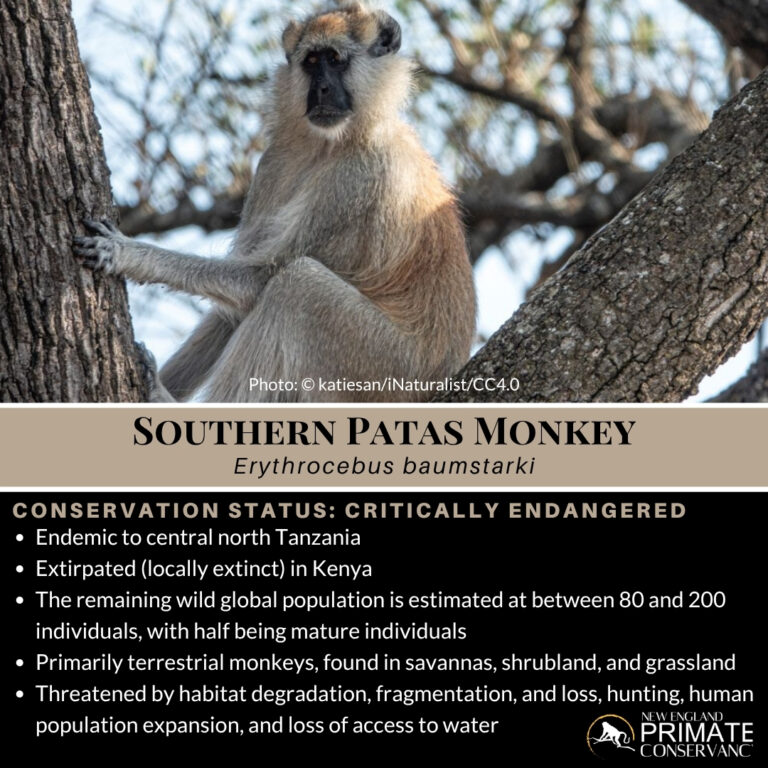
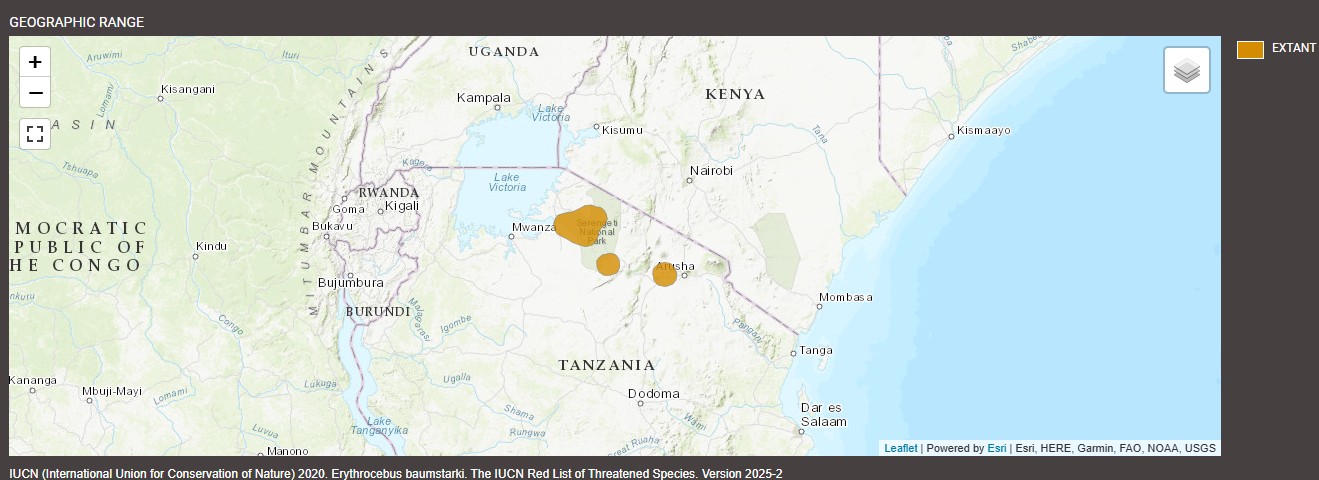
The southern patas monkey (Erythrocebus baumstarki) is endemic to central north Tanzania and has historically lived in three distinct populations: the Serengeti ecosystem, southwest of Mount Kilimanjaro, and southwest of Arusha. Unfortunately, very few of these monkeys remain, and the Kilimanjaro population has not been seen since 2011. Meanwhile, early data indicate the population in the Serengeti may have split into two groups—one in the western Serengeti and one in the Ngorongoro conservation area.
Although the southern patas monkey once lived in southern Kenya, they have not been seen there since 2015 and is now considered to be extirpated, or locally extinct, from that country.
The geographic range covered by the southern patas monkey is quickly declining. In 1995, their range covered 14,440 mi² (37,400 km²). Today, scientists estimate that number is just 830 mi² (2,150 km²). Over the past 100 years, there has been an 85% decrease.
This species lives in open, semi-arid acacia woodlands at elevations between 2,624-5,183 feet (800-1,580 m). The wet season runs from November to June, with an average of 4 inches (106 mm) of rain each month. There are two distinct peaks during the wet season: a small one in December during the short rains (November to December) and a major peak in April during the long rains (January to June). This is the hottest time of year, with highs up to 99°F (37°C). From July to October, the dry season, the average monthly rainfall is 2.2 inches (57 mm), and temperatures may dip down to 55°F (13°C).
As recently as 2018, some scientists classified the southern patas monkey as a subspecies of the common patas monkey (Erythrocebus patas). Since then, however, the scientific community has come to accept the southern patas monkey as a unique species due to their distinct fur coloring and geographic separation from other patas monkey species.
Size, Weight, and Lifespan
Southern patas monkeys are sexually dimorphic, which means that the two sexes look very different. Females weigh an average of 14.3 pounds (6.5 kg), which makes them less than half the size of the males, who have an average weight of 27.3 pounds (12.4 kg).
Measured from the top of their head to their rump, male southern patas monkeys are 23.6-34.4 inches (60-87.5 cm) long. Females are, again, smaller, with a length of 19.3 inches (49 cm).
The lifespan of this species is unknown, although the closely related common patas monkey has been known to live up to 21.6 years in the wild.
Appearance
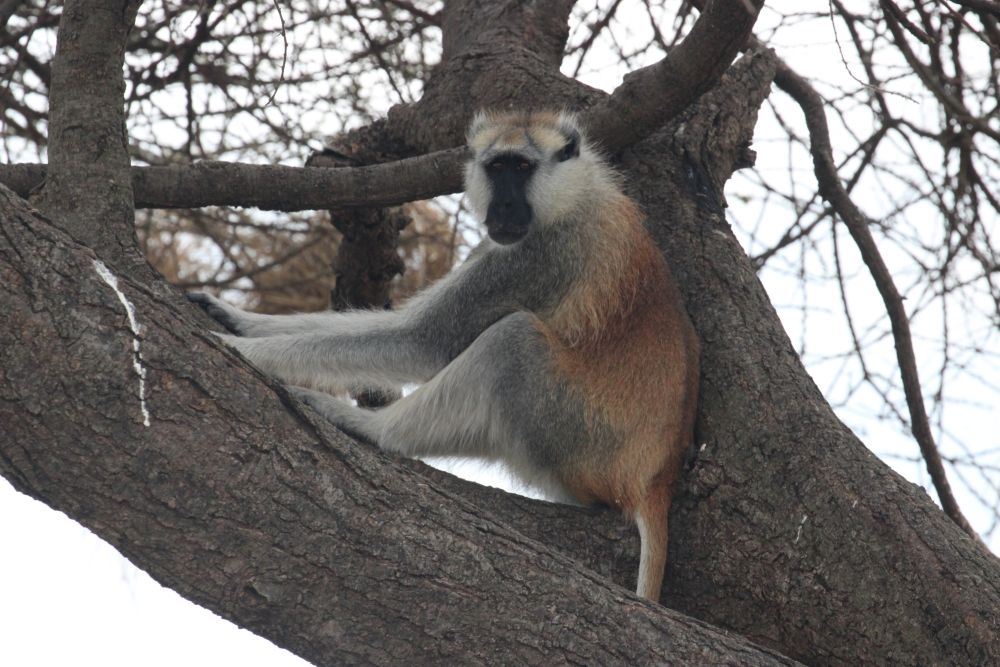
Southern patas monkeys have black face masks, a white neck, and pale red crowns. They have long canines and expansive cheek pouches, which let them collect food to eat later. Their backs are a deep russet color, effective for camouflaging them in the open acacia woodlands they call home. They have long, thin tails colored similarly to their back.
Their long arms and legs are covered in dark grey fur closer to the body. Closer to their black hands and feet, the fur fades to a soft cream color. These long arms and legs help southern patas monkeys run up to 34.2 miles an hour (55 km/hour), which is the fastest ground speed of any primate.
Although southern patas monkeys look similar to common patas monkeys, the black nose and lack of a white mustache mark a key distinction between the two species. Because their geographic ranges don’t overlap, you can also use location to confidently identify which species you’re looking at–if you’re lucky enough to spot one of these elusive monkeys!
Diet
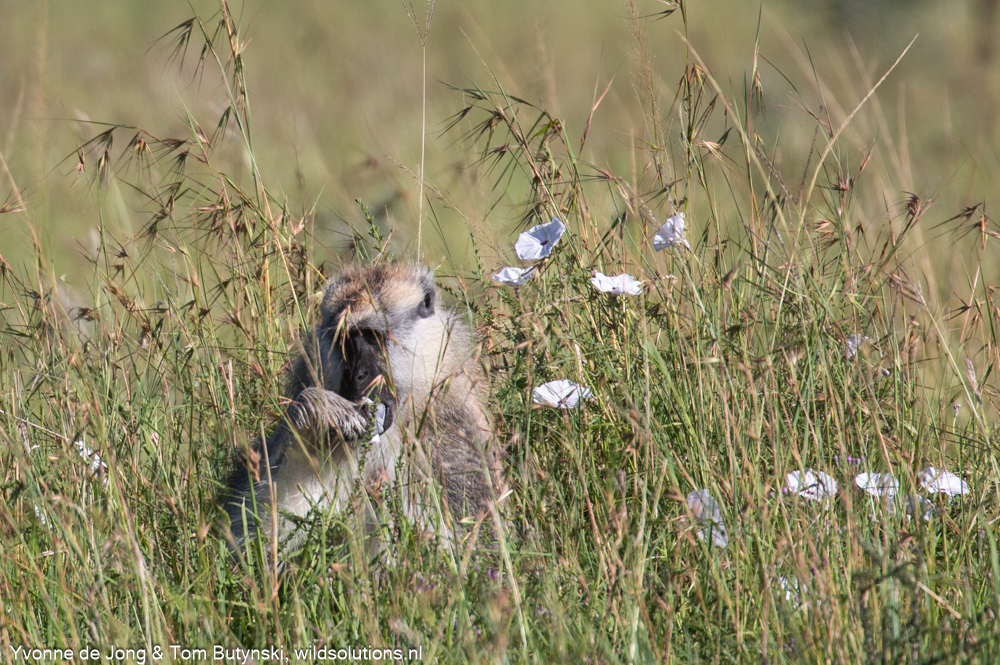
The southern patas monkey feeds heavily on plant gums, particularly from whistling thorn acacia trees. These trees produce gum in response to injury or stress, and it serves as an important food source. Because of this reliance, southern patas monkeys require large areas with abundant, healthy acacia trees.
Like many African monkeys, they have cheek pouches that allow them to gather and temporarily store food while foraging—an advantage when feeding on the ground.
Although detailed studies of this species are limited, research on the closely related common patas monkey suggests that gums may make up a large portion of the diet, possibly up to two-thirds. This level of reliance is more typical of smaller primates, making it notable for a species of this size. Other foods include leaves, insects such as ants, flowers, fruits, and occasionally small animals or birds’ eggs.
Behavior and Lifestyle
Southern patas monkeys are diurnal, or active during the day. They are primarily terrestrial and split their time 60% on the ground and 40% in the trees.
In addition to depending on the whistling thorn acacia for food, southern patas monkeys also sleep in these trees at night. To avoid predators, they pick a different site each night and sleep spread out from one another.
Whether on the ground or in the trees, this is an agile species. Using all four limbs, they can bound up vertical tree trunks and move quickly along branches. When disturbed, southern patas monkeys usually flee across the ground, reaching top speeds of 34 miles an hour (55 km/h). Needless to say, this can make them difficult for scientists to observe.
Male patas monkeys have notably long canines relative to their body size, used in displays and competition.
Southern patas monkeys need to drink water every day, and prefer to do so from waterholes, ponds, and tanks in open areas, rather than streams, which are often surrounded by dense vegetation. Unfortunately, the increasing presence of herders, livestock, and dogs at the few water sources in their habitat has made it much harder for these monkeys to get the water they need.
They keep long day ranges, usually travelling 0.8-4.6 miles (1,380 7,500 m) each day. Southern patas monkeys keep even larger home ranges of 8.8-20mi² (23-52 km²). Having lots of space can be nice, but it has made it hard for scientists and conservationists to locate and observe this species.
Southern patas monkeys live in groups of 5–74 individuals, typically with one male, several females, and their young. Female patas monkeys form strong bonds within their group and are not very tolerant of strangers. Females do not form a strict linear hierarchy, and because they remain in their natal group, they form the stable core of the group and are highly familiar with their home range. Males, by contrast, join groups later in life and are often more peripheral outside of the breeding season. As a result, females play a central role in maintaining group cohesion and shaping movement patterns.
The male’s role is like that of a watchdog. He goes up in a tree, alone, to scan the area for possible danger, while the rest of the group hides in the grass, waiting for the all clear.
Because any noises would alert predators to their location, southern patas monkeys move quietly and rarely call out. Instead, they primarily use visual cues such as facial expressions and body posture to communicate with one another. For example, an open-mouthed stare is threatening, while a crouching posture indicates submission.
Scientists have documented alarm calls in the closely related common patas monkey, which are used to warn others of a threat. Males utter a “bark grunt” in response to all predators and other male patas who are not part of their group.
Other alarm calls are used by all patas monkeys—rather than just the adult males—and are specific to the threat. A “cough” alarm is used for jackals and wildcats, a “loud chutter” is reserved for baboons, domestic dogs, jackals, and wildcats, and a “nyow” call responds to baboons, domestic dogs, and lions. When there are snakes or raptors, they use a “quiet chudder” or “gecker.”
There may also be calls specific to an adult female interacting with a child in her group. She calls out a “moo” when approaching the infant, while the infant utters a “want” call to attract some mothering attention.
Although details of how the southern patas monkey mates are limited, observations of the closely related common patas monkey provide some insight. Females do not mate exclusively with the resident male, and during the breeding season, they may also mate with visiting males from outside the group. In some observed cases, females have been seen approaching and soliciting these males, suggesting they can play an active role in mating interactions.
Female southern patas monkeys reach sexual maturity at 3 years of age, at which point they can give birth every year. A typical pregnancy lasts 167 days. Most births occur during the dry season, so that, later, the baby is weaned during the wet season, when food is more readily available.
All the females in the group take care of the young together, a practice known as allomothering. This may be part of how females in the group strengthen their bonds with each other. Baby southern patas monkeys can usually take care of themselves once they’re six or seven months old.
Females remain with their natal group throughout their lives. Young males leave their birth group at around three years of age, either voluntarily or after being driven off by the resident male. They then spend roughly two years alone or in all-male groups—where they gain some protection from predators—until reaching full maturity at about five years of age.
The southern patas monkey plays an important role in its ecosystem as both a consumer and a seed disperser. By feeding heavily on plant gums—particularly from acacia trees—it is part of the ecological network centered on these trees. It also eats fruits, helping to disperse seeds across its range and support plant regeneration. In addition, it consumes insects and other small prey and serves as prey for larger predators, making it an integral part of the food web.


The International Union for Conservation of Nature lists the southern patas monkey as Critically Endangered (IUCN, 2020), appearing on the IUCN Red List of Threatened Species. Their primary threats include hunting, loss of water access, and the destruction of their habitat. This loss, degradation, and fragmentation of where they live is driven by agriculture, charcoal production, and human developments such as roads and housing. The threats will likely keep mounting over time, as the human population is doubling every 20-30 years over much of the southern patas monkey’s range.
Surveys of the southern patas monkey population in 2009 found fewer than 900 individuals left in Tanzania. The IUCN estimated in 2020 that there were between 80 and 200 individuals left in the wild, with only half of them old enough to reproduce. With so few individuals remaining, a shrinking genetic pool and loss of genetic diversity also leave future generations more susceptible to diseases.
When there were no sightings for two years, from mid-2023 to mid-2025, scientists worried the southern patas monkey had already become extinct before finally spotting a group of 14 in Serengeti National Park in May 2025.
Southern patas monkeys in the western Serengeti face several localized threats. Overgrazing by livestock is degrading the whistling thorn acacia woodlands on which they depend. They are also hunted in some areas for bushmeat, for their pelts used in traditional ceremonies, and in retaliation for crop raiding. Although they are not typically a primary target of large-scale hunting, they are vulnerable to being caught in wire snares set for other animals.
Drought, climate change, and expanding human settlement—particularly along the western boundary of the Serengeti—are placing increasing pressure on the southern patas monkey’s habitat. As grazing land becomes scarce, livestock herders move their animals into protected areas, further degrading acacia woodlands. At the same time, water shortages and the conversion of land to agriculture increase competition for resources between people, livestock, and patas monkeys, sometimes leading to the monkeys being killed. The growing human presence also brings more domestic dogs, which can and have killed primates.
The southern patas monkey is listed in Appendix II of the Convention on International Trade in Endangered Species (CITES), an international agreement between governments whose goal is to ensure that international trade in specimens of wild animals and plants does not threaten their survival.
The southern patas monkey primarily lives in protected areas such as the Serengeti National Park and Ngorongoro Conservation Area, Grumeti Game Reserve, Ikorongo Game Reserve, Ikona Wildlife Management Area, and Burko Masailand Hunting Concession. Unfortunately, protection in these areas is not always enforced, and there are no conservation programs that focus on this species.
- https://www.iucnredlist.org/species/92252436/92252442
- https://laisbell.faculty.ucdavis.edu/wp-content/uploads/sites/741/2022/04/de_jong_et_al_2009_oryx.pdf
- https://onlinelibrary.wiley.com/doi/abs/10.1002/ajp.23316
- https://journals.plos.org/climate/article?id=10.1371/journal.pclm.0000388#sec007
- https://news.mongabay.com/2024/12/gum-eating-tanzanian-monkey-is-awol-fueling-extinction-fears/
- https://www.serengeti.com/weather-climate-serengeti.php
- https://www.wildsolutions.nl/rediscovered/
- https://www.wildsolutions.nl/wp-content/uploads/DeJongButynski_2024_Primates-in-Peril.pdf
- https://www.wildsolutions.nl/wp-content/uploads/ButynskiDeJong_2024_Southern-Patas-Monkey_compressed.pdf
- https://wildsolutions.nl/wp-content/uploads/deJong-patas-Swara061.pdf
- https://primate.wisc.edu/primate-info-net/pin-factsheets/pin-factsheet-patas-monkey/
Written by Jiayu Liang, April 2026