
Von der Decken’s Sifaka, Propithecus deckenii
VON DER DECKEN'S SIFAKA
Propithecus deckenii
Geographic Distribution and Habitat
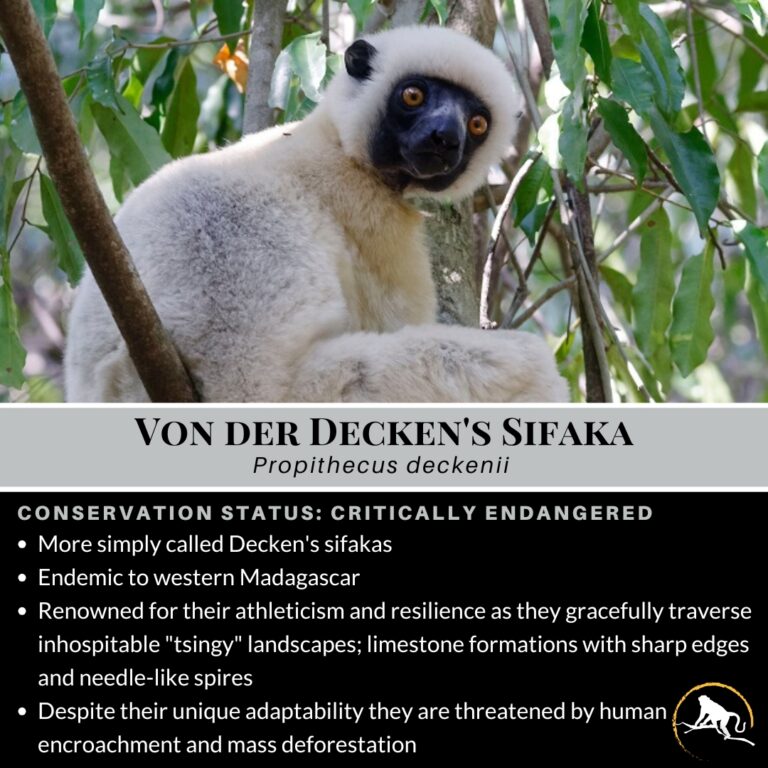
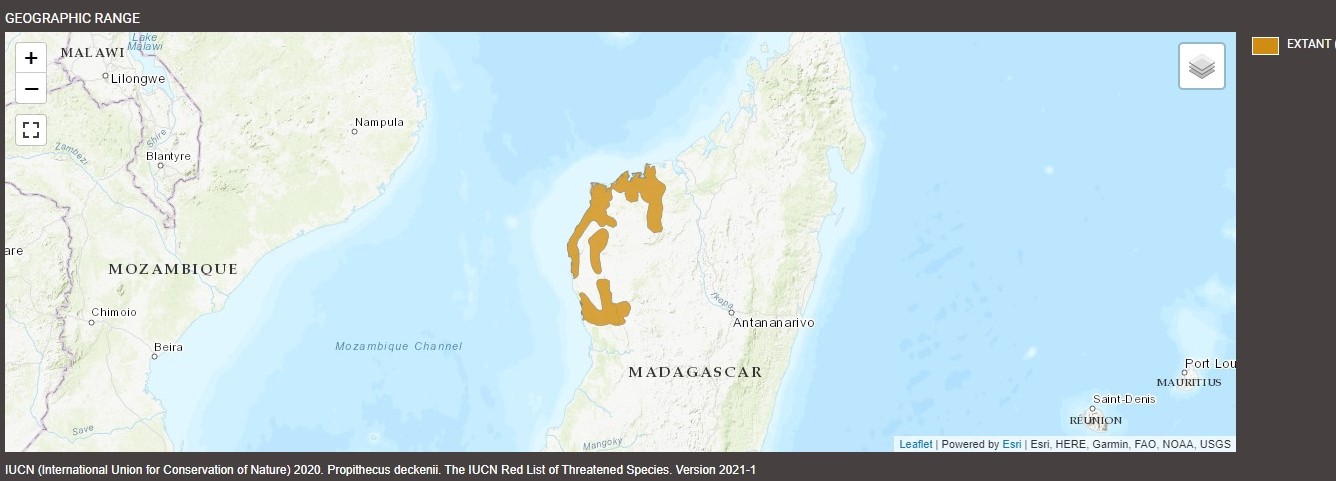
Von der Decken’s sifaka (Propithecus deckenii), sometimes called Decken’s sifaka, is one of several sifaka species found only in Madagascar. Because it is found only in one place, we called this species “endemic” to Madagascar. It lives primarily in the dry deciduous forests of the island’s northwestern region, especially between the Mahavavy and Manambolo rivers.
This species was once grouped with the Verreaux’s sifaka, but further anatomical research has confirmed that Von der Decken’s sifaka is its own distinct species. Like other sifakas, it is well adapted to challenging environments where few other primates can survive.
One of the most unusual habitats it occupies is a landscape known locally as the “tsingy,” a dramatic formation of sharp limestone pinnacles found in parts of western Madagascar. These jagged, needle-like rock formations create a rugged and difficult terrain, but Von der Decken’s sifakas move through them with remarkable agility, leaping and climbing with ease.
In some areas, particularly near the Manambolo River, their range overlaps with that of the crowned sifaka. Individuals showing mixed physical traits have been observed, suggesting possible hybridization, though this has not yet been fully studied.
In addition to mainland populations, Von der Decken’s sifakas are also found on the island of Nosy Be, just off Madagascar’s northwestern coast.
Size, Weight, and Lifespan
Von der Decken’s sifakas are medium-sized lemurs with long, lean bodies built for leaping through trees. Adults typically measure around 18 inches (45 cm) from head to body, but their long tails can double their overall length. Males and females are roughly the same size, each weighing between 7 and 13 pounds (3–5 kg).
These lemurs are remarkably agile for their size, using their strong legs to spring from branch to branch, sometimes covering distances of 10 feet (3 meters) or more in a single bound. While precise data on their lifespan in the wild is limited, sifakas in human care can live into their 20s, indicating that these lemurs are built for both endurance and survival in their challenging habitats.
Appearance
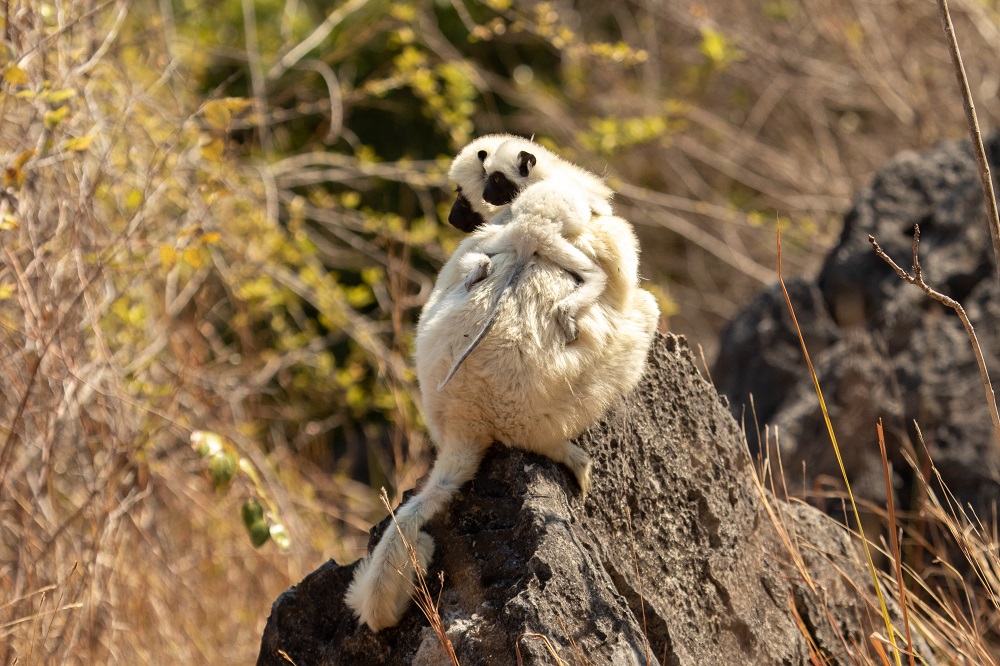
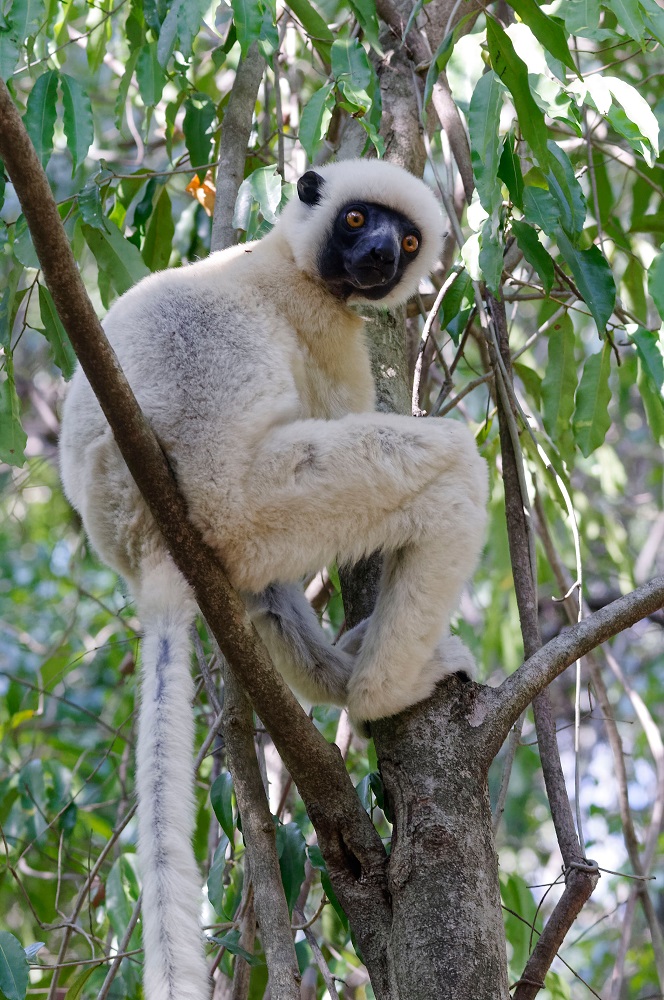
These are striking lemurs with bold black faces that are mostly hairless, making their bright yellow-orange eyes stand out. Their bodies are covered in dense, creamy-white fur. In some areas, especially on the chest, tail, and around the fingers and toes, dark skin shows through, giving their coat a subtle grayish tint. Small tufts of brown fur create soft “halos” at the tops of their chests and around the armpits, adding another layer of texture to their appearance.
Von der Decken’s sifakas are built for movement. Their long, powerful limbs are muscular and agile, and their fingers and toes are padded to protect them while climbing and leaping. Hook-shaped hands and opposable big toes allow them to grasp branches, and even the sharp limestone ledges of the tsingy landscape, securely. This makes them experts at navigating their tricky, vertical world.
Diet
Von der Decken’s sifakas are herbivores, meaning they eat only plant material. Their diets change with the seasons, reflecting which plants are available in their dry forest environment. During the wet season, when rain promotes new growth, sifakas take advantage of a wider variety of leaves, flowers, buds, and fruits. In the dry season, when fruits and tender plants are less plentiful, they may rely more on mature leaves, bark, and other tougher vegetation that remain available.
Like other sifakas, Von der Decken’s have a specialized digestive system to help them process this fiber-rich diet. Their digestive tract is exceptionally long, which allows food to be broken down slowly. An uncoiled version would measure many times their body length! A significantly enlarged caecum (a pouch at the beginning of the large intestine) hosts a diverse community of bacteria that can help break down tough plant fibers. Some of these friendly microbes even help neutralize toxins found in certain leaves and other plant parts that sifakas eat.
Although detailed studies on the precise diet of Von der Decken’s sifakas are still limited, observations indicate they take advantage of what their seasonal forest offers, adjusting their feeding behavior as the environment changes throughout the year. Their ability to switch among available plant foods helps them survive in a habitat where seasonal dryness can make resources scarce.
Behavior and Lifestyle
Von der Decken’s sifakas are diurnal, meaning they are active during the day and rest at night. Their movements are well known for being both powerful and graceful. Using their long, strong hind legs, they leap from tree to tree or rock to rock. Midair, small folds of skin between their arms and body act like tiny parachutes, helping them land safely. Their hook-shaped hands, opposable big toes, and padded digits allow them to cling securely to branches before planning their next move. This can be especially helpful in navigating the sharp limestone of their environment. In fact, because of the unique challenges of the “tsingy” terrain, Von der Decken’s sifakas descend to the ground more often than other sifaka species.
When resting, they often sit upright on branches or cling to trunks with limbs wrapped securely around the tree. Sleeping sifakas tuck their heads into their chests and curl their tails around their bodies, staying balanced and protected while they rest.
Although these lemurs are generally calm and quiet compared to other lemur species, they can still be territorial. Groups mark their territories with scent glands and carefully monitor for intruders. Encounters with rival sifaka groups can escalate, sometimes resulting in intense conflicts, though adult females are usually spared during these disputes.
Despite their caution toward different species, Von der Decken’s sifakas are known to coexist peacefully with some other lemur species, sharing their forests without major conflict. Their behavior reflects a careful balance between agility, social structure, and survival in a challenging environment.
Sifaka is pronounced shi-FAHK.
The name “sifaka” comes from one of their most recognizable calls: a sharp, rising sound often written as “tschi‑faak.”
These primates live in small, tight-knit groups of 3-10 individuals. These groups are matriarchal, meaning adult females generally lead the group, make key decisions about movement and feeding, and maintain social order. Within the group, members travel, forage, and rest together, forming strong social bonds that help them survive their challenging environment.
Sifakas are most active early in the morning and late in the afternoon, avoiding the hottest hours of the day. During these cooler periods, groups move through the forest searching for food, feeding on leaves, flowers, buds, and fruit. At midday, they retreat to shaded spots where they can rest, digest their fibrous meals, and conserve energy before resuming activity later in the day.
Social life within the group can change during mating season. Subordinate males may compete for dominance, seeking opportunities to mate, while females remain at the center of group decision-making. Despite occasional competition, cooperation within the group is essential for finding food, avoiding predators, and raising young.
Although Von der Decken’s sifakas are elusive and challenging to study in the wild, observing their daily routines and group interactions provides valuable insight into how these lemurs balance survival, social structure, and movement in one of Madagascar’s most unique landscapes.
The name “sifaka” comes from one of the genus’s most recognizable calls: a sharp, rising sound often written as “tschi‑faak.” This call, along with a variety of other vocalizations, helps sifakas stay in contact with one another and can serve as an alert to potential threats or a signal to regroup.
Sifakas use different sounds depending on the situation. Some calls help maintain group cohesion as they move and feed, while others function as warnings that prompt sifakas to scan the forest canopy and seek safety when necessary. Research on related sifaka species has shown that the acoustic qualities of these calls can vary between populations, which may reflect differences in social behavior or anatomy.
In addition to vocal sounds, sifakas rely on body language, facial expressions, and touch to communicate. Gentle grooming not only removes dirt and parasites, but can also strengthen social bonds and reduce tension within the group. Sifakas also use scent marking (rubbing scent glands on trees and branches) to signal territory boundaries and convey information about reproductive status.
Together, these communication methods help Von der Decken’s sifakas maintain group cohesion, coordinate movement through complex terrain, and interact socially in ways that support survival and social structure in their dynamic world.
Von der Decken’s sifakas mate seasonally, and the breeding period can bring significant social changes as subordinate males compete for higher ranks within their group or in neighboring groups. Males and females may use scent-marking to signal reproductive readiness and attract mates.
After mating, females carry a single infant in their womb for about 130-141 days, otherwise known as the gestation period. Newborn sifakas are completely dependent on their mothers, clinging to her belly as she moves through the forest. After two to three months, infants transition to riding on their mother’s back. By around six months, they are weaned and begin learning the essential skills they need to navigate the forest and live within their social group. Play and imitation of adult behaviors help juveniles develop motor skills, social understanding, and survival techniques.
Sifakas reach adult size by about 21 months, but juveniles remain socially immature until around 2.5 years old. Female sifakas typically stay in their natal groups for life (the group they were born into), while males may leave upon reaching sexual maturity to seek opportunities for improving their social rank in another group.
Von der Decken’s sifakas play an important role in maintaining the health of their unique ecosystems. As they feed on fruit, leaves, flowers, and buds, they help disperse seeds across the forest, allowing plants to grow in new areas and maintaining the diversity of the forest. Their selective feeding also helps shape the structure of the forest, influencing which plant species thrive and which do not.
The tsingy limestone formations where these sifakas live are largely uninhabitable, but the deep canyons and rifts between the spires support pockets of plant and animal life. By moving between these isolated patches, sifakas transport seeds and nutrients, connecting these miniature ecosystems and supporting the survival of many species that share their habitat. Their leaf-based diet, combined with a specialized digestive system, also helps cycle nutrients back into the soil, indirectly promoting forest regeneration and plant growth.


The International Union for Conservation of Nature lists Von der Decken’s sifaka as Critically Endangered (IUCN, 2017), appearing on the IUCN Red List of Threatened Species.
These primates face an extremely high risk of extinction in the wild. The main threat to this species is the loss and fragmentation of its forest habitat. Madagascar’s forests have been cleared over centuries for farming, charcoal production, logging, and grazing, and these pressures continue today. Many areas where Von der Decken’s sifakas live have already been heavily altered, and signs of forest destruction are found at nearly every surveyed site.
As forests shrink and break into smaller patches, sifaka groups become isolated from one another. This makes it harder for them to interact and exchange genes, which can weaken the health of the population over time. Isolated groups are also more vulnerable to disease, parasites, and other threats. Hunting and capture add additional pressures. Although some communities avoid killing sifakas, others still hunt them for food, and a small number are taken for the illegal pet trade.
Madagascar is home to an astonishing variety of wildlife, most of it found nowhere else on Earth. Sadly, deforestation has left less than 10% of the island’s original forests intact. Without protection and careful management, the outlook for Von der Decken’s sifakas and other lemurs remains precarious.
Von der Decken’s sifakas are listed in Appendix I of the Convention on International Trade in Endangered Species (CITES), an international agreement between governments whose goal is to ensure that international trade in specimens of wild animals and plants does not threaten their survival.
Protecting Von der Decken’s sifakas depends on preserving the unique forests they call home. Several protected areas in northwestern Madagascar, including national parks and reserves, provide safe habitats where sifakas can live and move about without immediate threats from logging or development. Because their forests are fragmented, conservationists also work to connect forest patches, creating corridors that allow sifaka groups to interact and maintain healthy genetic diversity. These efforts help prevent inbreeding and support the long-term survival of the species.
Community involvement is another key part of conservation. Education programs teach local people about the importance of sifakas and the forests they inhabit. By encouraging sustainable land-use practices, such as carefully managed agriculture and reforestation, these initiatives aim to balance the needs of people and wildlife.
Researchers continue to monitor sifaka populations, gathering information about their health, behavior, and reproduction. This scientific knowledge helps guide conservation strategies and measure the success of protective actions. Through a combination of protected habitats, forest restoration, community education, and ongoing research, conservationists are working to give Von der Decken’s sifakas a fighting chance in the wild.
- Irwin, M. T., et al. (2010). Propithecus deckenii. In: Mittermeier, R. A., Rylands, A. B., & Wilson, D. E. (Eds.), Handbook of the Mammals of the World, Volume 3: Primates. Barcelona: Lynx Edicions.
- IUCN SSC Primate Specialist Group. (2017). Propithecus deckenii. The IUCN Red List of Threatened Species 2017: e.T19095A115198133. Retrieved from Irwin, M. T., et al. (2010). Propithecus deckenii. In: Mittermeier, R. A., Rylands, A. B., & Wilson, D. E. (Eds.), Handbook of the Mammals of the World, Volume 3: Primates. Barcelona: Lynx Edicions.
- Garbutt, N. (2007). Mammals of Madagascar: A Complete Guide. London: A & C Black.
- Sussman, R. W., & Kiarie, M. (2013). Sifaka behavior and ecology in Madagascar. International Journal of Primatology, 34(4), 765–784.
- Kappeler, P. M., & Ganzhorn, J. U. (2004). Lemur Ecology and Adaptation. In: Goodman, S. M., & Benstead, J. P. (Eds.), The Natural History of Madagascar. Chicago: University of Chicago Press.
- iNaturalist. (n.d.). Propithecus deckenii. Retrieved April 2026, from https://www.inaturalist.org/taxa/32412-Propithecus-deckenii
- Cawthon Lang, K. A. (2006). Primate Factsheets: Sifaka (Propithecus). Primate Info Net, Wisconsin National Primate Research Center, University of Wisconsin–Madison. https://primate.wisc.edu/primate-info-net/pin-factsheets
- King, T. & Rakotonirina, L. 2020. Propithecus deckenii. The IUCN Red List of Threatened Species 2020: e.T18357A115572684. https://www.iucnredlist.org/species/18357/115572684.
Written by Chloe Becker, April 2026