
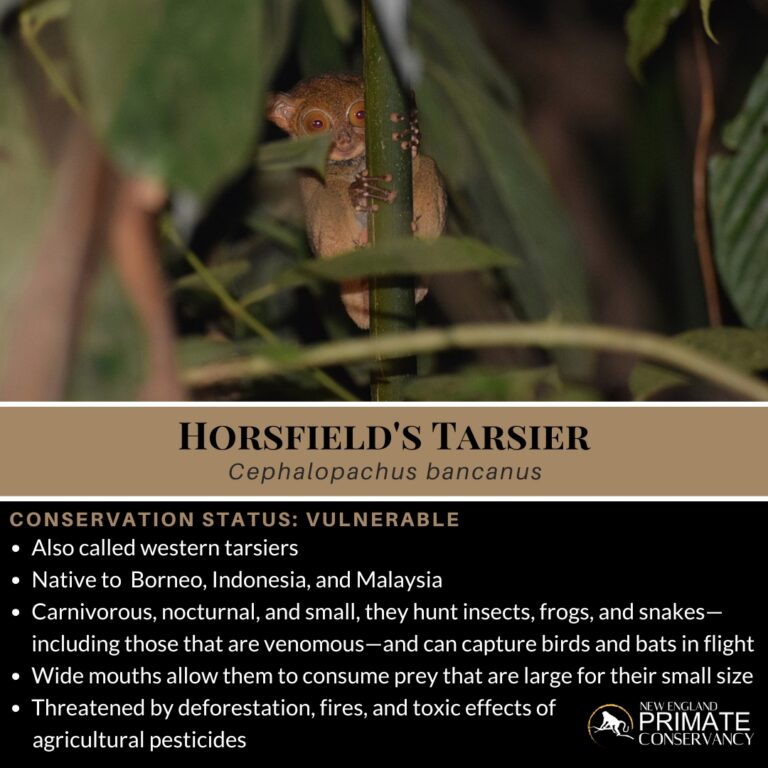
Horsfield’s Tarsier, Cephalopachus bancanus
HORSFIELD'S TARSIER
Cephalopachus bancanus
Geographic Distribution and Habitat
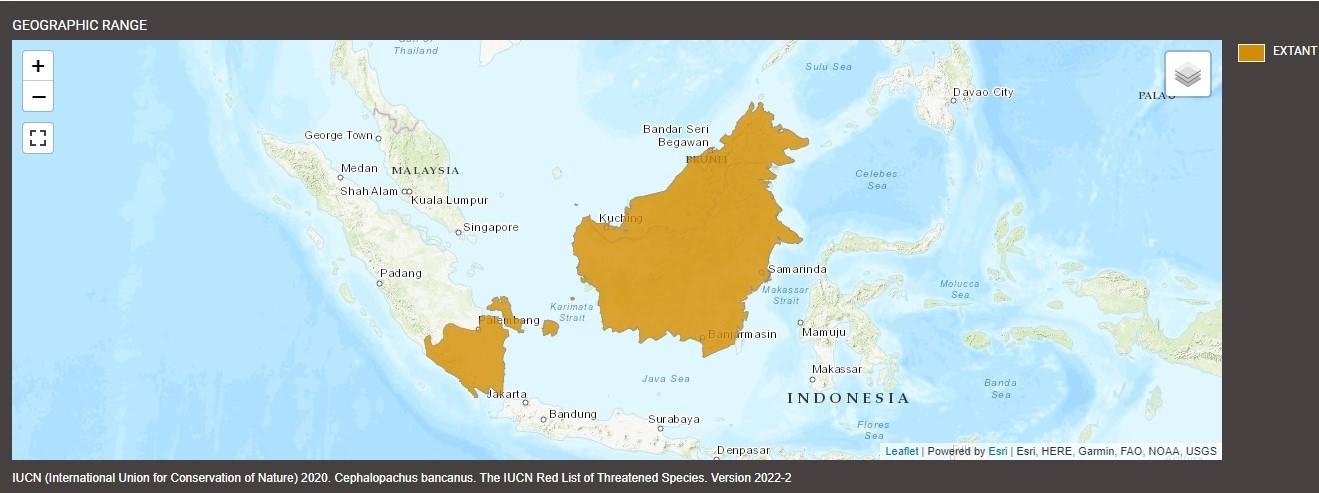
The Horsfield’s tarsier, also known as the western tarsier, is found in Indonesia, Malaysia, and Borneo. They are found in primary and secondary forests, as well as along the coasts or on the edge of crop forests and plantations. In Indonesia, they specifically occur in Bangka, Belitung, Karimata, southeastern Sumatra, the South Natuna Islands (Serasan), and Kalimantan (Borneo). Borneo, the world’s third-largest island, is divided between Indonesia, Malaysia, and Brunei. Although the island accounts for only 1% of Earth’s land mass, Borneo holds 6% of global biodiversity in its rich, tropical rainforests.
Across these political territories, natural borders for Horsfield’s tarsiers are defined by various rivers, oceans, seas, and mountain ranges. In Indonesia, mountain ranges are shaped by volcanic chains, with the most notable being the Barisan Mountains on Sumatra, Muller and Schwaner Mountains in Kalimantan, and the Dieng Plateau in Java. These areas are further characterized by dense tropical rainforest, high volcanic activity, and steep terrain. The Indian Ocean, Musi River, Java Sea, and South China Sea also serve as major geographic boundaries for Horsfield’s tarisers.
The territories they occur in experience two distinct seasons: a dry season from April to October and a monsoon season between November and March. Due to their proximity to the equator, Indonesia, Malaysia, and Brunei have a tropical climate marked by high temperatures, high humidity, and significant rainfall. The average daily temperature generally ranges between 77 and 95 degrees Fahrenheit (25 to 35 degrees Celsius). Humidity often remains over 80%, and there is little variation between seasons. During the monsoon season, rainfall can exceed 11.8 inches (300 mm) per month. Extreme weather such as this can cause massive flooding in tropical rainforests, rural areas, and cities. Yet, Horsfield’s tarsiers are adapted to live in these conditions. However, if climate change continues to increase the frequency of these extreme weather events, they may experience habitat loss and population declines.
Horsfield’s tarsiers are named after Thomas Horsfield, a doctor and naturalist from the United States of America. Between 1799 and 1819, he traveled to Indonesia, then known as the Dutch East Indies, to study the territory’s plants, animals, and geography. Before his departure in 1819, he identified the western tarsier from specimens collected on the island of Bangka, just off the coast of Sumatra. His findings were officially posted in 1821, and later in 1824 in his work Zoological Researchers in Java and the Neighboring Islands. The western tarsier became known as “Horsfield’s tarsier” after his publication.
All tarsiers were previously placed in the genus Tarsius. In 2010, taxonomists Colin Groves and Myron Shekelle designated Horsfield’s tarsiers as the sole member of the genus Cephalopachus and recognized three subspecies.
Size, Weight, and Lifespan
Adult Horsfield’s tarsiers have a head and body length between 5.1 and 5.2 inches (12.9 and 13.2 cm). There are minor sexually dimorphic differences between males and females, particularly in size and body weight. Males are typically larger and heavier than females, weighing between 3.8 and 4.8 ounces (110 to 138.5 grams). Females, on the other hand, tend to be smaller and lighter, weighing between 3.7 and 5.12 ounces (104 to 145 grams). In both sexes, the tail is nearly double the size of their head and body length, measuring between 8 and 9 inches long (20.32 and 22.86 centimeters)!
In the wild, individuals typically live to about 16 years.
Appearance
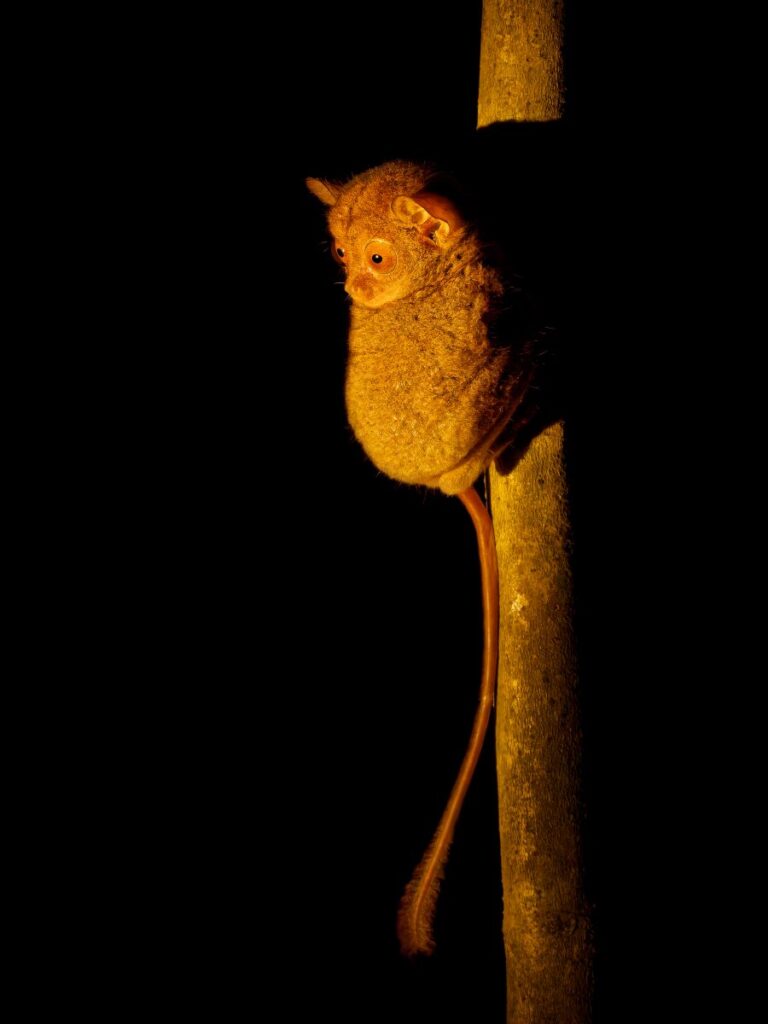
Horsfield’s tarsiers are compact, with thick fur in varying shades of orange, cream, brown, and yellow. Young individuals are typically more orange than older ones. As they age, the hair around their face grays, and their teeth lose their integrity. They possess 34 teeth adapted for crushing insect exoskeletons and other prey items.
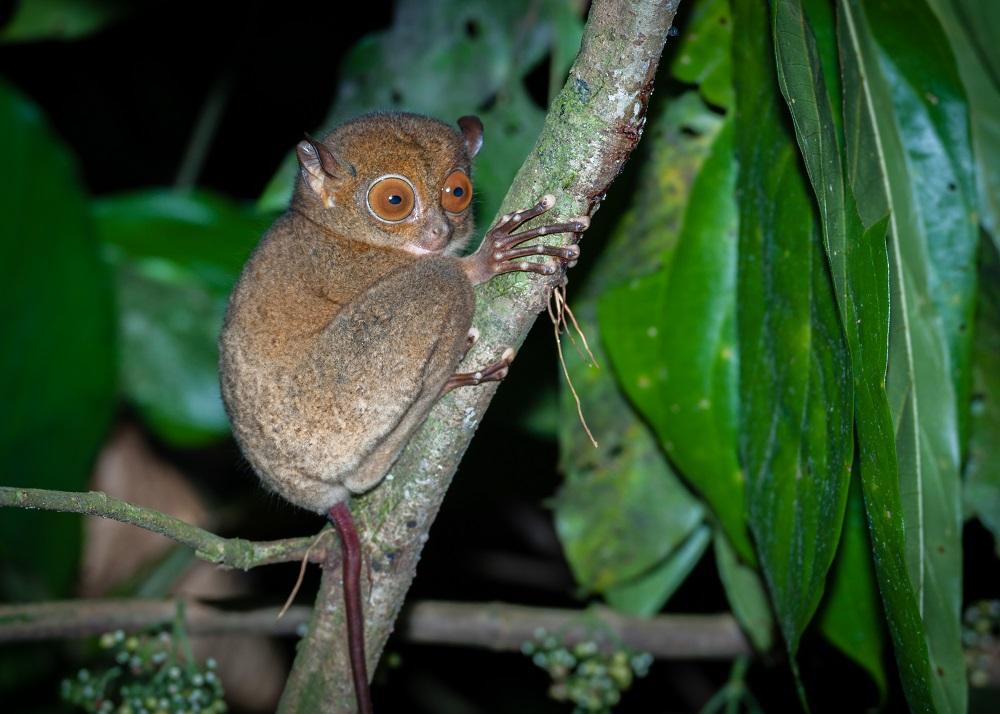
All tarsiers have large eyes, roughly 0.59 to 0.71 inches (15 to 18 millimeters) in diameter, that help them see in low-light conditions. Because light conditions change throughout the day, their eyes contain lenses, corneas, and irises that help collect light and enhance images. Since color differentiation can be challenged in low light, their eyes have specialized night-vision cells that help them detect texture, movement, and contrast.
Their rounded ears stick out from the side of their heads and are quite large for their body size. Their ears are horizontally ridged, and researchers suggest that these ridges act as an acoustic lens. This design helps them focus on high-frequency sounds, identify small objects, and determine the vertical position of sound sources. If the grooves were vertical instead of horizontal, they would direct most of the sound waves away from the ear canal, rather than towards it. Overall, their unique shape acts like a sonar antenna system and enhances their nocturnal lifestyle.
Tarsiers have grooming claws on the second and third toes of their feet, while their fingers and remaining toes bear nails like other primates. Their digits are tipped with enlarged pads that provide a strong grip, helping them cling to vertical surfaces and land precisely after powerful leaps. These pads enhance friction rather than acting as sticky surfaces. Their fingers and toes are relatively hairless, allowing for better contact and control. Their tails are mostly hairless—often ending in a tuft—and play an important role in balance and stability.
Diet
Unlike other primates that are either omnivores or herbivores, tarsiers are the only fully carnivorous primates. Horsfield’s tarsiers do not eat plants. Instead, they feed on small animals and insects such as beetles, grasshoppers, cockroaches, butterflies, moths, ants, birds, bats, and freshwater crabs. Specific species include: Malay viscount butterflies (Tanaecia pelea), Malay baron butterflies (Euthalia monina), common palmflies (Elymnias hypermnestra), lesser short-nosed fruit bats (Cynopterus brachyotis), banded Malaysian coral snakes (Calliophis intestinalis), and lowland freshwater crabs (Parathelphusa maculata).
Because they have the ability to rotate their heads 180 degrees in each direction, they are able to scan the forest effectively for prey. For about 2 hours each night, individuals hunt and jump between branches, often clinging to lower ones because they give them better access to ground-dwelling prey. How can they support themselves? Using enough force from the combined effort of their feet and tail, they can cling to trees and hold themselves in place.
In addition to physical adaptations, they also have specialized digestive adaptations suited for their animal-based diet. These adaptations include sharp, pointy teeth for piercing exoskeletons and a short digestive tract. Because meat and fat are easily digestible, their short tracts allow them to break down food easily. Water helps with their digestion, and they typically consume water from wet leaves or tree shoots.
Behavior and Lifestyle
Horsfield’s tarsiers are nocturnal and are most active between dawn and dusk when their environment is gray, dark, and hazy. These arboreal animals live most of their lives among trees, and their preferred forms of locomotion are vertical climbing and leaping. With extraordinarily long hind legs—especially their elongated ankle bones—tarsiers are among the most powerful leapers of any primate. They can jump up to 40 times their body length—that’s like a grasshopper leaping the length of a small truck!
During the daytime, they sleep vertically, clinging to small branches, vines, or trees. To hide from predators, they require plenty of tree cover and choose sleeping locations that allow them to remain concealed over long periods of time. In addition to camouflage, sites such as these also provide shelter from rainfall. Because their eyes are so sensitive to bright light, it is also crucial that their chosen site be shaded. They frequently rest in tangles of dark, dense vegetation or beneath naturally formed platforms created by fallen trees. Climate and temperature significantly influence habitat quality, especially seasonally, so sleeping site locations can vary.
Tarsiers have a unique spinal morphology that allows them to rotate their heads an impressive 180 degrees in either direction. Unlike most other animals, they can nearly achieve a full 360-degree head rotation, which is the farthest of any mammal!
Unlike some other tarsier species that live in small groups, Horsfield’s tarsiers are solitary animals, preferring to spend most of their time alone. They typically sleep, feed, and forage independently unless mating with a partner. They are monogamous, meaning that individuals mate with one partner rather than many. During the dry season, when resources are less abundant, individuals are more likely to interact with one another as they travel further than normal to look for food.
Although Horfield’s tarsiers live in the same forests as other primate species, including gibbons, langurs, and macaques, they do not interact with them. Because they do not directly compete for food and operate on different rest schedules, they do not run into each other. Typically, the only interactions they have with other mammals are when they are fulfilling the role of predator or prey. Because of their small size, they are especially vulnerable to predation. Whether arboreal or arial, their primary predators include the Asian palm civet (Paradoxurus hermaphroditus), the barred eagle owl (Bubo sumatranus), the Malay eagle-owl (Bubo nipalensis), the reticulated python (Malayopython reticulatus), and the Burmese python (Python bivittatus).
Did you know tarsiers can communicate “silently”? While they also produce audible calls, they can use ultrasonic vocalizations—sounds above the range of human hearing. In fact, they are the only primates known to both produce and detect purely ultrasonic calls, with frequencies reaching around 90 kilohertz (humans can only hear up to about 20 kilohertz). These high-frequency sounds fade quickly over distance, which may help keep their communication private. You may see a tarsier open its mouth as if to call—but hear nothing at all.
In addition to vocalizations, they also utilize scent marking as a form of olfactory communication. These scent marks act as a form of self-advertisement, signaling their presence to others in the surrounding area. In addition to having scent glands on their anogenital regions, they also have natural scent glands on their face and chest. Due to its chemical complexity, urine is an important and commonly used scent marker, and it is spread onto saplings, branches, tree roots, and bushes. Often, scent marks are used by individuals to attract mates and identify intruders.
Mating occurs between October and December, during which males and females court each other through a series of chasing and vocalizing. Once the pair forms and successfully breeds, the female is pregnant for about 6 months before giving birth to a single infant. Newborns weigh around 0.88 ounces (25 grams) at birth, and arrive with their eyes fully open. A light layer of fur covers their body, and within the first few hours of their life, they are capable of clinging to branches and their mother’s back.
At birth, a tarsier infant is already remarkably large—about 20% of its mother’s body weight—reflecting a significant investment even before its life has fully begun. From that moment on, the mother’s attention is focused on keeping her infant safe as it grows and gains independence. Survival matters not only because of the energy already devoted to gestation and the demands of nursing, but because each infant represents a rare and important opportunity in a species that produces few young. If an infant is lost, a mother may reproduce again sooner, but raising a surviving infant to independence is what ultimately contributes to her lifetime reproductive success.
To support her infant’s development, she stays close during the early stages of their life. For the first few days, she carries the infant in either her mouth or on her back before they begin their own exploration. Because the mother must continue to provide for both herself and her infant, she often “parks” the infant in a secure, concealed spot in the trees while she forages. She returns periodically—or responds to the infant’s calls—to nurse and reposition it, keeping the infant protected during its most vulnerable early weeks.
Fathers do not participate in infant care. Once the nursing stage is complete, young tarsiers must begin to fend for themselves, gradually reaching sexual and developmental maturity between about 1.5 and 2 years of age.
As carnivores, Horsfield’s tarsiers primarily consume insects, making them specialized insectivores. By feeding on a wide variety of insects, they contribute to the natural regulation of local populations. Alongside other insect-eating animals, they play a role in maintaining ecological balance within their habitat.


The International Union for Conservation of Nature lists Horsfield’s tarsiers as Vulnerable (IUCN, 2015), appearing on the IUCN Red List of Threatened Species. From 1995 to 2015, at least 30% of their natural habitat was lost due to various threats, including deforestation, forest conversion, the expansion of oil palm plantations, and commercial logging. Researchers suspect the population has also decreased by 30% over this period due to these threats, and if habitat loss continues, a similar decline over the next 20 years is suspected.
In addition to environmental threats, they also face direct threats from humans. In provinces like Lampung, they are considered pests to crops. Even though they are completely carnivorous, farmers and local populations consider them a pest. To deter them from the area, they spray agricultural pesticides throughout the land, which can, unfortunately, lead to contamination and suffering for the tarsiers. When a primate eats an infected insect, the toxic substances will accumulate in their body, which can cause physical deformities, reproductive issues, developmental issues, severe organ failure, or death. Younger animals are even more vulnerable to insecticides because their bodies absorb higher doses of the chemicals. Because their bodies are still developing, they struggle to break down and detoxify chemicals, prolonging the poisoning. If they are captured, they will most likely be sold in the illegal pet trade.
Horsfield’s tarsiers are listed in Appendix II on International Trade in Endangered Species (CITES), an international agreement between governments whose goal is to ensure that international trade in specimens of wild animals and plants does not threaten their survival. They occur in a few protected areas across their range, such as Bukit Barisan Selatan National Park, Kerinci Seblat National Park, and Way Kambas National Park.
In 2007, Brunei, Malaysia, and Indonesia came together to protect nearly 220,000 square kilometers of natural forest in their “Heart of Borneo” initiative. The Heart of Borneo (HoB) refers to the largest remaining forest tract on the island, and is one of the largest transboundary rainforests remaining in the world. The program aims to conserve the biodiversity of the Heart of Borneo for the benefit of the people. Today, it focuses on blending economic development with conservation, targeting sustainable forestry, ecotourism, and protecting biodiversity. Still, these countries face pressures from logging, agricultural expansion, and hydropower dam projects.
- Bejar, S.G.F., Purificacion, D.M.P., Aragones, L.V. et al. Sleeping Site Selection, Sleep-related Positional Behavior, and Social System of Philippine Tarsiers (Carlito syrichta) Inhabiting a Protected Forest Fragment in Mindanao Island, Philippines. Int J Primatol 45, 1178–1207 (2024). https://doi.org/10.1007/s10764-024-00443-5
- Dröscher, I., Kappeler, P.M. Maintenance of familiarity and social bonding via communal latrine use in a solitary primate (Lepilemur leucopus). Behav Ecol Sociobiol 68, 2043–2058 (2014). https://doi.org/10.1007/s00265-014-1810-z
- Keeley BW, Keeley ATH, Houlahan P. Ridge number in bat ears is related to both guild membership and ear length. PLoS One. 2018 Jul 25;13(7):e0200255. doi: 10.1371/journal.pone.0200255. PMID: 30044815; PMCID: PMC6059413.
- Revathe, T., Mundry, R., Utami-Atmoko, S.S. et al. Maternal Behavior in Sumatran Orangutans (Pongo abelii) is Modulated by Mother-Offspring Characteristics and Socioecological Factors. Int J Primatol 45, 1021–1048 (2024). https://doi.org/10.1007/s10764-024-00435-5
- Zinner D, Paciência FMD, Roos C. Host-Parasite Coevolution in Primates. Life (Basel). 2023 Mar 17;13(3):823. doi: 10.3390/life13030823. PMID: 36983978; PMCID: PMC10058613.
- https://www.iucnredlist.org/species/21488/17976989
- https://wwf.panda.org/discover/knowledge_hub/where_we_work/borneo_forests/
- https://news.mongabay.com/2025/04/heart-of-borneo-dams-raze-indigenous-forests-for-indonesia-green-energy-drive/
- https://primate.wisc.edu/primate-info-net/pin-factsheets/pin-factsheet-tarsier/#:~:text=Unique%20spinal%20morphology%20makes%20tarsiers,some%20tarsiers%20from%20one%20another.
- https://www.inaturalist.org/guide_taxa/178738#:~:text=5,hair%20near%20the%20distal%20end.
- https://www.guinnessworldrecords.com/world-records/395084-farthest-head-rotation-by-a-mammal#:~:text=In%20the%20mammal%20kingdom%2C%20the,rotate%20their%20heads%20almost%20360%C2%B0.
- https://news.mongabay.com/2021/12/extinction-not-only-threatens-primates-their-parasites-are-in-danger-too/
- https://www.nature.org/en-us/about-us/where-we-work/united-states/ohio/stories-in-ohio/insect-conservation/#:~:text=Birds%20Need%20Bugs,falling%20populations%20of%20flying%20insects.&text=Healthy%20natural%20areas%20maintain%20a,of%20these%20chain%2Dreaction%20effects.
- https://www.endangeredspeciesinternational.org/tarsiersection4.html#:~:text=Western%20tarsier%20young%20move%20away,food%20or%20their%20shy%20nature.
- https://www.gbif.org/species/7503658
- https://www.treehugger.com/tarsiers-cool-facts-about-these-wonderfully-weird-primates-4864006#:~:text=2%20This%20unique%20anatomy%20allows,to%20insects%20and%20other%20prey.
- https://www.primates.com/primate/tarsiidae.html
- https://en.wikipedia.org/wiki/Barisan_Mountains#:~:text=The%20Bukit%20Barisan%20or%20the,possible%20for%20a%20volcanic%20eruption.
Written by Brooklynne Mitchell-Arno, March 2026