
Northern Pig-Tailed Macaque, Macaca leonina
NORTHERN PIG-TAILED MACAQUE
Macaca leonina
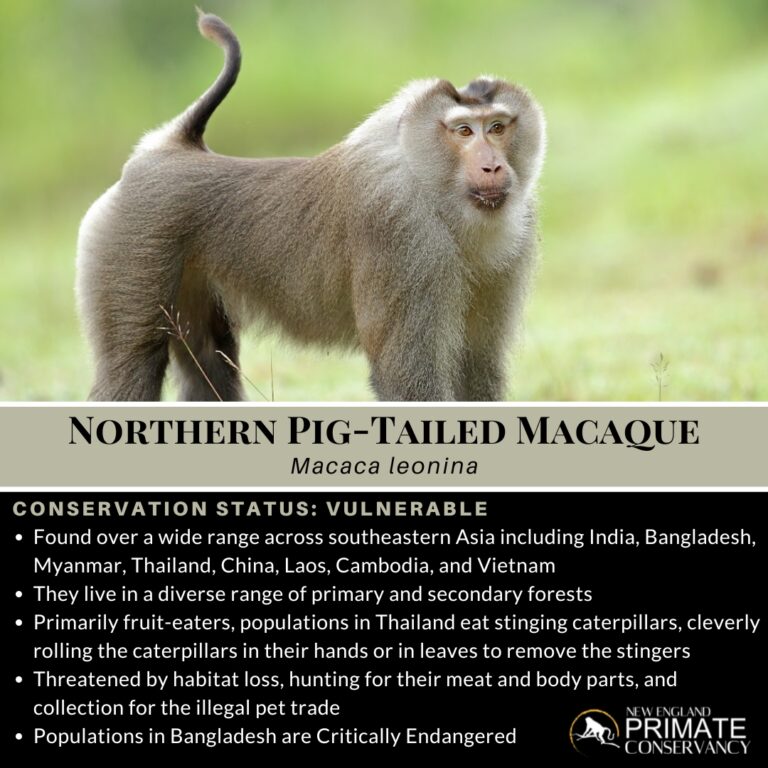
Geographic Distribution and Habitat
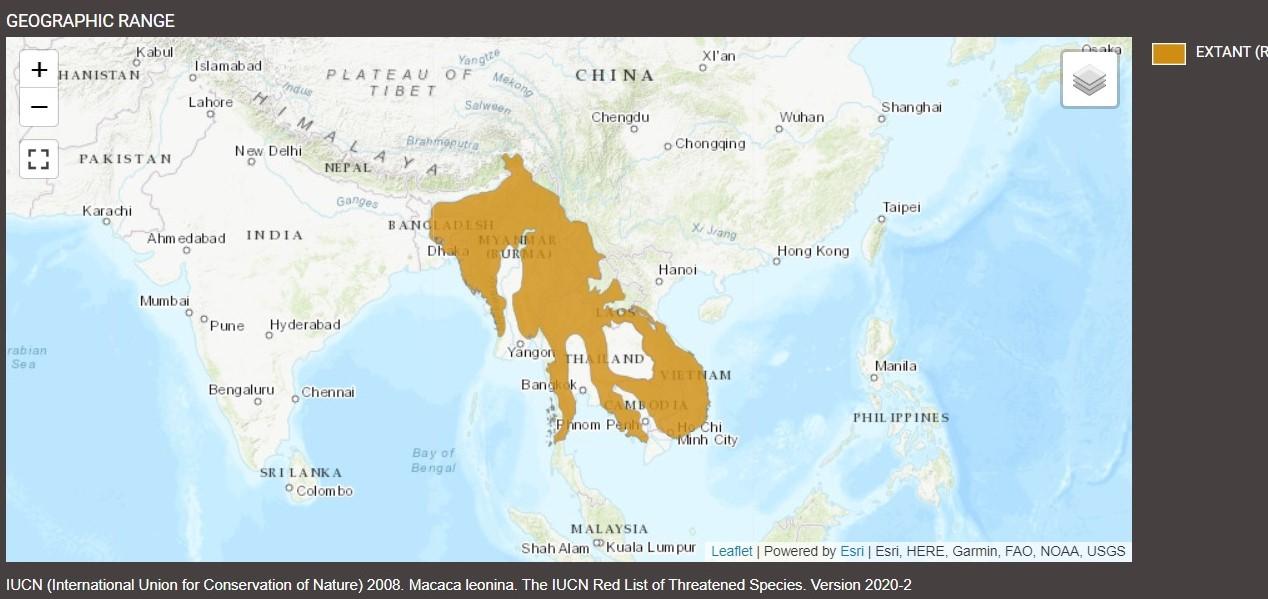
Northern pig-tailed macaques are distributed widely across mainland Southeast Asia and parts of South Asia. Their range includes eastern Bangladesh, northeastern India, southern China, Myanmar, Thailand, Lao PDR, Cambodia, and central to southern Vietnam.
Within these regions, northern pig-tailed macaques inhabit forest types, including tropical evergreen and semi-evergreen forests, tropical wet evergreen forests, moist deciduous forests, coastal forests, swamp forests, and even low-elevation pine forests in parts of Laos and China. They are also found in montane or mountainous forests and can tolerate degraded forests impacted by logging or other human activities. In western Thailand and Laos, they are often in riparian forests or those located along rivers and streams.
Across their range, northern pig-tailed macaques are found from about 164 feet to 6,560 feet (50-2,000 m) above sea level. In China, they occupy elevations throughout this range, while in Laos and Vietnam, they are more commonly in lowlands below 1,640 feet (500 m). In Myanmar, populations live at higher elevations from 623 to 1,312 feet (190 to 400 m).
In lowland forests, mean temperatures typically range from 75 to 86°F (24–30°C), while montane forests may be cooler, averaging 61 to 75°F (16–24°C). The wet season generally spans May to October, bringing heavy rainfall and increased fruit availability; consequently, macaques forage more intensively in the canopy. The dry season, from November to April, is marked by lower water and fruit availability, prompting macaques to increase their daily movement, forage on alternative food sources such as leaves or human crops, and adjust group cohesion to maximize feeding efficiency. These seasonal shifts also influence the location of nesting and sleeping sites, with macaques favoring taller, denser trees during the wet season to avoid flooding and predation.
Previously, the northern pig-tailed macaque was considered a subspecies of the southern pig-tailed macaque (Macaca nemestrina). Research in the early 21st century, however, led to a reclassification of this taxon. For many years, scientists classified it as Macaca nemestrina leonina, a subspecies or regional variation rather than a distinct species.
Careful comparisons of physical features (morphology), distribution patterns, and reproductive characteristics showed consistent differences between the northern and southern forms. As a result, scientists split the pig-tailed macaques into two separate species: the northern pig-tailed macaque (Macaca leonina) and the southern or Sundaland pig-tailed macaque (Macaca nemestrina).
One of the important distinguishing features involved sexual swellings in females. Sexual swellings are temporary enlargements and reddening of the skin around the genital area during the reproductive cycle. The pattern, size, and coloration of these swellings differ between the two species, helping researchers confirm they are biologically distinct.
However, the two species are known to interbreed where their ranges meet. Although they mostly live in separate geographic areas, they both inhabit southern Thailand. In this narrow contact zone, limited hybridization occurs, including on the islands of Phuket and Yao Yai. Despite this small area of overlap, the consistent physical and reproductive differences between the northern and southern populations strongly support their classification as separate species.
Size, Weight, and Lifespan
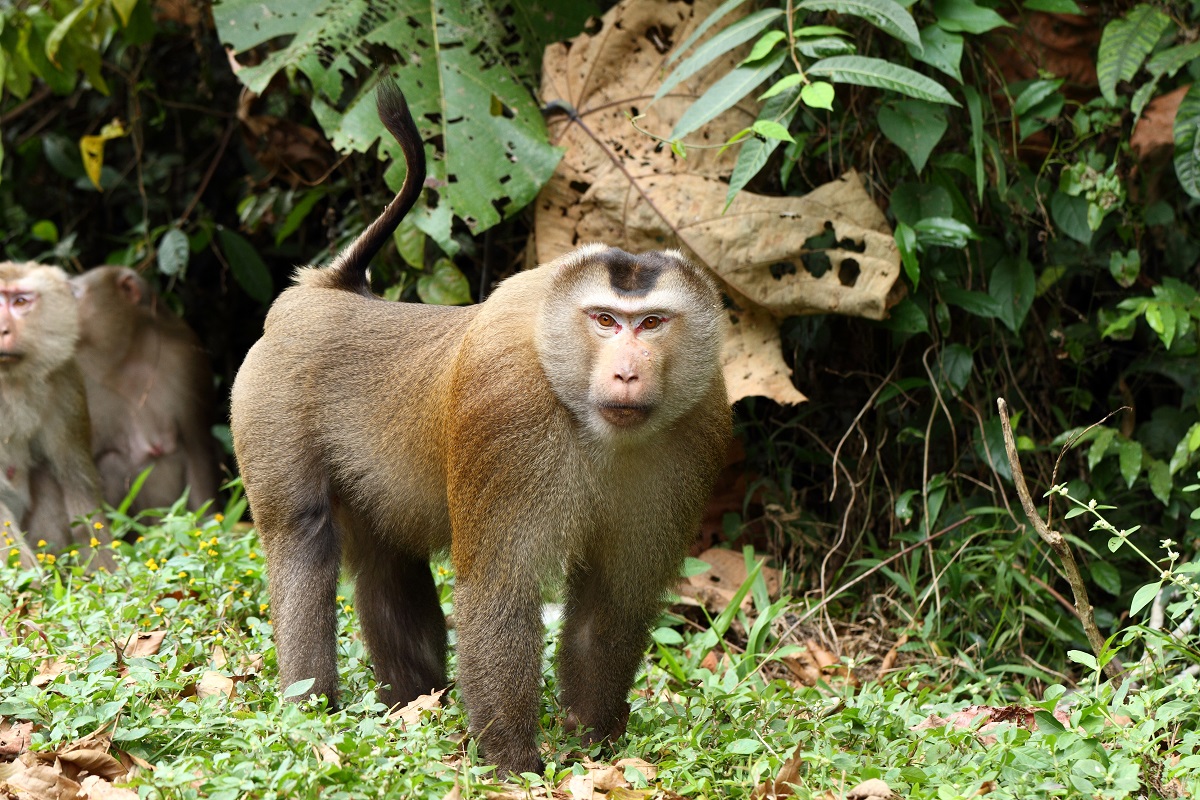
Northern pig-tailed macaques exhibit clear sexual dimorphism, meaning males and females differ noticeably in size and body build. The most obvious difference is body weight. Adult males typically weigh between 13.7 and 20 pounds (6.2-9.1 kg), while females are smaller, weighing about 9.7-12.6 pounds (4.4-5.7 kg). In general, males are often over 17.6 pounds (8 kg), whereas females are usually under 13.2 pounds (6 kg).
Males also have longer bodies. Their head-and-body length ranges from 19.7-23.4 inches (50-59.5 cm), compared to 15.7–19.3 inches (40-49 cm) in females. The tail is relatively short compared to body size and is often carried in a gentle upward curve, resembling that of a pig. Males have tails measuring 7.1-9.8 inches (18-25 cm), while females’ tails are slightly shorter at 6.3-7.9 inches (16-20 cm).
Like many macaques, this species has a moderately long lifespan for a medium-sized primate. In the wild, it is estimated that individuals live into their late teens or early twenties, though exact data from wild populations are limited. Under rare, highly managed captive conditions—such as in well-resourced, professionally run institutions—they may live longer.
Appearance
If you were to encounter a northern pig-tailed macaque in the forest, the first thing you would likely notice is its compact, sturdy build and its expressive, patterned face.
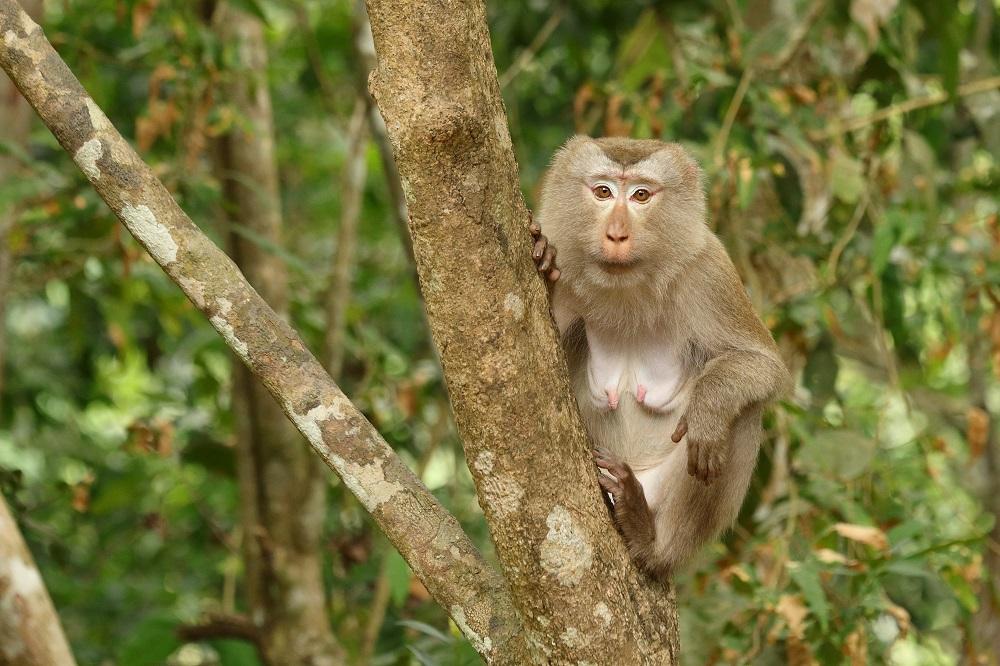
Framing the face is a rounded “crown” of fur, a grayish cap that begins along the cheeks, sweeps over the top of the head, and curves beneath the chin. At the center of this crown sits a darker brown patch. Just above the eyes, pale triangular markings stand out against the darker fur. From the outer corners of each eye, thin reddish lines angle upward diagonally, almost like carefully drawn mascara. These facial markings are one of the clearest ways to distinguish this species from its closest relative, the southern pig-tailed macaque.
Its muzzle is elongated but not overly long, giving the face a balanced, alert appearance. The eyes often appear intense and focused, especially when the animal pauses to observe movement in its surroundings. Like other macaques, they possess expandable cheek pouches, specialized pockets of skin inside their cheeks, allowing them to quickly stuff food into their mouths and store it for later. This adaptation allows macaques to rapidly retreat to a safer spot before eating.
Moving down the body, you would see a coat ranging from grayish to brownish tones. Adult males often have a darker streak running down the center of their back, sometimes with a reddish hue toward the shoulders that deepens into darker fur toward the lower back. Males also tend to have more defined shoulder muscles, giving them a powerful, stocky look.
As their name suggests, their tails are short and immediately eye-catching. Unlike the long, flowing tails of many other macaques, this one looks compact and almost purposeful. It is most often held upright in a sharp bend, forming a neat angle above the back, much like a small handle. At times, it may arch forward, curve gently, or point downward, but it rarely hangs loosely behind the body. Covered in thin, dark fur, the tail gives the macaque a distinctive pig-tailed silhouette, making the species easy to recognize once you have seen it.
If the macaque shifts position, climbs, or briefly rises from a seated posture, you may catch a glimpse of their ischial callosities, thickened, oval pads of bare skin beneath the tail. These specialized sitting pads allow the animal to rest comfortably on branches for long periods, an adaptation well-suited to life in the trees.
Diet
When it comes to food, northern pig-tailed macaques are primarily frugivorous, meaning that fruit makes up the bulk of their diet. They feed on both fleshy and dry fruits from hundreds of plant species, often including flowers, buds, leaves, and young shoots. In one study from northeastern India, fruit accounted for 66% of their diet, with seeds and leaves each contributing roughly 6%, flowers about 2%, and insects, eggs, and small vertebrates made up nearly 12%. If we recreated this diet as a human-like dish, the majority of the plate would be fruit with tiny handfuls of seeds and leaves scattered around, a small sprinkling of flowers, and a protein-rich nibble of insects, eggs, and small animals making up the final portion.
Northern pig-tailed macaques in Thailand even eat some species of stinging caterpillars. To avoid the irritating hairs, the macaques first rub the caterpillars—either between their hands or against a leaf or branch—to remove the stinging hairs. After eating them, they may also rub their hands and mouth to remove any remaining hairs. This behavior is an example of extractive foraging, in which animals process food before eating it to make it safe or accessible.
Across their range, these macaques eat more than 90 different plant species, highlighting their behavioral flexibility and environmental adaptability. Although they prefer fruit, northern pig-tailed macaques are highly adaptable and omnivorous when fruit is scarce. In these times, they may supplement their diet with leaves, bamboo shoots, roots, fungi, ants, termites, spiders, caterpillars, beetles, lizards, and even small mammals. They also take advantage of human foods when available, including rice, bread, and biscuits, particularly in areas where traditional agricultural practices like slash-and-burn farming are common.
Their feeding behavior is also closely tied to their chosen habitats. In pristine forests, they typically follow a “low-cost, low-yield” strategy, foraging efficiently in areas with abundant fruit. In degraded or plantation forests, such as those with non-native acacia or eucalyptus trees, they adopt a “high-cost, high-yield” strategy, traveling longer distances and alternating between foraging and transit to maximize nutrient intake when preferred fruits are limited.
Behavior and Lifestyle
Like many primates, the daily behavior of northern pig-tailed macaques is heavily shaped by the quest for food and safety. They are diurnal, meaning they are active during the day and rest at night. Their daily activities revolve around three main feeding periods, with long rests at mid-day and shorter breaks in the mid-morning. Studies in Assam, India, recorded that these macaques spend roughly 45% of their time resting, 23-24% feeding, and 17–19% moving, with grooming accounting for 6–8% of their time. Feeding sessions can last 2.5 to 3.8 hours daily, and in areas with cultivated crops, such as rice paddies or sugarcane leftovers, they may spend up to 65% of feeding time on the ground.
While they are excellent climbers and can quickly dash into the treetops when threatened, these macaques spend a significant portion of their time on the forest floor, especially when foraging or crossing open spaces. Scientifically speaking, they are primarily arboreal, moving through the trees for safety, but they sometimes use terrestrial routes or travel on the ground. For example, they often feed on crops, traverse clearings, or forage in degraded habitats, adjusting their behavior with the seasons and food availability.
They are also highly strategic foragers, adjusting their home range and movement due to shifting fruit availability. When wild fruits are plentiful, they stay within smaller areas near preferred fruit trees. In degraded forests or plantations where natural fruit is scarce, they travel farther and use more energy to access human crops or introduced fruit species.
Sleeping and behaviors that support sleep are other important aspects of their lifestyle. In Thailand’s Khao Yai National Park, they prefer tall sleeping trees, averaging nearly 69 ft (21 m) in height, and often reuse the same trees, a strategy to avoid predators. Selecting high, sturdy trees also protects from ground predators and provides better visibility of approaching threats.
Did you know? Their stubby, curly tail gave them their name! Imagine a little piglet tail perched on a monkey!
Nap champions: Resting comprises nearly half of their day. Monkey business can be exhausting!
Seed spreaders: By eating and dropping seeds, they help rainforests grow and regenerate.
Big family: They live in groups that can range from a cozy dozen to a bustling 150, splitting up to avoid squabbles while feeding.
Northern pig-tailed macaques are highly social and gregarious, living in multi-male, multi-female groups that vary widely in size. Typical groups contain 12–40 individuals, though overall group size across their range can range from 9 to 81 macaques. Studies in Bangladesh reported an average group size of 20 individuals, with population densities of 6.47-17.87 macaques per square mile (2.5–6.9 individuals per square km). In some areas of Thailand, Vietnam, and Laos, gatherings of 50–150 individuals have been observed, possibly representing multiple groups gathering to exploit temporarily abundant food resources. These variations in group size reflect differences in habitat quality, food availability, and human disturbance.
Like many Afro-Eurasian monkeys, their social structure is hierarchical, with one dominant male at the top, followed by ranked males and females. Within these groups, relationships are complex and maintained through frequent social interaction. Macaques spend much of their day grooming, playing, chasing, and vocalizing with one another.
Grooming, in particular, is one of the most important social behaviors. While it serves a hygienic role, with 75% of grooming time spent removing ectoparasites and skin flakes, it also plays a critical role in maintaining affiliative bonds and reducing social tension. Studies show that macaques spend more time on social grooming than self-grooming, underscoring its social importance. Grooming preferences vary by age and sex, suggesting that social rank, maturity, and relationship strength influence who grooms whom. Higher-ranking individuals often receive more grooming, while lower-ranking individuals may groom upward in the hierarchy, possibly reinforcing alliances or gaining tolerance. Grooming also has a calming effect. In one study of a female pig-tailed macaque, heart rate was significantly lower when she received grooming compared to when she groomed others or groomed herself. Heart rate declined by as much as 20 beats per minute during bouts of receiving grooming, particularly following aggressive encounters, suggesting that grooming helps reduce stress and restore social harmony.
Beyond their intricate social interactions, northern pig-tailed macaques must also navigate and share the physical landscape in which these relationships unfold. The species’ home range varies widely, from about 205 to 857 acres (83-347 ha), with partial overlap between neighboring groups of roughly 25-48%. The macaques travel distances between 0.4 and 1.4 miles (690–2,240 m) daily. When food is far apart, they will move farther. Resource competition with other species is relatively low, with only about 22% overlap in food use, highlighting their adaptability in sharing habitats. For instance, in Khao Yai National Park, Thailand, white-handed gibbons (Hylobates lar) often accessed ripe fruit before macaques arrived, and the macaques avoided trees occupied by gibbons, sometimes foraging nearby or waiting for access. By adjusting their daily travel distances and utilizing different parts of their overlapping ranges, northern pig-tailed macaques can coexist with neighboring groups and other frugivores while effectively accessing food and other resources.
Northern pig-tailed macaques also adjust group composition according to environmental conditions. In areas with scattered feeding sites, groups may become larger to enhance foraging efficiency. When they rely on human food sources, groups often become more sedentary, forming smaller, stable units. Conversely, in pristine forest habitats with abundant wild fruit, smaller, nomadic groups are more common.
Even in large groups, social dynamics are flexible. Macaques split into smaller sub-groups while feeding to minimize conflict, then rejoin for travel, balancing the benefits of safety in numbers with the need to access food efficiently. This adaptability in group size, movement, and social organization allows northern pig-tailed macaques to thrive across a range of habitats, from dense forests to human-influenced landscapes.
Within northern pig-tailed macaque social groups, they rely on a rich system of vocalizations to maintain connections, coordinate activities, and convey important information.
Alarm calls are key to group safety. Females and juveniles often emit a sharp “awheek, wheek” to alert others to danger. The alpha male will produce deeper “hrr-hrr” or “argh” calls, which command attention and signal the presence of threats.
During everyday activities, nearly all individuals emit softer “pno-pno” or “po-po” calls while traveling or foraging, helping the group stay together and coordinate movements across the forest.
They also use vocalizations in reproductive and social contexts. Adult males may call after mating with sounds such as “khek-khek,” “ghek-ghek,” “agh-agh,” or “khejh-kheh,” which can communicate their recent success or social status within the group.
Combined with gestures, postures, and physical interactions, these vocal signals allow northern pig-tailed macaques to maintain social bonds, organize group movement, and respond rapidly to threats, demonstrating the sophistication of their communication within complex social groups.
Northern pig-tailed macaques are seasonal breeders, with most mating observed in winter and spring in northeastern India. Females are typically sexually receptive from August to December, though some may remain receptive into February. During this time, prominent, reddened sexual swellings, a visible sign of fertility caused by hormonal changes during ovulation, are observed on females. These swellings help attract males and signal readiness for mating.
Mating involves one or multiple mounts over consecutive days, and observers can sometimes identify a sperm plug, indicating recent copulation. Following successful mating, females undergo a pregnancy period of about 171–180 days or roughly six months. Births occur during the dry season from January to May, though some individuals may give birth later, occasionally extending into June.
Northern pig-tailed macaques typically bear a single offspring, which the mother nurses for up to two years, providing constant care and protection to the infant. This extended period of lactation and maternal care ensures that the young develop the skills and strength needed to eventually navigate the forest, forage for food, and integrate into the complex social structure of their group.
No long-term studies of northern pig-tailed macaques have been undertaken. The closely related southern pig-tailed macaque reaches sexual maturity between the ages of 3 and 5 years old. Females remain with their troop for their entire lives, but males eventually disperse to find a new troop. Once found, he will join the troop at the bottom tier and attempt to work his way up the rankings.
Northern pig-tailed macaques play a key role in tropical forest ecosystems, particularly as seed dispersers. By feeding on a wide variety of fruits, flowers, and buds, they inadvertently help plants colonize new areas. Seeds are dispersed in several ways: swallowed, spat out, or dropped, allowing them to escape predators, avoid competition, and reach suitable locations for germination.
Studies in Khao Yai National Park, Thailand, have shown that a single macaque can disperse thousands of seeds per defecation, including seeds up to 58 mm in length from more than 80 fruit species. They move seeds from primary forests to secondary forests, aiding regeneration and maintaining forest diversity. The effect on seed germination varies by species: some seeds germinate better after passing through the macaque’s digestive system, while others remain unaffected or slightly reduced in viability.
Large-seeded fruits, which are not eaten by smaller frugivores that dominate degraded or fragmented forests, rely on animals like macaques for dispersal. Studies show that dietary overlap with other frugivores is low, with northern pig-tailed macaques eating unique fruit species and sizes that few other animals handle. This underscores their unique ecological niche and the importance of their conservation for maintaining natural seed dispersal processes in Southeast Asian forests.
In addition to their role as frugivores, macaques help regulate insect and small animal populations by consuming them. Without them, they may become too abundant and become pests for humans. As prey for leopards, tigers, snakes, and large birds, northern pig-tailed macaques ensure ecosystem balance.
Thus, northern pig-tailed macaques promote forest health and biodiversity through their foraging and seed dispersal, ensuring that tropical forests continue to regenerate, while also keeping insect and small animal populations in check, preventing them from becoming pests.


The International Union for Conservation of Nature lists the northern pig-tailed macaque as Vulnerable (IUCN, 2015), appearing on the IUCN Red List of Threatened Species. Populations are suspected to have declined by more than 30% over the past three generations, from 1980 to 2015. Without proper measures, this decline will unfortunately continue at a similar or faster rate. Nationally, the species is considered Endangered in India and Critically Endangered in Bangladesh.
The primary drivers of this decline are habitat loss and fragmentation. Human development, agriculture, plantations, and infrastructure projects, including roads, dams, and power lines, replace suitable macaque habitats. Selective logging, firewood collection, and deliberate burning further degrade habitat, reducing the availability of fruiting trees and key sleeping sites. Monocultures and plantations create gaps in the forest canopy, limiting resources and shelter for these macaques.
Hunting and trade also pose serious threats to northern pig-tailed macaques. Whether for food, sport, or traditional medicine, a demand exists for meat, bones, and live animals as pets. In some areas, trained males are exploited for coconut harvesting or sold to resorts for entertainment. Accidental deaths due to trapping further contribute to population decline.
Regional threats vary as follows:
- In India and Bangladesh, habitat loss and poaching are the main dangers, with high levels of forest destruction seen in Assam.
- In Laos, Vietnam, and Cambodia, the hunting of macaques for food and trade, as well as habitat loss in lowland areas, is negatively impacting populations.
- In Thailand, exploitation for labor and entertainment drives additional pressure.
- In Myanmar, shifting cultivation, logging, and rubber plantations contribute to habitat loss alongside hunting.
- In China, hunting, habitat degradation, and disturbance affect population stability.
The northern pig-tailed macaque is listed in Appendix II of the Convention on International Trade in Endangered Species (CITES), an international agreement between governments whose goal is to ensure that international trade in specimens of wild animals and plants does not threaten their survival. At the national level, the species receives protection under various pieces of legislation in different countries.
Bangladesh lists the species under Schedule III of the Bangladesh Wildlife (Preservation) (Amendment) Act, 1974. Species in Schedule III are legally protected, prohibiting hunting, capture, trade, or possession without government authorization. While not classified among the country’s most critically protected wildlife categories, inclusion in this schedule still provides formal recognition and legal safeguards against exploitation.
In China, the macaque is designated as Category I under the Chinese Wildlife Protection Act (1989). Category I represents the highest level of national protection. Species in this category are considered rare or endangered and receive strict legal safeguards. Hunting, capturing, or trading these animals is generally prohibited, and habitat protection receives priority. Violations involving Category I species typically carry severe penalties.
India lists the species under Schedule II of the Indian Wildlife (Protection) Act, 1972. Schedule II affords species strong legal protection, similar in many respects to those in Schedule I, though penalties may differ slightly. Hunting, trade, and capture are prohibited, and offenses can result in substantial fines and imprisonment. This designation reflects recognition of the species’ conservation importance within India. With few populations remaining, the species urgently needs a revision of its legal status to enhance protection measures.
Northern pig-tailed macaques live in numerous protected areas across their range, which serve as vital refuges against hunting and habitat loss. Key locations include:
- Bangladesh: Chunati Wildlife Sanctuary, Lawachara National Park, Rema-Kelanga Wildlife Sanctuary
- China: Daxueshan, Nanguanhe, Wuliangshan, Xishuangbanna Nature Reserves
- India: At least 29 protected areas, including Balpakhram National Park, Namdapha National Park, Dampa Wildlife Sanctuary, Mehao Wildlife Sanctuary, among others
- Myanmar: Pidaung Wildlife Sanctuary
- Thailand: Doi Suthep Pui National Park, Huai Kha Khaeng Wildlife Sanctuary
- Viet Nam: Cat Tien National Park, Pu Mat National Park
- Lao PDR: Possibly Nam Ha National Biodiversity Conservation Area
Despite these protections, the species continues to face serious threats, including human encroachment, agriculture, hydropower projects, and tourism. Strengthened enforcement, expanded protected areas, and community-based conservation programs are critical for the long-term survival of northern pig-tailed macaques across South and Southeast Asia.
- https://www.researchgate.net/publication/347588560_Grooming_pattern_in_captive_Macaques_A_comparative_study
- https://link.springer.com/article/10.1007/s00442-002-1073-7
- https://www.researchgate.net/publication/283255145_Python_molurus_Predation_on_a_Macaca_nemestrina_in_Khao_Yai_National_Park_Thailand
- https://onlinelibrary.wiley.com/doi/abs/10.1002/ajp.1350260110
- https://doi.org/10.1016/0031-9384(89)90089-9
- https://doi.org/10.1002/ajp.23117?urlappend=%3Futm_source%3Dresearchgate.net%26utm_medium%3Darticle
- https://doi.org/10.1007/s10329-012-0316-4?urlappend=%3Futm_source%3Dresearchgate.net%26utm_medium%3Darticle
- https://www.researchgate.net/publication/343876652_Food_and_Feeding_Behavior_of_Northern_Pig-tailed_Macaque_Macaca_leonina_Blyth_1863_at_Lawachara_National_Park_Bangladesh
- https://doi.org/10.1007/s10764-012-9649-5
- https://doi.org/10.3329/bjz.v52i3.80793
- https://www.thainationalparks.com/species/northern-pig-tailed-macaque
- https://archive.org/details/biostor-150828/mode/2up
- https://www.iucnredlist.org/ja/species/39792/217754289
- https://www.alltheworldsprimates.org/Home.aspx
- https://wwwworldlandtrust.org/species/mammals/northern-pig-tailed-macaque/
- https://www.gbif.org/species/4267148
- https://www.bioexplorer.net/animals/mammals/monkeys/northern-pig-tailed-macaque/
Written by Brenda Awuor, February 2026