
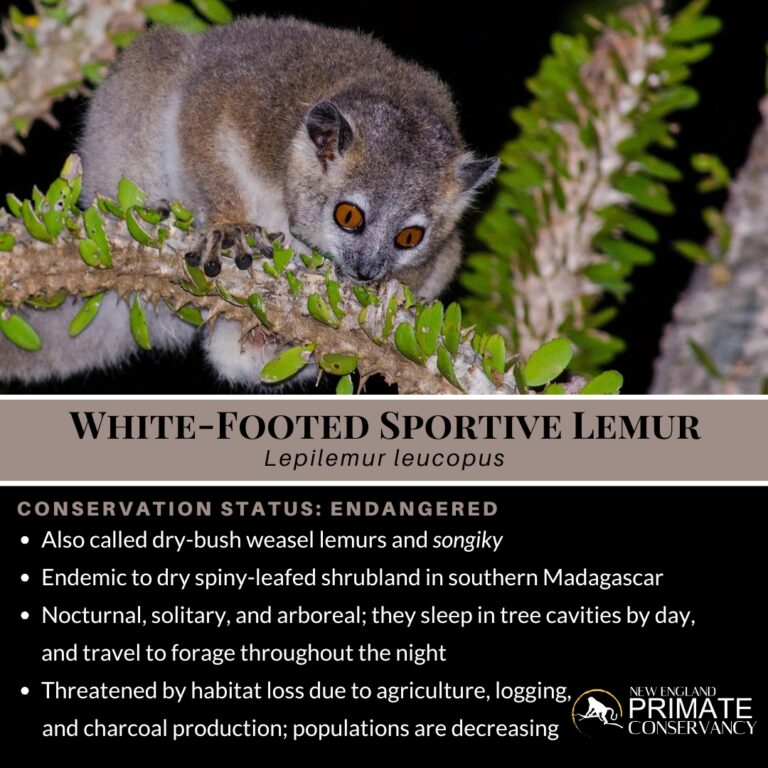
White-Footed Sportive Lemur, Lepilemur leucopus
WHITE-FOOTED SPORTIVE LEMUR
Lepilemur leucopus
Geographic Distribution and Habitat
White-footed sportive lemurs (Lepilemur leucopus), also known as white-footed weasel lemurs or dry-bush weasel lemurs, are native to Madagascar, an island located off the southern coast of Africa. As an endemic species, remarkably, lemurs are the only primates inhabiting the island, and wild populations cannot be found anywhere else on Earth. Their habitat stretches from the Mandrare River in the west to the forested regions of Andohahela National Park in the east, covering approximately 893.83 square miles (2,315 square kilometers).
They are primarily found in prickly Didieraceae forests and bush areas in southwestern Madagascar—hence the nickname “dry-bush lemurs.” The Didiereaceae Forest, also called the Spiny Forest or Spiny Thicket, is a unique dry ecosystem where plants are spiny and succulent-like. With an average annual rainfall of less than 19.7 inches (50 centimeters), plants have adapted with water-storing stems and dense spines to prevent water loss. The soil quality suffers due to insufficient rainfall, and is further impacted by the soil’s insoluble qualities because it is mostly made of red sands or limestone.
In addition to Didereaceae forests, white-footed sportive lemurs also occur in gallery forests, riverine environments, and subtropical, dry lowland forests. The average temperatures in these areas are consistently warm to hot, typically ranging from 77 to 84 degrees Fahrenheit (25 to 29 degrees Celsius). Summer, occurring between December and March, can reach up to 95 degrees Fahrenheit (35 degrees Celsius). Winter, which occurs between June and September, is drier and milder, and the average temperature is between 68 and 77 degrees Fahrenheit (20 to 25 degrees Celsius).
Unfortunately, their geographic range is severely fragmented due to deforestation and is undergoing a period of rapid decline in size and habitat quality. It has been estimated that there will be an 88% reduction in the species’ range between the years 2000 and 2080 due to climate change alone. As they cannot adapt to significant environmental changes, they are particularly susceptible to the impacts of climate change and require very specific conditions to survive.

Size, Weight, and Lifespan
White-footed sportive lemurs have an average weight of 1.2 pounds (540 grams) and are about the same size as a one-month-old kitten (Felis catus), which weighs about one pound (450 to 500 grams)! There is slight sexual dimorphism (physical differences between genders other than their sexual organs) between males and females, but in general, their head and body length ranges between 9.5 and 10.2 inches (24 and 26 centimeters). Their tail is long, ranging in length between 8.3 and 10.2 inches (21 to 26 centimeters).
Wild and captive lifespans are unknown. No sportive lemur species has been successfully kept in captivity.
Appearance
The pelage patterns of white-footed sportive lemurs vary in shades of brown, cream, black, and gray, and are infused with reddish undertones that can shine when reflected by light, allowing for effective camouflage in their environment. This unique coloration allows them to escape predators by blending with the shadows cast throughout the forest, and is especially useful during foraging, feeding, and resting periods. Their patchy fur breaks up their body’s shape, making it harder for predators to distinguish them from the surrounding backdrop. Furthermore, the lighter fur on their undersides helps blur their appearance in sunlight, making them less visible to aerial hunters.
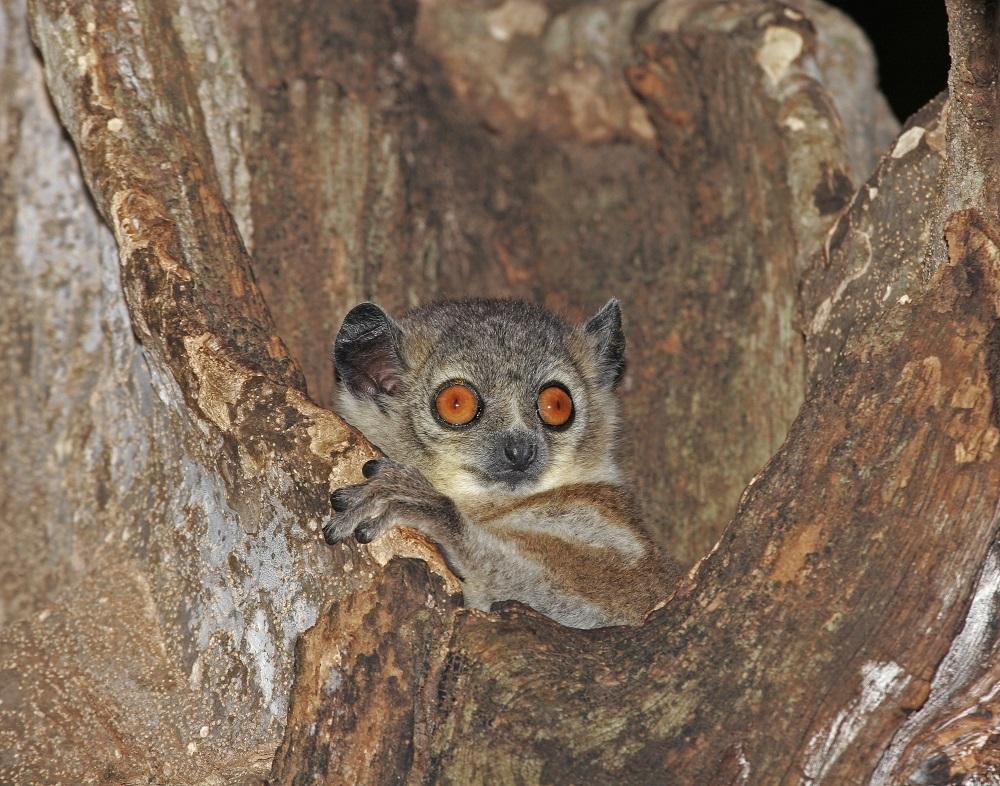
As nocturnal primates, having a keen sense of smell and enhanced vision is essential to their survival. Their black, hairless, and moist snouts feature comma-shaped nostrils and contain sensory receptors known as Eimer’s organs, which enhance their ability to detect scent and texture.
Additionally, they possess orange eyes that have evolved to provide enhanced vision in low-light conditions. Their eyes have a mirror-like layer called the tapetum lucidum, which reflects light through their retina and gives photoreceptors a second chance to absorb images missed during the first pass. Essentially, the tapetum lucidum reflects unused light to the retina, maximizing light under dim conditions. If you’ve ever seen your cat’s eyes glow at night when a light has been shone, you’ve seen the tapetum lucidum. This is why they see best at dawn or dusk, because the sky is coated with soft, hazy light. Because color can be hard to identify under these conditions, their eyes also possess specialized night-vision rods that help them detect texture, movement, and contrast, rather than color.
Diet
As a largely folivorous species, the majority of the white-footed sportive lemur’s diet consists of leaves and various plant materials. Their preferred common food sources include: Madagascar ocotillo (Alluaudia procera), pond cypress (Alluaudia ascendens ), tamarind tree (Tamarindus indica), and pencil cactus (Euphorbia tiruculli). Flowers, particularly those from the tamarind tree, also act as a supplementary food source when these preferred foods are scarce.
Their preferred diet of leaves is difficult to digest, and white-footed sportive lemurs have evolved a suite of anatomical and behavioral traits to cope with these harsh foods. Although they are relatively small-bodied, their intestines are long and complex, resulting in a slow metabolism and long digestion periods. Without this anatomical adaptation, they would be unable to process the leaves they eat. Digesting leaves takes a lot of time and energy, and as a result, sportive lemurs spend a large percentage of their time resting. Other behavioral adaptations include limiting nighttime activity to conserve energy and coprophagy.
Coprophagy, or feces consumption, is not common for all animals, but is sometimes an essential adaptation for white-footed sportive lemurs. Coprophagous animals consume and re-digest their feces to further break down the cellulose that is contained within them. This behavior is commonly observed during the dry season, when extra nutrients and energy are needed. Individuals who are older or dentally impaired benefit from the behavior the most.
Behavior and Lifestyle
As arboreal primates, they spend most of their lives in trees. Over time, they have evolved several adaptations for this environment, including having opposable thumbs and big toes, as well as long tails that assist with balance. They also have large pads on their hands and feet that help with gripping, and strong, powerful legs that propel their movements. Their preferred locomotion is vertical climbing, but they also leap, sometimes jumping 13 feet (4 meters) between branches!
As nocturnal primates, they are most active at night and sleep during the day, relying on their powerful eyesight and sense of smell to navigate the world. They mainly feed on their own, making them vulnerable to predators, and relying on these keen senses to avoid them. Their primary predators include fossa (Cryptoprocta ferox), Madagascar harrier-hawks (Polyboroides radiatus), Madagascar tree boas (Sanzinia madagascariensis), and introduced predators such as domestic dogs. Although not natural predators, humans also pose a serious threat to this species, especially through deforestation and illegal hunting practices. When hiding from predators, they flee to empty tree holes, leafy nests, or tangles of branches. Although these spots also act as their resting areas, they provide enough cover that it makes it harder for the lemurs to find them. These areas are also where you will find them resting or sleeping during the day.
In Malagasy, the official language of Madagascar, white-footed sportive lemurs are referred to as “songiky” (which translates to “song” in English) because of their impressive vocal range and variety! Their sounds include barks, cries, wails, and howls, and provide territorial defense against predators and other unwanted intruders.
Their social system is described as solitary and dispersed. In this system, a dominant male’s territory overlaps with that of one or more solitary females. Their mating system is polygynous, which means it is common for males to mate with multiple females. For example, one male can share territory with one to five females and mate with each one. Females ultimately benefit from the increased safety and protection males provide in these areas, so it is common for two or more females to share a home range with a male. However, as solitary animals, most individuals spatially avoid one another.
Males benefit from this arrangement by affording them exclusive mating access without competing with other males. Although males rarely interact with females after they mate, they remain in the surrounding area to defend their territory and watch over females. They will not provide or defend food resources for females.
In southwestern Madagascar, white-footed sportive lemurs are highly territorial, and there is minimal overlap between individuals of neighboring troops. Such neighbors include mouse lemurs (Microcebus spp.), dwarf lemurs (Cheirogaleus spp.), ring-tailed lemurs (Lemur catta), and Verreaux’s sifakas (Propithecus verreauxi). Like white-footed sportive lemurs, mouse lemurs, and dwarf lemurs are also nocturnal primates, so they are all usually active at the same time.
As nocturnal primates, white-footed sportive lemurs must remain alert to their surroundings at all times. Evolutionarily, this has led to the development of a complex communication system, including various forms of vocal, olfactory (scent), and physical communication types.
Their vocalizations often serve as warnings and help defend their territory against predators. Their sounds vary widely, from deep barks to long wails or howls, with each call serving a specific purpose. Some lemurs even possess specialized vocal structures that allow them to produce calls at lower frequencies, making them seem larger and more intimidating to other animals.
Both males and females have strong scent glands near their genitals that secret foul-smelling substances. Composed of nearly 200 chemical signals, the substance communicates identity, health, and fertility. Typically spread on twigs or branches throughout their territory, it acts as a form of olfactory communication to all lemurs in the surrounding area. They are also known to use feces and other scent markings to outline home range boundaries.
During confrontations to determine territory and mating rights, males may chase, bite, swat, lunge at, or pull each other’s fur. Although these behaviors are normal, they often result in cuts, bite marks, or other wounds.
White-footed sportive lemurs are a polygynous species, so their mating system is one in which one male mates with multiple females, and each female typically mates with only one male. Males establish territories that overlap with multiple females, engaging with each during the breeding season. The breeding season generally takes place during the dry months, from May to August.
After mating, females are pregnant for approximately 5 months. During this critical period, they experience major hormonal and physical changes to support fetal development. In the early wet season, between November and January, a single infant is born with the ability to open its eyes and cling to its mother.
Mothers take on virtually all parental responsibilities. For the first four months of an infant’s life, they carry them in their mouths, nurse them, and temporarily leave them on branches while they forage—a behavior known as “parking.” Until they reach sexual maturity, juveniles stay with their mother for about one year. During this time, they learn essential arboreal skills for foraging and navigation. Sexual maturity is reached at around 18 months; females remain with their mothers, while males leave in search of territory and mating opportunities.
As leaf-eating primates, white-footed sportive lemurs play a critical role in maintaining the health of Madagascar’s forest ecosystems. They directly contribute to plant health and biodiversity by facilitating plant turnover, which helps prevent excessive tree growth in the forest. In Madagascar, this overgrowth, especially by non-native or invasive plants, hinders natural forest regeneration and reduces the availability of nutrient-rich food sources. Additionally, overgrown areas can complicate arboreal primate navigation, as they require a more open environment for safe, continuous movement and shelter. An overgrown forest will force them to the ground, increasing their stress and vulnerability to predation from terrestrial animals.


The International Union for Conservation of Nature lists white-footed sportive lemurs as Endangered (IUCN, 2018), appearing on the IUCN Red List of Threatened Species. The main threats to this species include habitat loss from annual burning to create new pasture for livestock and the harvesting of trees for charcoal production. The geographic range of this species is already extremely fragmented. They are highly sensitive to minor environmental changes, and these practices pose significant threats to their continued survival.
While hunting is not a major threat, reports from 2025 indicate that lemur meat has recently become a sought-after delicacy in Madagascar, with approximately 13,000 lemurs sold each year for this purpose. Their trade peaks during the breeding season and threatens an already troubling decline in wild lemurs. To address this issue, it is essential to implement more firearm regulations, provide alternative livelihoods for hunters, and develop focused strategies.
White-footed sportive lemurs are listed in Appendix I of the Convention on International Trade in Endangered Species (CITES), an international agreement between governments whose goal is to ensure that international trade in specimens of wild animals and plants does not threaten their survival. Across Madagascar, they are protected in four protected areas: Nord-Ifotaka, Ankodida, Behara-Tranomaro, and Vohidava-Betsimalaho. Protected areas are geographically defined lands or marine spaces formally designated, recognized, and managed to ensure the long-term conservation of nature. They are usually recognized in partnership with Indigenous communities, acknowledging the cultural values of the communities they reside in. Their primary goal is to stop biodiversity loss, protect endangered species, and combat climate change.
To ensure the protection of white-footed sportive lemurs, additional survey efforts are necessary to determine their entire distribution, assess population status, understand their ecology, and identify all threats.
- Dröscher I, Kappeler PM. Defining the Low End of Primate Social Complexity: The Social Organization of the Nocturnal White-Footed Sportive Lemur (Lepilemur leucopus). Int J Primatol. 2013;34(6):1225-1243. doi: 10.1007/s10764-013-9735-3. Epub 2013 Nov 16. PMID: 24347750; PMCID: PMC3858612.
- Fernández-Duque E, de la Iglesia H, Erkert HG. Moonstruck primates: owl monkeys (Aotus) need moonlight for nocturnal activity in their natural environment. PLoS One. 2010 Sep 3;5(9):e12572. doi: 10.1371/journal.pone.0012572. PMID: 20838447; PMCID: PMC2933241.
- https://www.alltheworldsprimates.org/Members/Home/MasterPrimate.aspx?tid=43
- https://www.iucnredlist.org/species/11618/115566334#assessment-information
- https://www.nature.com/scitable/knowledge/library/primate-sociality-and-social-systems-58068905/#:~:text=The%20least%20gregarious%20primates%20have,%2C%20some%20tarsiers%2C%20and%20orangutans.
- https://lemur.duke.edu/lemurs-can-smell-weakness-in-each-other/
- https://www.sciencedaily.com/releases/2013/11/131118080930.htm
- https://www.earthsendangered.com/profile.asp?gr=&view=c&ID=1&sp=897
- https://phys.org/news/2025-07-lemurs-madagascan-forests.html#:~:text=Mothers’%20movements%20and%20behaviors,causes%20malnourishment%20in%20the%20lemurs.
- https://news.mongabay.com/2019/06/food-choice-leaves-some-lemurs-more-vulnerable-to-loss-of-forest-habitat/#:~:text=Share%20this%20article,highest%20rate%20of%20any%20country.
- https://news.mongabay.com/2025/11/lemurs-are-being-eaten-as-an-urban-delicacy-in-madagascar/
Written by Brooklynne Mitchell-Arno, February 2026