
Preuss’s Red Colobus, Piliocolobus preussi
PREUSS'S RED COLOBUS
Piliocolobus preussi
Geographic Distribution and Habitat
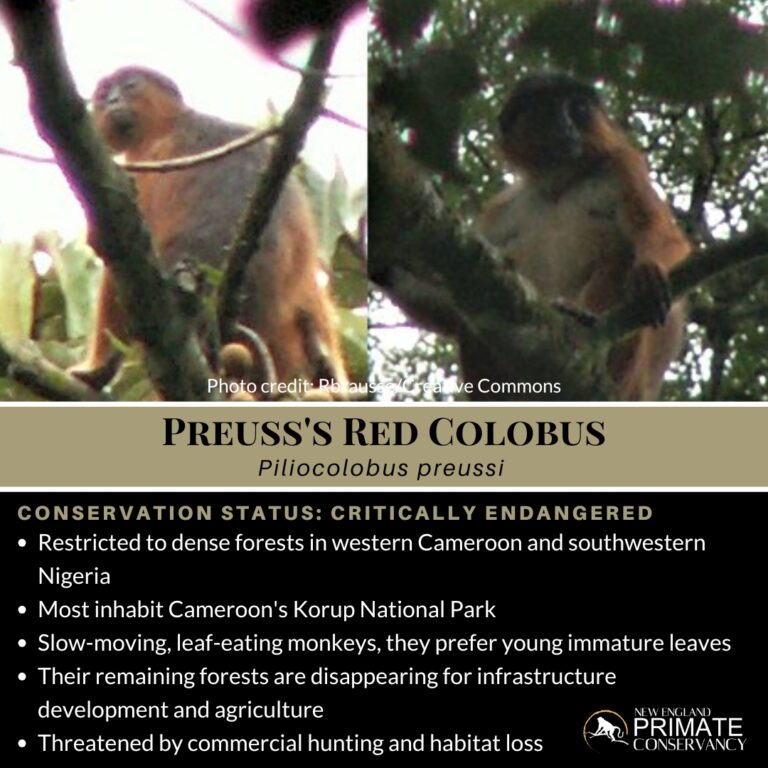
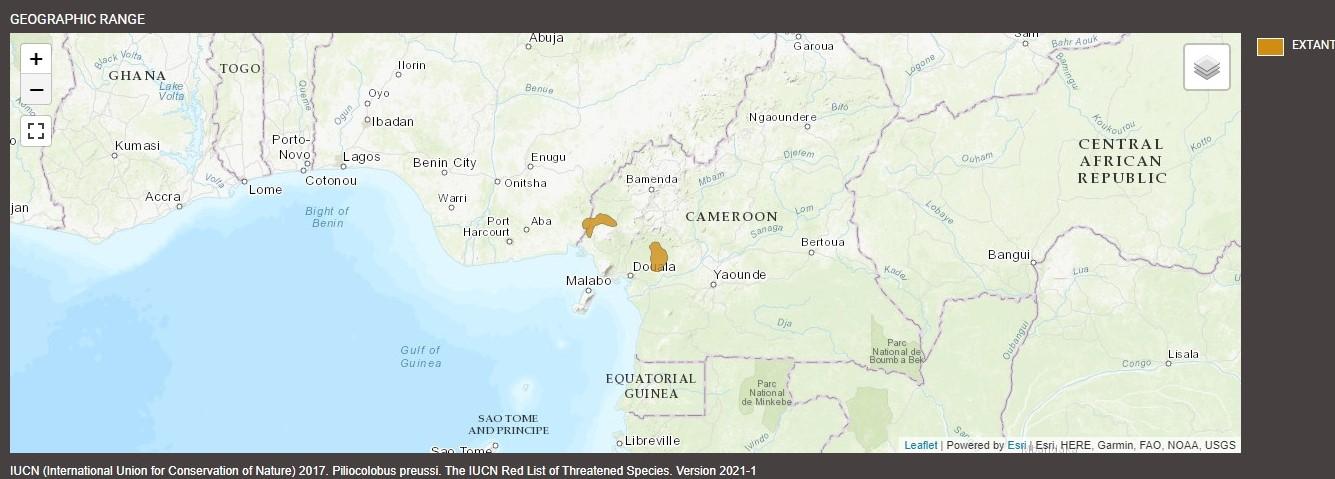
Preuss’s red colobus is found primarily in southwest Cameroon in Korup National Park and its surrounding forests. They are also found in southeastern Nigeria in the Cross River National Park, which lies within the Gulf of Guinea and is possibly the largest undisturbed forest in West Africa. The populations in the two countries are not connected. They have previously been recorded in the Ebo Forest and in the Makombe-Ndokbou forest to the north in Cameroon, but have not been observed in these regions by researchers since 2012 or 2018, respectively.
Within their restricted range, Preuss’s red colobus typically inhabits mature lowland forests and moist sub-montane forests. In Korup National Park, they experience a single dry season between December and February, followed by the wet season between March and October. During the wet season, Korup National Park experiences an average monthly rainfall of 20 inches (50 cm) and an annual rainfall of over 197 inches (500 cm), making it one of Africa’s wettest regions.
Size, Weight, and Lifespan
Females have an average head and body length of 2.03 feet (62 cm), while males have a head and body length of 1.80–2.07 feet (56 cm–63 cm). Females and males both typically have a tail length of about 2.5 feet (76 cm). Females have an average weight of 16.09 pounds (7.3 kg), and males have an average weight of 18.3 pounds (8.3 kg).
The lifespan for Preuss’s red colobus has not been recorded, but they likely can live up to about 20 years, similar to other red colobus species.
Appearance
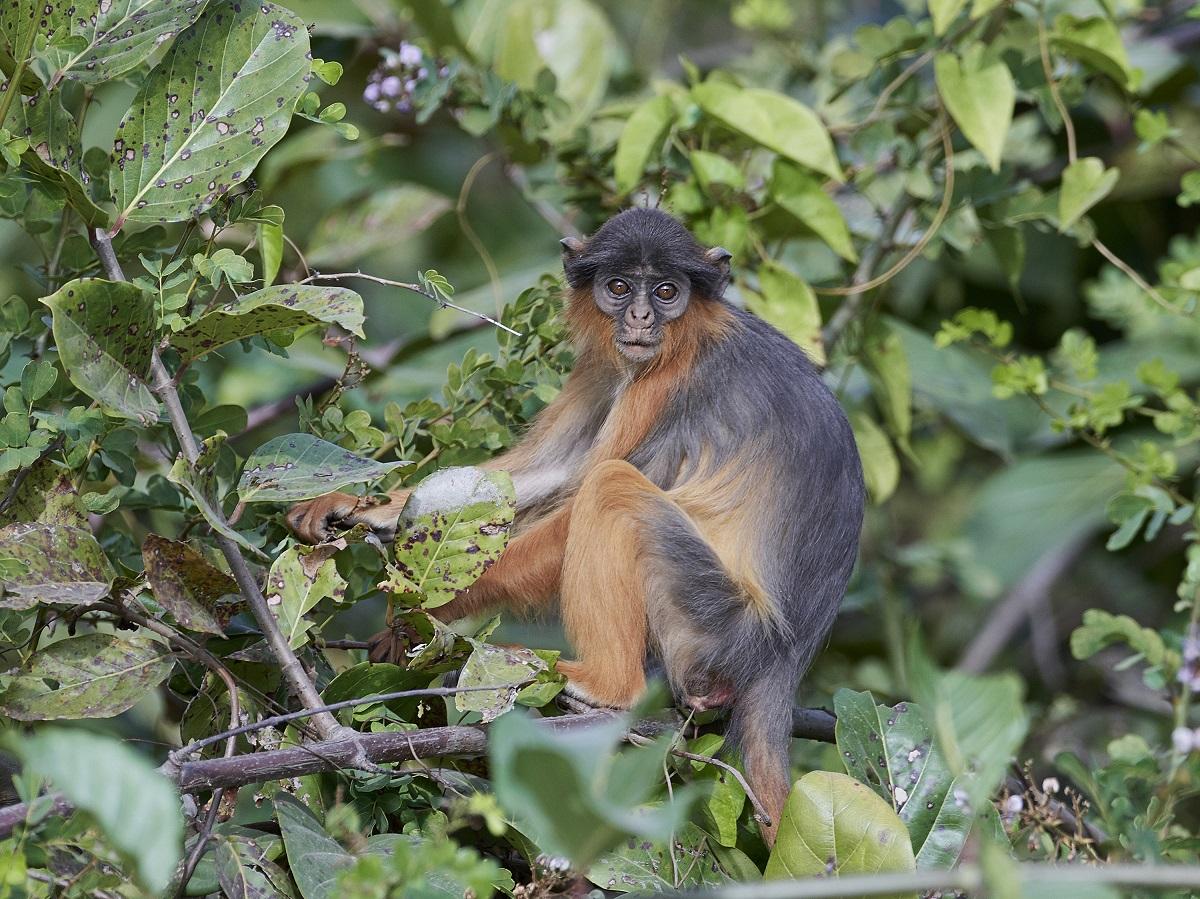
The Preuss’s red colobus has dense, frizzy fur, frizzier than that of other red colobus species. Their foreheads are crowned with black fur that blends with the black skin on their face. From the top of their head down to the base of their tail, Preuss’s red colobus has a brown or blackish back, making the deep orange fur peaking out on their cheeks, and along their limbs and their long tails more striking. Their bellies are a pale reddish-gold color that extends to their chin. Similar to other colobus, their thumbs are reduced to a mere nub to make climbing through the upper canopy easier.
In contrast to black and white colobuses that are fully white at birth, baby red colobuses have black backs and a light grey underbelly when born.
Diet
Like other colobus monkeys, the Preuss’s red colobus is a folivore and primarily eats leaves. They know which leaves to select for the highest protein content, particularly young leaves that they gorge themselves on in the rainy season, when they are abundant. Preuss’s red colobuses have been observed feeding from seventeen different plant species. When in need of a sweet treat, they will occasionally eat fruit and even flowers. Many of their primary food trees are exploited for timber, such as the red ironwood trees in Cameroon.
Like many leaf-eating primates, red colobus are foregut fermenters and have multiple chambers in their stomach to facilitate the breakdown of dense plant material. Their gut structure is similar to that of ruminants like cows, which also have a very dense vegetation diet.
Behavior and Lifestyle
The Preuss’s red colobus spends most of their time in the upper canopy, making them arboreal. They rarely venture to the ground and will even sleep in the higher layers of the forest. They are diurnal, meaning they are active during the day and sleep through the night (although Pruess’s red colobus still makes plenty of time in their day for resting). They walk quadrupedally along branches and climb and leap between them.
While chimpanzees have not been documented hunting Preuss’s red colobus, they have been known to commonly hunt other red colobus species. Another known predator of other colobus species that may also hunt Preuss’s red colobus is the crowned hawk-eagle.
Preuss’s red colobuses live in large multimale-multifemale social groups, with an average group size of 24–33 individuals, but may reach as many as 60 or even 100 individuals. Colobus monkeys in general tend to have smaller home ranges and travel less in a day compared to other African monkeys and apes. They’ll typically stay within a specific “core area” within their home range. Researchers think this lack of wanderlust is because they don’t need to travel very far for food. It also conserves the energy needed to digest their leafy diets.
From one study investigating the daily habits of Preuss’s red colobus in Cameroon, we have an idea that they enjoy a slow morning, mostly resting and socializing through midday. They become more active in the afternoon in search of a late lunch, followed by another nap. Leaf-eating monkeys tend to have slower digestion times, and researchers think this activity pattern may allow Preuss’s red colobuses more time to digest between meals.
The Preuss’s red colobus shares habitat with putty-nosed guenons, red-eared monkeys, crowned monkeys, mona monkeys, drills, red-capped mangabeys, and chimpanzees, and will associate with all of them except for drills and chimps.
To communicate across such large social groups, Preuss’s red colobuses relies mostly on vocalizations to relay information to each other. Males will use barks, chirps, and nyows, which can carry over 328 yards (300 m), as alarm calls to warn other group members of potential danger. Adult males will also yelp as a greeting between each other or during agonistic encounters; it is also sometimes heard during copulation.
Unique to red colobus, females emit a yowl when they are interested in finding a romantic partner.
Female red colobuses are known to have sex swellings, although Preuss’s red colobuses seem to have smaller swellings compared to other red colobus monkeys and may not even show any swellings at all. It is assumed that these swellings signal ovulation, but there has yet to be a hormonal study to prove this.
Interestingly, subadult and juvenile males tend to have a similar outward appearance of their genital structure to females, which some researchers speculate may deter aggression from adult males in the group. Young males will even present to adult males the same way females do. Both males and females transfer groups, although female red colobuses seem to do so more frequently.
Copulations and births occur year-round. Female colobuses generally have a gestation period of around 6 months, after which they’ll give birth to a single child. Mom is the primary caretaker of the new little one, as male red colobuses have little interest in babies, and allomothering (where other females will help care for another’s baby) is rare among red colobuses.
While the specific relationship between Preuss’s red colobuses and the ecosystems they reside in has not been studied, we can find some clues in their known biology as to what their ecological role is. Because they do eat some fruit, they may act as seed dispersers and help maintain the tree diversity of the forest. However, fruit makes up a minimal portion of the Preuss’s red colobus diet. While not as well studied as the significant ecological role frugivorous seed-dispersing primates have, scientists think that folivores may also play an important role as ecosystem engineers by keeping larger trees from shading out smaller trees that may still be growing.


The Preuss’s red colobus is classified as Critically Endangered by the International Union for Conservation of Nature (IUCN, 2019), appearing on the IUCN Red List of Threatened Species. Their populations are declining. Between 1990 and 2016, researchers noted an 80% decline in sightings of Preuss’s red colobuses in Korup National Park. Only 3,300–4,600 individuals are thought to be present in Korup National Park, which has been considered a stronghold for the species.
Preuss’s red colobuses are primarily impacted by high-levels of illegal hunting in all areas where the species is found. Many people in the region feel that wild animals are nuisances that will destroy the crops their livelihood depends on, making conservation efforts a hard sell. Possibly due to feeling safer in the higher levels of the canopy, Preuss’s red colobuses typically do not have a strong fear response when humans are present, which, combined with their large body size, vivid fur color, and large, easily located groups, makes them an easier target for hunters. Some hunters will keep younger Preuss’s red colobuses as pets.
Another substantial threat the Preuss’s red colobus faces is habitat loss and degradation due to logging and industrial agriculture, particularly oil-palm plantations. Ongoing conflict in Cameroon also poses a threat to many species in the region. Conservation activities had to be stopped in Korup National Park in 2017 due to civil unrest, which has likely also increased hunting pressure.
Preuss’s red colobuses are listed in Appendix II of the Convention on International Trade in Endangered Species (CITES), an international agreement between governments whose goal is to ensure that international trade in specimens of wild animals and plants does not threaten their survival. They are also listed under Class B of the African Convention on the Conservation of Nature and Natural Resources.
Red colobus monkeys are seen as indicators of the overall health of the forest they reside in due to their particular sensitivity to habitat degradation, making them important umbrella species for conservation.
While hunting is a major threat to the Preuss’s red colobus, it is important to remember that hunters do so for survival. Many of these people not only hunt red colobuses and other animals, but they are also teachers, farmers, craftsmen, tailors, or practice other trades. Particularly in areas experiencing civil unrest, hunting for additional income and substance is necessary. Some professions, such as farming, may generate significant income during harvest season, but earnings are often seasonal rather than steady. During the long periods between harvests, families may rely on “fast money” activities, such as hunting, to meet immediate financial needs.
Local education is needed to help people in the region understand the importance of the species, as well as incentives against hunting and investment into other forms of income for the community. In 2016, the Cross River National Park in Nigeria implemented improvements to ranger patrols seeking out signs of illegal hunting activity and documenting sightings of Preuss’s red colobuses. Conservationists hope that these patrols will decrease hunting activity and subsequently cause an increase in Preuss’s red colobus sightings.
- Linder, J., Morgan, B.J., Abwe, E.E., Jost Robinson, C.A., Imong, I. & Oates, J.F. 2019. Piliocolobus preussi. The IUCN Red List of Threatened Species 2019: e.T41026A92633245. https://dx.doi.org/10.2305/IUCN.UK.2019-3.RLTS.T41026A92633245.en
- Fonkwo, S. N., Mbida, M., Angwafo, T. E., & Ebua, V. B. (2018). Hunting of preusss red colobus (Procolobus preussi) in Korup National Park, Cameroon. International Journal of Biodiversity and Conservation, 10(2), 100-105.
- Abanyam, P. A. (2018). Distribution and conservation of the Preuss’s red colobus (Piliocolobus preussi) in Nigeria. In Proceedings of 6th NSCB Biodiversity Conference; Uniuyo(Vol. 268, p. 272pp).
- Fonkwo, S. N., Mbida, M., Angwafor, T. E., & Ebua, V. B. (2015). Activity budget of Preuss’s red colobus (Procolobus preussi) in Korup National Park, south-west region, Cameroon. International Journal of Biological and Chemical Sciences, 9(4), 1799-1808.
- FONKWO, S. N., EBILE, P. A., & DANIELS, K. (2025). Preuss’s Red Colobus Associations with Other Primates and their Threats in Korup National Park, Cameroon. Cameroon Journal of Biological and Biochemical Sciences, 33, 64-78
- Groves, C. P. (2007). The taxonomic diversity of the Colobinae of Africa. Journal of Anthropological Sciences, 85, 7-34.
- Hofner, A. N., Jost Robinson, C. A., & Nekaris, K. A. I. (2018). Preserving Preuss’s red colobus (Piliocolobus preussi): An ethnographic analysis of hunting, conservation, and changing perceptions of primates in Ikenge-Bakoko, Cameroon. International Journal of Primatology, 39(5), 895-917.
- Matthew Richardson, Nelson Ting.Piliocolobus, preussi,. © All the World’s Primates. N Rowe, M Myers, eds. (alltheworldsprimates.org) Downloaded 2/20/2026
- Chapman, C. A., Bonnell, T. R., Gogarten, J. F., Lambert, J. E., Omeja, P. A., Twinomugisha, D., … & Rothman, J. M. (2013). Are primates ecosystem engineers?. International Journal of Primatology, 34(1), 1-14.
- Nijboer, J., & Clauss, M. (2006). The digestive physiology of colobine primates. Fibre intake and faeces quality in leaf-eating primates, 9.
- Fashing, P. J. (2011). African Colobine Monkeys Their Behavior, Ecology, and Conservation. In Primates in Perspective (second, pp. 203 – 229). Oxford University.
Written by Lina Rademacher, February 2026