
Eastern Woolly Lemur, Avahi laniger
EASTERN WOOLLY LEMUR
Avahi laniger

Geographic Distribution and Habitat
The eastern woolly lemur is also known as the eastern avahi and Gmelin’s woolly lemur, names that reflect both its geographic range and Johann Gmelin, the German naturalist who first documented the species. Lemurs are endemic to the island of Madagascar, meaning they cannot be found anywhere else in the world.
Eastern woolly lemurs occur in northeastern Madagascar, from the Bemarivo River in the north to the Mangoro River in the south. The region has a humid tropical rainforest climate with high annual rainfall (60–150 inches or 150–381 cm), most of which falls during the rainy season from November to April.
Eastern woolly lemurs inhabit both lowland and high-elevation forests and prefer areas dominated by small-crowned trees and open canopies. They move primarily by vertical leaping, and dense canopies can restrict this form of locomotion. As a result, they are particularly well suited to secondary forests, where young, closely spaced trees with small-diameter trunks facilitate more efficient movement through the forest.
Population densities of eastern woolly lemurs can reach up to 63 individuals per 247 acres (1 km²) within protected areas. However, overall population numbers are declining, largely due to local extinctions in regions where hunting is rampant.
Despite the extensive study of lemurs, nocturnal species, or those active at night, such as the eastern woolly lemur, remain comparatively understudied.
The eastern woolly lemur and the western woolly lemur were formerly classified as two subspecies under the scientific name Avahi laniger. Despite similarities in appearance and behavior, genetic analyses revealed clear differences—significant enough to justify recognizing each as a separate species. As a result, the eastern woolly lemur retains the scientific name Avahi laniger, while the western woolly lemur is now classified as Avahi occidentalis.

Size, Weight, and Lifespan
Eastern woolly lemurs weigh 2.4–2.9 pounds (1.1–1.3 kg). Their bodies, excluding the tail, measure 11–13 inches (27.7–32.2 cm). Their tails are longer than their bodies, measuring 13–15 inches (33–37 cm).
Eastern woolly lemurs are among the smallest members of the Indriidae family, which also includes the Indri (Indri indri), the largest living lemur at 6–9 kg, and the diademed sifaka (Propithecus diadema), which typically weighs 4–6 kg.
Lifespan estimates are lacking. Eastern woolly lemurs are challenging to study in the wild because of their small size and nocturnal nature. People have also been unsuccessful in maintaining any of these primates in captivity. Other closely related lemurs, like sifakas, live over 20 years under specialized human care, suggesting eastern woolly lemurs may reach similar ages.
Appearance
Eastern woolly lemurs are stocky primates with large, brown, forward-facing eyes. Their tightly curled, dense fur, which gives them their “woolly” appearance, is gray-brown, shifting to a subtle reddish tone on the tail. Short ears are mostly hidden by thick fur. Pale fur patches on the cheeks and above the eyes likely serve for visual signaling and facial communication. A prominent white stripe runs along the thighs, especially visible when they assume a hunched stance while gripping branches vertically with elongated legs. Woolly lemurs have strong hind legs that let them launch themselves between trees straight from a sitting position without needing a running start. Their shorter arms help them grab and hold onto tree trunks when they land.
Their small body size is unusual for folivores. Most leaf eaters are larger since leaves are less nutrient-dense, and they typically consume more foliage to meet energy needs. Eastern woolly lemurs’ small size is an uncommon adaptation tied to their diet and nocturnal habits, explored in the next section.

Diet
These lemurs are primarily folivorous, feeding on various kinds of leaves. They occasionally eat flowers and rarely fruit. While leaves have less sugar than fruit, they are an important protein source. Woolly lemurs prefer young leaves, which are softer and richer in sugars than mature leaves.
Leaf fiber, especially cellulose, requires long digestion. Many folivores rely on large or multi-chambered stomachs with specialized bacteria. Woolly lemurs have a rich gut microbiome but only a single-chambered stomach, so they take frequent feeding breaks for digestion.
As nocturnal foragers, they have two nightly feeding peaks, separated by a four-hour resting interval. By targeting young, nutrient-rich leaves, lengthening resting periods for digestion, and utilizing a specialized gut microbiome, eastern woolly lemurs sustain a folivorous diet without the large body size typical of other leaf-eating mammals. Nighttime activity helps reduce competition with diurnal folivores and lowers overall energy costs, since moving in cooler nighttime temperatures requires less energy.
Behavior and Lifestyle
Eastern woolly lemurs become active at sunset (4–5 pm), feed for four hours, then rest to digest. During this break, they nap or groom. They can rest up to 65% of the night since leaves are hard to digest. Feeding resumes around midnight and continues until dawn.
Eastern woolly lemurs tend to travel between patches of tender leaves and travel further when food is scarce. They can travel over 328 yards (300 m) per night. At daybreak, they sleep in their family groups, making sleeping sites in the lower canopy (7–33 feet or 2–10 m), where dense foliage hides them from hawks and other predators.
Eastern woolly lemurs spend almost all their time in the trees; they are fully arboreal. They move using a method called vertical clinging and leaping (VCL), holding themselves upright on tree trunks and pushing off with their hind legs to leap between tree trunks. They can leap up to 13 feet (4.2 m) and usually stay about 5 feet (1.6 m) above the ground. They tend to avoid the upper parts of trees or tree crowns, since moving with VCL makes it hard to travel along horizontal branches.
Resting during the day in small pairs or group sizes helps them avoid detection by diurnal predators, particularly raptors. Monogamous pairs also avoid the social stresses associated with large groups, such as dominance hierarchies, troop takeovers, or infanticide. This stable social structure allows pairs to reliably reproduce and raise offspring without threats from social competition.
Eastern woolly lemurs are nocturnal folivores feeding on leaves at night to avoid competition with daytime leaf-eaters.
They are unusually small for a leaf-eating primate, weighing only 1.1–1.3 kg, which helps them conserve energy on a low-nutrient diet.
Eastern woolly lemurs live in stable monogamous pairs, sometimes with three generations in a group, and small group sizes reduce predation risk and social stress.
They move through the forest by clinging and leaping vertically and prefer forests with closely spaced trees rather than those with dense canopies.
Females give birth to a single infant usually between August and September,
Eastern woolly lemurs defy common primate patterns by being nocturnal, forming small monogamous groups, and specializing in a leafy diet. Adults form monogamous pairs and are also found in groups of four to five, which includes multiple generations of offspring. They generally remain within a home range of 2.5 to 5 acres (1 to 2 ha). While many species in smaller groups face food scarcity and intense competition, folivores typically live in larger groups because of the abundance of leaves. Yet, eastern woolly lemurs form small groups despite being small-bodied, nocturnal folivores, illustrating a “folivore paradox” adapted to their specific conditions.
Adult pairs form lifelong bonds, so there is no dominance-hierarchy competition between them. Pairs will forage separately but close enough to each other’s calls. Males tend to stay closer to females when they have offspring.
Most folivorous primates are diurnal, meaning they are active during the day and rely on vision to select the best foliage. In contrast, the eastern woolly lemur is nocturnal, a pattern that seems counterintuitive for a leaf-eating primate. Feeding on leaves at night may seem disadvantageous because leaves store sugars during the day, but at night, the plants use those sugars for respiration, leaving the foliage less energy-rich. The evolutionary reasons for the eastern woolly lemur’s nocturnal habits remain unclear, but the leading theory suggests that night activity helps reduce competition with diurnal folivores, increasing its chances of survival.
Most antagonistic or aggressive interactions involve two pairs, particularly when one trespasses into another’s territory. Even then, physical altercations are avoided by using loud vocalizations to ward off intruders. While both sexes engage in these territorial calls, males are more active in travelling and patrolling their territories.
Eastern woolly lemurs compete directly with the weasel sportive lemur (Lepilemur mustelinus), another nocturnal leaf-eater. The woolly lemurs move quickly through food patches, picking the best leaves, while weasel sportive lemurs feed more slowly, spending longer at each site. As a result, weasel sportive lemur populations are higher in habitats with a lower population of eastern woolly lemurs, showing that competition between the two species affects where they feed and how they use the forest.
The most common form of communication in eastern woolly lemurs is vocalization, used by both males and females. In dense foliage, individuals can easily lose sight of each other, and vocal signals help maintain contact and convey urgent information when visual cues are unavailable. Eastern woolly lemurs appear to recognize individuals by their calls, much like humans recognize familiar voices.
The rarely used “Avahee” call (the genus namesake) is a loud, territorial warning near home-range edges. The most common call, a loud whistle, reunites separated pairs. Growls are used during close contact.
Eastern woolly lemurs have glands under the skin, especially near the throat and reproductive organs, but active scent marking or olfactory communication is rarely observed.
Little is known about eastern woolly lemur reproduction, except that they form mostly permanent monogamous pairs. Mating is seasonal, and females are fertile for only about 24 hours during the breeding period. Pregnancy lasts about 235 days (7–8 months); mothers give birth to a single infant. Births usually occur in August or September, just before the heavy rains from November to April. Lemur mating and birthing seasons are closely linked to food availability and seasonal changes on the island. The rainy season triggers new plant growth, providing more food for lemurs. By timing births just before this period, mothers can meet the higher energy demands of caring for infants, and young lemurs benefit from the increased food supply as they grow, improving their chances of survival.
At birth, infants cling to their mother’s belly while nursing. As they grow stronger and more independent, they move to their mother’s back, making it easier for her to move through the forest. Because the time between births is roughly one year, juveniles often remain with their parents when a new infant is born. Mothers typically wean infants at about one year of age. In some cases, three generations of lemurs may remain together in a group, resulting in group sizes of up to five individuals.
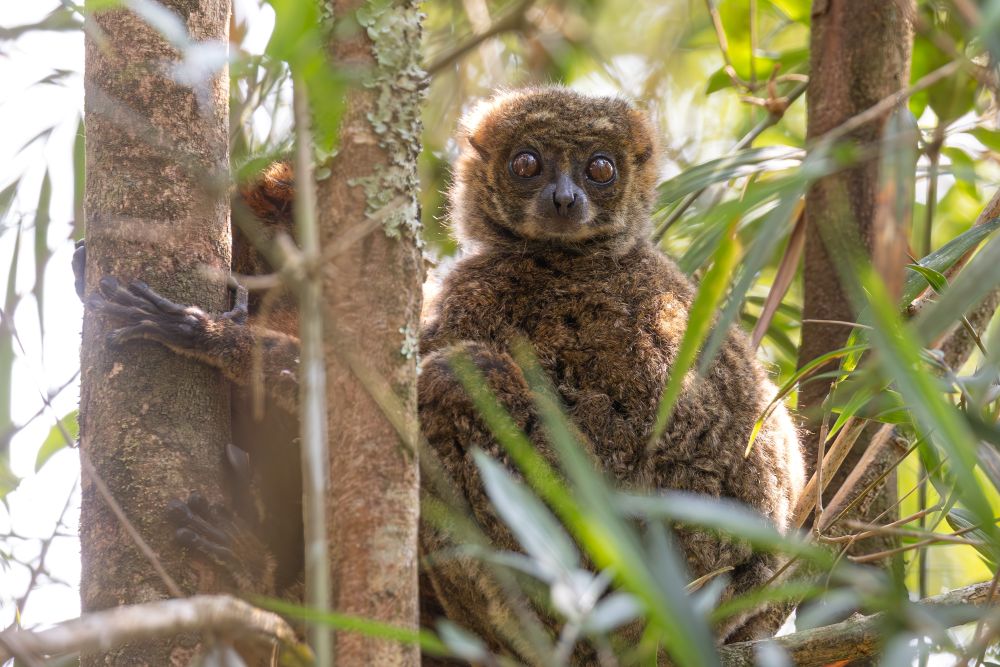
Woolly lemurs are an important part of Madagascar’s forests, forming delicate relationships among species that result in a highly diverse and interconnected ecosystem.
As nocturnal folivores, eastern woolly lemurs occupy a unique ecological niche, meaning they play a role in their environment that few other species fulfill. Most folivorous primates are diurnal (active during the day), which reduces direct competition with eastern woolly lemurs. This type of niche partitioning allows multiple species to coexist within the same habitat while accessing similar food resources. In comparison, the weasel sportive lemur (Lepilemur mustelinus), which is also a nocturnal folivore living in the same habitat, feeds on lower-quality leaves. Eastern woolly lemurs are able to outcompete them by moving between food patches more efficiently and consuming higher-quality foliage first.
Eastern woolly lemurs are natural prey for raptors such as goshawks. One study estimated that approximately 21% of their population may be lost to raptor predation annually. These birds of prey are diurnal and typically target them at their daytime sleeping sites. While camouflage and dense foliage usually provide protection from most predators, goshawks are specialized hunters in dense forests and can locate them from perches or the forest floor. Smaller sleeping groups are therefore more effective at avoiding detection and predation.
As forests are cleared for logging and development, habitats become fragmented and forest edges increase. Many species require continuous forest to access sufficient food and living space. However, eastern woolly lemurs are relatively edge-tolerant and are able to travel between forest patches in search of food. As folivores with a preference for young leaves, they benefit from high leaf production on the edges of forests. Additionally, their diets may be less impacted by disturbances because of the abundance of leaves compared to fruit-eating primates that rely on rarer, seasonally available resources. This adaptability makes eastern woolly lemur populations more resilient to deforestation and may explain why they have remained relatively stable despite extensive logging pressure.


The International Union for Conservation of Nature lists the eastern woolly lemur as Vulnerable (IUCN, 2019), appearing on the IUCN Red List of Threatened Species.
Madagascar has a long history of deforestation and habitat loss from logging and agriculture. Between 1973 and 2014, the country lost over 37% of its forest cover. As an island, its ecosystems are particularly vulnerable to disturbances, and natural regeneration or recovery often takes generations, if it occurs at all.
Eastern woolly lemurs have been negatively affected by habitat loss, though they are more tolerant of environmental changes than some other species. Habitat fragmentation and human development have also increased hunting pressure. Areas that were once dense and difficult to access are now more attainable, allowing hunters to set traps and capture lemurs more easily. Regions with intense logging activity tend to experience higher losses of eastern woolly lemurs to hunting.
Eastern woolly lemur is listed in Appendix I of the Convention on International Trade in Endangered Species (CITES), an international agreement between governments whose goal is to ensure that international trade in specimens of wild animals and plants does not threaten their survival.
Lemurs are considered a flagship species because of their uniqueness and their close connection to the island ecology of Madagascar. All lemurs are protected by national laws, which make hunting them without a permit illegal. However, enforcing these laws is difficult in forests where legal and illegal logging activities allow hunters to illegally capture lemurs.
Eastern woolly lemurs are largely protected in national parks such as Parc National de Marojejy and the Réserve Spéciale d’Ambatovaky, where densities can reach up to 63 individuals per 247 acres (1 km²). Habitat protection appears to be the most effective way to support population growth.
Local governments and NGOs, including the Lemur Conservation Foundation and the Wildlife Conservation Society, maintain research stations and educational programs to better understand lemurs, protect their habitats, and reduce hunting pressure.
Captive breeding has been unsuccessful for woolly lemurs, making in situ conservation, or protection of their natural habitats, essential for their survival.
- Andrianasolo, T.H., Andrianjazalahatra, T.L., Rakotondranary, S.J., Ramarokoto, R.E.A.F., Randria, G.I.S.È.L.E., Rüdel, N.I.N.A., Schüller, J.Ö.R.G. & Ganzhorn, J.U., 2006. Habitat utilization of nocturnal lemurs in evergreen littoral forests of different degrees of degradation. German-Malagasy Research Cooperation in Life and Earth Sciences, pp.151-159.
- Faulkner, A.L. & Lehman, S.M., 2006. Feeding patterns in a small-bodied nocturnal folivore (Avahi laniger) and the influence of leaf chemistry: a preliminary study. Folia Primatologica, 77(3), pp.218-227.
- Ganzhorn, J.U., 1993. Flexibility and constraints of Lepilemur ecology. In: Lemur social systems and their ecological basis. Boston, MA: Springer US, pp.153-165.
- Ganzhorn, J.U., Abraham, J.P. & Razanahoera-Rakotomalala, M., 1985. Some aspects of the natural history and food selection of Avahi laniger. Primates, 26(4), pp.452-463.
- Greene, L., 2019. The Ecology and Evolution of the Folivore Gut Microbiome in Madagascar’s Lemurs. Dissertation, Duke University.
- Harcourt, C., 1991. Diet and behaviour of a nocturnal lemur, Avahi laniger, in the wild. Journal of Zoology, 223(4), pp.667-674.
- Harcourt, C. & Thornback, J., 1990. Lemurs of Madagascar and the Comoros: the IUCN Red Data Book. Gland, Switzerland and Cambridge, UK: IUCN.
- Karpanty, S.M., 2006. Direct and indirect impacts of raptor predation on lemurs in southeastern Madagascar. International Journal of Primatology, 27(1), pp.239-261.
- Lehman, S.M., Rajaonson, A. & Day, S., 2006. Edge effects and their influence on lemur density and distribution in southeast Madagascar. American Journal of Physical Anthropology, 129(2), pp.232-241.
- Lehman, S.M., Rajaonson, A. & Day, S., 2006. Lemur responses to edge effects in the Vohibola III classified forest, Madagascar. American Journal of Primatology, 68(3), pp.293-299.
- Norscia, I. and Borgognini-Tarli, S.M., 2008. Ranging behavior and possible correlates of pair-living in southeastern avahis (Madagascar). International Journal of Primatology, 29(1), pp.153-171.
- Patel, E., 2020. Avahi laniger. The IUCN Red List of Threatened Species 2020: e.T2434A115559557.
- Raharinirina, H., Sambado, S., Richard, Y., Ravelojaona, R.N., Rakotomalala, Z. & Ratsoavina, F.M., 2025. Distribution and habitat use by the eastern woolly lemur, Avahi laniger (Gmelin 1788), in the fragmented forests of the Ambohidray Protected Area in Moramanga, Central-Eastern Madagascar. Madagascar Conservation & Development, 20(1), pp.32-40.
- Rumpler, Y., Warter, S., Rabarivola, C., Petter, J.J. & Dutrillaux, B., 1990. Chromosomal evolution in Malagasy lemurs: XII. Chromosomal banding study of Avahi laniger occidentalis (Syn: Lichanotus laniger occidentalis) and cytogenetic data in favour of its classification in a species apart—Avahi occidentalis. American Journal of Primatology, 21(4), pp.307-316.
- Sabin, E., Delarue, C., Misandeau, C., Besse, P., Salmona, J. & Chikhi, L., 2013. Taille de la population d’Avahi laniger dans la réserve d’Ambodiriana-Manompana, Nord-est de Madagascar. Lemur News, 17, pp.70-72.
- Thalmann, U. & Geissmann, T., 2000. Distribution and geographic variation in the western woolly lemur (Avahi occidentalis) with description of a new species (A. unicolor). International Journal of Primatology, 21(6), pp.915-941.
- Warren, R.D. & Crompton, R.H., 1997. Locomotor ecology of Lepilemur edwardsi and Avahi occidentalis. American Journal of Physical Anthropology, 104(4), pp.471-486.
- LEMUR CONSERVATION WEBSITE, n.d. Eastern woolly lemur. [Online] Available at: https://www.lemurreserve.org/lemurs/eastern-woolly-lemur/
[Accessed 21 Jan 2026]. - PRIMATE INFO NET, n.d. Table of primate reproduction data. [Online] Available at: https://primate.wisc.edu/primate-info-net/pin-factsheets/about-the-primates/behavior-and-ecology/table-of-primate-reproduction-data/
[Accessed 21 Jan 2026].
Written by Acima Cherian, January 2026