
Central American Spider Monkey, Ateles geoffroyi
CENTRAL AMERICAN SPIDER MONKEY
Ateles geoffroyi
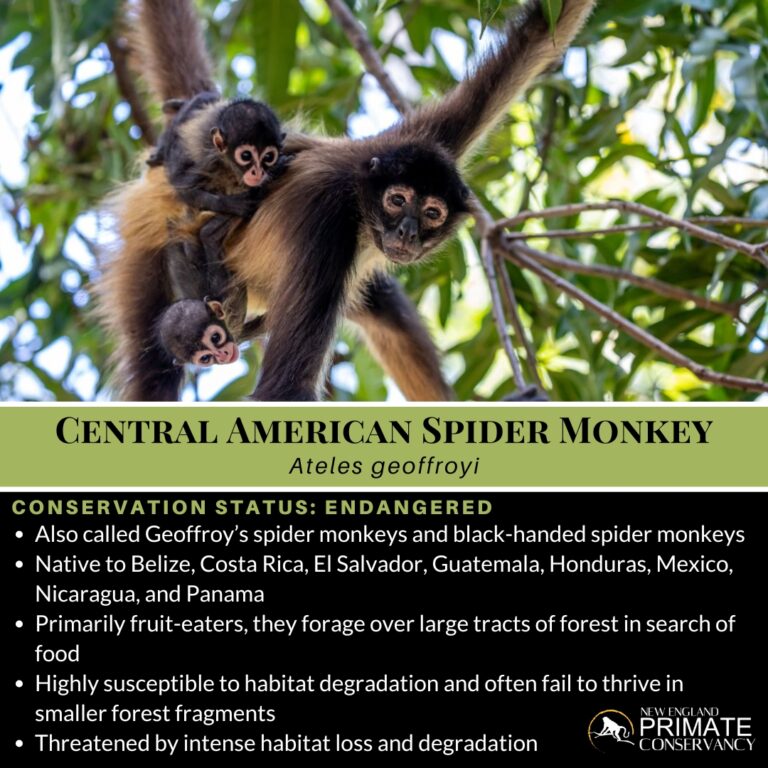
Geographic Distribution and Habitat
Central American spider monkeys (Ateles geoffroyi), also called Geoffroy’s spider monkeys and black-handed spider monkeys, are found across Central America and southern Mexico. Their range stretches through Mexico, Belize, Guatemala, Honduras, El Salvador, Nicaragua, Costa Rica, and Panama. Some evidence suggests the southernmost subspecies may also occur in a small part of Colombia, near the Panama border.
These monkeys inhabit a variety of forest types, including tropical forests, semideciduous forests (forests where some trees lose their leaves part of the year), and mangrove forests along coastal areas. They are most often found in areas with evergreen forests, where trees retain their leaves year-round and where their main food source, fruit, is more abundant. A variety of useful physical adaptations allow them to easily navigate through the canopy, the highest level of the forest.
The Central American spider monkey (Ateles geoffroyi) belongs to the genus Ateles. This species is made up of several recognized subspecies, which vary slightly in appearance and geographic range. Differences may include fur color, facial markings, or the amount of dark pigmentation on the head and limbs.
Common names can sometimes cause confusion. Central American spider monkeys are often called black-handed spider monkeys, referring to their darker hands and feet. It should not be confused with the black-headed spider monkey, a name sometimes used informally for certain dark-faced populations or for different spider monkey species altogether. Because common names vary by region and language, scientists rely on the scientific name (Ateles geoffroyi) to clearly identify the species and avoid misunderstandings.

Size, Weight, and Lifespan
Central American spider monkeys are among the largest Latin American monkeys. Adults typically measure 16-26 inches (40-65 centimeters) in body length, not including the tail. Their tail is often longer than their body, measuring up to 33 inches (85 centimeters), and plays a crucial role in movement through the trees. Adult spider monkeys usually weigh around 13-20 pounds (6-9 kilograms), with males and females similar in size.
In the wild, these spider monkeys generally live 20-25 years. In specialized human care, where they receive regular food, medical attention, and protection from predators, they may live more than 30 years.
Appearance
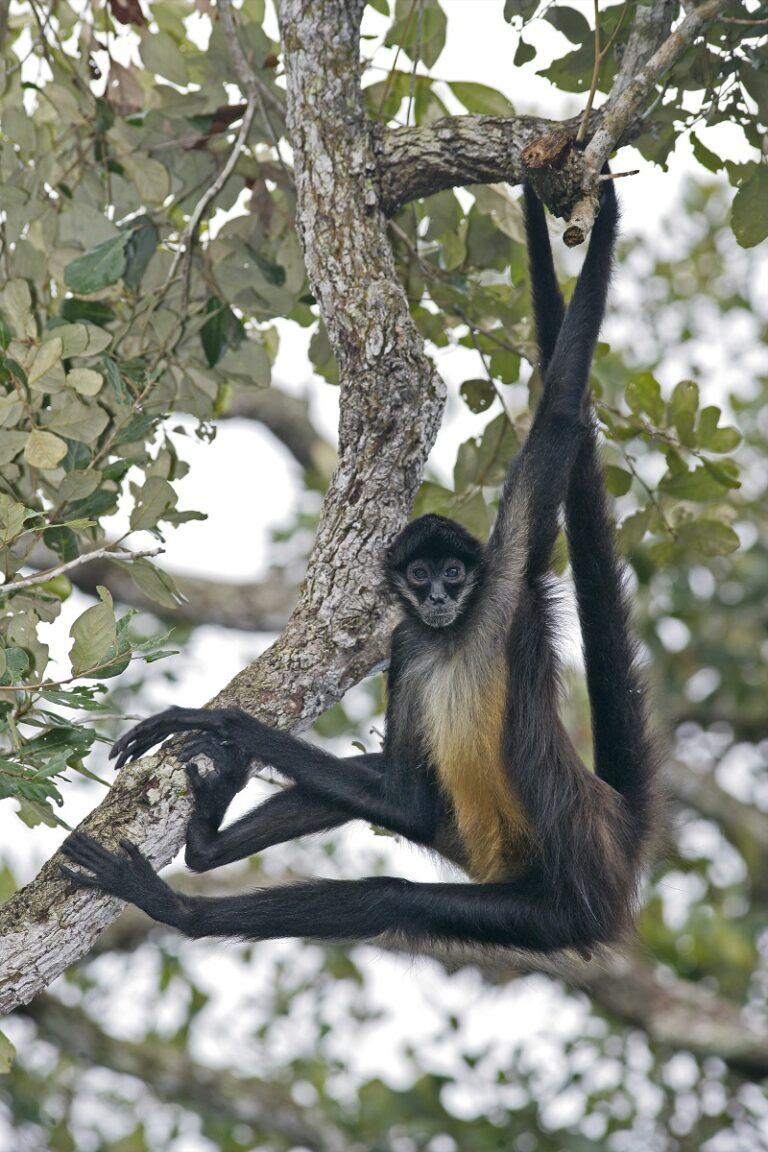
Central American spider monkeys have a slim, long-limbed appearance that is perfectly suited for life in the trees. Their arms are especially long compared to their legs, giving them a spider-like shape, which is how they got their name. This body shape allows them to swing easily through the forest canopy by hanging and swinging from their arms.
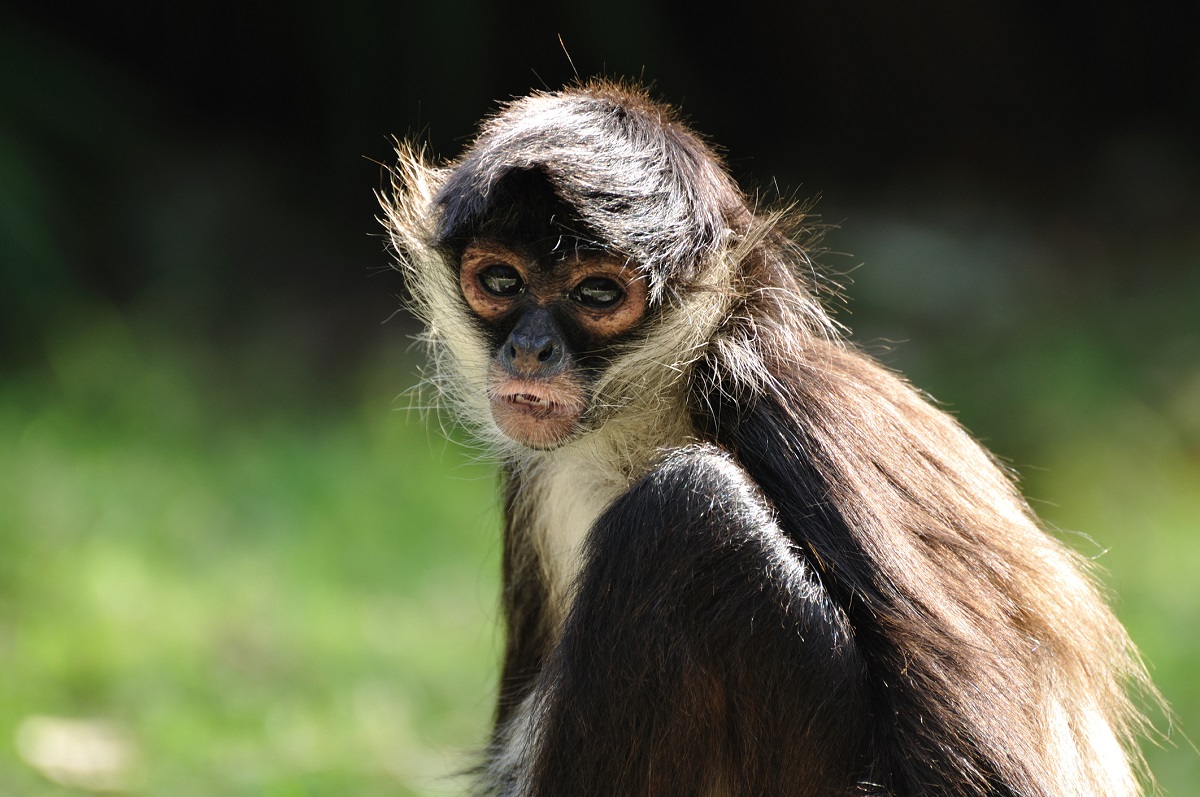
Their fur is typically black, dark brown, or reddish-brown, though coloration can vary between individuals and subspecies. The face is mostly hairless, with expressive eyes and a lighter-colored muzzle that makes facial expressions easier to see. Unlike many other monkeys, spider monkeys have reduced or absent thumbs, which helps them grip branches more securely as they move quickly through the trees. While a thumb might slow a monkey down by snagging during quick movements, the lack of a thumb allows them to navigate their habitat swiftly and successfully.
One of this primate’s most distinctive features is their prehensile tail. The term “prehensile” means the tail can act almost as another hand and can grasp and hold objects. The underside of the tail tip is hairless and textured, functioning somewhat like a fingertip and providing extra grip. Spider monkeys use their tails to hang, balance, and even support their full body weight while feeding, making the tail an essential tool for daily life in the forest canopy.
Diet
Central American spider monkeys primarily eat fruit, making them frugivorous. Ripe fruits provide the sugars and energy these active monkeys need to travel long distances through the forest canopy. Because fruit availability changes throughout the year, spider monkeys must remember the locations of many fruiting trees and often travel widely to find food.
In addition, these monkeys also eat leaves, flowers, seeds, and buds, especially during times when fruit is scarce. Young leaves are preferred because they are easier to digest and contain more nutrients than mature leaves. Occasionally, they may also consume small amounts of insects, though this makes up only a small part of their overall diet.
This flexible feeding strategy allows these spider monkeys to survive in a variety of forest habitats. As they move and feed, they play an important role in spreading seeds across the forest, helping new plants grow and supporting the health of tropical ecosystems.
Behavior and Lifestyle
This species of spider monkey is diurnal, meaning individuals are active during the day and rest at night. They spend nearly all of their time, both awake and asleep, in the forest canopy, often traveling long distances in search of food. Their daily routines are shaped by fruit availability, which can change with the seasons, requiring flexibility and strong spatial memory.
These monkeys are highly arboreal and rarely descend to the ground. Two types of movement, brachiation and bridging, are very common for this species. Brachiation is a movement that involves swinging from branch to branch, with their long arms, while their prehensile tail provides balance and support. Bridging involves pulling on a branch from a neighboring tree to lessen the distance required for traveling. These efficient forms of movement allow them to travel quickly and conserve energy in the treetops.
At night, Central American spider monkeys rest in tall trees, often spreading out rather than sleeping tightly clustered together. Their lifestyle depends on large areas of continuous forest, where they can move freely, avoid predators, and find enough food to support their active way of life
While they spend most of their time in the treetops, Central American spider monkeys will descend to the ground more frequently than other spider monkey species.
Large cats like jaguars and pumas, who can climb high in trees, are the most common predators of these monkeys.
Central American spider monkeys live in large social groups that may include up to 40 individuals, though not all members stay together at the same time. Instead, they organize into a social system called “fission-fusion”, which means the group regularly splits into smaller subgroups and later comes back together. These smaller groups may form based on factors such as age, sex, availability of food, and more.
During the day, they travel, feed, and rest in these shifting subgroups. This flexible social structure helps reduce competition for food, especially fruit, which can be scattered across the forest. Females often travel alone or with their offspring, while males are more likely to remain together and maintain strong social bonds.
Although they do not always stay close, group members recognize one another and maintain long-term relationships. This social flexibility allows these primates to balance cooperation with independence, helping them thrive in large, complex forest habitats.
These vocal primates communicate using sounds, facial expressions, body movements, and touch. They are especially known for their loud calls, including barks, whinnies, and screams, which can travel long distances through the forest. These calls help individuals locate one another when group members are spread out, and they can also warn others of danger, such as the presence of a predator.
Softer sounds, such as whimpers or quiet vocal calls, are often used between nearby individuals, especially between mothers and infants or during friendly social interactions. Facial expressions also play an important role. For example, a relaxed face or gentle eye contact may signal calmness, while bared teeth or widened eyes can indicate stress or aggression.
Body language provides important communication as well. Upright postures or purposeful movements can display confidence or dominance, while crouching or avoiding eye contact may signal submission. Spider monkeys also use physical contact, such as grooming or gentle touching, to reinforce social bonds and reduce tension. Together, these communication methods help spider monkeys stay connected, coordinate movement, and maintain social relationships in their large, flexible groups.
Females of this species reach sexual maturity between 4 and 5 years of age, while males mature closer to 5 years of age. In Central American spider monkey groups, females usually give birth to one infant at a time, though twins occur occasionally. After a gestation period (the time between conception and birth) of about 7 to 8 months, the infant is born fully dependent on its mother. Mothers provide primary care, including carrying, nursing, and protection.
Infants cling to their mother’s belly at first and later ride on her back as they grow stronger. Young spider monkeys develop slowly and may stay close to their mother for several years while learning how to travel, find food, and interact socially. This long period of care helps young monkeys gain the skills they need to survive in a complex forest environment. Strong mother-infant bonds and extended learning periods are key features of spider monkey family life and contribute to the species’ social and behavioral development.
Female spider monkeys have external reproductive anatomy that can closely resemble that of males, including an elongated clitoris. This is an example of sexual dimorphism, a term used to describe physical differences between males and females of the same species. Because of this similarity, even experienced observers may sometimes mistake females for males when identifying individuals in the wild. Some scientists suggest that this trait may help reduce aggression within groups by making sex and dominance less visually obvious, which may contribute to more tolerant and cooperative social relationships.
These spider monkeys play an important role in the health of tropical forests. As frugivores, they eat large amounts of fruit and spread seeds throughout the forest during travel. This seed dispersal helps new plants grow in different areas, promoting forest regeneration and maintaining plant diversity.
By feeding on leaves, flowers, and occasional insects, spider monkeys also influence the balance of plant and animal life in the forest. Their foraging activity affects which plants thrive and how nutrients are distributed in the canopy.
Because they rely on large, connected forest habitats, Central American spider monkeys are considered an indicator species. This means their presence and population size can show how healthy a forest ecosystem is. Protecting spider monkeys not only helps the species itself but also safeguards many other plants and animals that share their habitat.


The International Union for Conservation of Nature lists Central American spider monkeys as endangered (IUCN, 2020), appearing on the IUCN Red List of Threatened Species.
The greatest threat to this species is habitat loss. Large areas of tropical forest have been cleared for agriculture, cattle ranching, logging, and urban development, leaving forests fragmented into smaller patches. Fragmentation makes it harder for spider monkeys to find food, travel safely, and maintain healthy social groups.
They are also affected by hunting and the illegal wildlife trade, which further reduces their population. Because Central American spider monkeys need large, connected areas of forest to survive, even small habitat losses can have big impacts on their numbers and social structure.
Central American spider monkeys are listed in Appendix II of the Convention on International Trade in Endangered Species (CITES), an international agreement between governments whose goal is to ensure that international trade in specimens of wild animals and plants does not threaten their survival. Some subspecies require more protection and are listed in Appendix I.
Efforts to protect Central American spider monkeys focus on preserving existing forests, reconnecting fragmented habitats, and engaging local communities. Protected areas, such as national parks and reserves in Mexico and Central America, provide safe spaces where spider monkeys can live, feed, and reproduce without immediate threats from deforestation or hunting.
Because spider monkeys require large, continuous forests, conservationists emphasize the importance of wildlife corridors, or stretches of forest that link separate forest patches. These corridors allow monkeys to travel between areas to find food, mates, and new territory, which helps maintain healthy, genetically diverse populations.
Community involvement is also key. Environmental education programs teach local farmers, landowners, and students about sustainable land use, such as shade-grown agriculture, and the importance of protecting forests. By combining habitat protection, scientific monitoring, forest restoration, and community partnerships, these conservation efforts aim to secure a long-term future for Central American spider monkeys and the forests they call home.
- Aguilar-Melo AR, Calmé S, Pinacho-Guendulain B, Smith-Aguilar SE, Ramos-Fernández G. (2019) Ecological and social determinants of association and proximity patterns in the fission-fusion society of spider monkeys (Ateles geoffroyi).
- Cawthon Lang, K. A. (2006). Primate Factsheets: Spider monkey (Ateles). Primate Info Net, Wisconsin National Primate Research Center, University of Wisconsin–Madison.
- Campbell, C. J., & Gibson, M. (2001). Spider monkeys: Behavior, ecology, and conservation. In C. J. Campbell (Ed.), Primates in peril: The world’s 25 most endangered primates 2000–2002 (pp. 14–21). Primate Conservation.
- Di Fiore, A., Campbell, C. J., & Strier, K. B. (2009). Understanding the evolution of primate societies. University of Chicago Press.
- Wallace RB. (2008). Factors influencing spider monkey habitat use and ranging patterns. In: Campbell CJ (ed.), Spider Monkeys: Behavior, Ecology and Evolution of the Genus Ateles, pp. 128-154. Cambridge University Press, New York, USA.
- Geoffroy’s spider monkey facts. JungleDragon. Retrieved from https://www.jungledragon.com/specie/623/geoffroys_spider_monkey.html
- IUCN Red List of Threatened Species. (2023). Retrieved from https://www.iucnredlist.org/species/2279/191688782
- iNaturalist. (n.d.). Central American Spider Monkey. Retrieved from https://www.inaturalist.org/taxa/43411-Ateles-geoffroyi
- Smithsonian National Zoo & Conservation Biology Institute. (n.d.). Spider monkey. Retrieved from https://nationalzoo.si.edu/animals/spider-monkey
- CITES. (2024). Appendices I, II and III. Convention on International Trade in Endangered Species of Wild Fauna and Flora. https://www.cites.org/sites/default/files/eng/app/2024/E-Appendices-2024-05-25.pdf
Written by Chloe Becker, February 2026