
Bemaraha Woolly Lemur, Avahi cleesei
BEMARAHA WOOLLY LEMUR
Avahi cleesei
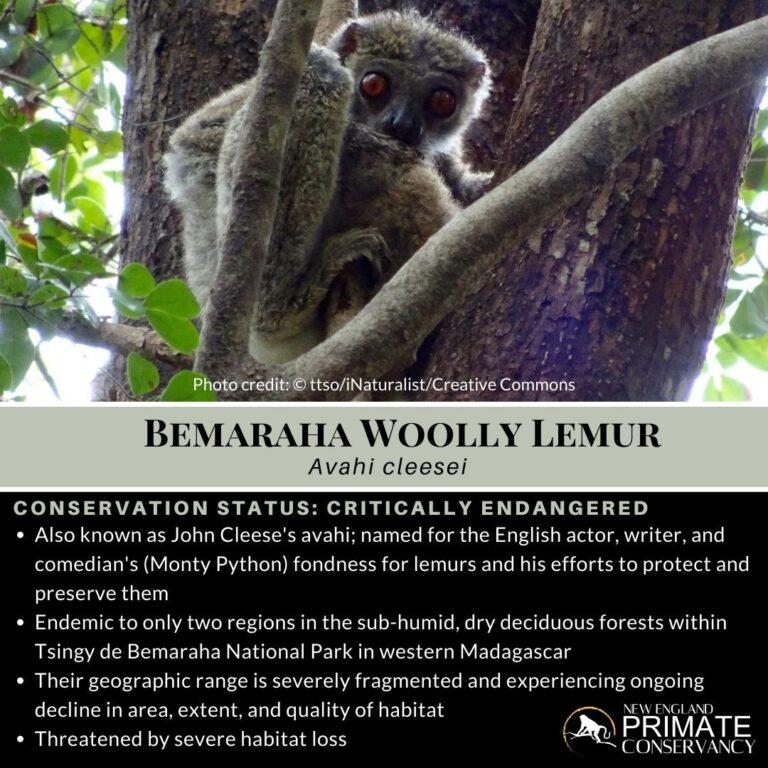
Geographic Distribution and Habitat
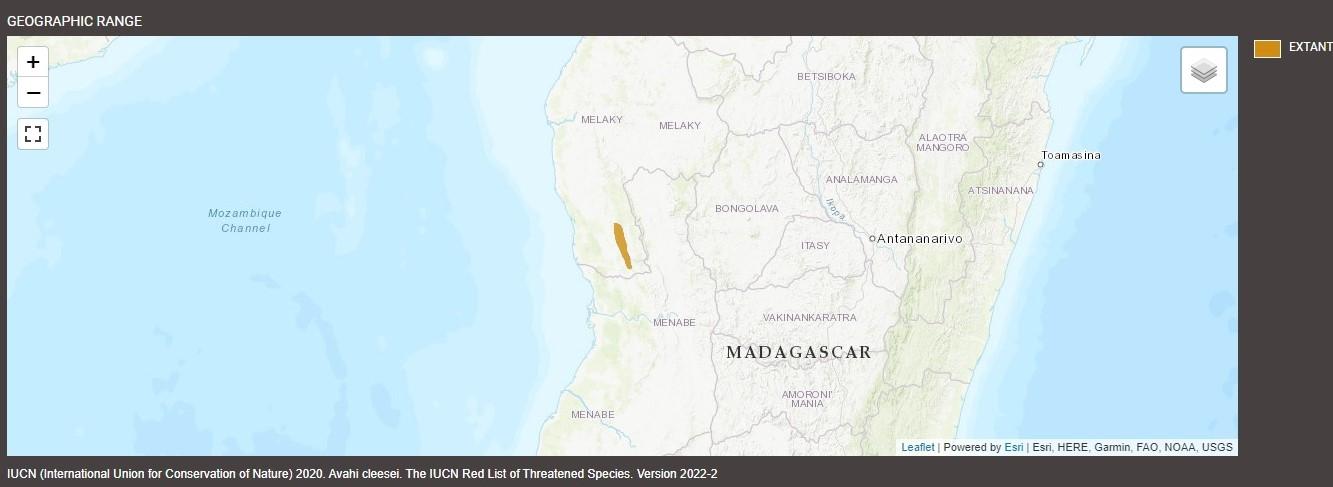
The Bemaraha woolly lemur, also known as John Cleese’s avahi, is one of Madagascar’s most geographically restricted primates. First recorded by scientists in 1990 and formally described as a distinct species in 2005, they are known only from the Tsingy de Bemaraha region of western Madagascar, north of the Manambolo River. Despite decades of surveys elsewhere in western Madagascar, no confirmed populations have been found beyond this small, isolated landscape. Within the Tsingy de Bemaraha National Park, sightings have been limited to a few forest patches, including the Ankindrodro forest and the type locality near Ambalarano, at the base of the dramatic western Tsingy escarpment.
The entire known range of the Bemaraha woolly lemur covers less than 190 square miles (500 km²). This range is not only extremely small but also severely fragmented, with habitat continuing to shrink in area, extent, and quality. The northern limits of its distribution remain uncertain. Still, extensive field surveys and local interviews suggest that the species does not occur between major river systems farther north, reinforcing the idea that this species is confined to a narrow ecological pocket shaped by rivers, karst formations, and historical isolation.
Ecologically, Bemaraha woolly lemurs are strictly arboreal (tree-dwelling), inhabiting a mosaic of tropical dry and sub-humid forests, including semi-deciduous, riverine, edge, and karst-associated habitats. They are most often found near the western Tsingy precipices, within deep limestone crevasses and gorges, and along small seasonal streams and swampy areas close to the Bemaraha massif. Although elevation estimates vary slightly among studies, the species inhabits lowland forests, generally below 330 feet above sea level (100 m), with many records clustering closer to 100–300 feet (30–90 m).
Many of the forests used by the Bemaraha woolly lemur remain surprisingly green even during Madagascar’s long dry season. These areas tend to have a high proportion of evergreen trees, often representing secondary forest growth. Detailed habitat studies describe forests with dense understory and relatively tall trees, averaging about 38 feet in height (11.7 m), with some emergent trees exceeding 72 feet (22 m) and trunk girths of over 31 inches (80 cm). Such a structure provides the vertical complexity needed for the lemur’s mode of movement and offers both food and cover in an otherwise seasonally harsh environment.
Within these habitats, the species shows a clear preference for vegetation with taller canopies, larger tree diameters, and higher plant diversity than is typical of many dry deciduous forests. Dense understory vegetation appears especially important, offering concealment while foraging and protection from predators. These forests also supply the buds, young leaves, and fresh growth that form the basis of the species’ diet, particularly during seasonal transitions.
Despite its overall rarity, the Bemaraha woolly lemur presents an intriguing ecological pattern: local population densities sometimes appear higher in moderately disturbed forests than in less disturbed ones. This suggests a limited tolerance, or even short-term advantage, in certain secondary habitats.
Locals call the lemur dadintsifaky, or “grandfather of the sifaka,” for its sifaka-like size and its heavier, more ponderous build, cloaked in thick gray-brown fur. That evocative local name captures something essential about the species: a distinctive lemur shaped by a unique landscape, now confined to a shrinking forest world where geology, climate, and human pressure converge.
The Bemaraha woolly lemur is a relatively recent discovery in Madagascar’s rich primate family tree, first encountered in 1990 and formally described as a new species in 2005.
To understand why scientists consider the Bemaraha woolly lemur a separate species, it is helpful to know that biologists use different methods for defining what constitutes a species. One common approach, called the Biological Species Concept, focuses on whether animals can interbreed and produce offspring. Under this definition, some scientists note that more information would be helpful to fully test how the Bemaraha woolly lemur relates to its closest relatives. Another approach, the Phylogenetic Species Concept, looks instead at whether a group of animals forms its own distinct evolutionary line with clear identifying traits. This method is widely used for primates, and under this framework, the Bemaraha woolly lemur is clearly recognized as its own species.
Genetic studies have helped clarify this picture. DNA analyses show that the Bemaraha woolly lemur and the closely related western woolly lemur form separate genetic branches, known as clades, on the woolly lemur family tree. Although their genetic differences are subtle and their chromosomes appear very similar, the two groups remain distinct. This pattern suggests that the Bemaraha woolly lemur may be the result of recent or ongoing speciation, the evolutionary process by which one species gradually splits into two over time.
More advanced genetic research conducted through 2025 has strengthened this conclusion. By examining large genetic datasets collected from many lemur populations, scientists found that major rivers in Madagascar act as natural barriers, limiting movement and interbreeding between groups. Very little mixing has occurred across these boundaries, supporting the idea that this is a separate evolutionary unit shaped by long-term isolation, climate changes, and shifting forest landscapes. In addition to this genetic evidence, the Bemaraha woolly lemur can be identified by its distinctive appearance.
The scientific species name cleesei honors John Cleese, the British actor and comedian, for his long-standing support of lemur conservation. Through films and documentaries focused on endangered wildlife and Madagascar’s primates, Cleese helped introduce global audiences to lemurs and the threats they face.
Together, physical traits, vocal differences, and growing genetic evidence all point to the same conclusion: the Bemaraha woolly lemur is a distinct species, shaped by Madagascar’s complex geography and ongoing evolutionary processes, and a reminder that new species can still be discovered in the modern world.
Size, Weight, and Lifespan
The Bemaraha woolly lemur is a small-bodied primate with proportions well-suited to life in the trees. The head-and-body length, measured from the nose to the base of the tail, shows only modest differences between males and females. For males, measurements range from 8–12 inches (20–31.5 cm), based on data from four individuals. Females are similar, measuring 9–12 inches (23–30.5 cm), based on three individuals. Our understanding of body size is based on fewer than ten measured animals in total, a very small sample that reflects the rarity and difficulty of studying this lemur in the wild.
The tail is slightly longer than the body in both sexes. Male tail lengths range from about 12–14 inches (31.5–35 cm), based on measurements from four individuals, while females range from about 13–14 inches (33–36 cm), based on three individuals. This long tail helps stabilize the lemurs as they move vertically through the forest, especially when landing after powerful leaps.
In terms of weight, the Bemaraha woolly lemur typically weighs about 1.7–2.9 pounds (0.75–1.3 kg). Male weights are known from four individuals, with one additional single measurement, and fall within this same general range. Female weights are based on three individuals, again showing substantial overlap with males. Although the numbers are few, they suggest that males and females are broadly similar in mass, contributing to the species’ sturdy, thick-furred appearance, an impression echoed in its local name, dadintsifaky, meaning “grandfather of the sifaka.”
Very little is known about the lifespan of the Bemaraha woolly lemur. No long-term studies have followed known individuals over many years, so precise estimates are not yet available.
Appearance
The Bemaraha woolly lemur has a soft, woolly coat that gives it a gently flecked appearance. The fur on their heads and dorsal surface (their backs) is brown-gray, while the fur on the chest, belly, and inner surface of the upper limbs is thinner, downy, and very light gray. One of their most distinctive traits is the presence of white patches on the back-inside of the hind legs, a feature unique to this species. Their tails vary among individuals, ranging from beige to brown-gray, with a subtle reddish tint along the top of the tail at the base.
The face of the Bemaraha woolly lemur is slightly paler than the upper forehead and crown. The area above the nose extends upward toward the forehead, creating a striking contrast with the surrounding fur. Bordering the face is a blackish band that forms a dark chevron, or V-shaped pattern, across the forehead. This feature helps distinguish the Bemaraha woolly lemur from other closely related western woolly lemurs, including the western woolly lemur (Avahi occidentalis) and the unicolor woolly lemur (Avahi unicolor), which have different facial markings, such as white masks or lack the chevron pattern. Its eyes are maroon with black, hairless eyelids, while the snout is also black and hairless. Whitish fur surrounds the corners of the mouth, subtly brightening the lower facial area.
Diet
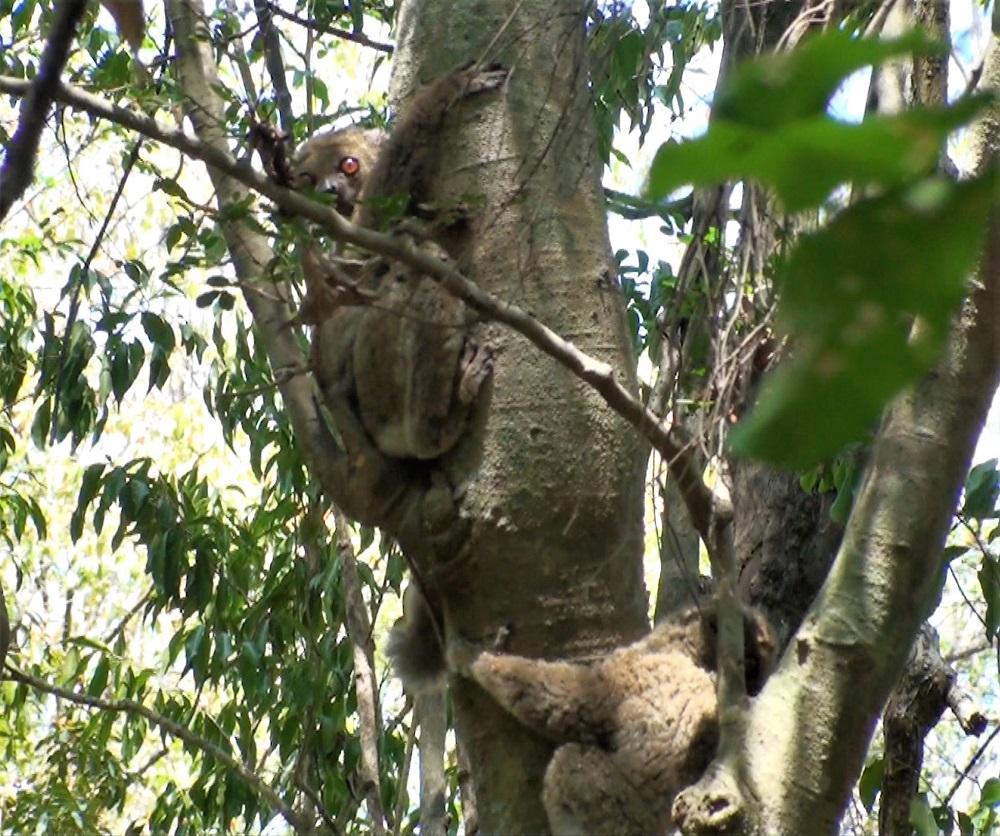
The Bemaraha woolly lemur is a devoted leaf-eater, dining almost exclusively on leaves and buds. But unlike some of its lemur relatives, it has a clear preference for young, tender leaves, which are rich in proteins and sugars and easier to digest than older foliage. This preference is not random, as its metabolism and gut microbiome largely dictate what it eats. Scientists studying fecal samples collected over five years (2013–2017) discovered that the lemur’s gut hosts a unique community of microbes, including bacteria that specialize in metabolizing plant proteins and fats. These microbes specialize in breaking down and recycling amino acids, transforming the proteins in young leaves into forms the lemurs can use. This allows the lemurs to extract maximum nutrition while avoiding plant toxins that might trouble animals with less specialized guts.
Mature leaves are tougher, harder to digest, and packed with chemical defenses like tannins, making them less nutritious. By choosing younger foliage, the Bemaraha woolly lemur maximizes the energy it gains from food while minimizing the digestive challenges older leaves present.
To support its specialized leaf diet, the Bemaraha woolly lemur also has an elongated digestive tract with a sacculated cecum, a pouch-like section over 14 times the length of its body, where microbes ferment fibers into short-chain fatty acids, a form of usable energy. Combined with a naturally low metabolic rate, these adaptations allow the lemur to survive on a diet that would be low in energy for many other animals.
Behavior and Lifestyle
The Bemaraha woolly lemur is arboreal, meaning it lives in the trees, and nocturnal, active during the night rather than the day. Detailed tracking of one male fitted with a radio transmitter revealed a consistent nightly routine. Activity typically begins around 5:50 p.m. and ends by 5:20 a.m., with two main peaks: an early evening burst shortly after leaving the sleeping site, and a pre-dawn peak as the lemurs return to rest. Occasionally, a smaller activity peak occurs between 10:00 p.m. and midnight. For much of the night, about 54% of the time, the lemur remains inactive, either resting or quietly clinging to branches.
Its body structure shapes its movements. With legs much longer than its arms, this body plan is typical of lemurs that use vertical clinging and leaping, gripping tree trunks upright and launching themselves between supports using powerful hind limbs.
The Bemaraha woolly lemur combines climbing, leaping, quadrupedal movement (walking on all fours), and suspensory behaviors to navigate the canopy efficiently. These behaviors allow them to forage for nutrient-rich young leaves, travel safely between trees, and maintain social interactions while minimizing exposure to predators
Protein at night? Check. Acrobat legs? Check. Love duets in the dark? Double check.
Who’s the funniest lemur? The one named after John Cleese, Avahi cleesei, brings a little comedy to the forest, at least in name.
The Bemaraha woolly lemur usually lives in small family groups, often consisting of just one male and one female, plus their unweaned young, depending on the season.
During the night, these lemurs are surprisingly active little travelers. Based on eight nights of tracking, the average minimum distance a lemur moves in a single night is about 0.20 miles (326 m), with a range from 0.14 miles (223 m) to 0.31 miles (494 m). While these numbers come from only a few recorded locations, they give a glimpse into how far these tiny night dwellers roam while foraging, socializing, and exploring their forest canopy.
Their home range is thought to be at least 0.29 hectares (0.72 acres), though this is based on very limited observations, so the actual area they use is likely larger. Even within these modest spaces, the Bemaraha woolly lemur balances the need to find enough young leaves with the safety of familiar trees, showing that even small lemurs can lead surprisingly busy lives in the dark of night.
For comparison, a more extensive study of southeastern Avahis (Avahi laniger and Avahi meridionalis) over 26 nights in a littoral forest provides insight into home range use and pair-living behavior. In that study, adult lemurs traveled farther and had larger home ranges than previously reported for other pair-living folivorous lemurs. Male–female cohesion appeared influenced by offspring presence, with females spending more time feeding and males traveling longer distances. While the Bemaraha data are limited, these broader patterns suggest that nocturnal woolly lemurs may adjust their ranging and social behavior in response to feeding needs, group composition, and reproductive cycles, highlighting how even small family groups can have dynamic nightly routines.
The Bemaraha woolly lemur is a nocturnal chatterbox of the forest. Its most distinctive call, a loud “vou-hy” (pronounced almost like “ava-hi”), echoes through the trees at night and is often repeated in a series or performed as a duet, where a mated pair takes turns responding to each other. These calls are most frequent during the lemurs’ activity peaks, early evening, around midnight, and just before dawn, when the forest is quiet, and the lemurs are foraging, traveling, or tending to their young.
These vocalizations serve many purposes. They help maintain pair bonds within their small family groups. The calls also coordinate spacing and keep group members together in the thick, dark understory, where seeing each other is nearly impossible. In addition, they act as territorial signals, advertising the presence of a group and helping defend their small home ranges. The lemurs may also use these calls to respond to intruders or potential threats.
Other sounds, such as softer whistles and quiet growls, are used for closer-range communication, but the “vou-hy” call remains the loudest and most recognizable. This type of vocalization is typical of woolly lemurs (Avahi sp.) across Madagascar, with similar calls noted in eastern woolly lemurs that sometimes function as alarms or location signals. For the Bemaraha woolly lemurs, vocal communication is essential. Living as small, arboreal, nocturnal lemurs in dense forests, they cannot rely on sight alone. Instead, their calls allow them to stay connected with family, maintain social bonds, and navigate their leafy world without ever needing to be seen.
Olfactory communication, through scent, is another effective way animals communicate when they cannot see one another. Woolly lemurs have scent glands, but it has not yet been determined how or when they use them. These glands likely convey information about individual identity, health, and possibly sexual status, as the glands are more pronounced in males.
The Bemaraha woolly lemur is thought to be monogamous, typically forming long-term pair bonds between one male and one female. Beyond this basic social structure, little is known about the details of their mating system or reproductive habits, as these nocturnal, forest-dwelling lemurs are difficult to observe. However, like other woolly lemurs, they likely raise their young in small family groups, with the parents caring for one or two offspring at a time. This tight-knit family setup helps ensure that the young are protected and learn how to navigate the canopy, forage, and communicate in their challenging forest environment.
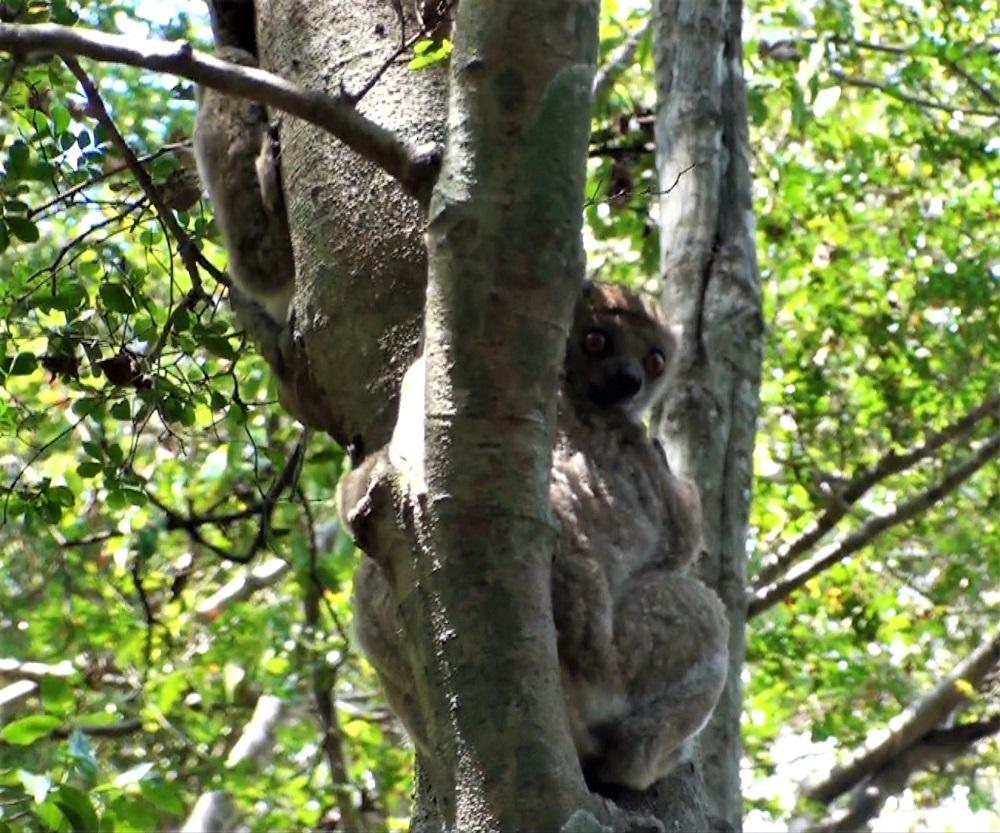
Bemaraha woolly lemurs play an important role in maintaining the health and balance of their forest home. By feeding primarily on young leaves and buds, they help regulate the growth of certain plants, encouraging new shoots and maintaining forest understory diversity. Their selective diet also reduces competition with other lemurs that focus on fruit or mature leaves, allowing multiple species to coexist in the same habitat.
The lemur’s nightly movements through the canopy, traveling over half a mile in a single foraging session, help redistribute nutrients through their droppings, subtly supporting soil fertility. Bemaraha woolly lemurs also act as prey items for aerial predators like hawks, and possibly the island’s apex predator, the fossa.


The International Union for Conservation of Nature lists the Bemaraha woolly lemur as Critically Endangered (IUCN, 2018), appearing on the IUCN Red List of Threatened Species.
This classification is the highest level of risk for extinction, and is due to the fragmentation and decline in size and quality of the species’ known range of less than 193 square miles (500 km²). Scientists estimate that the species population may have already decreased by 80% in the past and could decline by 80-90% in the future if current trends continue. Bemaraha woolly lemurs also face intense pressure from habitat loss, a problem affecting forests across Madagascar. Between 1973 and 2014, the island lost 37% of its forest cover, with deforestation continuing at around 1.1% per year in recent years. Nearly half of Madagascar’s forests are now within 100 meters of the forest edge, leaving these lemurs vulnerable to human activity and environmental disturbances.
Local observations highlight the severity of this threat. Forests near villages such as Ankinajao, which once supported many Bemaraha woolly lemurs, had been completely cleared by 2003. Even within Tsingy de Bemaraha National Park, areas near the Ambalarano forest experienced significant habitat loss between 2002 and 2007. The sub-humid forests at the base of the Tsingy escarpment, the only habitat where this species is currently known to occur, are under constant pressure from bush fires, which destroy large areas each year.
Other threats include logging and wood harvesting, ecosystem degradation and conversion, increased fire frequency, and disturbance or mortality caused by human activity. Because these lemurs have such a small, specialized range, any loss or degradation of habitat has an outsized effect on their survival.
The Bemaraha woolly lemur is listed in Appendix I of the Convention on International Trade in Endangered Species (CITES), an international agreement between governments whose goal is to ensure that international trade in specimens of wild animals and plants does not threaten their survival.
The species’ only confirmed protected habitat is Tsingy de Bemaraha National Park and Strict Nature Reserve, highlighting how limited its range is. Long-term captive management has not been successful for this species or any Avahi, making in-situ conservation essential.
Given the extremely small known range of the species, surveys recommended in 2012 are still urgently needed to identify additional populations or individuals. Such field studies would provide essential information on population size, distribution, and trends, helping conservationists target protection efforts more effectively. Monitoring population trends over time is also critical to detecting declines early and responding accordingly.
The following conservation actions could also make a difference:
- Site and habitat management: Protecting the sub-humid forests at the base of the Tsingy escarpment from logging, bush fires, and human encroachment is crucial. Establishing buffer zones around forest edges could help reduce the impact of deforestation.
- Species management: Limiting disturbances in the lemur’s habitat and preventing illegal harvesting or hunting is vital, even if direct hunting pressure is not well documented.
- Research and ecological monitoring: Detailed studies on life history, reproductive behavior, foraging ecology, and habitat use would inform more effective conservation strategies. Fecal microbiome studies could reveal how dietary needs and nocturnal habits shape survival, helping guide forest management.
- Community engagement and education: Working with local communities to promote sustainable forest use, prevent fires, and raise awareness about the species’ critical status could reduce threats and encourage participation in conservation.
- Connectivity conservation: Restoring degraded areas or creating habitat corridors could help link fragmented patches of forest, ensuring lemurs can move safely between feeding and sleeping sites.
- https://www.nature.com/articles/s41467-025-62310-y
- https://doi.org/10.1896/0898-6207.21.1.45
- https://www.depts.ttu.edu/nsrl/publications/downloads/SP51.pdf
- https://bioone.org/journals/primate-conservation/volume-2006/issue-21/0898-6207.21.1.45/Conservation-Assessment-of-the-Recently-Described-John-Cleeses-Woolly-Lemur/10.1896/0898-6207.21.1.45.pdf
- https://www.alltheworldsprimates.org/
- https://academic.oup.com/ismej/article/14/7/1675/7474943
- https://onlinelibrary.wiley.com/doi/10.1002/ajp.20191
- https://www.youtube.com/shorts/nW_xA_e4NII
- https://www.mammaldiversity.org/taxon/1000973/
- https://www.iucnredlist.org/ja/species/136335/115582253
- https://onlinelibrary.wiley.com/doi/full/10.1155/2011/362976
- https://link.springer.com/article/10.1007/s10764-005-9008-x
Written by Brenda Awuor, January 2026