
Sun-Tailed Monkey, Allochrocebus solatus
SUN-TAILED MONKEY
Allochrocebus solatus
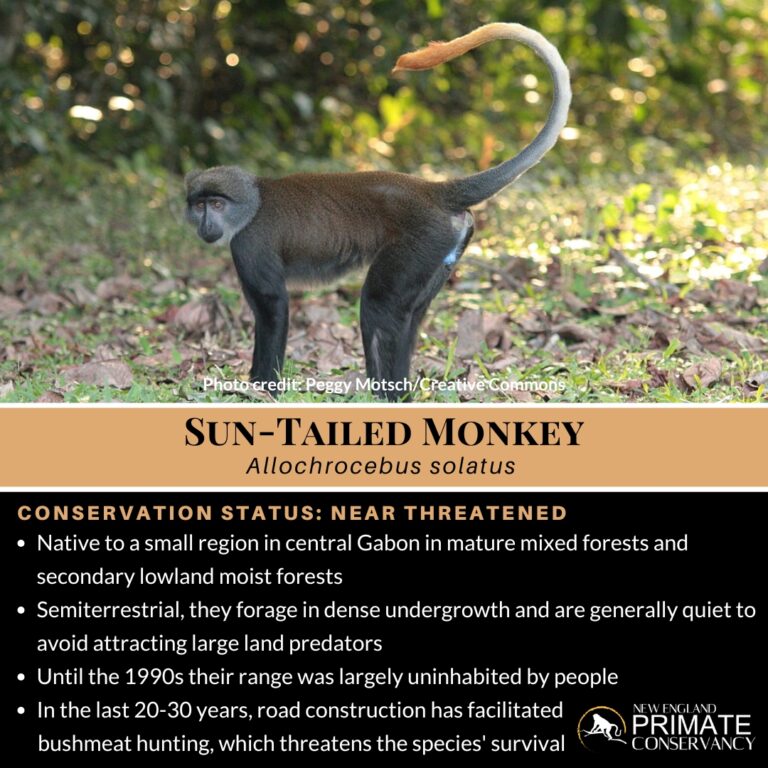
Geographic Distribution and Habitat
Sun-tailed monkeys are endemic to central Gabon, meaning they are found nowhere else in the world. There, they occupy a total geographic range of approximately 9,770 square miles (25,300 km2). They are found primarily south of the Ogooué River and west of the Offoué River, although some groups have been recorded on both sides of the Offoué. Despite decades of intensive wildlife research, sun-tailed monkeys have never been documented north of the Ogooué River, indicating that this river forms a strong natural boundary. The western and southern limits of their range remain uncertain, but confirmed records extend east of Waka National Park and south toward the foothills of the Massif du Chaillu.
These areas have a tropical rainforest climate, characterized by high rainfall and seasonal variation, which supports dense evergreen forests with thick undergrowth, creating the shaded conditions that sun-tailed monkeys prefer. Their habitat receives an average of 69 inches (175.3 cm) of rain per year, with two dry seasons, in January and February, and from June to September, and two wet seasons, from March to May and from October to December.
Within this climate, sun-tailed monkeys are a lowland forest species, preferring stands of trees at lower altitudes rather than mountainous regions. They are most commonly found below 1,640 feet (500 m) above sea level, and their population density declines sharply above 1,804 feet (550 m). This pattern may be linked to changes in forest structure at higher elevations, particularly differences in the understory, the layer of shrubs and young trees near the forest floor, where sun-tailed monkeys spend much of their time. They favor shady areas with dense, tangled vegetation, especially forests with thick undergrowth. The forests where they live are typically dominated by tree species such as Gabon mahogany, Awoura, false nutmeg, and the Mubala-oil tree, which together create a dark, layered environment close to the ground.
Sun-tailed monkeys prefer mature mixed forests, although they are also found in secondary lowland forests that have regrown after disturbance. They often remain common in areas that have experienced light logging, where small canopy openings allow dense undergrowth to develop. However, they tend to avoid places where the understory is either too open or densely forested, suggesting that sun-tailed monkeys depend on a careful balance between cover and ease of movement.
The sun-tailed monkey belongs to the genus Allochrocebus, a group of African monkeys that are closely related to Preuss’s and L’Hoest’s monkeys. Studies of their DNA show these three species of terrestrial, or ground-dwelling, guenons share a close evolutionary relationship, setting them apart from other arboreal, or tree-dwelling, guenons.
When first described in 1988, sun-tailed monkeys were placed under the Cercopithecus genus, which includes many African monkeys known for their adaptability and colorful faces. They remained listed under this genus in all IUCN Red List assessments until 2008.
However, following comprehensive studies of their genetics and morphology in 2013, scientists officially moved sun-tailed monkeys into their current genus of Allochrocebus. This classification more accurately incorporates the group’s evolutionary history into primate taxonomy, importantly guiding conservation strategies.
Size, Weight, and Lifespan
The sun-tailed monkey is a medium-sized monkey with a slender, agile build. Adult males typically weigh between 13 and 20 pounds (6-9 kg), while adult females are smaller, weighing around 7 to 10 pounds (3-4.5 kg).
The head and body length of males ranges from 24 to 28 inches (60-70 cm), and females measure slightly shorter at 20 to 22 inches (50-55 cm). Their tails are long, helping with balance as they move through the forest. Male tails range from 26 to 30 inches (65-76 cm), and female tails are slightly shorter, measuring 24 to 26 inches (60-67 cm).
These measurements reflect the sun-tailed monkey’s lifestyle as a semi-terrestrial species that moves both on the ground and through the lower canopy. Their size allows them to navigate dense undergrowth with agility while maintaining the strength to leap and climb efficiently.
At birth, sun-tailed monkeys are tiny and delicate. The first recorded birth in captivity clocked the infant at just 0.84 pounds (382 grams), illustrating the dramatic growth these monkeys undergo to reach adult size.
Based on other guenon species, it is likely that the sun-tailed monkey may live up to 20–30 years. One individual in captivity is estimated to be 18 years old.
Appearance
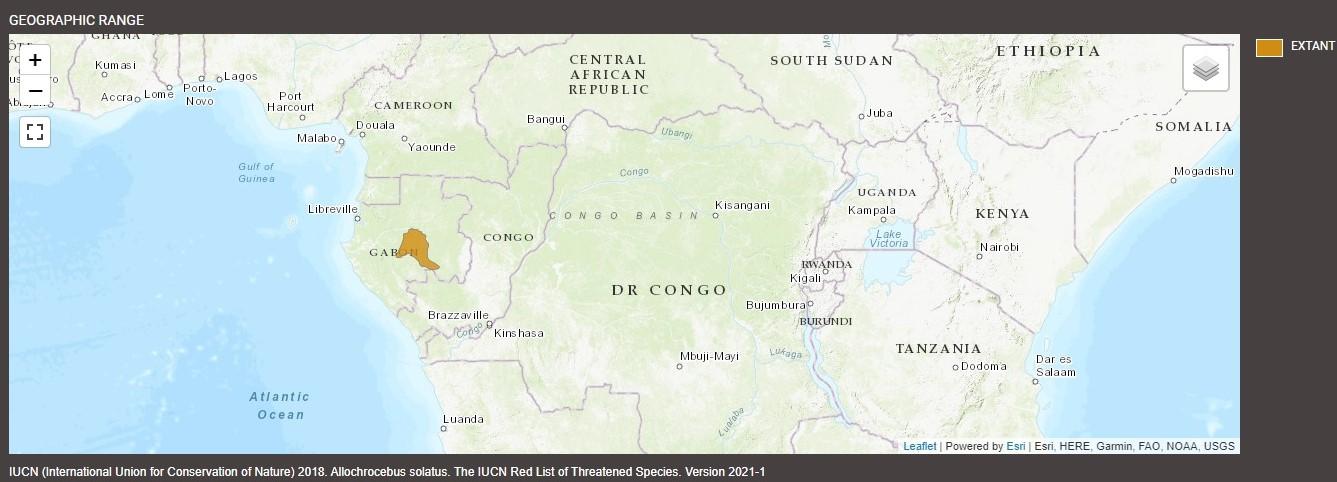
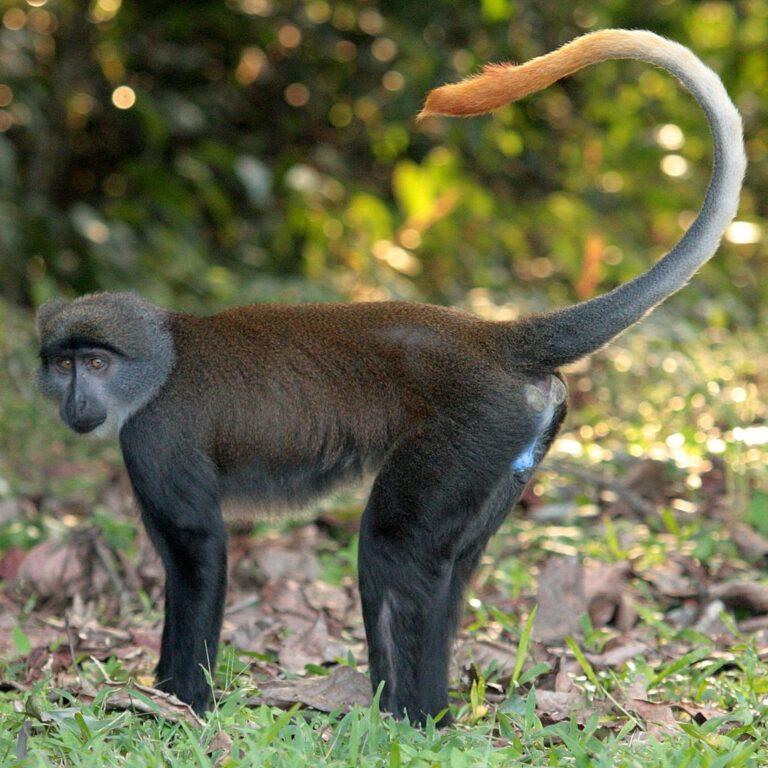
The sun-tailed monkey is a striking animal with a slender, agile body covered in grey-brown fur. Their backs are a rich rusty brown, while their tails fade from white near the base to the bright orange tip that gives the species its name. Males display more intense and contrasting coloration than females, and they have a distinctive white throat ruff, which is less pronounced in females.
The crown and nape of sun-tailed monkeys are dark gray to black, speckled with chestnut-orange, while the saddle, the area across their back, extends in chestnut-orange to their flanks, shoulders, and upper thighs. Their limbs are mostly black, and the upper chest and throat ruff stand out in bright white. The tail is held horizontally at first, curving downward and then upward at the tip, a posture similar to L’Hoest’s monkey, giving them a distinctive silhouette as they move.
Their faces are dark, with a black muzzle and agouti-gray cheek whiskers, and their ears peek out from the crown rather than being hidden by fur. Adult males also feature a bright blue scrotum, a vivid trait that contrasts with their coat.
Juveniles are yellowish-brown all over, with fur less vivid and less contrasting than adults. At three days old, the fur of a newborn sun-tailed monkey was orange-streaked black with lightly pigmented skin. By eleven weeks, both face and body begin to develop adult coloration, including the dark gray back, chestnut-orange saddle, white throat, and the tail’s bright orange-yellow tip.
This combination of rusty, orange, gray, and white markings, along with their agile build and expressive tail, makes sun-tailed monkeys one of the most visually distinctive primates in Gabon’s forests.
Diet
Sun-tailed monkeys are primarily frugivorous, meaning they mainly eat fruits, supplemented by seeds, grasses, leaves, and invertebrates. They also sometimes eat crops near villages. They opportunistically consume small vertebrates, and some monkeys have been observed hunting tiny forest antelopes, known as duikers, demonstrating their bold feeding habits. As they age, they may be less likely to engage in these possibly risky encounters with other vertebrates.
A 2014 study reported that the monkeys’ diet consists of 50% fruit, 30% seeds, 10% other plants, and 10% vertebrates. However, this same study also claimed that sun-tailed monkeys are 100% arboreal foragers, feeding entirely in trees. This is difficult to reconcile with what is known about the species’ behavior and habitat. Sun-tailed monkeys are semi-terrestrial, spending a significant portion of their time on the forest floor, particularly while feeding and foraging. They move in dense understory and occasionally climb low to mid-level trees, making their feeding behavior more flexible than the 2014 study suggests.
Earlier research indicated a more mixed diet, including a substantial portion of insects and terrestrial herbs, which better aligns with the species’ semi-terrestrial habits.
In short, while sun-tailed monkeys enjoy a variety of foods, their diet cannot be entirely arboreal, and any study claiming 100% tree-based feeding likely oversimplifies the reality of this adaptable, semi-terrestrial primate.
Behavior and Lifestyle
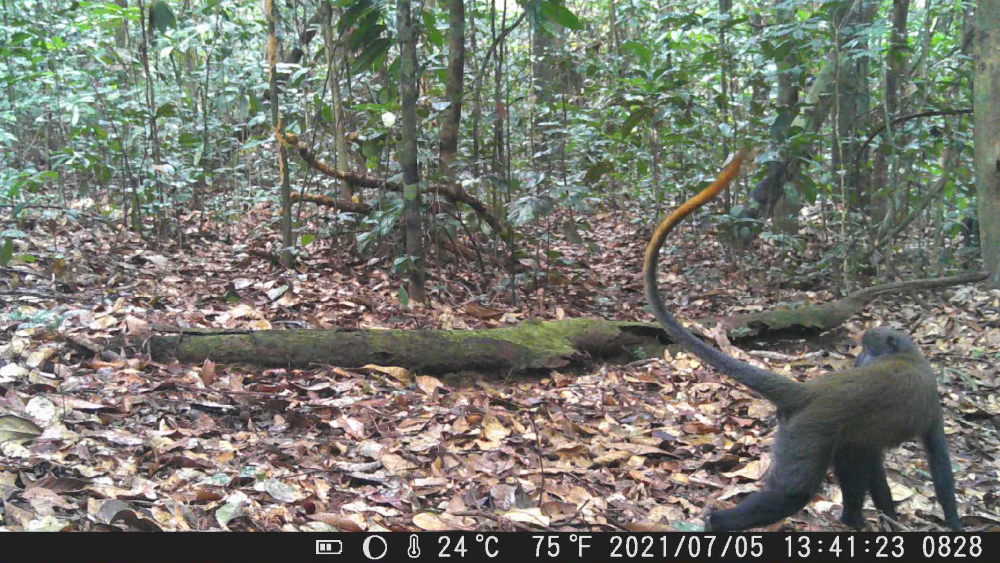
The sun-tailed monkey is a diurnal, semi-terrestrial primate, meaning it is active during the day and spends time both on the forest floor and in the trees. Although early reports described them as mostly ground-dwelling, later studies show that they spend about one-third of their time on the ground, particularly while feeding, and the rest of their time in trees at heights of approximately 10 to 33 feet (3-10m). This flexible use of both strata allows them to move efficiently through dense vegetation while staying alert to predators.
Sun-tailed monkeys are seasonal in their behavior, spending more time on the ground during the dry season to feed, while resting and socializing occur more frequently in the trees. They travel primarily as quadrupeds, walking on all fours, but they also climb, jump between trees, and occasionally walk on two legs, covering a distance of 0.6-1.2 miles (1-2 km) per day.
At night, sun-tailed monkeys sleep in trees, safe from most ground predators. Their semi-terrestrial habits, combined with careful use of the lower canopy, show how adaptable and resourceful these monkeys are in navigating the dense, shaded forests of Gabon.
Tail like a paintbrush: Their tails start white and fade to bright orange at the tip, like a painter’s brush dipped in sunset colors.
Shhh… quiet operators: These monkeys skip the shouting. In Gabon’s dense forests, soft sounds, and possibly even sounds humans can’t hear, may be safer than loud calls.
Floor or tree? Why not both: They spend about a third of their day on the forest floor but are also expert climbers, swinging and hopping through branches like little acrobats.
Natural umbrellas: These monkeys love shady areas with thick undergrowth, creating a “forest umbrella” that keeps them cool while they forage.
Primate makeovers: Juveniles start yellowish-brown, slowly transforming into the vivid, orange-backed adults. Think of it as their very own primate makeover show!
The sun-tailed monkey lives in unimale-multifemale groups, usually with one adult male leading several females and their young. Group sizes can range from 8 to 25 monkeys, with an average adult sex ratio of five females to one male. The male protects the group, systematically keeping others at bay to maintain his leadership, defending it from rival males. Meanwhile, females maintain social harmony, care for offspring, and coordinate daily activities such as feeding and resting. There is also a clear hierarchy among females, with mature daughters eventually taking a rank just below that of their mothers. This social structure helps the group coordinate feeding, grooming, and defense, making life safer and more efficient in the dense forests of Gabon.
Within these groups, social bonds are strong and often shaped by kinship. Sun-tailed monkeys tend to be less aggressive toward relatives, especially maternal kin, and are more likely to spend time close to family members. Young monkeys often show a preference for their mothers over their fathers, reflecting the importance of maternal relationships in their social development. Even their aggression toward other group members is influenced by spatial association and family ties, meaning monkeys that spend more time near each other tend to get along better.
The sun-tailed monkey’s social behavior demonstrates classic principles of kin selection and inclusive fitness, where monkeys favor relatives to increase the survival and success of shared genes. Observations from the semi-free-ranging colony at the Centre Internationale de Recherches Médicales de Franceville (CIRMF), Gabon, provide a rare glimpse into these interactions, confirming that even a little-known primate can have a complex, cooperative, and highly organized social life.
The sun-tailed monkey is a quiet communicator, especially compared with some of its louder guenon relatives. This low-volume lifestyle likely suits their semi-terrestrial habits and the dense, dark forests they call home. Loud calls might attract predators when they are foraging on the forest floor or moving through thick undergrowth, so staying quiet helps keep the group safe.
Instead of long-distance calls, they rely on soft contact vocalizations, both tonal and atonal, used by adults and juveniles to stay in touch within their group. Males emit an alarm bark when danger is near, while juveniles and females give sharp alarm calls to alert the group to potential threats.
Intriguingly, research on L’Hoest’s monkeys, close relatives within the same group, suggests that some guenons may communicate at frequencies too low for humans to hear. Preliminary studies propose that these monkeys use infrasonic or near-infrasonic calls to maintain group cohesion in dense vegetation, allowing them to “stay in touch” without broadcasting their location to predators. While this has not yet been confirmed in sun-tailed monkeys, their unusually quiet nature and shared ecology raise the possibility that similar hidden channels of communication may exist.
Visual signals are just as important. The white underside of their tail and the white throat ruff stand out in the dim light of the forest understory, allowing group members to communicate silently. A flick of the tail or a flash of the throat ruff can warn of danger, indicate movement, or maintain social bonds.
Altogether, the sun-tailed monkey’s communication system appears finely tuned to its environment: quiet, cautious, and potentially more complex than it first appears, perfectly adapted to life in dense forests where being heard is not always an advantage.
Female sun-tailed monkeys reach sexual maturity at about 4 years and 9 months, after which they can begin having offspring. The time between one birth and the next is just under two years, giving mothers time to care for their young before raising another.
Like many guenons, sun-tailed monkey mothers invest heavily in their infants, carrying them close to protect them from predators and help them navigate the dense forest. Most infants are carried ventrally (on the mother’s underside region), clinging to the mother’s chest in the early weeks of life. As they grow and gain strength, some may transition to dorsal carrying, on mom’s back, allowing her greater mobility while still keeping the baby safe.
This careful maternal care is crucial because sun-tailed monkeys are semi-terrestrial, often moving along the forest floor where predators could be a threat. Carrying infants close minimizes the risk of injury or loss, while also allowing young monkeys to gradually learn the skills needed to forage, climb, and navigate their forest home.
Infants are born small and delicate, weighing 0.84 pounds (382 grams) at three days old, highlighting the care required in the first months of life. Within the group, mothers, other females, and even the leading male play roles in socializing and protecting the young, fostering bonds that help the infants grow into agile, alert members of their forest family.
The sun-tailed monkey plays an important part in maintaining the health and balance of Gabon’s forests. As frugivores, they help disperse seeds from the fruits they eat, carrying them away from the parent tree and dropping them in new locations. This natural “planting” helps forests regenerate and promotes biodiversity, allowing many plant species to thrive.
Sun-tailed monkeys also consume seeds, leaves, insects, and occasionally small vertebrates, which helps regulate populations of plants and invertebrates in their habitat. By foraging both on the forest floor and in the lower canopy, they interact with multiple layers of the ecosystem, influencing everything from seedling survival to insect populations.
Their semi-terrestrial lifestyle makes them an important link between the ground-level and tree-level parts of the forest. As they move and forage, they stir up leaf litter and soil, indirectly contributing to nutrient cycling. Predators, such as snakes and raptors, rely on sun-tailed monkeys as part of the food chain, further integrating them into the forest’s web of life.
This species is a vital forest gardener and ecosystem engineer, helping to maintain plant diversity, support other wildlife, and keep the forest alive and thriving.


The International Union for Conservation of Nature lists the sun-tailed monkey as Near Threatened (IUCN, 2019), appearing on the IUCN Red List of Threatened Species.
This classification is due to ongoing pressures from hunting and habitat loss within its limited range. This species is endemic to central Gabon, with an extent of occurrence of about 9,770 square miles (25,300 square kilometers), though it is estimated to occupy only around 6,950 square miles (18,000 square kilometers). Much of its population is centered on the unprotected Forêt des Abeilles, leaving its habitat vulnerable to human activities.
Current threats include:
- Hunting and trapping: Subsistence and small-scale hunting are ongoing, targeting terrestrial animals, including the sun-tailed monkey. Their semi-terrestrial lifestyle makes them especially vulnerable to ground snares, which are commonly used in the region. Populations near villages have already declined, and continued hunting could further reduce their range.
- Logging and forest degradation: Small-scale and large-scale logging convert and degrade forests, reducing the dense understory that sun-tailed monkeys prefer. Indirect effects, like increased human access, also disturb populations.
- Agriculture: Shifting agriculture, small-holder farming, and agro-industry farming are ongoing in parts of their range, causing minor ecosystem stress and localized declines.
- Pollution: Industrial and mining activities, including seepage, may degrade habitat quality, though the scale of this threat remains uncertain.
Future threats could further challenge the species’ survival:
- Climate change and severe weather: Alterations in rainfall patterns, temperature, and habitat shifting could indirectly affect forest structure and resources, impacting food availability and shelter.
- Transportation and service corridors: The expansion of roads and railroads could fragment habitat, disturb groups, and increase human access for hunting. Even if only a minority of the range is affected, these corridors could cause fluctuations in population sizes and connectivity.
- Mining and quarrying: Future mining may further convert and degrade habitat, disturb populations, and introduce indirect ecosystem and species effects.
Studies have also documented health considerations in semi-free-ranging colonies. Sun-tailed monkeys can carry gastrointestinal parasites, malaria parasites, and trypanosomes, but these are secondary concerns for free-ranging populations. If hunting, logging, and habitat loss continue, fragmented and stressed populations may become more vulnerable to disease, compounding conservation challenges.
Protecting remaining forests, regulating hunting, and maintaining habitat connectivity are crucial to prevent this species from sliding into vulnerable status.
The sun-tailed monkey is listed in Appendix II of the Convention on International Trade in Endangered Species (CITES), an international agreement between governments to ensure that international trade in specimens of wild animals and plants does not threaten their survival. Additionally, the species is classified as Class B under the African Convention and was declared a totally protected species by the Gabonese government in 1994.
Protected areas play a crucial role in their conservation, with about 16.7 percent of their range falling within national parks, including Lopé, Waka, and Birougou National Parks. However, the species’ highest recorded density is in the unprotected Forêt des Abeilles, highlighting the urgent need to enforce hunting regulations in areas outside parks.
Captive populations and research provide valuable insights into the sun-tailed monkey’s behavior and social dynamics. A few individuals are held in semi-free-ranging captivity at the Centre Internationale de Recherches Médicales de Franceville (CIRMF) on the eastern edge of their natural range. Much of the information available on social behavior and group dynamics comes from this captive group, although it may not fully reflect the species’ behavior in the wild.
Conservation actions needed include:
- Land and habitat protection – safeguarding forest areas where the species lives.
- Site management – active management of critical habitats to reduce human disturbance and maintain dense undergrowth.
- Species management – regulating hunting and trade to prevent population declines.
- Education and awareness – promoting knowledge about the species to reduce hunting and increase local and international support.
- Law and policy enforcement – ensuring national and sub-national legislation is implemented effectively.
Research priorities to support conservation include:
- Understanding population size, distribution, and trends.
- Studying life history, ecology, and social organization in the wild.
- Monitoring harvest, trade, and human use.
- Identifying threats, including those posed by habitat degradation and climate change.
Monitoring and planning are also critical, including:
- Tracking population trends, habitat trends, and harvest/trade levels.
- Developing area-based management plans and harvest/trade management plans to ensure long-term protection.
Through protected areas, enforcement of hunting regulations, research, and awareness programs, conservationists aim to maintain and restore populations of sun-tailed monkeys across their natural range. Effective action is especially urgent in unprotected forests such as the Forêt des Abeilles, where the species is most concentrated.
- https://www.alltheworldsprimates.org
- https://www.youtube.com/watch?v=bVnp6CG4ce8
- https://doi.org/10.1111/aje.12276
- https://www.iucnredlist.org/ja/species/4230/154209091
- https://doi.org/10.1002/ajp.22441
- https://doi.org/10.1002/ajp.21993
- https://doi.org/10.3390/amh70020016
- https://doi.org/10.1111/jmp.12581
- https://doi.org/10.3390/amh70020016
- https://worldspecies.org/ntaxa/915129/i
- https://www.bioexplorer.net/animals/mammals/monkeys/sun-tailed-monkey/
- https://animalia.bio/sun-tailed-monkey
- https://tb.plazi.org/GgServer/html/CE199B17FFF0FFF5FFEA622CF90AF5D1
- https://ui.adsabs.harvard.edu/abs/2022nsf….2148760B/abstract
Written by Brenda Awuor, Dec 2025